
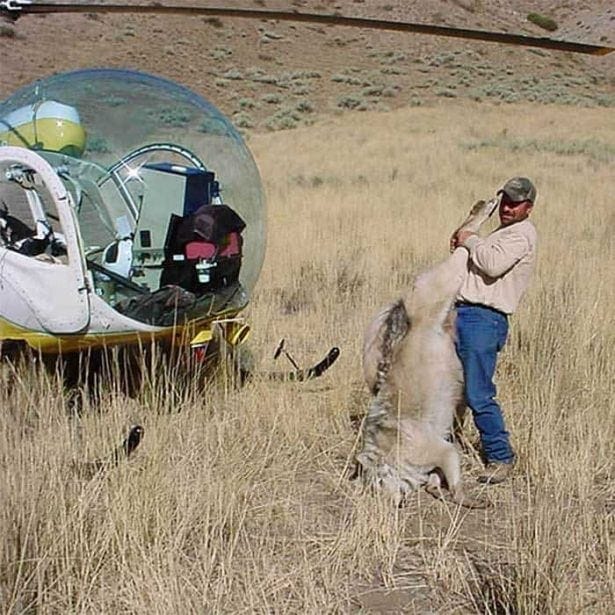
There is cheap grazing. And then there is $1.35 a month to graze a cow and her calf on America’s public lands.
That was the federal grazing fee in 2021: $1.35 per animal-unit month on BLM land and $1.35 per head-month on National Forest land. The federal government itself defines that unit as enough public-land forage for one cow and her calf for an entire month.
Do the arithmetic.
$1.35 divided by 30 days is 4.5 cents per day.
Four and a half cents.
For a cow-calf pair — on the order of a ton of privately owned livestock — grazing vegetation growing on land owned by all of us.
Try feeding a small housecat for 4.5 cents a day.
And calling this merely “below market” understates the absurdity. In the very same year, BLM's table of average private grazing-land lease rates listed Wyoming forage at $22.50 per AUM. The federal public-land fee was therefore just 6 percent of that private-land figure — a 94 percent discount.
But apparently even that level of public generosity is not enough.
Because when wolves encounter those privately owned livestock on or around our public lands, we get another bill.
We send the government after the wolves.
Internal USDA and Forest Service records released through FOIA nearly 4 years after the request was made, show just how casually this second subsidy operates.
In March 2021, USDA Wildlife Services notified the Forest Service of a wolf-control operation approximately 11 miles east-southeast of Alpine, Wyoming, on the Bridger-Teton National Forest. Wildlife Services described the purpose as protection of domestic cattle following what it called “chronic livestock depredations.”
Then came the operational plan:
“WS will be flying today and tomorrow weather permitting and all wolves found in the area will be removed.”
Not merely the animal demonstrated to have killed livestock.
“All wolves found in the area.”
And if the aircraft didn't finish the job:
“We will be using aerial assets but if the need persists may employ calling/shooting or trapping.”
The document makes another point explicit:
“Removal will involve FS lands.”
Read that again.
Privately owned cattle are put onto National Forest land at a federally subsidized grazing rate. Native predators living on and around that public land come into conflict with those cattle. And the government's response is to mobilize federal wildlife-control personnel, put aircraft in the air, and authorize shooting and trapping until the job is “complete.”
This isn't some incidental use of federal aircraft. USDA Wildlife Services says that in the western United States its aerial wildlife-management missions are flown almost exclusively to protect livestock from predators, using government or contracted fixed-wing aircraft and helicopters.
So the rancher gets the forage bargain.
The public gets the predator-control apparatus.
The Forest Service emails become even more revealing.
Forest Service employee Don Delong responded that the location fell within Wyoming's Seasonal Wolf Trophy Game Management Unit and explained that, at that time of year, it was managed as a “Predator Zone.” He quoted Wyoming regulations providing that wolves there could be taken without a license from March 1 through October 14.
Then he added this remarkable aside:
“By the way, I saw wolf tracks in the general area for a couple years in a row (several years ago), and I heard most of these wolves were probably taken by members of the public during March 1 — October 14 back then….”
In a follow-up email containing a map, Delong reduced the surrounding landscape to an even more chilling description:
“Everything else is ‘predatory zone.’”
Think about what those emails tell us.
Wolves in this landscape were already subject to extraordinarily liberal killing by the public. A Forest Service employee believed most of the wolves he had previously observed there had probably already been killed.
Yet when livestock depredations occurred, Wildlife Services' answer was still to put aircraft over the landscape and announce that every wolf they found would be removed.
The same FOIA release contains another Wildlife Services operation from November 2020, this one approximately 18 miles north of Kemmerer, Wyoming.
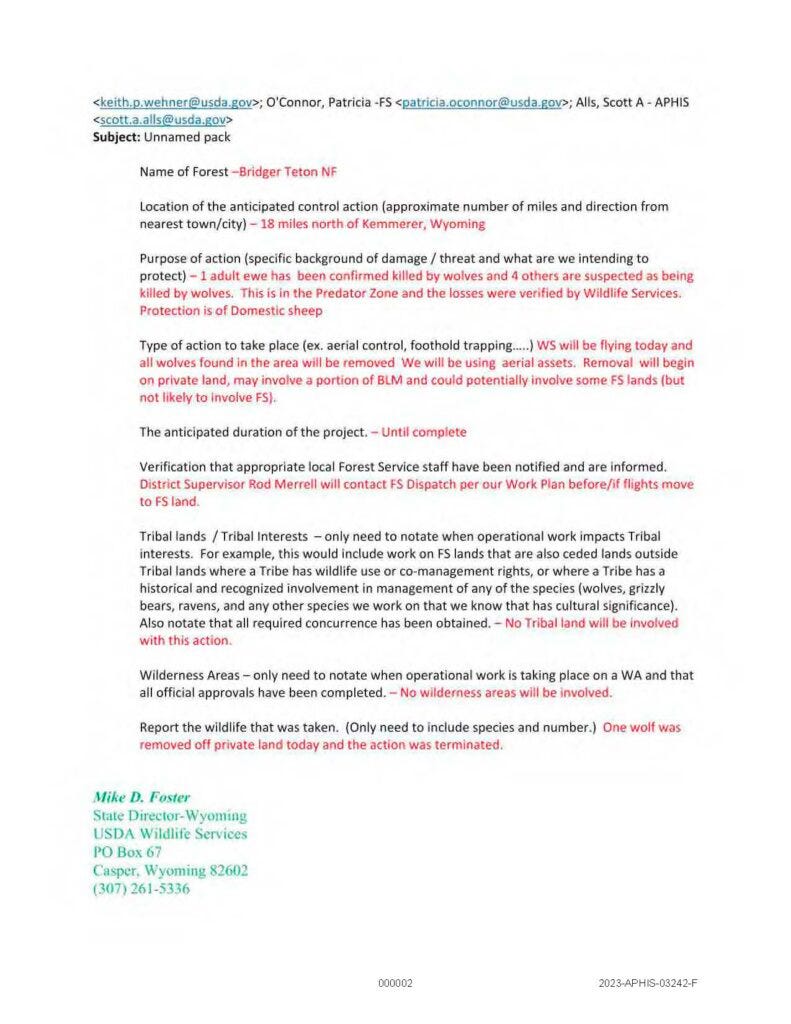
The triggering event was one confirmed ewe killed by wolves and four additional sheep suspected of having been killed by wolves. Wildlife Services wrote that the purpose was protection of domestic sheep and announced:
“WS will be flying today and all wolves found in the area will be removed.”
Again: all wolves found.
The agency reported that aerial assets would be used and that the operation could include BLM land. It later reported that one wolf had been “removed” from private land and the action was terminated.
This is the system in miniature.
First, livestock production receives access to publicly owned forage at a price so low that describing it as “rent” borders on parody.
Then the ecological consequences of putting domestic livestock into native carnivore habitat are externalized.
Then, when a native predator does exactly what a predator evolved to do, another government program arrives to make the landscape safer for the private commercial use.
Privatize the livestock profits. Socialize the costs. Kill the wildlife.
The grazing fee does not begin to capture the value of the forage, much less the wider public costs associated with administering livestock grazing or the ecological externalities imposed on watersheds, riparian systems, soils, native vegetation, fisheries and wildlife.
And these FOIA documents reveal another externalized cost that is harder to put on a grazing bill:
removing native predators so private livestock can occupy public land with less risk.
The records do not tell us what these particular flights cost. They do not tell us how much, if anything, the livestock operators contributed toward the federal response. They do not quantify the ecological cost of removing wolves. And, in the March 2021 correspondence, they do not tell us how many cattle had actually been lost before Wildlife Services announced that “all wolves found in the area will be removed.”
Those are questions worth answering.
But we already know enough to recognize the underlying bargain.
In 2021, the federal government charged a rancher $1.35 to graze a cow and calf for a month on public land.
That's 4.5 cents a day.
Then, when wolves threatened those privately owned animals, government personnel prepared to fly aircraft over the landscape and shoot or trap the native wildlife occupying it.
There is a term for an economic arrangement in which the public supplies the resource at a fraction of market value, absorbs substantial collateral costs, and then provides government intervention to protect the beneficiary's private property.
It is a subsidy. It is welfare. Welfare Ranching
And when the final public service supplied is killing wolves so private livestock can continue grazing our public lands for pennies, it is a subsidy Americans have every right to be disgusted by. Remember you are paying for all of it.Sage Steppe Wild
No posts
Comments
Nothing yet. Say the first thing.
Sign in to join the conversation.