
I listened to Zach Bush’s three hours with Joe Rogan on the car ride to another AAU tournament, and he never once said “OODA loop.” He didn’t need to. He spent the whole conversation describing it: the real one, not the four-boxes-and-arrows cartoon that gets slapped on LinkedIn every Monday morning.
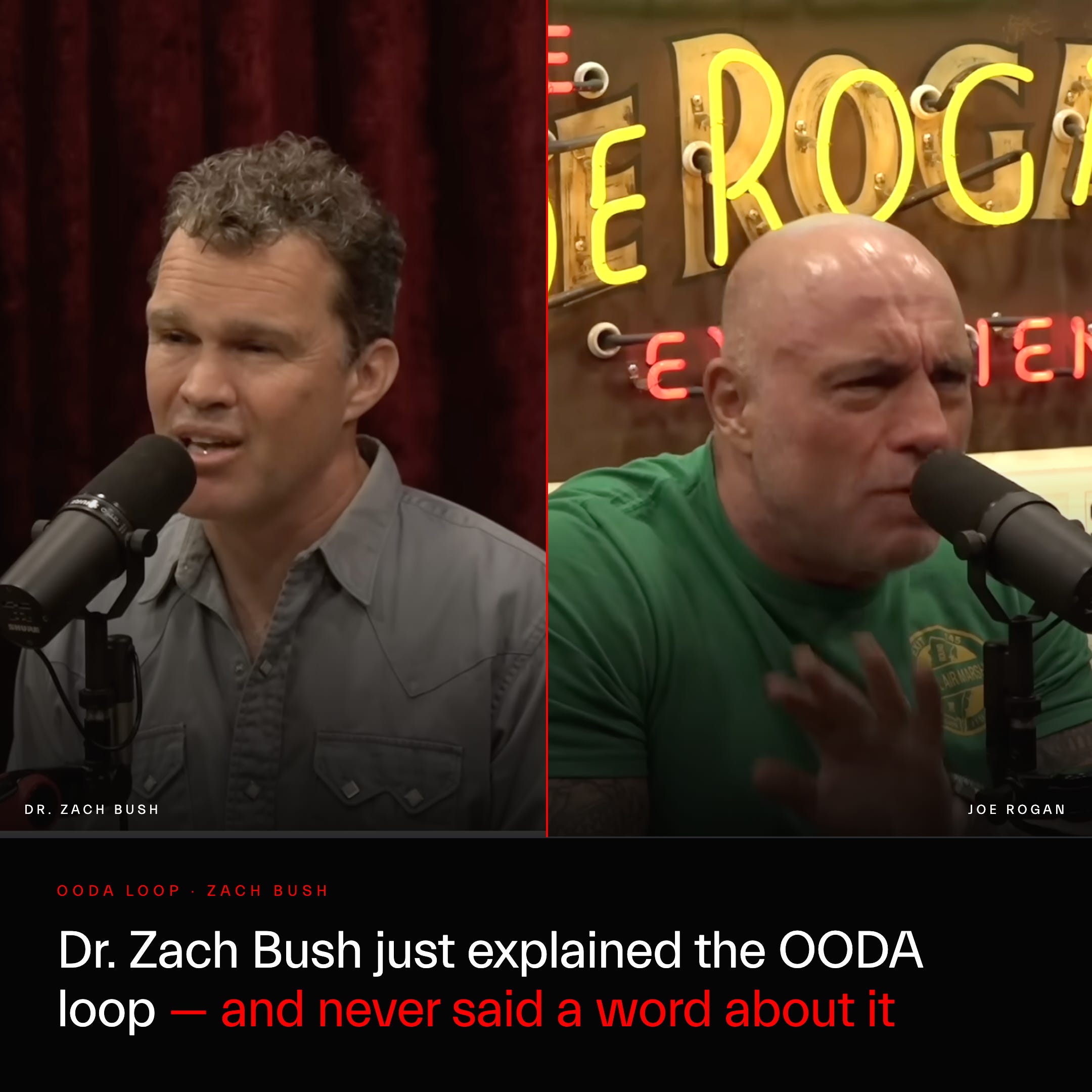
Boyd’s real loop is ecological. It isn’t a decision cycle, it’s how a living system interacts with other living systems and the invariants around it, the deep, stable features of a world you have to stay matched to. So when a hospice doctor and cancer researcher starts talking about antennas, isolation, and abstraction on the biggest podcast on Earth, my ears went up. Because he was handing millions of people Boyd’s thesis without the vocabulary, and getting it more right than most of the “strategists” I meet on Wall Street.
Let me take you through my whirl of reorientation.
The OODA loop you know is a lie of omission. Observe, Orient, Decide, Act, four arrows, back to start. A little decision racetrack. Speed wins. That version is fine for a slide and useless for a life.
Boyd’s real loop is a living system talking to its world. The center of gravity isn’t the speed. It’s the second O. Orientation. Boyd called it “the most important part of the O-O-D-A loop, since it shapes the way we observe, the way we decide, the way we act.” Orientation is the whole inheritance you carry into every moment: your genetics, your culture, your scars, the new information coming in, and your unfolding interaction with the environment. It’s not a step. It’s the engine that bends every other step.
Everything Bush said maps onto that engine. He reaches for a metaphor, one about attunement and attention: how tuned in a living thing is to the world it’s part of.
Bush’s word for a human being is antenna. Not a computer. Not a brain in a jar running calculations. An antenna, something built to receive and transmit information from the whole field around it. He tells Rogan we have “the most complicated antenna system of any organism on Earth,” and then, ten minutes later, Rogan blurts out that he thinks he’s “kind of like an antenna” for the guests on his show. Two guys landing on the same word from opposite directions.
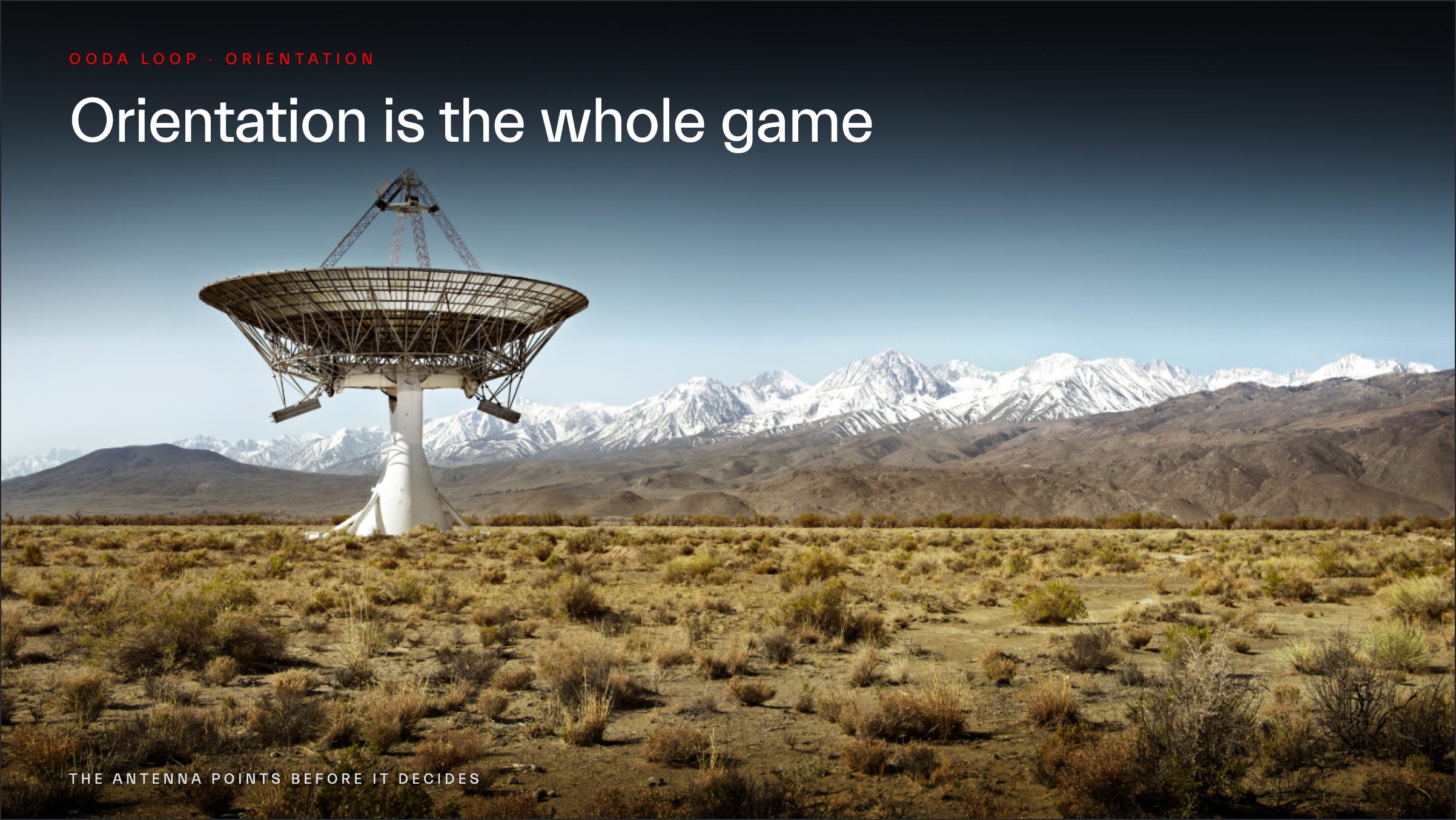
That’s Orientation. Boyd said we build “images, views, and impressions” of the world, and those images are only as good as our connection to what’s actually out there. Bush would say the antenna is only as good as its reception. Same claim. A well-oriented human is a wide-open antenna, tuned to reality, constantly updating. A disoriented human is a jammed antenna, running on old pictures that no longer match the world.
And here’s the line from Bush that almost made me pull over. He defines abstraction as “a disorientation that occurs when the context is lost.” He didn’t know he was quoting Boyd. But that’s the whole game. When you lose contact with the world, your model drifts, and your Orientation rots. Boyd spent a career proving it. Bush just said it in one breath on Rogan.
Here’s where it gets good, and why we call No Way Out the OODA loop and Flow podcast.
When the antenna is fully open and tuned, you don’t deliberate. You don’t run the racetrack. Action becomes implicit. Boyd’s “implicit guidance and control,” the fast path straight from Orientation to Act with no committee meeting in between. That’s flow. That’s the fighter pilot who’s already moving before he could tell you why. That’s the cabinet maker Bush describes, lost in the sanding and the stain, proud of a seam nobody will ever see. That’s Rogan following his curiosity with no board meeting deciding who’s allowed on the show. “It’s my phone, and I just go, that guy seems cool.”
Bush watches indigenous elders do it and says they aren’t studying the forest, they’re “just listening to the information.” He watches people at the end of life do it, antenna blown wide open. And then he says the thing that should be printed on the wall of every company drowning in process: those happy people in Siberia “are not working at all. They’re creating. They’re living.”
Flow isn’t a productivity hack. It’s what a living system does when nothing is jamming its Orientation. Open antenna, implicit control, matched to the world. When we teach flow, that’s what we’re actually restoring: not speed, connection.
Boyd’s theory of conflict comes down to one brutal, beautiful idea. You don’t win by out-gunning the other guy. You win by folding him back inside himself. You cut him off from the outside world, you corrupt his Orientation, and then you let the Second Law of Thermodynamics do the killing for you. Isolate a system and entropy takes over: confusion, doubt, paralysis. Boyd watched it in war games: guys just staring at the table, frozen, “out of the game,” because someone got inside their loop and cut them off from reality.
His starting axiom, borrowed straight from biology: living systems are open systems; closed systems are non-living systems. If you stop communicating with the outside world, he said, “we die out.” Cut the connection and you don’t just lose. You decompose.
Now listen to Bush describe a cancer cell. It’s “the loneliest cell in the human body.” A cell that loses connection and communication with its surrounding environment “immediately takes on the traits of a cancer cell. The longer it’s isolated, the more malignant it becomes.” Same story for the sociopath: “one human cell that became so isolated that it became malignant.”
That is Boyd’s folding-back-inside-himself, written in flesh. Isolation is the attack. Not a knife, not a drone, not a virus. Severed connection. Entropy finishes the job.
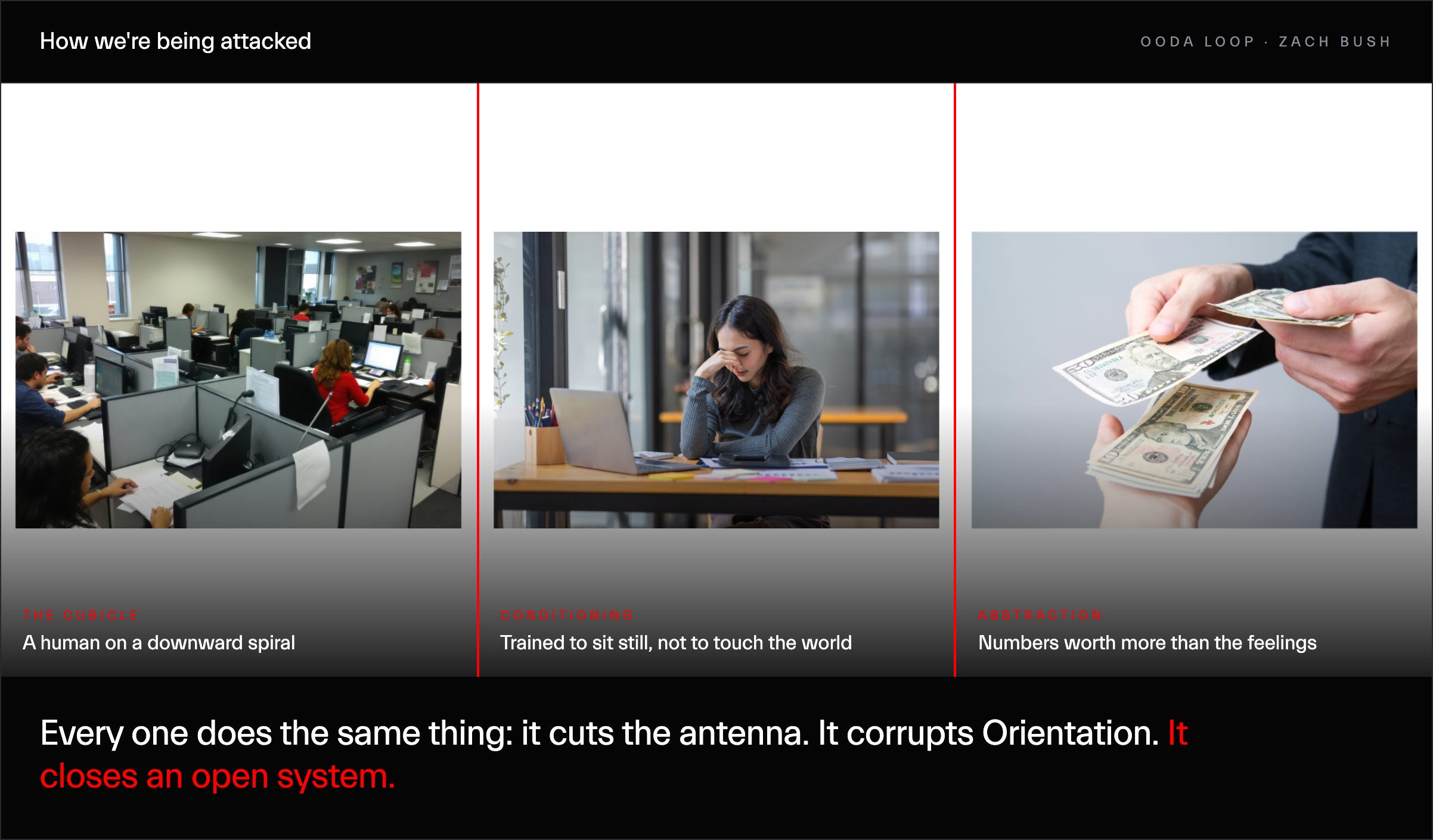
So who’s folding humanity back inside itself? Look at what Bush actually indicts, and notice not one of them is a person. The cubicle that puts a human on a “downward spiral.” A hundred and fifty years of schooling that trains kids to sit still and answer multiple choice instead of touching the world. Money and numbers as a layer of abstraction stacked between us and the felt reality of being alive. “We’ve been tricked into thinking that numbers are more valuable than the feelings.” Three billion pounds of glyphosate a year severing the living relationships in our soil and our guts. Every one of these does the same thing: it cuts the antenna. It corrupts Orientation. It closes an open system.
We are the adversary, and we’re being run through Boyd’s playbook. Isolated from nature, from each other, from our own felt sense, and then handed the entropy bill as chronic disease, anxiety, and a species that can barely reproduce. Nobody had to fire a shot. They just closed the loop.
Boyd named the whole contest: the strategic game of interaction and isolation. It was never about beating a person. It’s about staying connected to the world while whatever you’re up against drifts into isolation. So don’t go hunting for a villain. Just look at the system. Challenge the assumption, tear the thing apart, and ask what’s doing the isolating.

Boyd never told you to kill the enemy soldier. He told you to collapse the cohesion of the system that isolates and paralyzes. Bush never demonizes the sociopath or even the cancer cell. He calls them symptoms of a system that lost its connection. The office worker isn’t the enemy. The lobbyist reading nervous notes isn’t the enemy. They’re cells that got isolated. The target is always the machine of abstraction that severed the connection in the first place.
That’s not soft. That’s the sharpest possible aim. Go after the person and you’re playing the loser’s game: attrition, blood, and more isolation. Go after the system, the thing doing the folding, and you free every cell trapped inside it.
So what do we actually do? The same move Boyd and Bush prescribe, in two different dialects.
Open the antenna. Interact instead of isolate. Boyd’s whole remedy was to keep “many channels of communication with the outside world” open so your Orientation stays matched to reality. Get outside. Touch the soil, turn a wrench, build the house, sit with the dying, follow the curiosity with no committee’s permission. Every one of those is a channel back to the world. Every one of them re-tunes the antenna, restores Orientation, and drops you back into flow.
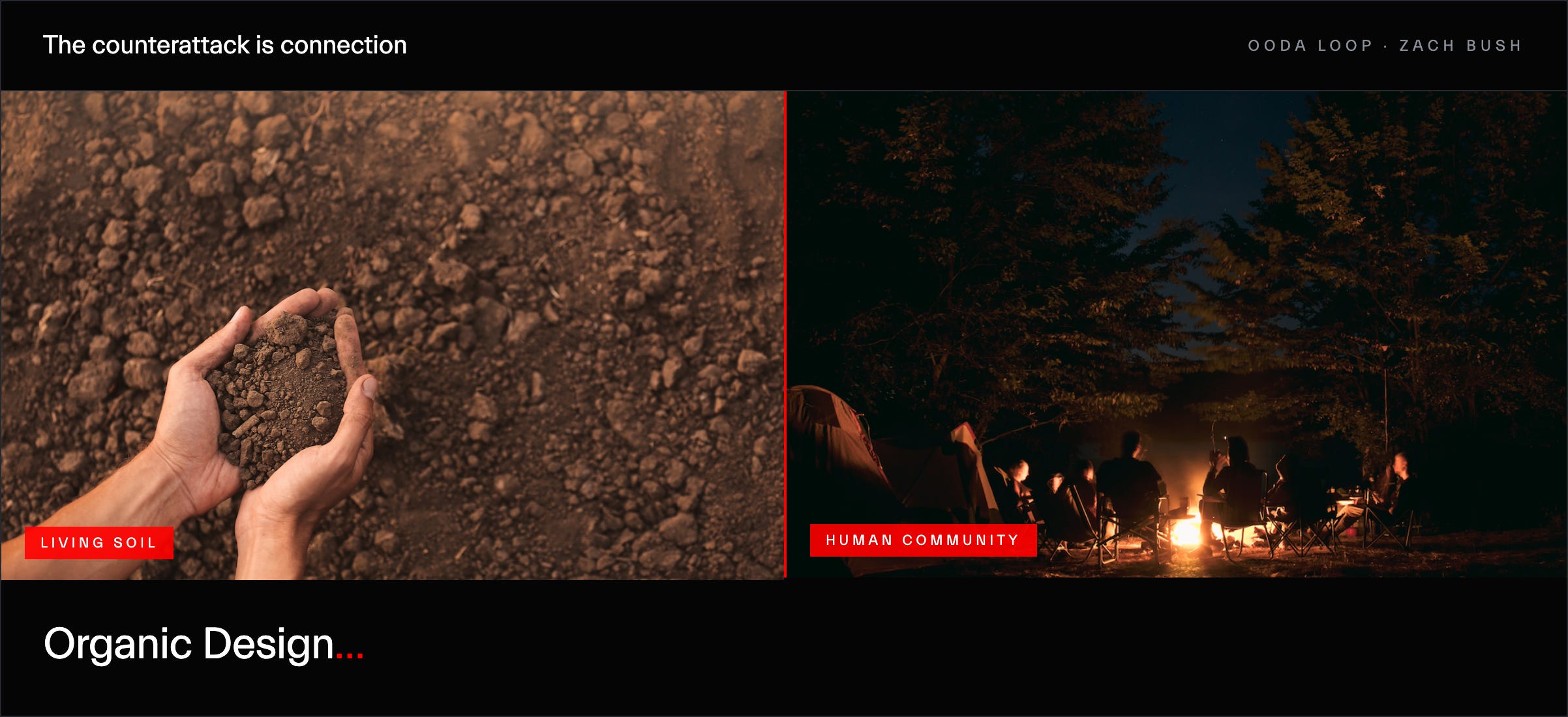
Bush says he doesn’t want followers, he wants builders. Boyd would call them open systems. Same people. The ones who refused to be folded back inside themselves.
The real OODA loop was never about deciding faster. It was about staying alive: staying open, staying connected, staying oriented to a world that never stops moving. Bush spent three hours proving it to Rogan’s whole audience and never once named it.
That’s fine. That’s our job. .
Now go tune into the episode yourself: Dr. Zach Bush on The Joe Rogan Experience. Three hours, not one mention of the OODA loop, the whole thesis hiding in plain sight. Listen for the antenna. Listen for the isolation. You’ll hear Boyd the entire way through.
Comments
Nothing yet. Say the first thing.
Sign in to join the conversation.