
Two seconds from the ocean, at roughly 695 miles per hour, Kegan “SMurf” Gill reached down and pulled the ejection handle. He does not remember deciding to do it. There was no time to decide. As he puts it, if he had stopped to think, he would not have gotten out.
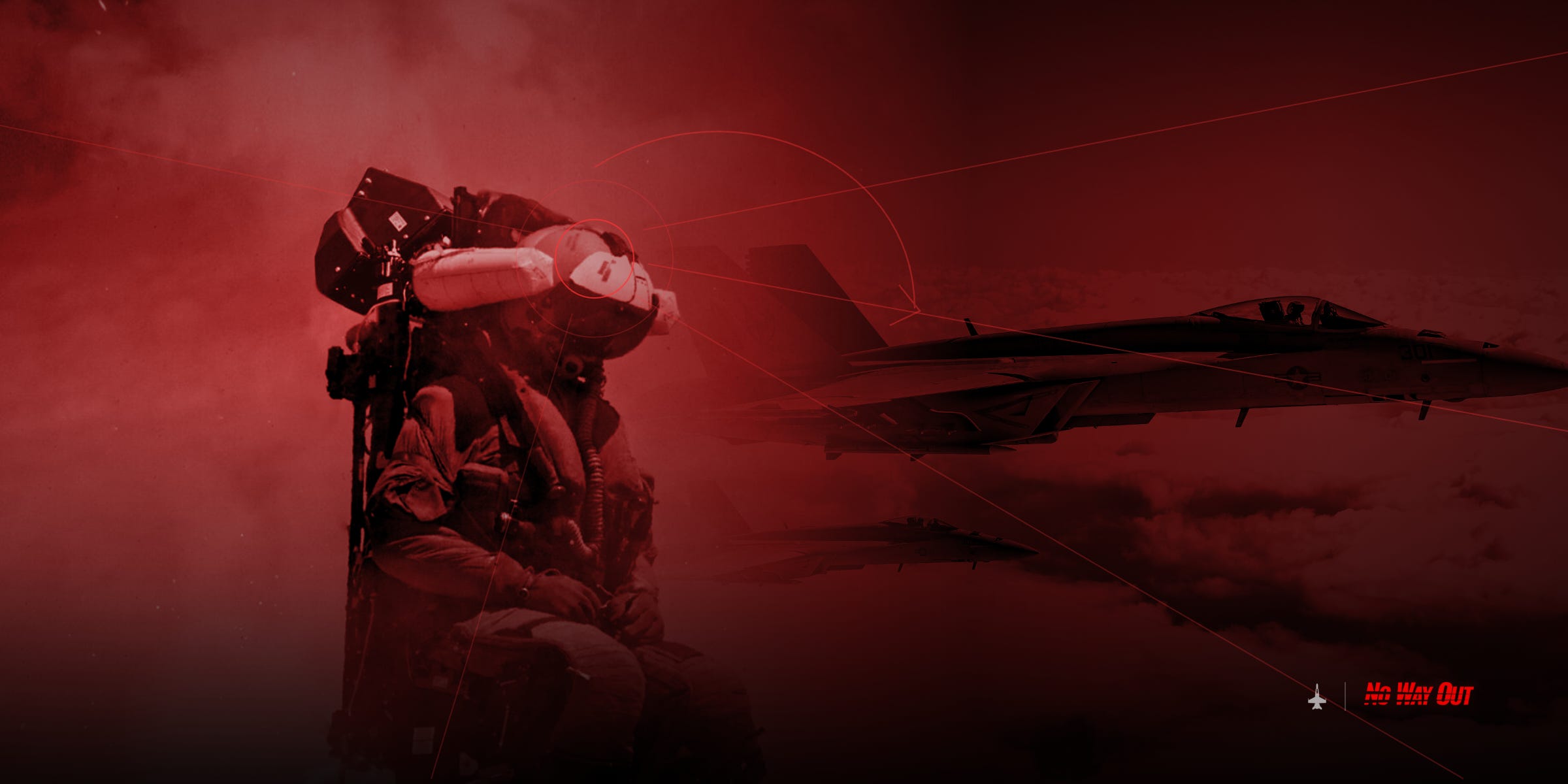
That single moment is the whole story in miniature, and it is the reason his story is worth more than the war-movie version of it. Kegan is reaching a huge new audience right now, and most of that audience will take away the spectacle: the fastest ejection in Naval aviation history, the shattered body, the survival. Those things are real. But the spectacle is the surface. What actually happened to Kegan, and what eventually saved him, is a story about orientation, and it is the clearest example I know of the thing we built this whole show to explain.
John Boyd is remembered for a four-box cartoon: observe, orient, decide, act. That cartoon is wrong, or at least it is a cheap photocopy of what Boyd actually meant. The center of the whole thing is Orientation, and Orientation is not one step of four. It is the lens that shapes all the others. It decides what you are even able to observe, which options you are able to consider, and which actions feel possible. Boyd built it out of three ingredients: your genetics, your culture, and your previous experience. It is your internal model of reality, and it runs mostly below conscious awareness.
When Kegan pulled that handle without thinking, that was Orientation doing its job. Boyd had a name for the pathway that runs straight from Orientation to Action without stopping at conscious deliberation. He called it Implicit Guidance and Control (IG&C), and it is the flow pathway, the one that matters most when the clock is measured in fractions of a second.
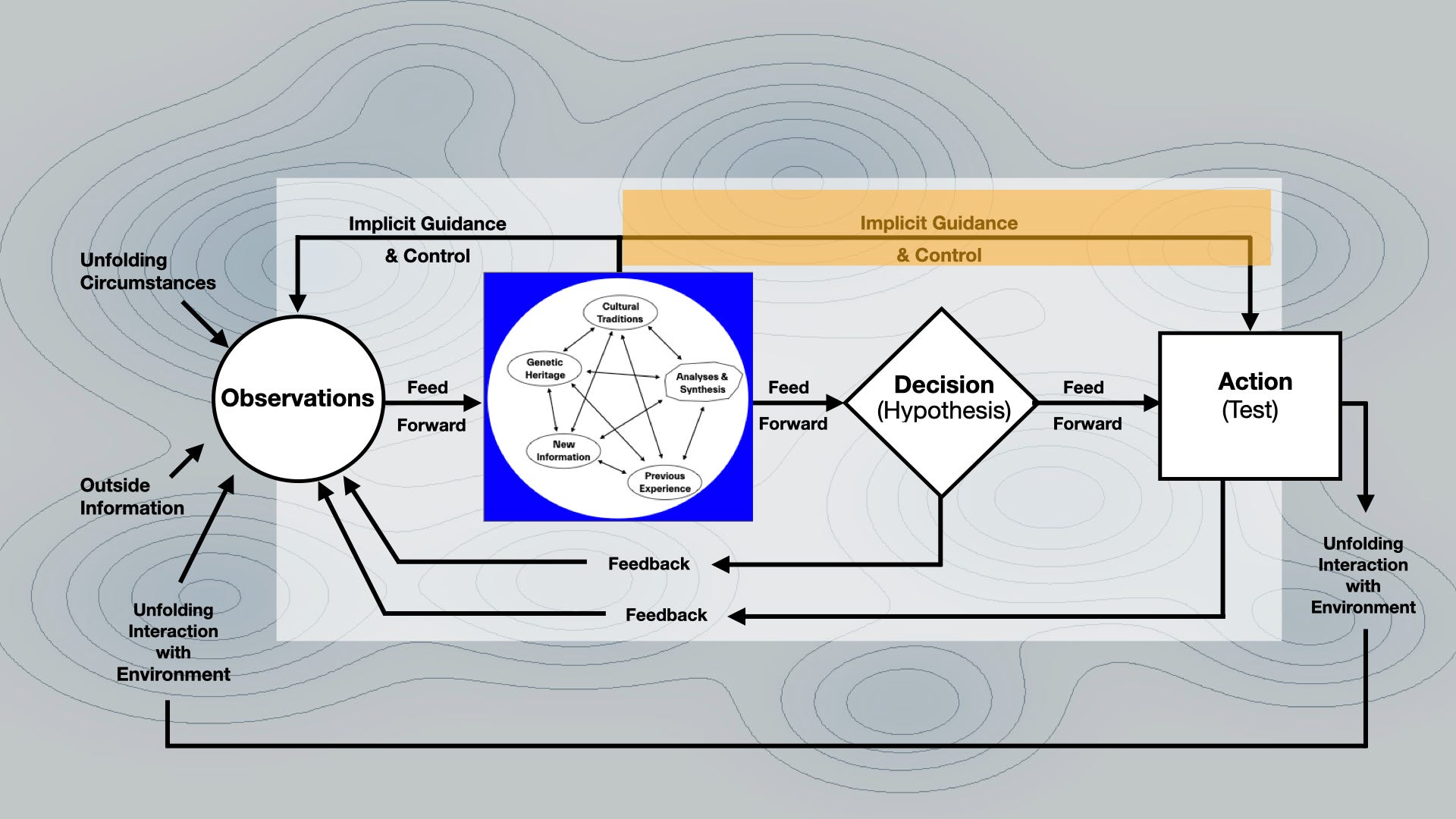
Cognitive science has language for this too. The slow, deliberate, step-by-step reasoning that the four-box cartoon of the loop actually describes is Type 2 cognition. You may know it as System 2 thinking. What fired in Kegan that day was the far faster, more automatic end of the mind, what some call Type 1 and Type 0 cognition, where perception and action are coupled so tightly they become a single motion with no deliberate step in between. Perception is still built inside us, represented by the other IG&C pathway, from Orientation to Observation, as we said. But in a trained operator, that internal perception runs straight to the hands. There was no time for Type 2 that day. There was only the coupling.
And that coupling is not a gift. It is built. It is precisely the skill a constraints-led approach to training develops, the reason good coaches put people in rich, realistic environments and let them attune to what matters instead of walking them through a checklist. Years of that kind of training had wired Kegan’s perception to his hands. On our show, Moose put it bluntly: if Kegan had run the linear, four-step loop that day, he would be dead. He survived because his orientation could act faster than thought, through the pathway Boyd cared about most.
That is the good news about Orientation. Here is the hard part.
The same crash that Kegan survived did something quieter and far more dangerous. It injured the system that builds his orientation.
Here is the part most people never sit with. Orientation is not made by the brain alone. It emerges from the whole human system, our genetics, our culture, and our previous experience, and the brain and mind are themselves part of that system, written in large part by our genetic code. And that squishy three pounds of tissue sits locked in the dark of the skull with no direct contact with the outside world. None. Everything it knows arrives secondhand, as signals from our sensory organs, what Boyd called Observations, and from those signals, or New Information, it builds a best guess of what is out there. Perception is not a window onto reality. It is a construction, a prediction our system is constantly making and correcting.

This is exactly what Karl Friston, one of the most cited neuroscientists alive, formalized. His framework, active inference, built on what he calls the Free Energy Principle, is in his own words the physics of sense-making and the physics of decision-making. Any living system is a prediction machine. It forecasts what happens next, compares the forecast to the signals coming in from the senses, and updates when the two disagree. Friston came on No Way Out and recognized Boyd in his own equations. Orientation, rendered in mathematics Boyd was reaching for in the 1980s but never had.
Hold those ideas together and Kegan’s collapse makes sense. A traumatic brain injury does not just hurt. It damages the machinery that turns sensory signals into a working model of the world. The hormones shift, the signals get noisy, the predictions stop matching what arrives. The model a person uses to meet reality quietly stops matching reality. In the language of the loop, trauma is unresolved surprise, a mismatch between prediction and what actually happened that never got integrated and never went away. Kegan’s orientation had been corrupted at the level of the system that generates it, and no amount of willpower rewrites a corrupted model.
What happened next is the part that should make anyone angry, and I want to be careful here, because our rule on this show is that we attack the system, not the people inside it. That is a hard rule to follow, by the way. Kegan went to the people who were supposed to help, and the answer was a pill, and then another pill, and then a higher dose. The medications masked the symptoms of a broken model without doing anything to repair the model. For a while they numbed the surprise. Over time they made it worse, and the doses climbed, and the bottom fell out. That is not a story about a villain. It is a story about a system whose incentives reward managing symptoms forever instead of fixing the underlying thing. Systems drive behavior.
Here is where the story turns, and where the science gets genuinely hopeful.
If trauma is a corrupted model, then healing is not about feeling a little less bad. It is about rebuilding the model. It is reorientation, in the most literal sense of the word. Boyd had a metaphor for how a mind builds something new: take apart what you know, break it down to pieces, and synthesize something that never existed before. He called it destruction and creation, and he believed it was the engine inside orientation.
That is, remarkably, close to what Kegan describes from the other side of his recovery. The path out did not come from the clinic that kept raising the dose. It came from work that shook his fixed model loose and let him rebuild it, psychedelic-assisted therapy done in a medical setting, then meditation, then the slow labor of integration. I will say plainly that none of this is medical advice, that ibogaine, 5-MeO-DMT, and other plant-based medicines we discuss on No Way Out are Schedule I substances in the United States and should be used with proper screening and supervision, and that Kegan did this with people who knew what they were doing. But strip away the controversy and look at the mechanism, and it is the loop. A rigid, damaged orientation gets destabilized, taken briefly into a high-entropy state where the old pattern loosens, and then rebuilt into something that fits reality again. The surprise finally gets integrated. The model updates. The metabolism restarts.
That is why we keep saying the OODA loop is not a decision procedure. It is the way a living system stays in contact with a world that will not hold still. Boyd was describing the physics of being alive, and Kegan lived every step of it, the implicit action that saved his body, the corrupted orientation that nearly took his life, and the reorientation that gave it back.
Kegan’s ejection is unrepeatable. His recovery is not. Reorientation is available to anyone whose model has stopped matching their world, which, sooner or later, is all of us. That is the whole reason the show is called No Way Out. There is no way out of a reality that keeps changing on us. The only way through is the willingness to break an old orientation and build a truer one.
If you found Kegan’s story somewhere else and wanted to understand what actually happened underneath it, that is what we go deep on here.
If you or a veteran you know is struggling, the Veterans Crisis Line is available 24/7: dial 988 then press 1, or text 838255.
Watch or listen:
For the science underneath it, see our conversations with Karl Friston and on active inference and the real OODA loop.
Comments
Nothing yet. Say the first thing.
Sign in to join the conversation.