
“Bon bini!* to the latest fresh batch of science news, delivered to your doorstep every week. We start off with the news that life on Earth could have more than one origin. If true, it could have a significant impact on the search for other beings in our solar system and beyond. Also, when years lasted 370-odd days, Amelia Earhart mystery could be solved this year, and ancient Neanderthal DNA gives you bulging biceps. Feel free to like/share/subscribe if you are so inclined!
Daniel
* Welcome in Papiamento, a Portuguese-based creole language spoken in Aruba, Bonaire, and Curaçao
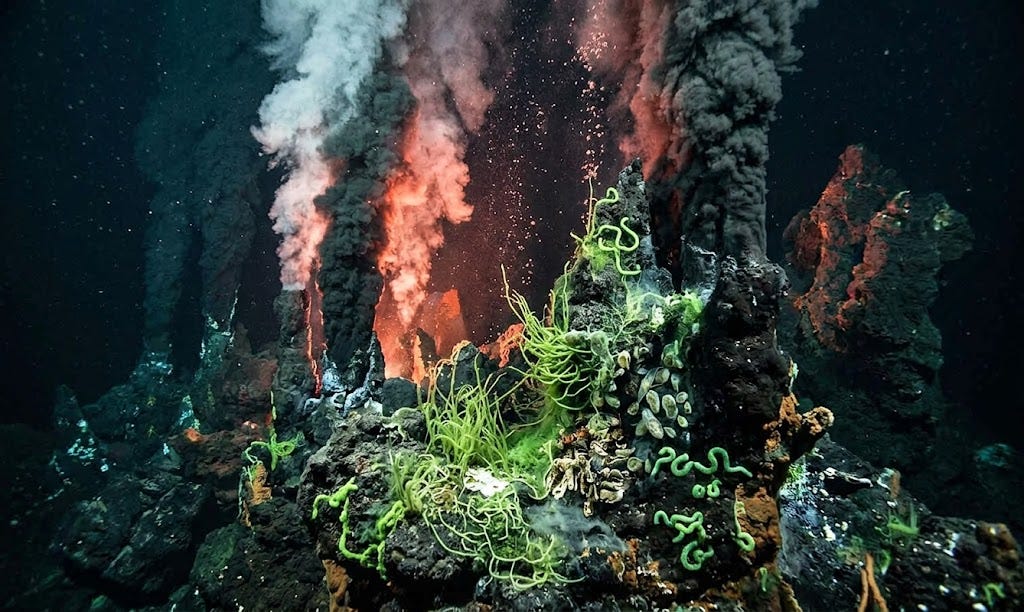
🧫 Life might have independently sprung up on Earth not once but twice. This could be huge news for the chances of finding little green men - well, microbes at least - on other planets.
New analysis from Heinrich Heine University, Düsseldorf, argues that free‑living emerged twice, with bacteria and archaea each making their own bold leap to independence four billion years ago.
Researchers have reconstructed the chemistry of the earliest metabolisms, showing life’s first attempts to escape the hydrothermal vents which sparked their existence in the first place.
These results reframe a foundational question: life’s genetic code may have a single root, but free‑living cellular life could have sprung from two origins. And it also gives us a big hint where to look for aliens. Read more on Science Daily
🐶 Our mammal ancestors might have been giving birth to live young tens of millions of years earlier than first thought. The fossils of a dog-sized carnivore that lived 236 million years ago may have rewritten agreed-upon evolutionary timelines🕙 Research into an ancient shell has revealed that 70 million years ago, the Earth had 372 days a year, and days lasted just 23 hours and 31 minutes. Scientists have come to these times thanks to the fossilised remains of a sea creature called a rudist bivalve.
Growth lines inside each shell of the animal, which was found in Oman’s Al-Hajar Mountains, record more than nine years of life in warm, shallow tropical seas. Sounds very pleasant.
All those years ago, our planet spun faster than it does today. We’ve got the Moon to thank for this, as its tides act like a brake, gradually slowing our spin and nudging our lunar pal almost 4cm farther away every year. Read more on The Times of India
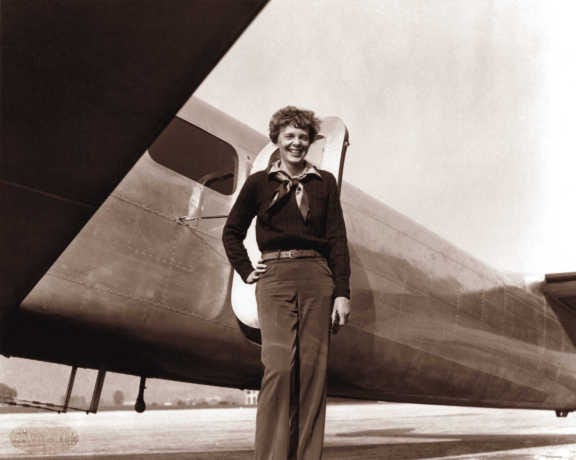
🛩️ One of the most enduring mysteries of the 20th century might have at last been solved by archaeologists who have been looking for Amelia Earhart’s missing plane. A team of researchers is heading for the remote Pacific island of Nikumaroro in October, hoping to finally prove what happened to the pioneering pilot after she vanished mid-flight in 1937 with navigator Fred Noonan.
The mission is a joint effort between Purdue University and the Archaeological Legacy Institute, and it centres on a specific underwater anomaly nicknamed the ‘Taraia Object’. It is a strange, plane-shaped outline spotted in satellite images near the edge of the Nikumaroro ’s shallow lagoon.
Earhart and Noonan disappeared on July 2, 1937, while attempting to fly around the world. Many believe the plane ran out of fuel and crashed into the deep ocean. However, the so-called Nikumaroro Hypothesis claims they landed on the flat coral reef at Nikumaroro and survived for a time as castaways. Read more on The Star
⭐ Astronomers have discovered a new kind of cosmic object lurking in the inky blackness of space - a black hole ‘star’. The massive object is about the size of our whole solar system, blazes a deep red, and pumps out roughly 100 billion times more energy than a normal star can muster.
The star has been spotted by the James Webb Space Telescope in the constellation Cetus. It’s from just a few hundred million years after the Big Bang gave birth to existence, right at the dawn of the first galaxies.
Computer models suggest that what we are looking at is a newborn black hole swaddled in dense gas that heats up and shines like a star, masking what’s within. Read more on The Guardian
🌌 Chinese researchers have uncovered ‘ripple’ structures in the Milky Way that go some way to explaining why our galaxy resembles a warped record, with one side bent upward and the other downward
⭐ Is empty space really empty? Readings taken from a dead star may finally solve a 90-year-old mystery and offer the strongest evidence yet that extreme magnetic fields can change how light travels through a vacuum
👋 Hello, fellow science geek. If you’re enjoying this newsletter, it would really help me if you could spread the word. Simply forward this email to a friend, and they can sign up here or click the share button below.
What’s Up, Doc?

🧀 Scientists looking into three artisan British cheeses have found the microbes responsible for their distinctive flavours may also offer surprising benefits for gut health. As the cheeses matured, beneficial bacteria transformed their aromas and textures and potentially produced compounds linked to reduced inflammation, cholesterol regulation, and appetite control
🧠 A study has tied estrogen-based menopausal hormone therapy to lower Alzheimer’s risk in women. Users had 39% lower odds of receiving a clinical diagnosis during their lifetimes, and they performed better on memory tests and in their ability to function independently
👃 Staying with Alzheimer’s, a new link has been discovered between gut health and the disease. It’s long been known that the gut microbiome of people with Alzheimer’s differs from that of healthy people, and now we might have found the molecule responsible
🥣 A breakfast staple has been shown to cut bad cholesterol in just two days - with the benefits still visible six months later. Oats are packed with superstar nutrient beta-glucan, which can help reduce weight and improve both gut health and blood pressure
👴 One of the most popular prescribed drugs for erectile dysfunction could have a remarkable side effect - helping you to live longer. Tadalafil is being touted as delivering benefits for the cardiovascular system, brain and even athletic performance
🛸 A Vietnamese boat builder and popular YouTuber turned a weird dream about alien aircraft into inspiration to build his own DIY flying saucer. Except this UFO doesn’t ‘fly’ at all. Instead, Tran Long Ho’s craft propels itself through water. Ho isn’t the first to try to make the classic flying saucer a reality. In 2019, a pair of aerospace engineers from Romania created a functional, saucer-like prototype called the All-Directional Flying Object.
Back in the late 1950s, the US Air Force had a go under the codename ‘Project 1974’. Dubbed the ‘Avrocar’, the aircraft was seen by military types as one that would one day replace the jeep and helicopter. However, as NASA Ames Chief Test Pilot Fred J. Drinkwater III put it, flying the Avrocar was “like trying to balance on a beach ball.” By 1961, after it was determined that flight above 10,000 feet was “dangerous if not nearly impossible”, funding was cancelled.
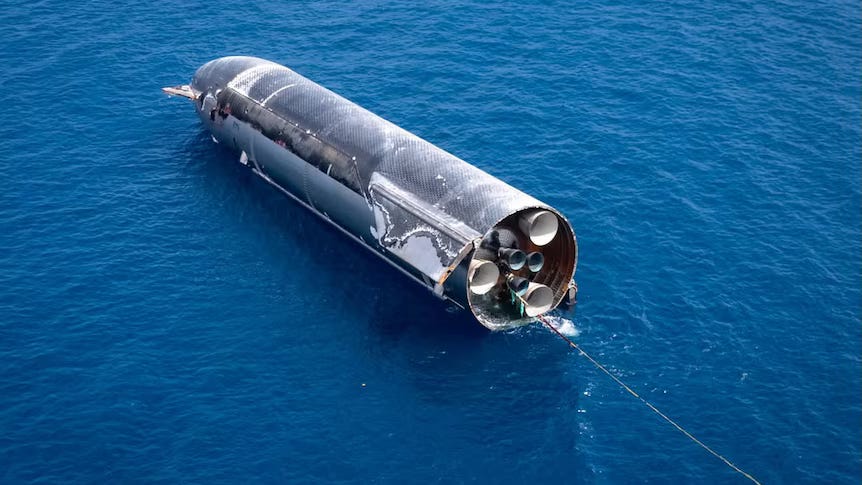
🚀 A huge space rocket belonging to Elon Musk's SpaceX is currently being towed to the shores of Christmas Island after splashing down in the Indian Ocean. Christmas Island-based photographer Chris Bray, who usually focuses on wildlife, said the sight of the ships towing the rocket had become "the talk of the town".
What has AI ever done for us?
🧠 AI isn’t making you dumber, but it may be changing how you think. As computers get better at reasoning, writing, and deciding what people should do, they increasingly take our attention away from the world and the people around us. Does this mean humans will lose the ability, or the will, to do those things by themselves?
“The more clearly we can focus our attention on the wonders and realities of the universe about us, the less taste we shall have for destruction.”
Rachel Carson
Weird Science Factoid
Pineapples contain an enzyme that eats you back. Bromelain breaks down proteins, which is why your tongue stings or feels raw when you eat fresh pineapple—the enzyme is actively digesting surface proteins in your mouth.

🤖 Japan’s ageing population is in trouble - but could robots come to the rescue? For starters, a lack of young farmers means that automated help is being rolled in to help with the cherry blossom harvest
🪨 Minerals associated with plate tectonics have been found in the oldest rock from Mars - a planet which famously has no plate tectonics. The meteorite features its own form of granite, which is formed in extremely hot, pressurised subterranean conditions
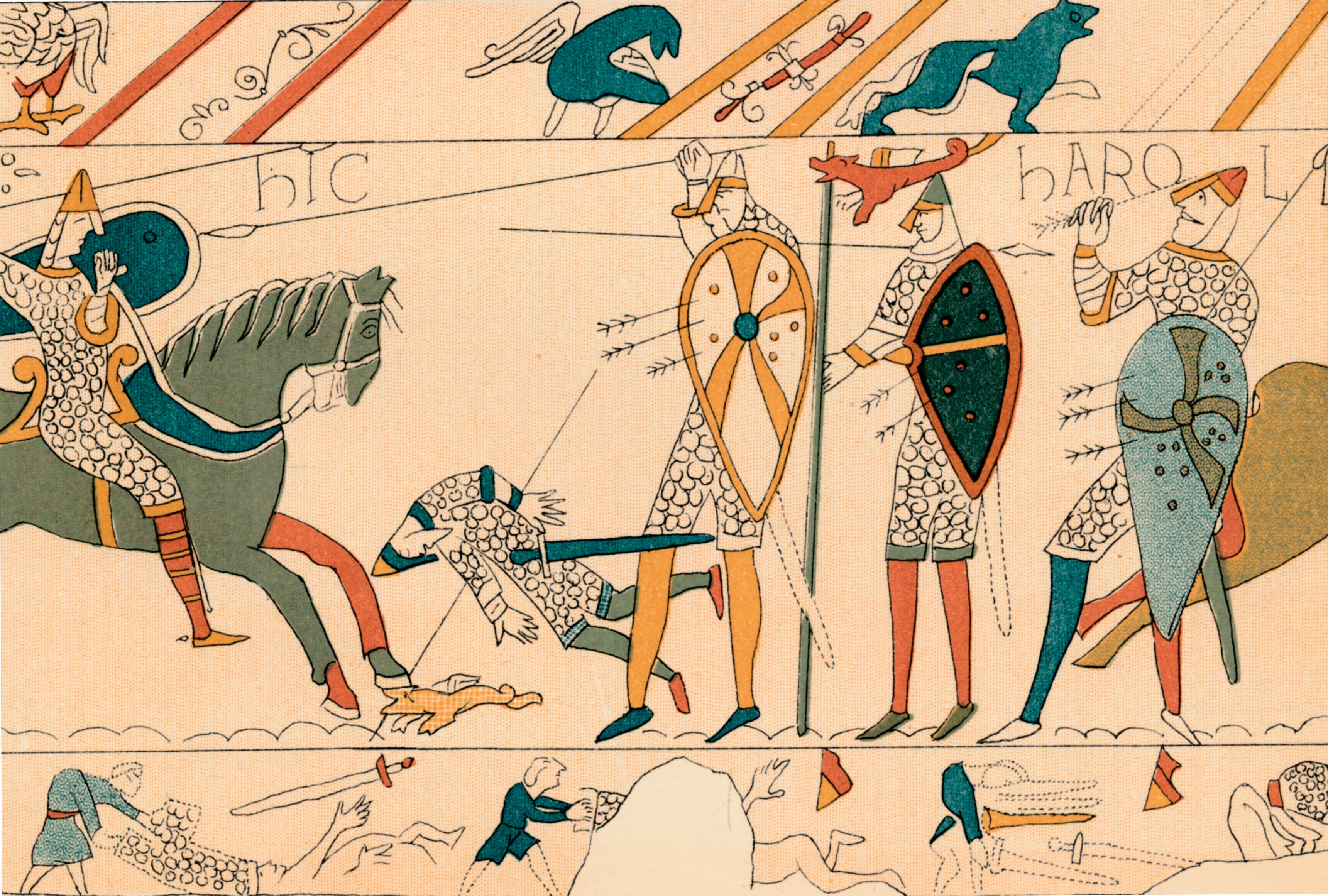
🏹 King Harold famously lost his eye, life, and kingdom in the Battle of Hastings back in 1066. A new discovery now hints that the Norman Conquest was down to poor old Harry backing the wrong Pope during a bitter religious power struggle
💍 Metal from beyond our world has been found in rings worn by ancient Mediterranean elites. Mycenaeans of Iliad and Odyssey fame were among those who brandished flashy bling made from meteorites to assert their prominence and power
💪 Ancient Neanderthal DNA is giving some people bulging biceps even today. A fortunate few carry a version of the growth hormone receptor used by our stocky cousins back in the day
🧑🚀 We’ve flown a radiation-blocking vest to the Moon and back, and it worked. A startup is developing personal protective equipment to shield astronauts from harmful space rays, rather than the entire spacecraft
AI is so 2025
Fortune runs out
Fret not, ye astronomer
We’re getting mealtimes wrong - here’s the best time to have dinner
Scientists link four-hour rule before bed to sharper memory and lower dementia risk
About TWSD
Science is weird, and here’s the proof. The Weird Science Drop goes where other, more-sensible newsletters fear to tread. Every week, we grab our trusty white lab coat, bunch of bubbling test tubes and world-ending robot prototype to go in search of the overlooked, under-the-radar and, above all else, most madcap science news, views and research.
Daniel Smith is an ancient experienced journalist who has worked for a host of news publishers on both sides of the Atlantic. A long, long time ago, he fancied himself an astrophysicist but turned out to be the worst scientist since the man who mapped all those canals on Mars, which turned out to be scratches on his telescope’s lens. Luckily, he is not working on the Large Hadron Collider, inadvertently creating a black hole that would swallow the world by pressing the big red button, but is safely behind a desk writing this newsletter, bringing you the fantastical underbelly of nature... The Weird Science Drop.
No posts
Comments
Nothing yet. Say the first thing.
Sign in to join the conversation.