
Thank you for reading The World of Direct Selling. You can upgrade to a paid subscription here. You’ll receive weekly articles that are exclusively available to our paid subscribers, as well as weekly industry news roundups. You will also have full access to our article archive.
Yearly plan is 40% off now!
>> The first part of this article was published last week. Click here to read the first part.
Stuart’s data at DSU was striking on this point: 90% of service-based direct selling companies are growing. On the product side, that number is closer to half.
The reason isn’t complicated. Services businesses are built around recurring revenue by design. The customer has a real reason to stay. The product side of this channel has been losing customers out the back door for years — not because the products don’t work, but because the buying experience doesn’t give people a reason to come back automatically.
I don’t think every product company needs to become a services company. But every product company needs to think like one. If your customer has to remember to come back, you’re already losing. The companies figuring it out are the ones attaching a service layer to their product — a wellness app, a health tracking component, a subscription that makes reordering automatic and effortless. You’re not abandoning what makes you a product company. You’re just finally building the infrastructure that protects the customers you’ve already earned.
A lot of field leaders are asking what their role looks like now that the lines between social commerce and direct selling are blurring. My honest answer: the fundamentals haven’t changed as much as people think.
The daily method of operation that built this channel — make a list, work your warm market, host a meeting, use your upline in a three-way call for validation — that’s not dead. But it’s incomplete. A field leader in 2026 who isn’t consistently creating content — a post, a story, a short video, even a thoughtful comment — is invisible to a whole generation of potential customers and builders.
Show people why you’re a customer first. That authenticity is what converts a viewer into a buyer, and ideally into someone who stays on subscription long after the initial excitement wears off.
Stuart quoted Peter Diamandis at DSU: any company will soon run on 25% less of its current workforce. Knowledge work is being automated. And a lot of people in this room heard that as a threat.
I hear it as an opening.
Every major consumer brand right now is trying to figure out how to manufacture community and culture. They’re flying influencers to events, putting them on stage, giving them recognition and a check. Think about that. We’ve been doing that for decades. This is what we do.
What AI cannot do is sit across from someone who just lost their job, or whose marriage is struggling, or who simply needs to believe in something again, and tell them they matter and that there’s a path forward. That is a human skill. That’s what the best leaders in this channel have always done, and it is worth more right now than it has ever been.
Stop outsourcing your relationships. Double down on the personal development side of your culture — because that’s the one thing no algorithm is coming for.
Stuart went on record at DSU predicting a billion dollars in companies and products will change hands this year. I believe him. I’ve been close enough to several of those deals to know the warning signs that most field leaders miss until it’s too late.
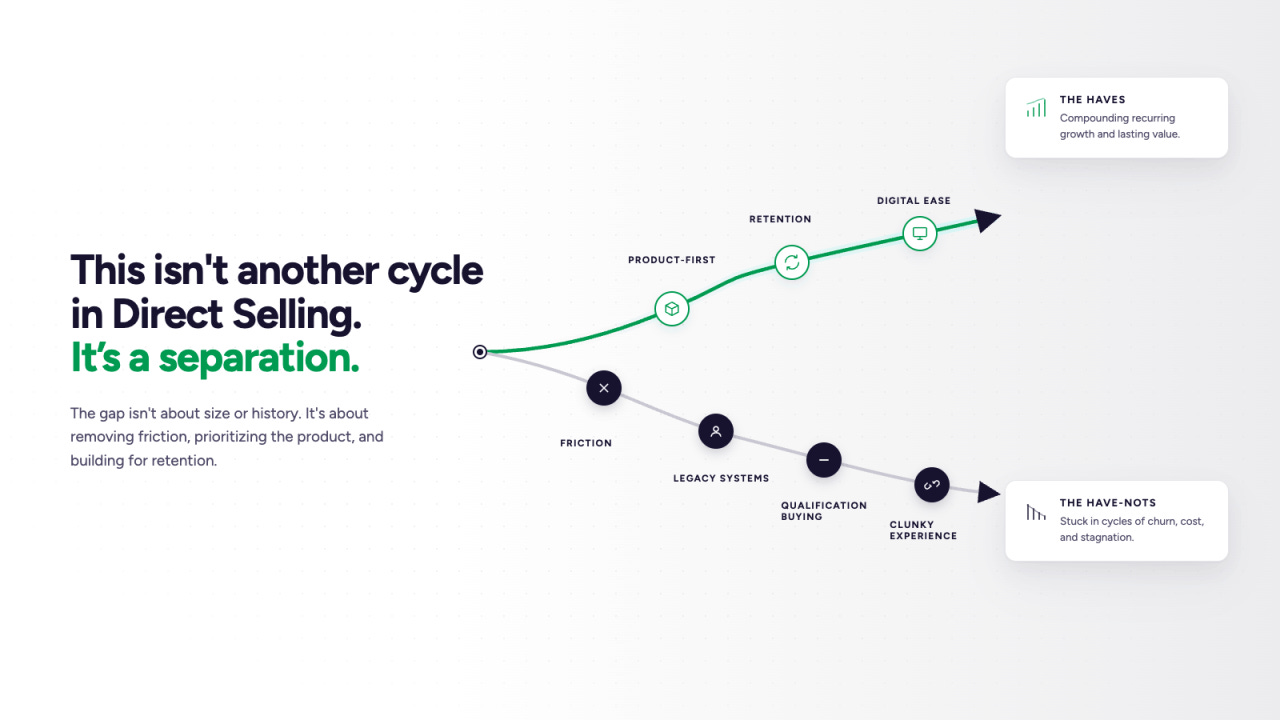
Here’s my filter: product first, technology second. If the product doesn’t have real customers reordering it because it works — not because of a qualification requirement — that company is a seller in this consolidation, not a buyer. And if the technology stack is clunky, the subscription experience outdated, the reorder process full of friction — same answer. The companies positioned to acquire in this environment are the ones that have already solved recurring revenue. The ones that haven’t are the ones being consolidated.
Customer retention numbers and technology investment will tell you more about a company’s future than anything you’ll ever see on a recognition stage.
Thirty-five years. A lot of keynotes, a lot of predictions, a lot of companies I watched rise and fall. The ones that made it weren’t always the ones with the best products or the biggest fields. They were the ones honest enough to see what was changing and disciplined enough to change with it.
That moment is right now. The clock is running.
…..
This article was originally published by Gregg Corella on LinkedIn. Republished with permission.
Thanks for reading! Feel free to share it.

A short selection of headlines from our weekly news roundup below:
Natura: Expects a decline in sales in the second quarter
Zinzino: Preliminary Q2 report shows revenue increase
QNET: Global convention attracted over 8,000 entrepreneurs
Upgrade to get access to these and to all other important direct selling news:
Article written by BDD, the Direct Selling Association of Germany
With €21.24 billion in annual sales, more than 900,000 sales partners and a central position in Europe, Germany remains one of the most attractive markets for international direct selling companies.

Germany is one of Europe’s most important consumer markets — and for direct selling companies, it offers a rare combination of scale, purchasing power, infrastructure and geographic reach.
Comments
Nothing yet. Say the first thing.
Sign in to join the conversation.