
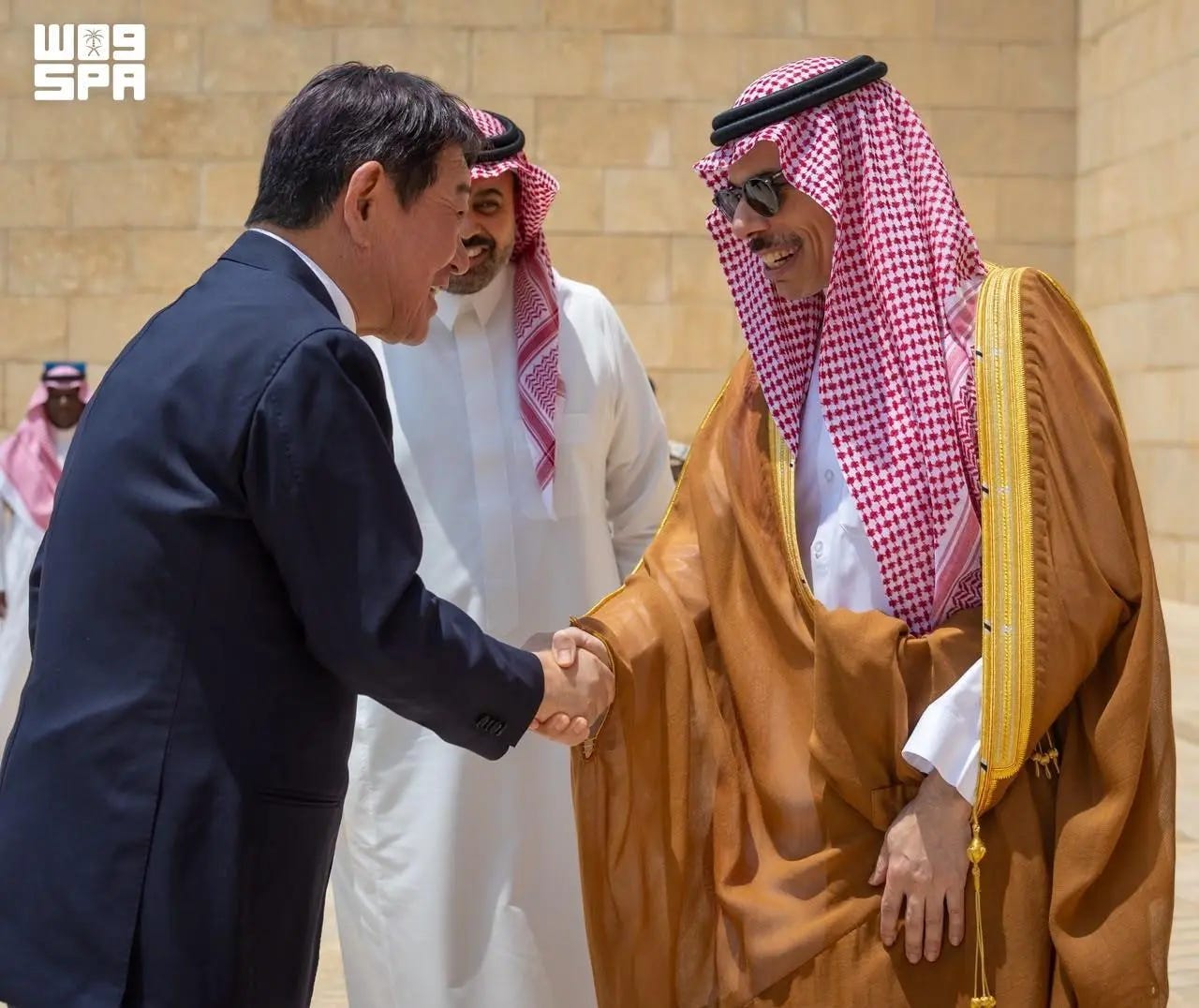
Riyadh, August 19, 2026, SPA -- Minister of Foreign Affairs Prince Faisal bin Farhan bin Abdullah received today Japanese Foreign Minister Toshimitsu Motegi at the ministry’s headquarters in Riyadh.
From Oil to Maritime Security: Saudi Arabia and Japan Expand Their Strategic Partnership
When Saudi Foreign Minister Prince Faisal bin Farhan received Japanese Foreign Minister Toshimitsu Motegi in Riyadh on August 19, the agenda reflected how far Saudi-Japanese relations have expanded beyond the commercial relationship that defined them for much of the past seven decades. The two ministers spent roughly two hours in their third Foreign Ministerial Strategic Dialogue, including a working lunch, discussing energy security, maritime navigation, Iran, Yemen, Palestine, investment, minerals, infrastructure, defense, technology, and developments in East Asia. Their conversation took place amid a Middle Eastern security crisis that has made Saudi Arabia increasingly important to Japan’s economic security while giving Riyadh new reasons to cultivate Tokyo as a political, technological, and investment partner.
The timing gave the meeting particular weight. Continued tensions involving Iran, disruption around the Strait of Hormuz, Houthi attacks affecting the Red Sea and Bab el-Mandeb, and uncertainty surrounding international energy supplies have exposed Japan’s vulnerability to events thousands of miles from its shores. Japan remains extraordinarily dependent on imported energy, and the Middle East supplied 94 percent of its crude oil in 2025. Recent disruptions have already forced Japanese refiners to change shipping routes. Idemitsu, for example, began moving Saudi crude through alternative routes involving the Suez Canal and Cape of Good Hope, increasing a journey that normally takes around 20 days to as much as 50 to 60 days.
For Riyadh, these conditions have expanded the diplomatic value of its traditional role as an energy supplier. Saudi Arabia increasingly presents itself to Asian partners as a source of energy, investment opportunities, critical resources, regional political access, and security cooperation. Prince Faisal’s remarks during the meeting captured that wider agenda. He identified investment, energy and resources, supply chains, defense, technology, and exchanges of expertise and capabilities as promising areas for expanded cooperation. He also pledged that Saudi Arabia would remain a reliable partner for Japan, including in energy.
Energy Security in a Much More Dangerous Region
Oil inevitably occupied a prominent place in the discussions because the security environment has made physical access to Gulf energy an immediate Japanese concern. Motegi thanked Saudi Arabia for its efforts to maintain supplies to Japan and international markets during instability around both Hormuz and Bab el-Mandeb. The two sides also discussed Japan’s POWERR Asia initiative, through which Tokyo wants to strengthen oil-stockpiling capacity across Asia. Prince Faisal responded positively and raised cooperation on oil stocks, Saudi Arabia’s East-West Pipeline, clean energy, and mineral resources.
The East-West Pipeline has acquired greater strategic value because it allows Saudi oil to move from the kingdom’s eastern producing regions to Yanbu on the Red Sea, reducing dependence on Hormuz. Japan has already experienced the value of this infrastructure. During the regional crisis earlier this year, Prime Minister Sanae Takaichi thanked Crown Prince Mohammed bin Salman for continued Saudi crude supplies through Yanbu, while the Saudi side pledged to help maintain energy supplies to Japan and international markets.
The conversation therefore involved more than assurances about barrels of crude. Tokyo is looking at the resilience of the entire system through which those barrels reach Japan: stockpiles, pipelines, shipping lanes, alternative ports, maritime security, and political arrangements capable of preventing future disruptions. Saudi Arabia can participate in almost every part of that equation.
That creates an unusual convergence between the traditional energy relationship and newer Saudi economic ambitions. Riyadh wants Japanese capital and technology for clean energy, mineral development, industrial infrastructure, and advanced manufacturing. Japan needs dependable access to energy and increasingly cares about diversified supply chains for minerals and industrial inputs. Saudi Arabia can use its existing energy relationship as the foundation for cooperation in sectors that will remain valuable as the global energy mix changes.
Hormuz and Bab el-Mandeb Move to the Center
Prince Faisal described maritime security as a top shared priority and specifically identified Hormuz, Bab el-Mandeb, and other international maritime routes. Motegi’s entire Gulf trip, which also took him to Oman, had been organized partly around de-escalation and freedom of navigation through those waterways.
For Japan, the geography is unforgiving. Its economy depends heavily on maritime trade, while a large share of its energy passes through waterways exposed to Iranian pressure, regional warfare, piracy, missile and drone attacks, and Houthi operations. Tokyo consequently has a strong interest in preventing either Hormuz or Bab el-Mandeb from becoming subject to political tolls, coercive restrictions, or prolonged military disruption.
Prince Faisal briefed Motegi on talks between Iran and Oman concerning Hormuz, while both ministers agreed that ships should enjoy free and safe passage without additional charges. Their language followed discussions the two ministers held by telephone on July 2, when they had already agreed that the international community should speak collectively in favor of restoring navigation through Hormuz without additional fees.
Their discussion of the Red Sea brought Yemen directly into the bilateral agenda. Motegi condemned continued Houthi attacks against Saudi Arabia and Yemen’s internationally recognized government, while Prince Faisal explained Saudi views on Yemen and Riyadh’s multinational maritime defense coalition. Motegi separately met Rashad Al-Alimi, chairman of Yemen’s Presidential Leadership Council, during his stay in Riyadh and connected Yemeni stability directly with the security of Bab el-Mandeb and international commerce.
Japan has historically preferred economic diplomacy, development assistance, and political engagement in the Middle East. The present crisis is forcing Tokyo to think more explicitly about the security architecture that protects those economic interests. Saudi Arabia offers access to regional diplomacy, energy infrastructure, maritime initiatives, and governments with direct influence over the conflicts affecting Japan’s supply routes.
Iran Brings the Political Relationship Forward
The ministers also spent considerable time discussing Iran. Motegi argued for reopening Hormuz and reaching a final U.S.-Iran agreement that addresses the nuclear issue. Prince Faisal briefed him on regional diplomacy, continuing a series of conversations between the two ministers since the escalation earlier this year. Their March and April calls had already covered Iranian attacks, Saudi mediation efforts, energy security, Hormuz, and the need for de-escalation.
Japan occupies an interesting position in this diplomacy. It has maintained longstanding relations with Iran while developing increasingly important ties with Saudi Arabia and other Gulf states. Tokyo has little interest in a regional confrontation that threatens oil imports, shipping, Japanese nationals, investments, or the wider global economy. Riyadh has similarly invested considerable diplomatic effort in containing escalation and maintaining communication with Tehran while protecting Saudi territory and economic infrastructure.
That shared preference for diplomatic containment gives the relationship a political dimension that oil contracts alone never provided. Japan can lend economic and diplomatic weight to Saudi-led regional stabilization efforts, while Saudi Arabia can give Tokyo greater access to the diplomatic negotiations shaping Gulf security.
Prince Faisal’s description of Japan’s role was revealing. He praised Tokyo’s support for international law, humanitarian and development activities, and peaceful solutions. Saudi Arabia is increasingly cultivating relations with middle and major powers that can contribute technology, investment, diplomacy, and economic resilience without requiring every bilateral relationship to revolve around great-power rivalry.
From Vision 2030 to Technology and Infrastructure
Economic cooperation has already been moving in this direction for several years. Saudi-Japan Vision 2030, launched in 2017, created an institutional framework connecting Saudi economic diversification with Japanese industrial and technological capabilities. The partnership now covers dozens of projects across energy, manufacturing, healthcare, entertainment, technology, infrastructure, and other sectors.
Japanese corporate involvement has grown accordingly. By 2025, Japanese companies had invested approximately $6.3 billion in Saudi Arabia, while the number of Japanese companies investing in the kingdom had risen substantially since the launch of the bilateral framework. Bilateral trade exceeded $36 billion, with Saudi petroleum and petrochemical exports accounting for most Saudi sales to Japan and Japanese automobiles, machinery, appliances, and equipment flowing in the opposite direction.
Recent agreements show where both governments want the relationship to go next. The eighth Saudi-Japan Vision 2030 Ministerial Meeting in September 2025 discussed autonomous-driving AI, space technology, gaming and esports, and the transfer of Japanese experience from Expo 2025 Osaka to Expo 2030 Riyadh. Earlier cooperation had included finance, healthcare, clean energy, and industrial AI.
During the August 19 dialogue, Motegi added desalination, electricity, and railway infrastructure to Japan’s priorities. Desalination has obvious relevance for Saudi Arabia because water security remains inseparable from its long-term development plans. Japanese companies possess considerable experience in water treatment and energy-efficient reverse-osmosis technology, while Saudi demand provides the scale required for commercialization, localization, and eventually exports to other water-stressed markets. Artificial intelligence, minerals, clean energy, and industrial technology offer similar possibilities.
The two governments are also reducing practical barriers to deeper commercial ties. They welcomed an agreement in principle on a Customs Mutual Assistance Agreement, while direct Riyadh-Narita flights scheduled to begin in November should improve business and tourism connections. These changes support a relationship increasingly driven by companies, investors, engineers, tourists, universities, and technology partnerships alongside government diplomacy.
Defense Enters the Economic Conversation
Prince Faisal’s explicit inclusion of defense among the areas for expanded cooperation deserves attention. Saudi-Japanese security relations remain far less developed than Riyadh’s defense relationships with Washington, London, Paris, or increasingly Ankara and several Asian partners. Japan’s defense industry is also operating under political and regulatory constraints that have historically limited arms exports.
Even so, Tokyo has gradually loosened some of those restrictions while investing more heavily in its own defense capabilities. Saudi Arabia is simultaneously seeking to localize defense production, acquire technology, diversify suppliers, and develop domestic expertise under Vision 2030. The resulting overlap creates room for cooperation in dual-use technologies, cybersecurity, sensors, communications, unmanned systems, maritime awareness, advanced materials, and other fields that connect commercial technology with national security.
Supply-chain security provides another bridge. Both governments increasingly see access to minerals, advanced technologies, energy, transportation infrastructure, and industrial capacity through a national-security lens. Saudi Arabia wants to turn its mineral resources and geographic position into industrial advantages. Japan brings manufacturing expertise, capital, processing technology, and demand for secure supplies. Cooperation in minerals therefore connects Saudi diversification with Japanese economic security.
A Relationship With a Wider Geographic Reach
Motegi also used the dialogue to explain Japan’s updated Free and Open Indo-Pacific policy, while the ministers discussed North Korea’s nuclear and missile programs and the issue of Japanese abductees. The inclusion of East Asia in a Saudi-Japanese foreign ministers’ dialogue shows the expanding geographic scope of their consultations.
Saudi Arabia has spent the past several years expanding its diplomatic and economic engagement across Asia, including China, Japan, South Korea, India, Pakistan, and Southeast Asia. Japan, meanwhile, increasingly views Gulf security as connected to its own economic resilience. Energy flows from Saudi Arabia to East Asia, manufactured products and technology move in the opposite direction, while maritime routes running from the Gulf through the Indian Ocean connect both regions.
The Strategic Partnership Council established by the countries’ leaders in 2024 and launched in 2025 gives these expanding interests a higher-level political framework. The August dialogue confirmed that both governments intend to use it to coordinate cooperation across fields that previously operated through separate economic, energy, or diplomatic channels.
What Comes Next
The immediate impact of the Riyadh meeting will probably emerge through individual projects rather than a single dramatic agreement. Energy cooperation can expand through stockpiling, Saudi export infrastructure, and clean-energy projects. Japanese companies are likely to receive additional opportunities in desalination, electricity, railways, AI, minerals, advanced manufacturing, and other sectors connected to Saudi Vision 2030. Direct flights and customs cooperation should make commercial interaction easier, while the Strategic Partnership Council can provide political backing when major projects encounter regulatory or financing obstacles.
Security cooperation may develop more gradually, particularly around maritime security, supply chains, infrastructure resilience, and dual-use technology. Continued instability around Hormuz and Bab el-Mandeb gives both governments a strong reason to institutionalize consultation. Japan needs information, access, diplomatic relationships, and dependable partners close to the waterways on which its economy depends. Saudi Arabia wants technologically capable partners willing to invest in the kingdom’s transformation and support a regional environment in which trade and development can continue.
The August 19 meeting consequently captured a relationship undergoing a significant change in scale. Saudi Arabia remains one of Japan’s most important energy suppliers, and Japan remains an attractive market for Saudi crude. Around that old commercial core, the two governments are building a network of cooperation covering mineral resources, AI, infrastructure, clean energy, investment, defense, maritime security, diplomacy, and supply-chain resilience.
Regional instability has accelerated that process. Every disruption in Hormuz demonstrates Japan’s exposure to Gulf security. Every Houthi attack near Bab el-Mandeb reinforces the connection between events in Yemen and Japanese economic interests. Every Saudi effort to diversify its economy creates opportunities for Japanese technology and capital. At the same time, Riyadh’s growing political weight gives Tokyo a partner capable of influencing the diplomatic environment surrounding the energy routes on which Japan depends.
Saudi-Japanese relations began largely as a highly successful exchange between a resource producer and an industrial economy. Seventy-one years after diplomatic relations were established, Prince Faisal and Motegi are working with a considerably broader proposition: Saudi energy and geography, Japanese technology and industrial expertise, and a shared interest in keeping the commercial arteries between the Gulf and Asia open. If the projects discussed in Riyadh develop as intended, that combination can turn one of Asia’s oldest Gulf energy relationships into a much more consequential strategic partnership.
Can Japan Rival China in Saudi Arabia and the Wider Middle East?
The widening Saudi-Japanese agenda also raises a larger question about Japan’s place in a Middle East where China has become one of the most powerful economic players. Riyadh’s interest in Japanese technology, minerals, infrastructure, energy security, and advanced manufacturing comes as Chinese companies continue to expand across many of the same sectors. Similar competition is taking shape elsewhere in the Gulf, where governments are actively courting Asian investment while trying to diversify their economic and technological relationships. The issue is therefore how much room Japan has to expand alongside a Chinese presence built through years of trade, investment, construction, and energy ties, and where Japanese capabilities can give Tokyo an advantage.
Japan has a realistic opportunity to expand its influence in Saudi Arabia and across the Middle East, although matching China across the entire economic relationship would require a scale of engagement that Tokyo has not shown so far. China has spent years building commercial connections that extend from oil purchases and petrochemicals to construction, telecommunications, electric vehicles, renewable energy, ports, logistics, consumer goods, and industrial equipment. Saudi Arabia imported roughly SAR 261 billion worth of Chinese goods in 2025, close to 28 percent of all imports. Imports from Japan reached about SAR 38 billion, or around 4 percent. That difference gives some indication of the commercial distance Japan would have to cover.
China’s advantage comes partly from the range of what it can offer. Chinese companies can build infrastructure quickly, provide financing, supply inexpensive manufactured goods, construct solar farms, install telecommunications systems, sell electric vehicles, and invest in industrial production. Beijing simultaneously buys enormous quantities of Gulf oil and petrochemicals. Saudi Arabia exported approximately SAR 170 billion worth of goods to China in 2025, overwhelmingly energy and related products, making China valuable on both sides of the trade relationship.
Japanese engagement has developed along a narrower path. Saudi Arabia remains a major supplier of crude to Japan, while Japanese exports have traditionally concentrated on automobiles, machinery, electrical equipment, and other manufactured products. Tokyo consequently lacks the commercial saturation that China has achieved. Japanese contractors and manufacturers no longer dominate large Middle Eastern projects to the extent that they did in earlier decades, while Chinese companies have become familiar participants in Saudi construction, energy, telecommunications, and infrastructure.
Saudi economic policy nevertheless creates considerable room for Japan because Riyadh increasingly wants several capable partners competing for access to its expanding economy. Vision 2030 requires enormous quantities of technology, capital, engineering knowledge, industrial equipment, and specialized expertise. Depending excessively on Chinese suppliers would create vulnerabilities of its own, particularly in telecommunications, advanced technology, manufacturing inputs, and critical infrastructure. Saudi policymakers have strong reasons to encourage Japanese, South Korean, American, European, Turkish, and other companies to remain active rather than allowing any one country to dominate the next phase of industrial development.
Japan fits particularly well into this strategy because it can offer technology and industrial expertise without seeking a politically exclusive relationship. Japanese companies remain highly competitive in advanced materials, precision manufacturing, robotics, automotive technology, industrial machinery, chemicals, water treatment, power systems, batteries, electronics, and several clean-energy technologies. Many of these sectors coincide directly with Saudi plans to move beyond crude exports and build domestic industries capable of producing higher-value goods.
Water offers a particularly promising example. Saudi Arabia already operates one of the world’s largest desalination systems and will require continuing investments in water production, recycling, efficiency, and distribution as cities and industrial zones expand. Japanese companies have decades of experience in membrane technology, reverse osmosis, pumps, advanced materials, and energy-efficient water systems. A Japanese strategy built around Saudi water security would therefore address an enduring national requirement while creating opportunities for localization and joint manufacturing.
Critical minerals offer another opening. Saudi Arabia has placed mining near the heart of its diversification strategy and estimates that its mineral resources are worth trillions of dollars. China already occupies a powerful position across global mineral processing and downstream manufacturing. Riyadh has little incentive to reproduce that dependence inside its own emerging mining industry. Japanese firms can bring processing technology, advanced materials expertise, financing, long-term purchasing agreements, and connections to Japanese manufacturers seeking secure mineral supplies.
The same calculation applies to clean energy. Chinese companies enjoy formidable advantages in solar panels, batteries, electric vehicles, and many components used in renewable-energy systems. Their ability to manufacture at enormous scale and compete aggressively on price makes direct competition difficult. Japan has greater room in technologies requiring specialized engineering, including hydrogen, ammonia, advanced battery materials, energy-management systems, carbon reduction technologies, and industrial efficiency. Saudi Arabia’s ambitions in hydrogen and low-carbon fuels give Tokyo opportunities to connect Japanese energy demand with Saudi production rather than competing with Chinese manufacturers product by product.
Japanese companies can also benefit from growing Saudi concern with economic resilience. The crises around Hormuz and Bab el-Mandeb have reminded governments and corporations that price alone cannot determine supply-chain strategy. Reliability, redundancy, intellectual-property protection, maintenance, technical support, cybersecurity, and political exposure increasingly enter procurement decisions. Japan’s reputation for reliable engineering and long-term industrial relationships becomes more valuable under those conditions.
Infrastructure presents a more difficult contest. Chinese construction companies can deliver large projects quickly and often at prices competitors struggle to match. They also benefit from extensive experience with state-backed overseas projects. Saudi Arabia has enormous infrastructure requirements connected to NEOM, Expo 2030 Riyadh, transportation networks, industrial zones, tourism, housing, and logistics. Japan probably cannot displace China across this entire market. It can compete selectively in rail technology, urban transportation, power infrastructure, water systems, smart-city technologies, specialized engineering, and projects where lifecycle performance carries greater weight than the initial construction price.
Artificial intelligence and digital infrastructure will create an even more consequential contest. Saudi Arabia wants to become a major AI and data-center hub and has committed large amounts of capital to semiconductors, cloud infrastructure, and digital industries. China can provide telecommunications hardware, surveillance technologies, cloud services, AI applications, and comparatively inexpensive equipment. Washington continues to place restrictions on the transfer of some advanced technologies where Chinese involvement creates security concerns. Saudi Arabia therefore faces decisions about which technological ecosystems it wants its most sensitive infrastructure to use.
Japan has an opportunity to position itself inside this space as a technologically advanced partner compatible with American and other Western systems. Japanese companies possess strengths in semiconductors, semiconductor materials, sensors, robotics, industrial automation, data infrastructure, and advanced manufacturing. Tokyo can work with Saudi Arabia without carrying the same strategic confrontation surrounding Chinese technology in Washington. That position becomes especially useful for Riyadh as it seeks access to advanced American technologies while maintaining extensive economic relations with China.
The regional picture follows a similar pattern. China has established itself across the UAE, Egypt, Iraq, Oman, Qatar, and other Middle Eastern markets through trade, construction, telecommunications, energy, and infrastructure. Beijing also possesses the enormous advantage of being a major customer for Middle Eastern hydrocarbons. Its trade volumes give Chinese diplomacy a commercial foundation that Japan cannot easily reproduce.
Some of China’s strengths have also created openings for competitors. Gulf governments have become more sophisticated in managing external powers and increasingly avoid building excessive reliance on one supplier. Concerns about debt, project quality, technology security, local employment, industrial localization, and dependence on Chinese supply chains can influence procurement decisions. Governments that want continuing access to American technology and security cooperation have additional reasons to diversify sensitive infrastructure.
Japan can capitalize on this environment by presenting itself as a source of economic diversification inside the diversification strategies of Middle Eastern states themselves. Saudi Arabia, the UAE, Oman, and other governments already seek multiple Asian relationships. South Korea has shown how effective such an approach can become. Korean companies have secured major roles in nuclear energy, defense, construction, automobiles, and technology while maintaining broad political relationships across the region. Japan has comparable industrial capabilities in many fields and a much longer history of commercial relations with Gulf energy producers.
Tokyo’s challenge comes from its own level of ambition. Japanese companies have often approached Middle Eastern markets cautiously, particularly where regulatory uncertainty, political risk, or aggressive pricing makes projects less predictable. Chinese firms frequently enter with stronger government backing and greater tolerance for commercial risk. If Japan wants a substantially larger regional role, occasional ministerial visits and cooperation agreements will have to produce more investment decisions, joint ventures, manufacturing plants, research partnerships, and long-term procurement arrangements.
Japan can also use finance more effectively. Gulf sovereign wealth funds are seeking opportunities in Asian technology and industry, while Japanese companies require capital for emerging technologies and international expansion. Reciprocal investment can create relationships that reach beyond traditional trade. Saudi investment in Japanese technology companies, combined with Japanese industrial investment inside the kingdom, would build constituencies on both sides with an interest in sustaining the partnership.
Defense and maritime security can widen the relationship further. China has expanded defense ties with several Middle Eastern countries and supplies drones, missiles, and other systems that Western governments have sometimes declined to provide. Japan will remain constrained by its defense export rules and political culture, although those restrictions have gradually loosened. Areas including maritime surveillance, sensors, cybersecurity, communications, robotics, dual-use technologies, and supply-chain security offer more immediate possibilities.
Current regional instability also exposes an important limit on Chinese influence. Gulf states have increasingly looked to Beijing to use its substantial economic relationship with Iran to support de-escalation and protect maritime commerce. China has engaged diplomatically while remaining cautious about applying sustained pressure on Tehran. Beijing wants access to Gulf energy, Iranian energy, regional markets, and political relationships simultaneously, and it has shown little appetite for assuming the security burdens associated with protecting those interests.
Japan carries far less geopolitical weight, though its regional relationships generate fewer suspicions about strategic domination. Tokyo maintains diplomatic access to Iran while enjoying strong relations with Saudi Arabia, the UAE, and other Gulf governments. It cannot replace the American security role or force Iran to change course, but it can contribute diplomatic support, development assistance, maritime cooperation, and economic incentives without becoming another pole around which regional competition organizes itself.
Saudi Arabia may find that quality increasingly useful. Riyadh’s foreign policy has moved toward maintaining extensive relationships with Washington, Beijing, Tokyo, New Delhi, Ankara, Seoul, and European capitals at the same time. The objective is not to select one external patron. Saudi Arabia wants access to the strongest capabilities each relationship provides while preserving room to maneuver.
Japan therefore does not need to overtake China in Saudi trade to become a much more influential Saudi partner. A more attainable goal would involve establishing Japanese companies in sectors Riyadh considers essential to its next stage of development, particularly minerals, water, advanced manufacturing, clean energy, AI-related industrial technologies, transportation, healthcare, and resilient infrastructure. Success in those areas would give Japan economic influence that raw trade figures alone would not capture.
Elsewhere in the Middle East, the same strategy can work most effectively in wealthier Gulf economies and states investing heavily in modernization. Competing with Chinese mass manufacturing or construction pricing throughout the region would consume enormous resources and offer uncertain returns. Building long-term positions in industries where Japanese technology, financing, engineering, and reliability carry a premium gives Tokyo a clearer route.
The competition also extends beyond Japan and China. South Korea, India, the United States, Türkiye, and European countries all want larger roles in Gulf industrialization. Saudi Arabia benefits from that competition because it can demand investment, localization, technology transfer, training, and domestic production as conditions for market access. Japan will therefore have to compete for Saudi attention rather than relying on the goodwill created by decades of oil trade.
Prince Faisal’s meeting with Motegi can be read within this much larger shift. Energy security gave Saudi-Japanese relations their original foundation, while current conditions are pushing both governments to decide whether they want to build something much broader upon it. China already possesses scale, market penetration, and political attention. Japan possesses technologies Riyadh wants, enormous industrial experience, substantial capital, and a relationship carrying relatively little political baggage.
How far Tokyo converts those advantages into influence will depend on how aggressively Japanese government agencies, companies, and financial institutions pursue the opportunity. Saudi Arabia has already opened the door through Vision 2030, its mining strategy, major infrastructure projects, AI ambitions, energy transition plans, and desire for diversified partnerships. Japan now has an opportunity to occupy considerably more of that space. The Saudi government has every reason to encourage it, because a stronger Japanese presence gives Riyadh another source of capital and technology while preserving the competitive environment at the center of its wider foreign economic strategy.
From Manga to Soft Power: Japan’s Cultural Opening in the Middle East
Economic competition with China is only part of Japan’s opportunity in Saudi Arabia and the wider Middle East. Tokyo possesses another source of influence that Beijing has spent considerable money trying to create for itself: a large audience of young people who already consume Japanese culture voluntarily. Manga, anime, video games, character franchises, fashion, food, and Japanese popular culture have developed substantial followings across Saudi Arabia and other Middle Eastern countries. That familiarity gives Japan an unusual starting point for expanding people-to-people relations because cultural interest already exists before government institutions become involved.
The demographic environment makes this especially relevant in Saudi Arabia. Roughly two-thirds of the population is under 35, and the social changes associated with Vision 2030 have created an enormous market for entertainment, gaming, tourism, live events, and cultural production. Anime and manga fit naturally into that transformation. Saudi fans attend conventions, follow Japanese franchises online, play Japanese games, collect merchandise, learn about Japanese food, and increasingly travel to Japan. Riyadh has also invested heavily in gaming and entertainment, creating commercial connections between Saudi capital and industries in which Japan remains a global leader.
Anime’s appeal across the Arab world also predates Vision 2030. Generations grew up watching Arabic-dubbed Japanese animation on regional television, often without initially thinking of these programs as instruments of Japanese cultural influence. Later access to satellite television, streaming services, social media, and online fan communities connected younger audiences directly with Japanese studios, artists, games, and popular culture. For many young Saudis and other Arabs, Japan therefore entered their cultural lives through entertainment long before Japanese diplomacy attempted to reach them.
This gives Tokyo an advantage that cannot easily be manufactured through government spending. Cultural influence becomes more durable when audiences seek it out themselves. Someone who starts with anime may become interested in Japanese history, food, travel, design, technology, literature, martial arts, or language. A teenager watching Japanese animation can eventually become a university student considering a semester in Tokyo, an entrepreneur looking for Japanese partners, a game developer interested in working with a Japanese studio, or an engineer seeking employment with a Japanese company.
Saudi Arabia’s rapidly expanding entertainment industry creates opportunities to turn that existing interest into lasting institutional connections. Japanese studios and gaming companies can collaborate with Saudi developers, artists, animators, writers, and investors. Universities can establish programs in animation, digital design, gaming, and Japanese language. Exchange programs can bring Saudi students to Japanese universities and technical institutes while sending Japanese students and researchers to Saudi Arabia. Joint productions can introduce Japanese creators to Arab stories and artistic traditions while giving Saudi creators access to one of the world’s most sophisticated entertainment industries.
Saudi investment in Japanese gaming companies makes this particularly interesting. The Public Investment Fund has accumulated significant holdings in major Japanese gaming businesses, while Savvy Games Group has become an important instrument of Riyadh’s effort to establish Saudi Arabia as a global gaming center. These investments have sometimes been discussed primarily as financial transactions. They also create potential cultural infrastructure. Training programs, joint studios, esports events, developer exchanges, localization centers, and regional publishing operations can connect Saudi youth directly with Japanese creative industries.
Such cooperation could extend well beyond Saudi Arabia. Anime enjoys large audiences in the UAE, Egypt, Jordan, Kuwait, Qatar, Morocco, Algeria, Türkiye, and other regional markets. Arabic-language fan communities cross national borders, allowing cultural products to circulate throughout the region. A Japanese company that develops a stronger presence in Riyadh or Dubai can therefore reach audiences far beyond a single national market.
China has been pursuing its own people-to-people strategy much more deliberately. Beijing has expanded Chinese-language education, university cooperation, scholarships, cultural programs, media partnerships, tourism promotion, and academic exchanges across the Middle East. Saudi Arabia has become an especially important target. Chinese-language instruction has expanded within Saudi education, while universities and schools have introduced Mandarin programs as political and commercial relations with Beijing have grown.
For young Saudis, the attraction of learning Chinese has an obvious economic component. China is Saudi Arabia’s largest trading partner, Chinese companies are increasingly visible inside the kingdom, and Chinese investment has expanded across energy, construction, technology, manufacturing, logistics, and other sectors. Mandarin can therefore look like a practical professional skill. Students can reasonably expect that knowledge of Chinese may help them work in trade, diplomacy, energy, technology, tourism, or companies doing business with China.
Beijing benefits from connecting language learning to economic opportunity. A student who spends several years learning Mandarin may study in China, develop professional networks there, consume Chinese media, work for a Chinese company, or become involved in bilateral business. Over time, these experiences produce a group of Saudi professionals who understand China, speak its language, and have personal relationships with Chinese institutions. Those networks become valuable to Beijing even when participants do not share Chinese political views.
Japan has considerable room to develop a comparable ecosystem around an attraction that already exists. Japanese-language instruction could become a natural bridge between popular culture and professional opportunity. Many anime and manga fans already encounter Japanese words, names, expressions, and cultural references. Universities and cultural institutions can turn curiosity into structured language study by connecting Japanese courses with scholarships, internships, exchange programs, tourism, gaming, technology, engineering, and employment.
Language study becomes much more attractive when students can see where it leads. If a young Saudi learns Japanese but encounters few Japanese companies recruiting Arabic-speaking graduates, limited scholarships, and little opportunity to spend time in Japan, enthusiasm may remain a hobby. If Japanese companies recruit locally, universities establish exchange programs, studios offer creative internships, and government programs fund study in Japan, the same cultural interest can develop into a professional relationship lasting decades.
Tokyo can also connect Japanese language education directly with sectors that Saudi Arabia wants to build. Engineering students could combine technical programs with Japanese study and internships at Japanese manufacturers. Students interested in gaming and animation could spend semesters at Japanese universities or vocational institutions. Saudi medical students and researchers could participate in exchanges involving Japanese healthcare technology. Mining and materials programs could connect Saudi students with Japanese companies interested in the kingdom’s mineral resources. Language then becomes part of a professional pipeline rather than an isolated cultural activity.
Tourism provides another bridge. Japan has become increasingly popular among travelers from the Gulf, while Saudi Arabia’s expanding outbound tourism market creates opportunities for Japanese cities beyond Tokyo, Kyoto, and Osaka. Anime tourism can draw visitors to locations associated with popular series, museums, studios, theme parks, gaming districts, and cultural events. Halal food availability, Arabic-language services, prayer facilities, and travel information designed for Gulf visitors can make Japan considerably more accessible to Saudi and other Middle Eastern tourists.
The relationship can work in both directions. Saudi Arabia’s opening to international tourism gives Japanese visitors greater opportunities to encounter the kingdom directly. Japanese interest in archaeology, heritage, desert landscapes, Islamic art, food, and the transformation underway in Saudi cities can support tourism and academic exchanges. Direct flights between Riyadh and Tokyo make these interactions easier and can gradually move the relationship away from one dominated by government officials and energy executives.
Japan can also draw on the enormous familiarity of its consumer brands. Toyota, Nissan, Sony, Nintendo, Panasonic, Canon, Yamaha, and other Japanese names have been present in Middle Eastern households and markets for decades. For many consumers, Japanese products established associations with durability, engineering, and technological sophistication long before China became the region’s largest commercial partner. Popular culture adds an emotional dimension to that older commercial familiarity.
Beijing’s cultural diplomacy operates from a different foundation. China can devote large institutional resources to Confucius Institutes, scholarships, educational agreements, media distribution, language programs, cultural festivals, and official exchanges. Its economic scale gives these efforts powerful reinforcement because students can connect China with employment and commercial opportunity. Japanese cultural influence often spreads through private companies, entertainment, consumer culture, tourism, and fan communities, producing a less centralized form of engagement.
Tokyo can achieve more by connecting these existing communities rather than attempting to reproduce China’s institutional model. Anime conventions can include educational and professional components. Gaming tournaments can become venues for developer recruitment and technical workshops. Japanese film festivals can connect directors and producers with Saudi counterparts. Universities can recruit students at cultural events. Japanese companies can sponsor language scholarships for young people interested in careers related to their industries. The connection between entertainment, education, and employment can gradually create an entire network of Saudi-Japanese interaction.
Localization will determine how far this can develop. Arabic dubbing and subtitling helped introduce Japanese animation to earlier generations, and contemporary Japanese companies can invest much more seriously in Arabic-language distribution. Saudi and other Arab creators can participate in localization rather than simply receiving finished Japanese products. Joint productions can incorporate Middle Eastern settings, characters, history, mythology, and storytelling traditions while retaining the artistic qualities that draw audiences to anime and Japanese games.
This approach can also avoid making cultural engagement feel like geopolitical messaging. Young people generally recognize when governments attempt to package entertainment as political persuasion. Japan already has the advantage of cultural products that audiences consume because they enjoy them. Government institutions can support exchanges, scholarships, language education, and creative partnerships around that demand without turning anime into an overt foreign-policy campaign.
Saudi Arabia has its own reasons to welcome such engagement. Vision 2030 seeks to create domestic entertainment, tourism, gaming, media, and creative industries capable of employing young Saudis and attracting international investment. Japan can contribute skills, training, intellectual property, production experience, and commercial networks to those ambitions. Cultural cooperation therefore fits directly into the kingdom’s economic transformation.
Other Middle Eastern governments face similar challenges. Large youth populations need employment, digital skills, educational opportunities, and access to growing industries. Japanese partnerships in gaming, animation, robotics, design, engineering, tourism, and technology can connect cultural interest with professional development. Such programs would give Japan a presence in the everyday lives and career decisions of younger Middle Easterners rather than limiting bilateral relations to ministries and large corporations.
The long-term competition with China will partly depend on these human networks. Trade volumes can change rapidly, major contracts eventually expire, and infrastructure projects reach completion. A Saudi engineer who studied in Osaka, a game designer who trained with a Japanese studio, an Arabic-speaking Japanese executive who spent years in Riyadh, or a Saudi entrepreneur who built a company with Japanese partners carries that relationship into future decisions. The same principle explains why China’s expansion of Mandarin education and scholarships deserves attention: Beijing is investing in people who may shape Middle Eastern business and government for decades.
Japan already possesses a powerful recruitment mechanism in the cultural imagination of younger Saudis and other Middle Easterners. The opportunity now is to connect that enthusiasm with Japanese-language study, university exchanges, scholarships, professional training, tourism, creative collaboration, and employment. Manga and anime cannot by themselves rival China’s enormous commercial presence. They can open doors that trade diplomacy alone rarely reaches, giving Tokyo a receptive audience from which much more substantial relationships can grow.
If Saudi-Japanese relations continue expanding into technology, mining, AI, infrastructure, energy, and advanced manufacturing, people-to-people engagement can provide the human foundation those projects require. Japan’s strongest response to China’s cultural and educational expansion may therefore begin with something remarkably ordinary: millions of young people across the Middle East who already know Japanese characters, stories, games, and cultural references and are curious about the country that produced them. Turning that curiosity into sustained personal and professional connections would give Tokyo a form of influence that no infrastructure contract can create on its own.
Can Tokyo Become a More Important Middle Eastern Intermediary?
Japan’s cultural appeal and expanding economic presence also raise a more political question about what Tokyo can offer the Middle East beyond investment, technology, and trade. Japan has repeatedly used its relations with Washington, Tehran, Riyadh, and other regional capitals to support dialogue during periods of crisis. Its dependence on Gulf energy gives it a strong interest in de-escalation, while its long relationship with the United States gives Japanese diplomacy access that few Asian powers can match. As Saudi Arabia searches for greater room to maneuver among competing powers, Tokyo may find an opening to become a more useful diplomatic intermediary, especially in disputes where regional actors want a channel that carries fewer political complications than mediation by Washington, Beijing, or Moscow.
The Iran crisis illustrates both the attraction and the limits of that role. Japan maintains longstanding diplomatic relations with Tehran and has generally kept communication open even during periods of severe tension between Iran and the United States. Tokyo supported the June 2026 U.S.-Iran memorandum on the cessation of hostilities and has continued pressing for implementation of the agreement, restoration of unrestricted navigation through the Strait of Hormuz, and further negotiations over Iran’s nuclear program. Japanese diplomacy has consequently occupied a useful position around the negotiations even when Tokyo has not served as the principal mediator.
That distinction is important when assessing Japan’s future role. Tokyo is unlikely to replace Oman, Qatar, Saudi Arabia, Türkiye, or other regional states that can engage the parties through dense political and security relationships. Japan can instead become an additional channel through which difficult messages, technical proposals, economic incentives, and assurances travel. Sensitive negotiations often depend on several intermediaries performing different functions at the same time, and Japan can contribute where economic credibility, discretion, and access to Washington carry particular value.
Iran itself has reasons to maintain this channel. Japan remains a major industrial economy with a long history of purchasing Iranian energy, even though sanctions and geopolitical pressure have greatly reduced that relationship. Tehran knows that Japanese companies possess technology, capital, and expertise that Iran would welcome if sanctions eventually ease. Japanese involvement in reconstruction, infrastructure, energy modernization, and industrial recovery could therefore become part of the incentives surrounding a durable diplomatic settlement.
Washington also sees Japan differently from many states attempting to mediate with Iran. The U.S.-Japan alliance is deeply institutionalized, encompassing military cooperation, intelligence, extended deterrence, technology, and economic security. American officials do not have to wonder whether Tokyo is seeking to weaken the alliance system through mediation. Japan can engage Tehran while remaining firmly embedded within the American strategic camp, which makes it easier for Washington to accept Japanese diplomatic involvement than similar initiatives from powers openly seeking to reduce U.S. influence.
Saudi Arabia may find the same characteristic useful. Riyadh has increasingly taken on diplomatic roles of its own while maintaining simultaneous relationships with the United States, China, Russia, Iran, Türkiye, Pakistan, and other powers. Saudi leaders have little interest in recreating an external patron-client relationship with any single country. A larger Japanese role gives them another channel into Asia and another diplomatic partner capable of communicating with Washington without bringing the political weight associated with American mediation itself.
Japan also enters these conversations with relatively little historical baggage in the modern Middle East. It has no colonial legacy comparable to Britain or France, no record of major military intervention resembling that of the United States or Russia, and no regional ideological project. Japanese foreign policy has generally emphasized commerce, development, infrastructure, energy, and diplomatic engagement. That history can make Tokyo easier to accept in politically sensitive discussions where parties may resist mediators associated with previous wars, sanctions campaigns, or regional rivalries.
Its economic profile reinforces the point. Japan can discuss energy security with Saudi Arabia, reconstruction with Iran, maritime commerce with Oman, infrastructure with the UAE, and development with states farther west without requiring each relationship to become part of a larger military alignment. Tokyo’s interest in keeping Hormuz and Bab el-Mandeb open also coincides with a regional concern that transcends many political divisions. Saudi Arabia, Iran, Oman, the UAE, and Japan all depend in different ways on uninterrupted maritime commerce even when their strategic interests diverge elsewhere.
Japan’s capacity to mediate nevertheless runs into a structural constraint: its position in the Indo-Pacific is becoming increasingly defined by strategic competition with China. Tokyo views China’s military expansion, pressure around the Senkaku Islands, activity around Taiwan, growing naval power, and technological ambitions as major security challenges. Japan has strengthened defense cooperation with the United States, increased military spending, expanded security relations with Australia, India, the Philippines, and European partners, and become more deeply involved in economic-security policies intended to reduce dependence on Chinese supply chains.
Middle Eastern governments are well aware of this orientation. Saudi Arabia has no intention of adopting Japan’s view of China as a strategic threat. China is Saudi Arabia’s largest trading partner, a major buyer of Saudi oil, an increasingly important investor, and a growing participant in sectors ranging from renewable energy and telecommunications to manufacturing and artificial intelligence. Riyadh has also developed more substantial defense ties with Beijing, giving the Chinese relationship a security component that barely existed a generation ago.
Saudi-Chinese defense cooperation deserves particular attention because it places a natural boundary around how far Tokyo can turn economic engagement into strategic alignment. Riyadh has purchased Chinese weapons for decades, and Chinese systems became especially attractive when American export restrictions or political disputes complicated Saudi access to particular capabilities. Cooperation has expanded around drones, missiles, defense production, technology, and military exchanges. China offers Saudi Arabia an additional supplier and a degree of leverage in negotiations with Western defense partners.
Japan cannot realistically compete with China across most of this defense relationship. Its arms-export policies remain considerably more restrictive, its defense industry has limited experience competing in Middle Eastern markets, and Tokyo has no political appetite for becoming a major weapons supplier to Saudi Arabia on the Chinese model. Japanese cooperation is more likely to concentrate on maritime awareness, cybersecurity, communications, sensors, robotics, space-related technology, supply-chain security, and other dual-use fields.
This divergence can complicate diplomacy whenever Indo-Pacific issues enter Saudi-Japanese discussions. Tokyo wants partners to support freedom of navigation, resist coercion, protect rules governing maritime commerce, and increasingly acknowledge concerns surrounding China’s behavior. Riyadh can agree with many of those principles without accepting their application as part of an anti-China strategy. Saudi policymakers distinguish between supporting maritime stability and joining an Asian containment architecture.
Prince Faisal’s recent dialogue with Motegi captured this balance. The two sides discussed both the Middle East and the Indo-Pacific, while Saudi Arabia simultaneously continues expanding economic and strategic cooperation with Beijing. Riyadh can support Japanese concerns about unrestricted navigation and international law while maintaining an extensive partnership with China because Saudi foreign policy increasingly separates individual areas of cooperation instead of organizing all relationships around a single geopolitical dividing line.
Tokyo will therefore gain more influence in Saudi Arabia if it resists the temptation to define its Middle Eastern role through competition with Beijing. Saudi officials are unlikely to respond favorably to a proposition that asks them to choose Japan at China’s expense. They have considerably more reason to engage if Japan presents itself as another valuable partner within a diversified Saudi network.
That approach also gives Japan greater diplomatic credibility with Iran. Tehran already views the United States and some American allies through the lens of containment and military pressure. If Japanese engagement becomes visibly subordinated to an anti-China or broader bloc strategy, Iranian officials may begin to see Tokyo less as an independent diplomatic channel and more as an extension of U.S. policy. Japan’s usefulness comes partly from preserving enough diplomatic individuality to maintain conversations that Washington itself may find difficult.
China faces its own version of this problem from the opposite direction. Beijing has tried to present itself as an alternative diplomatic actor in the Middle East and achieved a major symbolic success when it facilitated the 2023 Saudi-Iran rapprochement. Its enormous commercial relationship with both Gulf Arab states and Iran gives it access that Japan cannot match. Recent crises have exposed limits to China’s willingness and ability to translate that access into effective pressure.
Saudi Arabia and other Gulf states have increasingly asked whether Beijing can restrain Tehran or use its economic leverage to protect maritime commerce. China has maintained active diplomacy while remaining reluctant to impose costs on Iran or assume significant security responsibilities. Its priority remains preserving relationships across the region while avoiding military commitments that would turn commercial influence into expensive strategic obligations.
That creates room for Japan even though Tokyo possesses less leverage. Diplomatic usefulness does not depend entirely on economic scale. In negotiations involving Iran, Japan can bring credibility in Washington, a direct interest in restoring maritime stability, experience dealing with Tehran, and the possibility of future economic engagement. China brings greater commercial power but also the complications surrounding its strategic competition with the United States and its reluctance to pressure Iran too aggressively.
Saudi Arabia could therefore benefit from using both. Beijing can communicate with Tehran through one set of political and economic relationships, while Tokyo can operate through another. Oman, Qatar, Türkiye, Pakistan, and Saudi Arabia itself can provide additional channels. A Middle Eastern diplomatic system increasingly built around several overlapping intermediaries may suit Riyadh better than relying on a single outside power to manage crises.
Japan can enhance its role by investing more heavily in the infrastructure of diplomacy itself. That means maintaining specialists in Persian and Arabic, expanding regional expertise inside the foreign ministry, supporting academic and policy exchanges, developing stronger relations with Gulf research institutions, and creating sustained channels with Iranian officials and civil society. Mediation becomes more effective when relationships exist before a crisis erupts.
Tokyo can also connect diplomacy with economic incentives. If a U.S.-Iran settlement eventually opens space for sanctions relief, Japan could help organize energy investment, industrial modernization, environmental projects, medical cooperation, and reconstruction. Japanese companies would need political assurances and financial protections, but even the prospect of future engagement can give diplomats something concrete to discuss during negotiations.
Saudi Arabia would likely welcome Japanese involvement that contributes to regional stability without threatening its own strategic autonomy. Riyadh wants Hormuz open, Red Sea shipping protected, Iranian escalation contained, and economic development insulated as much as possible from regional conflict. Tokyo shares all four interests. Their overlap creates a basis for diplomatic cooperation even when their approaches to China remain very different.
Japan’s anti-China orientation will therefore set limits on the relationship primarily when Tokyo attempts to export that rivalry into Saudi decision-making. Riyadh will continue buying Chinese products, working with Chinese technology companies, selling oil to China, attracting Chinese investment, and developing defense cooperation with Beijing when doing so serves Saudi interests. Japanese officials will have to accept that reality if they want their own relationship to grow.
They may discover that Saudi Arabia’s willingness to work extensively with China actually increases the value of Japan. Riyadh’s strategy depends on maintaining several strong external relationships at once, preventing excessive dependence on any of them, and extracting technology, capital, markets, political access, and security benefits from each. A more active Japan gives Saudi Arabia another source of leverage and another option when relations with Washington or Beijing become complicated.
Tokyo’s path toward greater geopolitical relevance in the Middle East therefore runs through diplomatic usefulness rather than bloc politics. Its connections to Washington, history of engagement with Iran, dependence on Gulf energy, strong relationship with Saudi Arabia, and reputation for economic rather than military involvement give it tools that few other Asian powers combine. Japan will never possess China’s commercial scale or America’s military reach in the region. It can still occupy valuable diplomatic space between them.
Whether it does so will depend on how much autonomy Japanese policymakers are prepared to exercise. If Tokyo treats the Middle East largely as an extension of its Indo-Pacific competition with China, Saudi Arabia and other regional powers will keep political cooperation within narrow boundaries. If Japan accepts the region’s preference for multiple partnerships and develops its own role around mediation, economic incentives, maritime stability, technology, and long-term engagement, it can become a more credible intermediary precisely because it does not need to dominate the regional order. For Riyadh, that kind of partner fits remarkably well with the foreign policy Saudi Arabia is already building.
The Telecom Constraint: How China’s Digital Position Can Limit Japan’s Middle Eastern Reach
Japan’s ability to preserve diplomatic independence from its competition with China becomes more difficult once the relationship moves from diplomacy into digital infrastructure, because telecommunications networks create dependencies that can last for decades and extend into almost every sector that Riyadh and other regional governments now want to develop. Chinese companies have spent years establishing themselves across Middle Eastern telecom markets, including Saudi Arabia, and their presence increasingly overlaps with cloud computing, data centers, artificial intelligence, smart cities, industrial networks, surveillance systems, and the enormous digital infrastructure requirements created by Gulf economic diversification. Japan is therefore entering an environment in which China has already helped build parts of the technological foundation upon which future Saudi industries will operate.
Huawei provides the clearest example of how extensive that position has become. The company has worked with major Gulf telecommunications operators on 5G infrastructure, cloud services, data centers, enterprise technology, and digital applications, while ZTE and other Chinese companies have developed additional regional relationships. Saudi telecom operators have worked extensively with Chinese vendors as the kingdom has expanded 5G coverage and prepared for more advanced networks, giving Chinese companies technical familiarity with Saudi systems, established relationships with local operators, trained personnel, maintenance arrangements, and an understanding of the regulatory environment that any new competitor has to overcome.
These relationships become progressively harder to displace because telecom infrastructure does not operate like a market for ordinary consumer products, where a buyer can simply replace one supplier with another when a better offer appears. Networks consist of interconnected hardware, software, maintenance systems, spectrum management, cybersecurity tools, cloud infrastructure, technical standards, and personnel trained to operate particular systems. Once a telecom operator has invested heavily in one technological ecosystem, replacing large portions of it can become expensive, disruptive, and technically complicated, particularly when the existing supplier continues offering competitive upgrades and financing.
China’s advantage consequently extends beyond the equipment already installed. Chinese companies can build on established networks when Saudi Arabia introduces 5G-Advanced services, develops 6G capabilities, expands industrial internet applications, or connects factories, ports, transportation systems, energy infrastructure, and smart cities. Each additional contract can strengthen the commercial ecosystem surrounding earlier Chinese investments and make future procurement decisions increasingly dependent on compatibility with infrastructure already in place.
Saudi Arabia’s development plans amplify this effect because digital connectivity runs through almost every major Vision 2030 project. NEOM, smart-city development, autonomous transportation, industrial automation, mining, logistics, tourism, healthcare, artificial intelligence, energy management, and advanced manufacturing all require enormous volumes of data moving through reliable communications systems. Telecommunications infrastructure therefore becomes part of the architecture supporting economic diversification itself, giving the companies involved in building those networks access to opportunities far beyond conventional mobile services.
For Japan, this creates a structural disadvantage even in sectors where Japanese companies possess sophisticated technologies. A Japanese robotics manufacturer entering a Saudi factory, for example, may find that the facility’s communications architecture, cloud services, industrial internet systems, or data-management platforms already depend partly on Chinese technologies. Japanese smart-city companies can face similar conditions when bidding for transportation, sensor, energy-management, or public-service projects built around existing digital platforms. Compatibility requirements can quietly shape commercial decisions long before geopolitical considerations enter the discussion.
The problem becomes more significant as artificial intelligence moves closer to the center of Saudi economic policy. Riyadh wants to build enormous data-center capacity and develop domestic AI capabilities while attracting global technology companies and securing access to advanced semiconductors. AI systems require communications networks, cloud infrastructure, computing capacity, cybersecurity, sensors, and vast quantities of data. The country or companies that establish themselves across several of these components gain opportunities to shape how the larger technological ecosystem develops.
China can approach this market with an unusually broad package. Chinese companies can provide telecommunications hardware, cloud services, surveillance technologies, cameras, sensors, smart-city systems, consumer devices, industrial equipment, renewable-energy components, electric vehicles, and increasingly sophisticated AI applications. Chinese banks and state institutions can support some projects financially, while Beijing can place commercial cooperation within a broader political relationship with Riyadh. Japan possesses world-class capabilities across several individual technologies, yet it does not currently offer an equally integrated digital package.
Tokyo’s traditional technological strengths do not automatically translate into telecom influence either. Japan remains formidable in semiconductor materials, electronic components, sensors, optical technologies, robotics, precision manufacturing, and industrial systems, while companies such as NTT and NEC possess considerable telecommunications expertise. Japanese vendors have also played important roles in developing Open RAN and other approaches intended to create more interoperable mobile networks. Their global market share in radio-access infrastructure remains far below that of the largest Chinese and European suppliers, leaving Tokyo with fewer established commercial footholds from which to expand across the Gulf.
Open RAN could eventually provide Japan with one avenue into markets already dominated by established vendors because it seeks to reduce dependence on tightly integrated proprietary systems and allow telecom operators to combine components from different suppliers. Saudi Arabia has shown interest in advanced network technologies and wants to position itself as an early adopter of future communications systems, creating opportunities for Japanese companies involved in open-network architecture, optical communications, semiconductors, and network automation. Such opportunities will require competitive pricing, local partnerships, sustained government support, and convincing evidence that alternative architectures can perform reliably at national scale.
The American dimension complicates Saudi calculations further. Washington has spent years warning allies and partners about security risks associated with Chinese telecommunications equipment, particularly Huawei, and has restricted the company’s access to American technology. Those concerns become especially sensitive when telecom networks interact with defense facilities, government communications, intelligence relationships, critical infrastructure, or advanced American technologies whose transfer may depend on security safeguards.
Saudi Arabia cannot simply reproduce Washington’s approach because its economic relationship with China is too extensive and its technological strategy depends on maintaining access to multiple suppliers. Riyadh has consistently resisted demands that would force it into an exclusive American or Chinese technological camp. The kingdom wants American AI chips, cloud services, defense technology, and investment while continuing extensive cooperation with Chinese telecommunications, manufacturing, energy, and technology companies. Managing those overlapping systems will become progressively more difficult as Washington tightens security conditions around its most advanced technologies.
Japan occupies an unusual position within this tension because it participates deeply in the American security and technology architecture while retaining a commercial profile in the Middle East that generates fewer political disputes. Japanese companies can potentially offer Saudi Arabia advanced technologies that meet stringent cybersecurity and interoperability requirements without requiring every procurement decision to become a direct Saudi-American negotiation. That advantage becomes especially relevant in sectors where Riyadh wants access to Western technology while reducing the political friction surrounding Chinese involvement.
Tokyo still faces the problem of scale. China can treat telecom infrastructure as part of a much larger economic relationship involving oil purchases, petrochemicals, construction, solar energy, electric vehicles, manufacturing, logistics, and investment. A Chinese telecom proposal therefore enters a Saudi market already saturated with commercial relationships linking Chinese companies and Saudi institutions. Japan has fewer such connections, meaning that Japanese telecom and digital companies often have to establish their value project by project.
China’s position may also influence Saudi human capital. Engineers and technicians who spend years working with Huawei or other Chinese systems develop expertise that naturally encourages continued use of those technologies. Universities can design programs around technologies prevalent in the domestic market, while students may pursue Mandarin because Chinese companies offer growing employment opportunities. Vendor relationships gradually become professional networks involving engineers, managers, regulators, academics, consultants, and government officials whose careers have developed alongside the expansion of Chinese technology.
This interaction between technological and human networks connects directly with the broader competition for influence. China’s expansion of Mandarin education in Saudi Arabia does not occur separately from its commercial presence. As Chinese companies employ more Saudis and participate in more projects, knowledge of Chinese becomes economically useful, while familiarity with Chinese business practices spreads through the workforce. Telecom and digital infrastructure can therefore reinforce the people-to-people relationships Beijing has been cultivating through universities, scholarships, language programs, and professional exchanges.
Japan can respond by connecting its own cultural appeal with technical education more deliberately. Saudi students interested in Japanese language, gaming, robotics, engineering, or anime can be directed toward scholarships and technical programs related to telecommunications, semiconductors, cybersecurity, AI, and advanced manufacturing. Japanese companies operating in the kingdom can recruit from those programs and create career paths that give Japanese-language study an economic purpose comparable to the growing practical value of Mandarin.
Cybersecurity may provide Tokyo with another significant opening because Saudi Arabia’s dependence on digital infrastructure makes network security an increasingly important national concern. Japanese expertise in industrial cybersecurity, secure communications, semiconductor supply chains, and infrastructure protection can complement American and European technologies while giving Riyadh additional suppliers. Rather than trying to remove Chinese equipment across entire networks, Japan can participate in security architecture, network monitoring, specialized components, optical communications, and critical systems where Saudi authorities want greater technological diversity.
The defense implications make diversification especially attractive. As Saudi-Chinese military cooperation expands, telecommunications and dual-use technologies inevitably raise questions about how civilian networks interact with military communications, autonomous systems, satellites, drones, ports, and critical infrastructure. Washington will scrutinize these connections closely whenever Saudi Arabia seeks advanced American weapons or intelligence capabilities. Japan, whose own defense establishment has extensive experience operating within American security requirements, can offer technologies designed for environments where interoperability and information protection carry considerable importance.
Regional markets beyond Saudi Arabia present similar challenges. The UAE has extensive relationships with Chinese technology companies while simultaneously seeking advanced American AI and defense technologies. Egypt has embraced Chinese telecommunications and smart-city projects as part of a broader economic relationship with Beijing. Qatar, Kuwait, Oman, Iraq, and other states have varying degrees of Chinese involvement in their digital infrastructure. Japanese companies entering these markets therefore face ecosystems where Chinese vendors often possess longstanding relationships and considerable price advantages.
The regional competition will increasingly revolve around technological architecture rather than individual telecom contracts. The development of 6G, satellite communications, edge computing, autonomous vehicles, industrial AI, smart ports, and digitally managed energy systems will connect communications infrastructure with transportation, manufacturing, defense, and public administration. Companies that participate in building these systems will gain commercial influence across several industries simultaneously, which explains why China’s existing telecom position carries geopolitical significance far beyond mobile phones.
Saudi Arabia nevertheless has strong incentives to prevent that position from becoming an exclusive technological dependency. Vision 2030 aims to create domestic capabilities rather than exchange dependence on Western suppliers for dependence on Chinese ones. Riyadh increasingly demands localization, training, domestic manufacturing, technology transfer, and Saudi participation in major projects. Japanese companies can compete effectively when they offer partnerships that build Saudi capabilities instead of simply selling imported equipment.
Tokyo will also need to approach the region with considerably greater commercial persistence. Japanese technological quality alone will not overcome Chinese incumbency, especially when Chinese companies combine competitive prices with financing, local offices, rapid deployment, and strong government backing. Japanese ministries, development institutions, banks, trading houses, and technology companies will need to coordinate more closely if they want to convert Japan’s political relationship with Saudi Arabia into a meaningful position inside the kingdom’s digital economy.
The stakes extend directly into Japan’s diplomatic ambitions. A country whose companies provide important communications infrastructure gains relationships with regulators, ministries, security institutions, major corporations, and political leadership. Those relationships create access and familiarity that can support wider diplomatic engagement. China’s telecom presence therefore gives Beijing an institutional depth in Saudi Arabia and other Middle Eastern states that cannot be measured simply through bilateral trade statistics.
Japan can still expand substantially without displacing China from existing networks, particularly if Saudi Arabia continues pursuing technological diversification and worries about becoming excessively dependent on any one ecosystem. Advanced semiconductors, optical networks, Open RAN, cybersecurity, industrial communications, robotics, sensors, data-center technologies, and future 6G systems all offer opportunities for Japanese participation. Success will depend on entering these sectors early enough to influence the standards and infrastructure being built around them.
China’s telecommunications position therefore places a significant constraint on Japan’s ambitions while leaving substantial room for Tokyo to maneuver. Beijing has accumulated years of commercial relationships, installed infrastructure, technical expertise, and human networks that Japan cannot quickly reproduce. Saudi Arabia’s own preference for multiple partners creates an opening because Riyadh has strategic reasons to keep its technological options broad, particularly as American restrictions increasingly connect access to advanced AI and defense technology with questions about Chinese systems.
For Japan, the challenge is to become embedded in the next generation of Saudi digital infrastructure before today’s telecom advantage develops into a much wider Chinese technological ecosystem. Tokyo already possesses many of the components Riyadh wants, including advanced materials, semiconductors, sensors, robotics, cybersecurity, optical communications, and industrial technology. Converting those capabilities into regional influence will require Japanese companies and policymakers to treat telecommunications as part of the foundation for Saudi Arabia’s future economy and for the political relationships that will grow around it.
Japan’s Arabists and the Generational Test for Middle East Diplomacy
The technological competition with China ultimately leads back to a more fundamental question about the people conducting Japanese policy in the region. Japan has something many outside powers have struggled to develop: a generation of professional Arabists with serious Arabic-language skills, long experience in Middle Eastern capitals, extensive personal networks, and an ability to operate comfortably within local political and cultural environments. In Saudi Arabia and elsewhere, those qualities can give Japanese diplomats access and credibility that cannot be reproduced through occasional ministerial visits. The same institutional experience can also become restrictive when familiarity with established elites encourages diplomats to interpret rapidly changing societies through relationships and assumptions formed during an earlier Middle Eastern era.
Japan’s Arabist tradition developed within a foreign policy shaped heavily by energy security. Diplomats specializing in the region learned to navigate monarchies, ministries, royal courts, energy companies, established business families, religious institutions, and bureaucratic elites because those relationships protected Japan’s most important regional interest: reliable access to oil. Fluency in Arabic allowed them to develop personal connections that Western diplomats operating primarily in English sometimes lacked, while Japan’s relatively restrained political profile made sustained engagement easier across ideological and geopolitical divides.
That experience remains enormously valuable. Political relationships in Saudi Arabia and much of the Gulf still depend heavily on trust developed over time, and officials generally notice when foreign diplomats understand the language, history, social conventions, and sensitivities of the countries where they serve. Japanese diplomats who have spent decades working across Riyadh, Cairo, Amman, Abu Dhabi, Doha, and other regional capitals can move through political environments with a degree of confidence that newly assigned officials rarely possess.
The problem arises when cultural immersion becomes inseparable from the particular political and social networks through which that immersion occurred. A diplomat who built expertise during the 1990s or 2000s may know senior officials, established intellectuals, prominent businessmen, traditional media figures, and long-serving members of foreign-policy institutions exceptionally well. Those relationships provide access to one Middle East while offering a less complete picture of another one emerging beneath it.
Saudi Arabia illustrates the problem especially clearly because the country’s transformation has changed who exercises influence and where ideas originate. Younger officials have moved rapidly into senior government positions, while technocrats, entrepreneurs, women executives, entertainment companies, investors, technology specialists, tourism officials, creative industries, and internationally educated Saudis occupy spaces that carried far less political or economic weight twenty years ago. The institutions surrounding Vision 2030 have produced their own professional networks and policy cultures, often populated by people whose outlook differs considerably from the generation that managed the kingdom’s traditional relationships with foreign governments.
A diplomatic service can speak excellent Arabic and still miss part of this transformation if its strongest relationships remain concentrated among older institutions and familiar interlocutors. Linguistic competence does not automatically create generational access. A young Saudi founder building an AI company, a woman managing a tourism project, a gaming executive working with international studios, or a government technocrat overseeing mineral investment may speak excellent English, consume Korean and Japanese popular culture, travel frequently to Asia, and understand Saudi Arabia’s future through technology and investment rather than through the political debates that dominated an earlier generation.
This gap becomes particularly important because China and South Korea have been building relationships with many of these emerging constituencies through commercial activity. Chinese companies employ Saudi engineers, participate in digital projects, work with universities, sponsor training, and increasingly interact with younger professionals whose careers are developing alongside the kingdom’s economic transformation. South Korean companies have established similarly practical connections through construction, nuclear energy, defense, automobiles, entertainment, technology, and increasingly popular Korean culture.
Japan’s traditional Arabist strengths can therefore become much more powerful if Tokyo combines them with a second form of regional expertise centered on contemporary social and economic change. The diplomat who understands tribal history, classical political relationships, and the language of the royal court remains valuable. So does the official who understands gaming, venture capital, artificial intelligence, mining finance, entertainment, tourism, digital culture, women’s changing economic participation, and the ambitions of Saudis who have grown up during the Vision 2030 period. Japanese diplomacy increasingly needs both inside the same institutional structure.
Prime Minister Sanae Takaichi’s broader foreign-policy orientation creates an opportunity to accelerate that adjustment. Her government has pursued a more assertive Japanese role abroad, strengthened defense capabilities, emphasized economic security, and expanded cooperation with countries that Tokyo considers important to maintaining a favorable strategic environment. The relationships with the United States, India, and South Korea occupy especially prominent positions because each connects Japan to a different part of the emerging economic and security architecture stretching across the Indo-Pacific.
South Korea provides a particularly useful point of comparison for Japanese Middle East policy. Seoul has been unusually successful at turning industrial relationships into political influence across the Gulf. Korean companies participate in nuclear energy, construction, defense, technology, automobiles, healthcare, and infrastructure, while Korean entertainment has created an additional cultural connection with younger audiences. The UAE’s Barakah nuclear power plant demonstrated how a major industrial project can produce relationships involving engineers, regulators, universities, defense institutions, political leaders, and businesses simultaneously.
Closer Japanese-South Korean cooperation could allow Tokyo to learn from that experience while developing complementary projects. The two countries possess overlapping strengths in semiconductors, advanced manufacturing, automobiles, batteries, robotics, digital technology, and energy systems. They also share concerns about supply chains and critical minerals. Saudi Arabia’s enormous investment requirements give them opportunities to cooperate in some areas while competing in others, and their combined experience can help Asian industrial democracies establish a stronger presence in markets increasingly contested by China.
India adds another dimension because its relationship with the Gulf is rooted in geography, commerce, energy, migration, technology, and a vast human presence. Millions of Indians live and work across Gulf states, creating everyday connections that Japan cannot reproduce. New Delhi also participates increasingly in regional connectivity, defense cooperation, technology, food security, and investment. Japan’s expanding strategic relationship with India gives Tokyo access to a partner whose understanding of Gulf economic and social dynamics comes from constant interaction rather than occasional diplomatic engagement.
Japanese cooperation with India can become particularly useful around infrastructure, ports, logistics, supply chains, energy, and industrial corridors linking the Middle East with the Indian Ocean and Asian markets. Saudi Arabia’s geographic position gives it a natural interest in these connections. Japanese diplomacy that approaches Riyadh partly through the economic geography connecting the Gulf to India and East Asia can move beyond the older model in which Saudi Arabia appeared primarily as an energy supplier located inside a politically volatile Middle East.
The United States provides the third component of Takaichi’s emerging approach. Japan’s alliance with Washington gives Tokyo access to intelligence, defense technology, diplomatic coordination, and economic-security initiatives unavailable to most Asian countries. As Saudi Arabia seeks advanced American AI technology, defense systems, investment, and security cooperation, Japan can occupy a useful position inside many of the same technological and strategic networks. Japanese companies can sometimes provide compatible technologies without carrying the political disputes that accompany direct American involvement.
This closer alignment with Washington can create its own problems if Japanese Middle East policy becomes too tightly connected to American strategic priorities. Saudi Arabia increasingly guards its ability to maintain relationships with China, Russia, India, and other powers, while regional governments generally resist attempts to force their choices into an American-Chinese binary. Takaichi’s more muscular foreign policy can strengthen Japan’s credibility as a serious security actor, but Tokyo will gain little in Riyadh if assertiveness becomes synonymous with importing Indo-Pacific bloc politics into the Gulf.
The more consequential change may therefore occur inside Japan’s own foreign-policy institutions. A more active international strategy requires diplomats capable of connecting regional expertise with economic security, technology, defense, investment, and social change. Traditional area specialists often possess extraordinary cultural knowledge but may have spent careers inside bureaucratic structures that separated Middle Eastern affairs from technology policy, industrial strategy, or Indo-Pacific security. Those institutional boundaries increasingly make little sense when Saudi decisions about Huawei can affect access to American AI chips, Chinese defense cooperation can influence Western security relationships, and mineral investment can connect Saudi mines with Japanese manufacturing supply chains.
The challenge extends to political analysis. Older Middle Eastern diplomatic frameworks frequently organized regional politics around governments, ruling families, established opposition movements, religious institutions, energy markets, and familiar conflicts involving Israel, Palestine, Iran, and the Arab states. All of those remain relevant, while the political economy surrounding them has changed dramatically. Sovereign wealth funds now shape international investment. Technology companies can become instruments of state power. Entertainment policies affect national identity. Tourism changes social interaction. AI strategies influence foreign relationships. Mining policy connects domestic diversification with geopolitical competition.
Saudi Arabia cannot be understood adequately through the political language of the early 2000s because the state itself has changed how it defines power. Its leadership increasingly measures international relationships through their contribution to investment, technology transfer, industrial localization, human-capital development, tourism, entertainment, defense production, and access to new markets. Foreign ministries that continue approaching Riyadh mainly through energy and conventional regional diplomacy risk speaking to only part of the Saudi agenda.
Younger Japanese diplomats may be particularly important in closing this gap. They enter the foreign service after growing up in a more interconnected Asia and may instinctively see South Korea, India, the Gulf, and Southeast Asia as parts of overlapping economic and technological networks. They are also more likely to understand the cultural environment through which younger Saudis encounter Japan, including anime, gaming, tourism, food, technology, and social media. Combining those instincts with the Arabic fluency and historical knowledge of Japan’s established Arabists could produce a considerably more effective diplomatic corps.
Generational renewal does not require abandoning the older networks that Japanese diplomats have spent decades building. Those relationships remain valuable precisely because Middle Eastern politics continues to depend on personal trust and institutional memory. The opportunity comes from expanding the range of people Japanese diplomats consider politically relevant. A Saudi minister in his thirties, a female technology executive, an esports entrepreneur, a mining engineer, an investment-fund manager, and a filmmaker can all shape parts of the bilateral relationship that once belonged almost entirely to energy ministries and trading companies.
Embassies can adapt accordingly by treating outreach to technology companies, universities, cultural organizations, startups, entertainment businesses, investment funds, and young professionals as part of core diplomacy. Japanese officials can spend more time outside the familiar conference and ministry circuit, while exchanges can bring emerging Saudi professionals to Japan before they reach senior positions. The relationships formed at that stage can become diplomatic assets twenty years later.
Takaichi’s emphasis on a more active Japan also gives Tokyo an opportunity to rethink how it presents itself to these audiences. Younger Saudis already encounter Japan as a technologically sophisticated society, a source of popular culture, a tourism destination, and a producer of globally recognized consumer brands. They may know far less about Japanese foreign policy. A more visible Japanese role in maritime security, technology cooperation, investment, regional diplomacy, and defense can connect the Japan they encounter culturally with a Japan that participates more confidently in international affairs.
There is still a risk that the two visions will fail to connect. Tokyo can develop an ambitious strategy involving India, South Korea, the United States, economic security, defense modernization, and competition with China while its Middle Eastern diplomacy continues operating through older networks and familiar assumptions. In that situation, Japan would possess a new global strategy without a corresponding regional political language capable of implementing it. Saudi officials might hear one message from Japanese strategic policymakers concerned with China and another from veteran Middle East specialists accustomed to minimizing geopolitical friction and protecting established relationships.
Such an institutional disconnect would limit Japan more than any lack of goodwill in Riyadh. Saudi Arabia is actively seeking partners capable of understanding where the kingdom wants to go, and Japanese industry possesses many of the technologies required to help it get there. The difficulty would arise if Tokyo’s strategic establishment sees Saudi Arabia mainly through competition with China while its regional specialists continue seeing it largely through energy security and traditional Arab diplomacy. Neither perspective alone captures the country Japan is trying to engage.
Takaichi’s reorientation can overcome this limitation if it produces integration rather than simply greater assertiveness. Japan needs Middle East specialists involved in discussions about technology, supply chains, defense, AI, and Indo-Pacific strategy, while officials working on those issues need enough regional knowledge to understand why Saudi Arabia will resist alignment against China. The expertise of Japan’s Arabists becomes more useful when connected to new strategic questions rather than confined to the diplomatic frameworks within which it originally developed.
Saudi Arabia offers an unusually good place to test whether Japan can make that adjustment because the kingdom itself is trying to combine institutional continuity with rapid generational change. Japanese diplomats who understand both sides of that process can build relationships across the Saudi system, from established political figures to the younger technocrats and business leaders implementing Vision 2030. Few countries possess Japan’s combination of cultural goodwill, linguistic expertise, industrial capabilities, energy relationships, and access to Washington.
Whether Tokyo converts those assets into political influence will depend partly on whether Japanese diplomacy can recognize that today’s Middle East requires a different map of influence from the one its most experienced Arabists learned earlier in their careers. Takaichi’s closer engagement with South Korea, India, and the United States can widen that map by connecting Gulf policy with technology, maritime security, industrial strategy, critical minerals, and Asian economic networks. Japan’s established Arabists can supply the language, relationships, and cultural fluency needed to navigate the region. A younger generation can extend those relationships into the institutions, industries, and social networks now reshaping Saudi Arabia and its neighbors.
If those two forms of expertise reinforce each other, Japan can develop a Middle East policy considerably more ambitious than its traditional role as an energy customer and careful diplomatic partner. If they remain institutionally separated, Tokyo risks carrying an increasingly muscular global strategy into the region through a diplomatic framework built for an earlier Middle East. The outcome will help determine whether Japan becomes a serious political actor in the kingdom’s transformation or remains an admired and trusted partner whose influence never quite catches up with its potential.
No posts
Comments
Nothing yet. Say the first thing.
Sign in to join the conversation.