
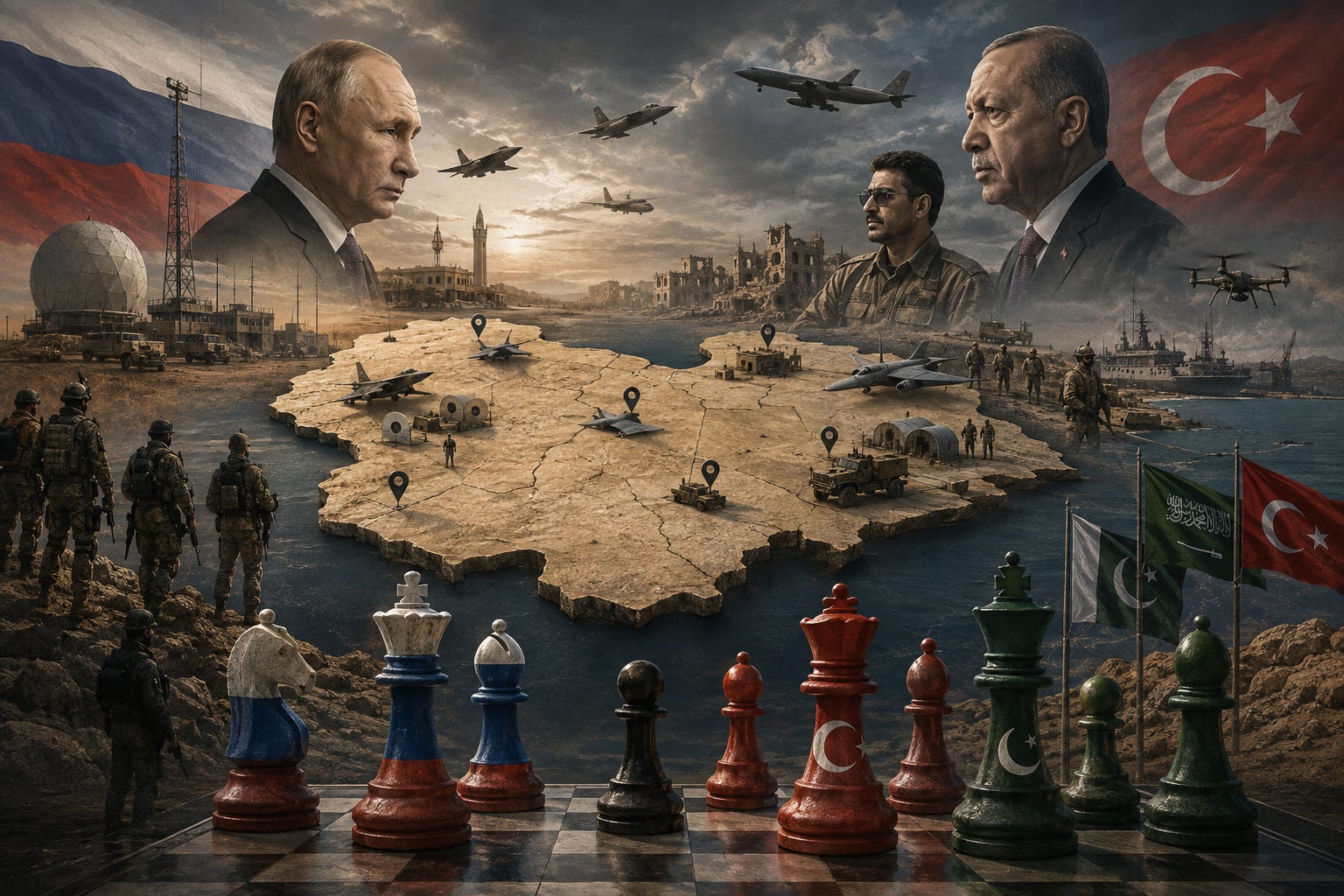
From Damascus to the Desert: Russia’s Libyan Pivot
Russia’s expansion across six Libyan air bases is beginning to reveal the architecture of Moscow’s post-Syria strategy, shaped by the erosion of the privileged military position it enjoyed under Bashar al-Assad and by a broader effort to connect the Mediterranean with Russia’s growing military relationships across Africa. Khmeimim Air Base and Tartus once gave Moscow an unusually permissive platform from which Russian forces could operate in the Levant, support naval activity in the Mediterranean, and sustain deployments farther south. Assad’s fall in December 2024 changed the political foundation of that arrangement, and the August 2026 agreement between Moscow and Damascus has now formalized a substantial reduction in Russian control. Syrian authorities are assuming responsibility for civilian facilities at Khmeimim and Tartus, while the remaining military installations are being reorganized as joint training centers rather than Russian-controlled expeditionary bases.
Moscow had already begun moving personnel, aircraft, and equipment toward Libya while negotiations over Syria continued. The resulting network encompasses Al-Khadim in eastern Libya, Al-Jufra in the center, Tamanhint and Brak al-Shati in the southwest, Maaten al-Sarra near the borders with Chad and Sudan, and Al-Qardabiyah around the Sirte corridor. The installations differ considerably in infrastructure, readiness, and operational purpose, so describing all six as equivalent Russian bases would overstate the degree of formal Russian control. Their collective significance is substantial because Russia is renovating runways, constructing support facilities, moving equipment, and establishing the logistical connections required to operate across them. The pattern suggests a transition from the concentrated expeditionary model developed in Syria toward a dispersed military network capable of supporting operations across North Africa, the Mediterranean, the Sahel, and Sudan.
Syria’s Political Risk Becomes Libya’s Strategic Opportunity
Russia’s Syrian intervention benefited from political conditions that are unlikely to be reproduced elsewhere. Assad depended heavily upon Russian military support after Moscow intervened directly in September 2015, which gave the Kremlin considerable freedom to develop Khmeimim, expand Tartus, deploy air defenses, station aircraft, and establish the logistical infrastructure necessary for a long-term military presence. Russia could conduct operations from Syrian territory while relying on a government whose survival had become intertwined with Russian protection, creating a degree of strategic predictability that made Syria exceptionally valuable.
The collapse of Assad’s government exposed the weakness inherent in that arrangement because political access depended upon the survival of a particular regime. Moscow did not lose every Syrian connection after December 2024, and its subsequent negotiations with Ahmed al-Sharaa’s government preserved a residual military relationship, yet the terms have changed fundamentally. The August 2026 agreement places civilian facilities under Syrian administration and converts the remaining Russian military installations into joint training and qualification centers. Moscow may retain personnel and influence, but it no longer enjoys the sovereign latitude that made Khmeimim an exceptionally useful Russian expeditionary base.
Libya offers Moscow an opportunity to distribute this political risk among several installations, geographical regions, local authorities, and operational relationships. Russia has spent years cultivating Khalifa Haftar and the Libyan National Army, while Wagner personnel established a physical presence during Libya’s civil war that survived the formal dismantling of much of Prigozhin’s organization. Africa Corps has inherited and expanded portions of this infrastructure, bringing personnel previously associated with an opaque mercenary system closer to direct Russian state control.
The timing therefore matters. Russia is not simply transferring an air base from Syria to Libya. It is applying lessons from the vulnerability of its Syrian position by constructing a network whose survival does not depend upon one installation, one host government, or one political agreement. Libya’s continuing institutional fragmentation, which has been disastrous for Libyan state formation, creates opportunities for an external actor capable of maintaining relationships with powerful substate authorities and embedding itself inside their security structures.
Six Bases, Different Functions
The geographical distribution of the six installations reveals considerably more than their individual capabilities. Al-Khadim, Al-Jufra, Al-Qardabiyah, Brak al-Shati, Tamanhint, and Maaten al-Sarra create a chain running from eastern Libya through the center of the country and into the deep south. This gives Moscow access to several distinct operational environments while allowing aircraft, personnel, weapons, fuel, spare parts, and intelligence assets to move between them.
Al-Khadim provides an eastern entry point within territory dominated by Haftar’s forces and is well positioned for connections with Benghazi and the eastern Mediterranean. Russian transport activity through eastern Libya allows Moscow to bring matériel into a relatively secure political environment without depending upon western Libyan institutions. Its usefulness also derives from its relationship to the broader Haftar-controlled infrastructure in Cyrenaica, where Russian personnel can operate with considerable protection from local authorities.
Al-Jufra performs a different role because its central location makes it one of the most valuable junctions in the network. From Jufra, movement can proceed north toward Sirte, east toward Haftar’s principal territories, southwest toward Fezzan, and farther south toward African routes. During the Wagner period, Jufra already served Russian and Russian-backed forces as an aviation and logistical facility. Continued development gives Moscow an inland hub capable of receiving matériel and redistributing it without concentrating everything on the Mediterranean coast.
Al-Qardabiyah and the Sirte corridor carry greater Mediterranean and political significance. Sirte lies close to the dividing line that has repeatedly separated eastern and western military spheres, while its location near Libya’s oil crescent gives any external military presence there an additional economic dimension. Control or influence around this corridor affects access between eastern and western Libya, approaches to major hydrocarbon infrastructure, and the central Mediterranean coast. Russian positioning in this area therefore intersects with Libya’s internal balance of power as well as Moscow’s regional objectives.
Brak al-Shati and Tamanhint extend the network into Fezzan, where the strategic map changes considerably. Southern Libya contains vast spaces, weak state institutions, smuggling routes, tribal networks, mineral interests, and connections toward Niger and Chad. Airfields there provide logistical reach that roads alone cannot offer, particularly when military personnel or specialized equipment need to move across large distances quickly.
Maaten al-Sarra carries perhaps the greatest long-term implications because of its location near Chad and Sudan. Rehabilitation of an isolated airfield in southeastern Libya makes limited sense if Russia’s primary objective remains influence over Tripoli or Benghazi. It becomes far more consequential when examined alongside Russian activities in Sudan and the Sahel. A functioning military airfield in this location can help bridge the enormous distance between Mediterranean supply routes and Russian partners farther south and east.
The six installations consequently create operational redundancy while giving each part of the network a geographical specialization. Russia can move assets inland when coastal exposure becomes problematic, reroute flights when one installation becomes politically sensitive, support Mediterranean operations from northern facilities, and sustain African activities through southern ones. The network can also expand incrementally, allowing Moscow to improve infrastructure according to emerging requirements without waiting for a comprehensive basing treaty with a unified Libyan government.
Libya Becomes the Russian Gateway to Africa
The African dimension explains why the Russian investment in southern Libyan airfields deserves greater attention than the headline question of whether Libya is replacing Syria. Russia’s military relationships across Mali, Burkina Faso, Niger, the Central African Republic, and Sudan require an increasingly sophisticated logistical structure. Governments may invite Russian advisers or Africa Corps personnel, but maintaining them requires aircraft, spare parts, weapons, communications equipment, maintenance crews, medical support, fuel arrangements, and regular personnel rotations.
For years, Syria contributed to the logistical bridge connecting Russia with African operations. The degradation of Russia’s privileged position there creates an incentive to establish routes that do not depend upon Syrian political consent. Libya is particularly useful because its geography points simultaneously toward the Mediterranean and the African interior. A transport aircraft arriving in eastern or central Libya can feed matériel into southern installations, after which personnel and equipment can move toward the Sahel or Sudan.
This arrangement also reduces some of the political exposure associated with direct flights from Russia into individual African states. Logistics can be distributed through intermediate facilities, equipment can be staged before onward deployment, and Africa Corps personnel can rotate through a regional hub. Libya becomes a rear area for multiple operations rather than another isolated Russian deployment.
That development fits the institutional transformation from Wagner to Africa Corps. Wagner combined military services, political consulting, information operations, resource extraction, personal relationships, and commercial concessions through a system centered heavily on Prigozhin. The Kremlin’s post-2023 restructuring has sought greater state supervision over those activities. A permanent network of military infrastructure supports that objective by giving the Russian Defense Ministry and military intelligence establishment physical assets through which personnel and resources can be organized.
Libya can consequently become the logistical spine of Russia’s African strategy. The value of this position will increase if Moscow expands security relationships in the Sahel, acquires additional mineral concessions, secures greater access in Sudan, or faces restrictions on alternative transport routes. Every additional Russian partnership south of Libya increases the utility of the Libyan network, while every improvement to that network lowers some of the logistical costs of maintaining those partnerships.
Haftar Gains Power and Acquires a Dangerous Dependency
For Khalifa Haftar and his family, the Russian expansion supplies military support while increasing their international relevance. The Libyan National Army has always depended upon external relationships, including ties with Egypt, the UAE, Russia, and at different moments France. Hosting a substantial Russian military network gives Haftar additional leverage because outside governments concerned about Moscow’s expansion cannot easily ignore the authorities controlling the territory where that expansion is occurring.
This dynamic is particularly important in Haftar’s dealings with Europe and the United States. Western policymakers may dislike his authoritarianism, his family’s growing control over eastern Libyan institutions, or his obstruction of national political processes, yet Russian entrenchment raises the potential cost of disengagement. Haftar can implicitly present himself as the gatekeeper whose cooperation is necessary to limit Moscow, even while his relationship with Moscow contributes to the problem.
Russia acquires leverage through the same process. Aircraft require maintenance, specialized systems require technicians, air-defense platforms require trained crews, and military supply relationships generate dependencies that become difficult to reverse quickly. As Russian infrastructure becomes embedded across LNA-controlled territory, Moscow gains relationships with commanders, security services, logistics officials, business networks, and members of the Haftar family.
Succession adds another dimension because Khalifa Haftar’s age makes the durability of his political system increasingly dependent upon the ability of his sons and allies to preserve their positions. Russia has incentives to cultivate this broader network rather than treating Haftar himself as the sole guarantor of access. Military infrastructure reinforces such relationships because it creates recurring interaction among Russian officers, Libyan commanders, local authorities, contractors, and security personnel.
The arrangement can therefore survive changes in individual leadership. Moscow’s objective is less dependent upon securing permanent loyalty from a single Libyan figure when it possesses physical installations, local military relationships, supply chains, and personnel already distributed across eastern and southern Libya.
A New Problem on NATO’s Southern Flank
The expansion also changes the military geography confronting NATO because Russian infrastructure is moving closer to the central Mediterranean while becoming more dispersed. Libya lies opposite Italy, Malta, and Greece, while the Sirte area is only several hundred miles from Sicily. Russian aircraft, surveillance systems, drones, electronic warfare equipment, and air defenses positioned in Libya would therefore operate within a region central to NATO maritime movements and European energy security.
The consequences become more significant during a wider confrontation between Russia and NATO. European defense planning already concentrates heavily on the Baltic region, Poland, the Black Sea, and the High North. A durable Russian military presence in Libya creates additional requirements to monitor southern approaches, protect Mediterranean shipping, track aircraft and naval movements, and assess Russian intelligence activities across North Africa.
Russian infrastructure in Libya can also support activities below the threshold of conventional conflict. The country contains migration routes, smuggling economies, oil infrastructure, competing militias, and political institutions whose decisions can have immediate consequences for southern Europe. Moscow does not need direct command over these systems to benefit from proximity, access, intelligence, and relationships with actors capable of influencing them.
Energy adds another source of potential leverage. Libya possesses Africa’s largest proven oil reserves and remains an important supplier to European markets. Russian political and military influence around eastern Libya and the oil crescent gives Moscow proximity to infrastructure whose disruption can affect prices and European supply calculations. The Kremlin has repeatedly treated energy, commercial relationships, political influence, intelligence activity, and military power as mutually reinforcing instruments, and Libya provides an unusually dense environment in which all of them intersect.
The Mediterranean and the Sahel Become One Theater
Russia’s emerging network exposes a weakness in the way Western governments frequently divide regional policy. Mediterranean security, Libya stabilization, migration, Sahel counterterrorism, Sudan, African mineral competition, and NATO’s southern flank are often handled through different bureaucratic channels. Russian military geography increasingly connects them.
An aircraft entering Libya from the Mediterranean can deliver personnel or equipment that eventually supports operations hundreds of miles south. A Russian relationship with an eastern Libyan commander can facilitate infrastructure used to sustain military partnerships in the Sahel. Access to southern Libyan airfields can improve Russia’s position toward Sudan. Security relationships can protect commercial interests, while commercial concessions can help finance or justify a continuing security presence.
The result is a corridor rather than a collection of unrelated deployments. Libya occupies the northern hinge of that corridor because it combines Mediterranean access with enormous territory extending toward the African interior. Mali, Burkina Faso, and Niger provide Moscow with political relationships farther south, while Sudan offers access toward the Red Sea and a separate set of military and commercial opportunities.
This geography also allows Russia to compensate for economic and military limitations. Moscow cannot match the aggregate economic resources of the United States and Europe across Africa, and the war in Ukraine has imposed major demands upon Russian military capacity. A network of strategically positioned bases, relationships with military governments, security assistance packages, resource concessions, and relatively small expeditionary forces can nevertheless generate influence disproportionate to the resources committed.
Libya is particularly valuable because infrastructure built for one purpose can serve several others. A runway supporting Africa Corps transport can also receive intelligence aircraft. A logistics facility supplying forces in the Sahel can support deployments elsewhere in Libya. Communications infrastructure built for military coordination can improve regional surveillance. Russia therefore gains cumulative value as the network becomes denser.
Turkey, Egypt, and the Gulf Enter the Equation
Russia’s expansion takes place inside a Libyan environment already shaped by Turkey, Egypt, the UAE, and other regional powers, making the six-base network part of a much larger competition over the country’s political and strategic orientation. Turkey retains military personnel and extensive security relationships in western Libya after its intervention helped prevent Haftar’s capture of Tripoli in 2019 and 2020. Ankara has also sought economic agreements, energy access, and political influence while maintaining contacts beyond its original western Libyan partners.
A larger Russian presence creates a complicated relationship between Moscow and Ankara because the two states have repeatedly combined competition with negotiated coexistence. Syria, the South Caucasus, and Libya have all demonstrated their ability to support opposing actors while maintaining direct channels designed to manage escalation. Russia’s shift toward Libya may make this relationship even more important as Turkey becomes one of the few regional powers with sufficient military presence, political access, and geographic proximity to constrain Russian expansion.
Egypt faces a different calculation. Cairo values stability in eastern Libya, maintains close relationships with Haftar’s camp, and regards the Libyan border as a major national security concern. Russian support for eastern Libyan forces can contribute to the security of authorities with whom Egypt cooperates, while a heavily entrenched Russian military presence introduces another external power immediately west of Egypt. Cairo consequently has reasons to tolerate portions of Moscow’s role while remaining wary of a permanent infrastructure network that could reduce Egyptian influence over eastern Libya.
The UAE has also cultivated Haftar and retains substantial interests in Libya and the wider Red Sea region. Russian expansion may overlap with Emirati preferences where both countries favor political actors hostile to Islamist movements and seek influence outside Western-led institutional frameworks. Their objectives are not identical, particularly as Abu Dhabi pursues its own relationships across Africa and seeks freedom to maneuver among Washington, Moscow, Beijing, and regional partners.
These overlapping relationships help explain why Russia may find Libya more politically resilient than Syria. Moscow does not require every regional actor to welcome its military expansion. It benefits when several influential governments prefer managing the Russian presence to confronting it directly, particularly when each government has separate interests tied to Haftar, energy, migration, counterterrorism, or Libya’s political future.
What Russia Is Building
The six-airfield expansion indicates that Russia is responding to the Syrian experience by changing the physical structure of its regional power projection. Khmeimim and Tartus offered extraordinary advantages while Assad remained in power, but their value rested upon a political arrangement that collapsed with his government. The new Syrian agreement allows Moscow to retain a foothold while depriving it of much of the freedom that made those facilities central to Russian expeditionary strategy.
Libya offers geography, fragmentation, local partners, Mediterranean access, African depth, and multiple installations that can perform complementary functions. Al-Khadim connects Russia with Haftar’s eastern stronghold, Al-Jufra provides an internal junction, Al-Qardabiyah places Moscow near Sirte and the central Mediterranean corridor, Brak al-Shati and Tamanhint extend the network into Fezzan, and Maaten al-Sarra pushes Russian military infrastructure toward Chad and Sudan. Their combined value comes from the connections among them and the strategic options those connections create.
This does not require Russia to abandon Syria completely. Moscow can retain training relationships and a reduced military footprint there while shifting functions that previously depended upon Syria into Libya. Such diversification makes Russian regional power less vulnerable to another sudden political rupture and gives Moscow several points from which to negotiate access.
The longer-term implication concerns Russia’s position in Africa. Libya can become the northern anchor of a military corridor reaching through the Sahel while simultaneously placing Russian assets on Europe’s Mediterranean flank. That combination links two strategic objectives Moscow has pursued for years: expanding influence in African states seeking alternatives to Western security partnerships and creating additional pressure points around Europe.
The six bases should therefore be read as infrastructure for a strategy whose geographical center is moving. Russia entered Syria in 2015 to demonstrate that it could rescue an allied government and return as a major Middle Eastern military power. A decade later, the Kremlin is adapting that expeditionary experience to a region extending from the Mediterranean coast into the African interior. Libya gives Moscow room to disperse its assets, cultivate several political relationships, connect separate theaters, and preserve options when individual governments become unreliable.
For Europe and the United States, the difficult question is how far that infrastructure will be allowed to mature before Russia’s Libyan presence becomes expensive to reverse. Runway repairs and transport flights attract less political attention than a formal naval-base treaty, while warehouses, communications facilities, defensive positions, maintenance infrastructure, and regular personnel rotations can gradually create the operational equivalent of permanent access. By the time the political implications become impossible to ignore, the physical and local foundations of the Russian presence may already be entrenched.
Russia’s departure from the privileged basing system it once enjoyed in Syria is consequently producing a broader strategic footprint rather than a simple retreat. Moscow has exchanged dependence on an allied regime for dependence on a network of relationships and installations whose geographical reach extends much farther into Africa. The success of that strategy remains contingent on Libyan politics, Haftar’s succession, Turkish and Egyptian calculations, Russian resources, and the willingness of Western governments to contest the expansion. Yet the direction is already visible across the six airfields: Russia is reorganizing its Mediterranean presence around Libya while building the infrastructure needed to make North Africa the logistical gateway to its ambitions across the continent.
Ankara Courts the Heir: Turkey’s Haftar Gambit
Russia’s expansion across Libya’s airfield network makes the country increasingly important to Moscow’s Mediterranean and African strategy, although infrastructure cannot guarantee durable access without the political relationships that protect it. This brings Turkey directly into the equation because Ankara remains Russia’s principal strategic competitor inside Libya while increasingly cultivating eastern Libya and, most significantly, Saddam Haftar, one of Khalifa Haftar’s most powerful sons and an increasingly important figure within the Libyan National Army. Turkey is consequently competing for influence inside the same political and military system upon which Russia’s emerging Libyan architecture depends, with implications extending to Moscow, the Haftar family, Tripoli, Egypt, the UAE, Europe, and Libya’s eventual political settlement.
Ankara Moves East
Turkey entered the most recent phase of Libya’s civil war as the decisive external military supporter of the internationally recognized authorities in Tripoli. Its 2019 security and maritime agreements with the Government of National Accord established the framework for direct Turkish intervention, while Turkish drones, military advisers, air-defense systems, intelligence support, and Syrian fighters helped stop Haftar’s offensive against Tripoli in 2020. The war consequently produced a relatively clear geographical distribution of external influence, with Turkey establishing the strongest foreign military position in western Libya while Russia, Egypt, and the UAE developed extensive relationships with Haftar’s eastern-based system.
That division has steadily become less useful to Ankara as Libya has moved from large-scale civil war toward prolonged political fragmentation. Turkish policymakers have expanded contacts with eastern Libyan institutions, parliamentarians, business networks, military officials, and members of the Haftar family while preserving Ankara’s extensive relationships in Tripoli and Misrata. Saddam Haftar has become especially important within this outreach because his expanding military responsibilities, control over significant economic and security interests, and growing international profile make him a plausible successor, power broker, or central figure in whatever arrangement follows Khalifa Haftar.
Turkey’s courtship of Saddam therefore reflects a judgment about where Libyan power may be moving. Khalifa Haftar’s age has made succession increasingly important, while Saddam and other members of the family have accumulated influence over military formations, economic institutions, reconstruction projects, border security, and foreign relationships. Ankara has little incentive to allow Moscow, Cairo, or Abu Dhabi to monopolize relationships with the generation likely to inherit much of this system, particularly when Turkey already possesses military and economic interests whose future depends upon developments across Libya rather than solely within the western region.
The outreach also addresses a structural weakness in Turkey’s original Libya strategy because the 2020 intervention secured western Libya without giving Ankara equivalent access to the east and south. Those regions contain much of Libya’s oil infrastructure, major military facilities, important borders, and the territory through which Russia is constructing its African logistical network. Establishing relationships with Saddam and the institutions surrounding him therefore allows Turkey to pursue influence across Libya while retaining the considerable advantages it already possesses in the west.
Saddam Haftar Becomes the Prize
Saddam’s interest in Turkey is equally understandable because his position becomes stronger when no external patron can claim exclusive influence over him. Russia provides military assistance, personnel, and strategic backing, Egypt offers geographical depth and longstanding connections with eastern Libyan institutions, and the UAE has supplied political, financial, and military support to the Haftar camp for years. Turkey offers another source of military expertise, defense technology, investment, diplomatic access, and commercial opportunity while retaining substantial influence among the western Libyan forces that defeated Khalifa Haftar’s Tripoli offensive.
Relations with Ankara can therefore strengthen Saddam’s position both inside the Haftar system and beyond eastern Libya. A figure capable of maintaining productive relationships with Russia, Egypt, the UAE, and Turkey can present himself as an autonomous Libyan actor rather than the client of one external sponsor, while simultaneously playing those relationships against one another when negotiating weapons, investment, political support, or recognition. Such diversification becomes particularly valuable during a succession process in which Saddam may need external backing without appearing dependent upon a single foreign government.
Turkey also offers Saddam access to political constituencies that Moscow cannot easily provide. Russian influence remains strongest within the eastern military establishment and through the infrastructure supporting Haftar’s forces, whereas Turkey maintains extensive relationships with officials, armed groups, businesses, and political networks in western Libya. Saddam’s ability to communicate through Ankara therefore gives him an indirect bridge toward actors who fought his father only six years ago, potentially helping him convert regional military power into a broader national political role.
This possibility has considerable implications for Libya’s eventual political settlement because Saddam could use Turkish engagement to reposition the Haftar family from an eastern military power into a participant with relationships across the country. Ankara, meanwhile, gains the possibility of influencing a future eastern leadership without surrendering its position in Tripoli, creating an arrangement in which both sides benefit from reducing the political baggage inherited from the 2019-2020 war.
Turkey Reaches Into Russia’s Libyan System
For Moscow, Turkey’s eastern opening creates a strategic problem precisely because Russia’s Libyan position depends upon political access as much as military infrastructure. Runways, hangars, warehouses, air-defense systems, and transport aircraft acquire strategic value only while the authorities controlling surrounding territory permit Russia to use them, and much of that access ultimately rests upon Moscow’s relationship with the Haftar family and the military establishment built around it.
Ankara can therefore weaken Russian leverage without attempting to remove Russian forces directly. If Turkey provides Saddam and the LNA with additional military training, technical support, investment, diplomatic connections, and alternative defense relationships, the Haftar system gains options that reduce the relative importance of Moscow. Russian influence has partly benefited from the difficulty eastern Libya would face in replacing specialized military capabilities, maintenance arrangements, logistical support, and external political protection, so every credible alternative supplier changes the bargaining relationship.
Turkey is unusually well equipped to become such an alternative because its defense industry can supply drones, armored vehicles, communications equipment, electronic systems, precision weapons, training, maintenance, and increasingly sophisticated aerospace technologies. Ankara can combine those capabilities with construction companies, infrastructure investment, trade, energy relationships, transportation links, and diplomatic engagement, giving it several avenues through which relationships with eastern Libya can become institutional rather than merely personal.
The resulting competition would differ substantially from the Russian-Turkish rivalry of 2019-2020. Moscow and Ankara previously supported opposing military camps separated by a front line, allowing each side to develop relationships within relatively distinct territorial spheres. If both powers cultivate Saddam and other senior figures within the LNA, their competition moves inside the same institutions, where Russian and Turkish officials can find themselves seeking influence over the same commanders, procurement decisions, infrastructure projects, political appointments, and foreign-policy choices.
This development becomes especially relevant to Russia’s six-base network because Turkish influence over the Haftar succession could eventually affect the political conditions under which Russian forces operate. Ankara does not need Saddam to order Russia out of Libya, which would be difficult and potentially destabilizing; it benefits if a future Haftar leadership becomes sufficiently diversified that Moscow can no longer assume privileged access or convert military dependence into political obedience.
Ankara Is Hedging Against Libya’s Succession
Khalifa Haftar’s eventual departure will create one of the most consequential transitions in post-2011 Libya because the system he has constructed combines formal military institutions, family control, tribal relationships, commercial networks, security organizations, patronage structures, and foreign sponsorship. Its durability will depend upon whether his sons and senior commanders can preserve enough of those relationships to prevent fragmentation while negotiating among themselves over authority, resources, and command.
Turkey has strong incentives to establish relationships before that transition occurs because waiting for a succession crisis would leave Ankara competing against Russia, Egypt, and the UAE after those states had already spent years cultivating the principal eastern actors. Engagement with Saddam gives Turkey access to information, military relationships, commercial networks, and personal channels that can become considerably more valuable if the internal distribution of power changes suddenly.
Ankara is simultaneously hedging against uncertainty in western Libya, where competing governments, armed formations, municipalities, business interests, and political networks continue to struggle over authority. Turkey possesses substantial military influence there, yet influence over a particular government does not necessarily guarantee influence over whatever political arrangement eventually emerges from negotiations, elections, elite bargains, or another period of instability. Relationships with eastern Libya therefore protect Turkish interests against political change on both sides of the country.
This creates a more flexible Turkish strategy in which Ankara can preserve military agreements and security relationships in the west while developing political, economic, and defense contacts in the east. Such positioning would make Turkey increasingly difficult to exclude from any national settlement because whichever coalition eventually dominates Libyan politics would probably contain actors with established Turkish relationships.
What This Means for Russia
Moscow is likely to manage Turkey’s engagement pragmatically while defending the parts of its Libyan presence it considers essential. Russia and Turkey have accumulated considerable experience combining rivalry with negotiation in Syria, the South Caucasus, the Black Sea, energy markets, and Libya, where both governments have generally preferred managed competition to direct military confrontation when their interests collide.
The threshold for Russian concern will depend upon how far Turkish engagement penetrates the security structure surrounding Russian access. Turkish business activity in Benghazi, diplomatic contacts with Saddam, or reconstruction contracts are unlikely to threaten Moscow directly, whereas Turkish influence over decisions involving Jufra, Al-Khadim, Brak al-Shati, Tamanhint, Maaten al-Sarra, or other installations supporting Russian movements toward Africa would affect a much more important strategic interest.
Moscow consequently has incentives to deepen relationships with Saddam itself while cultivating other members of the Haftar family and senior LNA commanders so that its access does not depend upon one successor. Russia can also accelerate infrastructure improvements, expand technical dependencies, and embed personnel more deeply within local military systems, increasing the political and operational costs that any future Libyan authority would incur by attempting to restrict Russian access.
Turkey’s involvement may nevertheless prevent Russia from achieving the degree of dominance over eastern Libya that Moscow might otherwise have expected. A Saddam Haftar capable of moving among Ankara, Moscow, Cairo, and Abu Dhabi would have greater bargaining power than a successor dependent primarily upon Russia and its traditional regional partners, making the future of Russian basing arrangements more negotiable and potentially more expensive.
What This Means for Turkey
For Ankara, engagement with Saddam offers an opportunity to convert its military success in western Libya into influence over the country as a whole. Turkey already possesses assets that other external powers struggle to replicate, including a formal military presence, substantial commercial interests, close relationships with western political and military actors, geographic proximity across the Mediterranean, and one of the region’s most capable defense industries.
An eastern opening could also protect Turkey’s maritime interests. Ankara’s agreement with Tripoli defining maritime jurisdictions in the eastern Mediterranean remains central to its regional strategy and has generated strong opposition from Greece and other actors. A future Libyan government containing powerful eastern figures could attempt to revise, reject, or renegotiate arrangements concluded by previous Tripoli governments, making relationships with the Haftar family potentially important to the durability of Turkey’s Mediterranean position.
Economic incentives reinforce the geopolitical ones because eastern Libya requires enormous reconstruction investment after years of conflict and the destruction caused by Storm Daniel in 2023. Turkish construction firms have extensive historical experience in Libya, and access to eastern projects could create commercial constituencies favoring stable relations with Ankara. Trade and reconstruction therefore provide Turkey with instruments of influence that complement military relationships while creating local interests invested in preserving the relationship.
The strategy carries risks because Ankara must cultivate Saddam without alienating its longstanding partners in western Libya. Political and military actors who fought Haftar may regard Turkish engagement with his son as opportunistic or threatening, particularly if they believe Ankara is preparing to sacrifice western interests for a national accommodation with the Haftar family. Turkey therefore has to broaden its eastern relationships while convincing Tripoli and Misrata that their own security arrangements remain intact.
What This Means for Egypt and the UAE
Egypt faces perhaps the most complicated regional calculation because eastern Libya has long formed part of Cairo’s immediate security environment. Egypt shares a lengthy border with Libya, has extensive relationships with the LNA, and has viewed Haftar as an important barrier against instability and hostile armed groups. A stronger Turkish relationship with Saddam introduces Ankara into a political-military environment where Cairo previously possessed substantial influence.
Egyptian concerns are magnified by the broader history of Turkish-Egyptian rivalry, although their bilateral relationship has improved considerably in recent years. Cairo may accept Turkish economic activity and political engagement in eastern Libya if it contributes to stability, while becoming considerably more cautious about Turkish military penetration of the LNA or permanent Turkish access to eastern facilities. Saddam can benefit from this sensitivity because the possibility of deeper Turkish cooperation gives him additional leverage when negotiating with Cairo.
The UAE faces a related problem because Abu Dhabi invested heavily in the Haftar project during the civil war and has maintained extensive relationships with the family and eastern Libyan institutions. Turkish rapprochement with the Haftars reduces the exclusivity of that relationship while creating possibilities for pragmatic Turkish-Emirati accommodation around reconstruction, investment, and economic projects.
Both Egypt and the UAE may ultimately prefer a diversified Haftar leadership to one excessively dependent upon Moscow. Russia’s six-base expansion creates strategic concerns extending beyond Libya, particularly if Russian military infrastructure becomes permanently integrated with operations across Africa. Turkey’s entry into eastern Libya can therefore function simultaneously as competition for Cairo and Abu Dhabi and as a partial counterweight to Russian dominance.
What This Means for Libya
For Libyan actors, competition among Russia, Turkey, Egypt, and the UAE creates opportunities for bargaining while increasing the danger that domestic institutions become even more closely tied to external patrons. Saddam can use Turkish engagement to reduce dependence on Moscow, while western Libyan actors can use Turkey’s continuing military presence to constrain the LNA. Each external relationship gives Libyan elites additional resources with which to negotiate against domestic rivals.
The emerging configuration could also alter the prospects for reunifying Libya’s military institutions. Turkey possesses strong relationships with western forces while Russia remains embedded with the LNA, so Turkish engagement with Saddam creates channels that did not exist during the height of the civil war. Defense contacts, training arrangements, and direct communication between Ankara and eastern commanders could eventually contribute to negotiations over military integration if the political environment permits them.
The same relationships can institutionalize division if external powers continue treating Libyan forces as competing client networks. Much will depend upon whether Saddam uses Turkish engagement to broaden his national political position or simply to accumulate another foreign patron, and whether Ankara seeks an integrated Libyan security structure or a durable sphere of influence extending from western Libya into selected eastern institutions.
Turkey’s courtship of Saddam Haftar therefore reaches far beyond an unexpected rapprochement between former battlefield enemies. Ankara is positioning itself inside the succession process that will determine the future of eastern Libya, Saddam is diversifying his external relationships before that succession is settled, and Russia is discovering that its expanding military infrastructure does not automatically translate into exclusive political influence over its host. Egypt and the UAE must adjust to a Haftar system with more foreign options, while western Libyan actors must decide how much Turkish engagement with their former adversaries they are prepared to tolerate. The competition surrounding Saddam may ultimately determine whether Russia’s six-base network becomes the foundation of a dominant Russian position in Libya or one component of a far more crowded strategic environment in which the Haftar family increasingly plays Moscow, Ankara, Cairo, and Abu Dhabi against one another.
Diplomacy Without Unity: Washington Returns to a Divided Libya
Turkey’s courtship of Saddam Haftar becomes still more consequential when placed alongside a second development: Washington is preparing to restore a permanent diplomatic presence in Libya after nearly fourteen years of operating principally from Tunis. The State Department notified Congress in July 2026 of plans to spend nearly $41 million on security measures associated with a phased resumption of embassy operations, while senior American officials have simultaneously intensified contacts with Abdulhamid Dbeibah’s government in Tripoli, Khalifa and Saddam Haftar in the east, the Central Bank, military officials from both camps, and other political actors. This diplomatic return is occurring without a corresponding reunification of Libya. Rival power centers remain intact, national elections remain elusive, armed formations continue to exercise autonomous power, and the Haftar system controls much of the east and south while Tripoli retains a separate political-security structure in the west. Washington is therefore returning physically to Libya while the political conditions that once justified keeping much American diplomacy offshore remain unresolved.
Diplomacy Without Unity: Washington Returns to a Divided Libya
The decision makes considerably more sense when viewed through the geopolitical developments surrounding Libya than when treated primarily as a vote of confidence in the UN political process. Russia is converting eastern and southern Libya into an increasingly important military corridor toward Africa, Turkey is expanding beyond its established western sphere by cultivating Saddam Haftar and other eastern actors, European governments remain concerned about migration and energy security, and Libya possesses Africa’s largest proven oil reserves at a moment when competition over energy infrastructure and strategic minerals has become inseparable from wider geopolitical competition. An American diplomatic presence in Tripoli gives Washington greater capacity to operate inside this environment rather than attempting to manage it through periodic visits from Tunis.
The absence of meaningful political unity may actually help explain the timing because American interests increasingly require simultaneous engagement with several Libyan power centers. A conventional diplomatic strategy built around recognizing one government and waiting for that government to extend effective authority across the country has produced diminishing returns. Dbeibah remains internationally recognized but cannot dictate political outcomes in Benghazi, Sirte, or Fezzan, while Haftar exercises substantial territorial and military power without possessing internationally recognized national authority. The Central Bank, National Oil Corporation, municipalities, militias, tribal actors, and separate security institutions retain varying degrees of autonomy, creating a political system in which formal recognition and actual power frequently diverge.
Washington’s recent diplomacy already reflects this reality. American officials have met Dbeibah in Tripoli while cultivating the Haftar family in Benghazi, and Secretary of State Marco Rubio’s June 2026 meeting with Saddam Haftar demonstrated that the younger Haftar is increasingly being treated as a consequential national interlocutor rather than simply the son of an eastern commander. Massad Boulos subsequently moved between western and eastern Libyan actors while promoting institutional unification, and American officials have supported dialogue involving economic, security, and political institutions. The pattern suggests that the United States is increasingly practicing a form of dual-track engagement resembling, in political terms, the hedging strategy Turkey has begun pursuing geographically.
Washington Is Returning to the Libya That Exists
The American approach appears to recognize that waiting for Libya to reunify before establishing a serious diplomatic presence would allow other powers to shape the political environment in the meantime. Russia did not wait for elections before establishing military infrastructure. Turkey did not wait for a unified government before signing security agreements, deploying forces, protecting its maritime claims, and later cultivating eastern Libya. Egypt and the UAE have spent years developing relationships with eastern institutions, while Italy has maintained extensive interests involving energy and migration.
An American policy conditioned upon the completion of Libya’s political transition would consequently operate on a timetable largely determined by actors with incentives to delay that transition. Libya has spent more than a decade moving through transitional governments, temporary arrangements, failed electoral timetables, competing legislatures, UN roadmaps, ceasefires, and elite bargains. Political actors who derive authority and economic benefits from the current system frequently have limited incentives to subject themselves to elections capable of removing them.
A restored diplomatic presence gives Washington a better ability to understand these relationships at close range and to maintain sustained contact with the officials, commanders, business figures, technocrats, and local actors who influence decisions. Libya is particularly difficult to analyze through episodic diplomatic visits because formal institutions reveal only part of the distribution of power. Personal relationships, militia affiliations, family networks, commercial interests, municipal politics, and foreign sponsorship frequently determine whether an agreement signed at the national level can actually be implemented.
Physical presence also carries symbolic weight. The United States withdrew its embassy personnel in 2014 as Libya descended into renewed civil war, and the memory of the 2012 Benghazi attack inevitably shaped subsequent American risk calculations. Returning personnel therefore communicates that Washington intends to treat Libya as an arena requiring sustained political engagement rather than as a security problem managed primarily from outside the country.
Russia Changes the American Calculation
Russia provides the strongest strategic explanation for why that engagement has become more urgent. Moscow’s six-airfield network is developing precisely in areas where the internationally recognized Tripoli government exercises little meaningful authority, which severely limits what American diplomacy conducted exclusively through western Libyan institutions can accomplish. Asking Dbeibah’s government to constrain Russian activity at Maaten al-Sarra, Jufra, Brak al-Shati, Tamanhint, or Al-Khadim has limited utility when the political and military decisions governing those facilities are made inside the Haftar system.
Washington therefore needs access to the same eastern actors Moscow is cultivating, which helps explain the growing American engagement with Saddam Haftar. The United States can pressure the Haftar family over Russian access, offer security cooperation, encourage military integration, facilitate economic relationships, and increase Saddam’s international options. Each of these activities potentially reduces the degree to which the Haftar system depends upon Moscow.
The approach resembles the strategic effect of Turkey’s eastern opening even when American and Turkish objectives differ. Turkey gives Saddam an alternative military, commercial, and diplomatic partner, while Washington can provide international legitimacy, access to American institutions and businesses, security cooperation, and a relationship with the power that remains central to the international financial system surrounding Libya’s oil economy. Saddam’s ability to diversify away from Russia increases when Ankara and Washington are both willing to deal with him.
American support for military unification becomes particularly important in this context. The participation of eastern and western Libyan forces in Flintlock 2026 demonstrated an American effort to create professional relationships across the military divide. A genuinely integrated Libyan military would make Russia’s current arrangements more complicated because Moscow benefits from a fragmented command structure in which access can be negotiated directly with the Haftar camp. If military facilities eventually become subject to national command arrangements, decisions concerning foreign forces and basing would become harder for any regional commander to make independently.
The obstacle is that military integration cannot simply be declared through exercises or diplomatic agreements. Haftar’s power depends heavily upon control over an autonomous military structure, while western armed groups have their own reasons to resist subordination to a national command potentially influenced by the Haftar family. Washington may therefore be pursuing incremental integration through training, professional contacts, border-security cooperation, and joint exercises because a comprehensive military settlement remains politically remote.
The Saddam Haftar Question Becomes More Complicated
American engagement also changes the significance of Turkey’s relationship with Saddam because Ankara and Washington now have overlapping reasons to prevent Moscow from acquiring excessive leverage over the probable Haftar succession. Neither needs Saddam to become conventionally pro-American or pro-Turkish. Both benefit if he remains sufficiently diversified that Russia cannot treat eastern Libya as an uncontested strategic platform.
Reports surrounding American diplomacy have even suggested proposals that could give Saddam a major role within national institutions, including discussion of a possible position at the head of the Presidential Council. Such an arrangement would be enormously controversial, particularly in Misrata and among western Libyan constituencies that fought Haftar’s 2019-2020 offensive. It would nevertheless fit a strategic calculation in which Washington seeks to bring the Haftar system inside national institutions rather than leaving it outside them with its military infrastructure and Russian patronage intact.
The danger is that incorporating Saddam through an elite bargain could institutionalize the existing distribution of power rather than resolve it. Dbeibah and the Haftar family could gain national legitimacy through a negotiated arrangement while remaining insulated from electoral accountability, leaving many Libyans with the impression that foreign powers had simply divided the state among entrenched elites. Resistance to such an arrangement would be particularly strong among constituencies demanding elections and among armed groups that fear losing influence under a national settlement favoring the two dominant families.
Washington therefore faces a difficult problem in determining whether institutional unification is producing a state or merely consolidating an elite cartel. A unified budget, coordinated economic institutions, military dialogue, and agreements between eastern and western leaders can reduce immediate instability, yet they can also distribute resources among existing power holders without addressing the political legitimacy crisis that has persisted since the collapse of the planned 2021 elections.
America and Turkey Are Beginning to Converge
The emerging American and Turkish strategies possess an important area of convergence because both governments are broadening engagement across Libya’s internal divide while Russia remains much more structurally dependent upon the east. Turkey retains its strongest military position in western Libya but is cultivating Saddam and eastern institutions, while Washington retains formal diplomatic relations with the Tripoli government but is increasingly treating the Haftar family as indispensable to security, economic, and political negotiations.
This creates the possibility of an informal balancing arrangement in which Ankara and Washington compete over some Libyan questions while sharing an interest in preventing Russian consolidation. Turkey possesses military assets, commercial networks, geographical proximity, defense technology, and relationships with western armed groups. The United States possesses diplomatic weight, financial influence, security relationships, sanctions authority, and considerable influence over the international environment in which Libya sells oil and manages state revenues.
Saddam becomes particularly important because he sits at the intersection of these strategies. Moscow needs the Haftar system to preserve its bases and African logistical corridor, Ankara wants access to eastern Libya and protection against a post-Haftar political realignment, and Washington needs an eastern interlocutor capable of affecting Russian military access and participating in any national institutional arrangement. Saddam can extract benefits from all three relationships while avoiding an exclusive commitment to any of them.
That competition may gradually make eastern Libya less hospitable to Russian dominance even if Russian forces remain. Moscow could find itself paying more politically and materially to preserve privileges that once depended primarily upon its relationship with Khalifa Haftar, particularly if Saddam concludes that Russian military support is most valuable when balanced against Turkish, American, Egyptian, and Emirati alternatives.
The Embassy Is Also About Oil
The economic dimension of the American return is inseparable from this strategic competition because Libya possesses enormous energy resources whose production has repeatedly been disrupted by political struggles. American officials have recently emphasized energy investment and opportunities for U.S. companies while Libya has moved forward with its first major oil licensing efforts in years. A permanent diplomatic presence can support American firms, facilitate negotiations, monitor political risks, and strengthen relationships with the National Oil Corporation and other institutions responsible for an industry upon which the Libyan state remains overwhelmingly dependent.
Oil also provides one of the few structures linking the divided country because eastern forces control territory containing important production and export infrastructure while revenues continue to pass through national institutions. Disputes over budgets, spending, appointments, and distribution of oil income consequently connect military power with economic governance. Washington’s interest in unified economic arrangements reflects an understanding that political stabilization is unlikely while rival elites can repeatedly weaponize oil production and public spending against one another.
Russia’s presence gives these questions additional geopolitical significance. Moscow does not need formal ownership of Libyan oilfields to benefit strategically from proximity to the oil crescent and relationships with actors capable of affecting production. The possibility that Russian influence could intersect with energy disruptions gives Washington and European governments another reason to prevent eastern Libya from becoming excessively dependent upon Moscow.
American commercial engagement can provide alternative incentives. If eastern Libyan authorities expect investment, reconstruction contracts, energy partnerships, and access to Western markets, they acquire economic reasons to preserve workable relationships with Washington. Such incentives are unlikely to remove Russian forces by themselves, but they broaden the cost-benefit calculation confronting Libyan actors deciding how much strategic access to grant Moscow.
Europe Cannot Treat the American Return as a Substitute for Its Own Strategy
A stronger American presence also affects European governments that have spent years managing Libya primarily through concerns over migration, energy, and Mediterranean security. Italy possesses particularly extensive energy and migration interests, while France has cultivated relationships across the Libyan divide and Greece remains intensely concerned about Turkish-Libyan maritime agreements. These interests have frequently produced fragmented European policies that external actors can exploit.
Washington’s return could provide greater coordination on Russia, military unification, energy security, and political negotiations, although European governments cannot assume that American priorities will reproduce their own. The United States appears increasingly interested in strategic competition, investment, security cooperation, and preventing Russia from consolidating its African corridor. European governments face additional domestic political pressures involving migration and maritime boundaries that can lead them toward different Libyan partners.
The result could nevertheless be a more crowded balancing environment around the Haftar system. Russia, Turkey, the United States, Egypt, the UAE, Italy, and other European actors all possess reasons to cultivate eastern Libya, which gives the Haftar family extraordinary opportunities to diversify relationships. External competition may reduce Moscow’s ability to dominate the east while simultaneously increasing the incentives for Libyan elites to postpone political consolidation and continue extracting resources from competing patrons.
Presence Is Not a Political Settlement
The American return therefore should not be interpreted as evidence that Washington believes Libya is approaching unity. The more revealing interpretation is that the United States appears increasingly unwilling to wait for unity before competing for influence. A diplomatic presence provides the relationships, information, commercial access, and political reach necessary to operate in a country whose fragmentation has itself become part of the geopolitical competition.
That choice contains an unavoidable tension because Washington is simultaneously promoting institutional unification and adapting its diplomacy to the persistence of institutional division. American officials can work with Dbeibah, engage Saddam Haftar, encourage joint military activity, support Central Bank reforms, promote oil investment, and oppose Russian expansion without resolving the question of who legitimately governs Libya. These policies may stabilize particular relationships while leaving the constitutional and electoral crisis unresolved.
The greatest risk is that geopolitical urgency gradually displaces political transition. If containing Russia requires cooperation with the Haftar family, protecting investment requires accommodation with Dbeibah, and maintaining stability requires preserving existing security arrangements, elections can continually move farther into the future. Washington could then help create a more unified administrative system without producing a more legitimate political system, particularly if unification becomes synonymous with agreements among the elites already controlling Libya’s principal institutions.
The strategic case for returning American officials is nevertheless increasingly powerful because absence has consequences of its own. Russia has used the intervening years to establish military infrastructure stretching from the Mediterranean toward the Sahel, Turkey has entrenched itself militarily in the west and is now reaching east, and the Haftar family has accumulated enough territorial and institutional power to become unavoidable in national diplomacy. Managing those developments from Tunis leaves Washington reacting to relationships that other powers are building inside Libya.
The emerging American approach therefore reflects the same underlying reality that has driven Turkey toward Saddam Haftar and Russia toward a distributed basing network. Libya’s continuing division has ceased to be merely an obstacle awaiting resolution and has become part of the strategic environment through which outside powers pursue their interests. Washington is returning because the competition over Libya is advancing faster than Libyan reunification, and the United States risks surrendering influence if it makes one contingent upon the other. Whether that presence eventually helps create functioning national institutions will depend on how Washington handles the central contradiction of its new position: it needs the cooperation of the very power structures whose continued autonomy has prevented Libya from becoming the unified state American diplomacy officially seeks to build.
The Migration Switchboard: Can Washington Close Libya’s Back Door?
Washington’s return therefore raises a harder question than whether additional diplomats can compete with Russia for influence over the Haftar family or encourage another round of institutional negotiations. Libya is also one of the principal junctions connecting migration from the Sahel, Sudan, the Horn of Africa, and parts of the Middle East with Mediterranean routes into Europe, while the same fragmented security system that facilitates foreign military penetration also sustains trafficking, smuggling, detention, extortion, and illicit trade. More than 900,000 foreign migrants were estimated to be present in Libya during 2026, and migration routes pass through areas containing Russian military infrastructure, Haftar-controlled security forces, western militias, Turkish-supported institutions, and criminal networks whose relationships frequently overlap. An expanded American presence could give Washington greater capacity to monitor and disrupt deliberate manipulation of these flows, although it could also draw the United States more deeply into the transactional political economy that has allowed migration control itself to become a lucrative source of patronage.
The Migration Switchboard: Can Washington Close Libya’s Back Door?
The possibility of weaponized migration has to be understood carefully because large migrant flows do not require a foreign government to manufacture migration from the beginning. Sudan’s war, insecurity across the Sahel, economic collapse, persecution, demographic pressures, and established smuggling networks already generate large populations seeking safety or economic opportunity. Weaponization occurs when a state or politically connected actor deliberately facilitates, redirects, accelerates, obstructs, or threatens to release existing movements in order to obtain political concessions or create pressure on another government.
Libya provides unusually favorable conditions for this form of coercion because migration can be manipulated at several points along the route. Border authorities can permit or restrict entry from Sudan, Chad, or Niger; armed groups can determine which smuggling corridors remain open; detention facilities can hold or release migrants; coastal forces can intercept boats or allow departures; criminal organizations can adjust prices and routes; and political authorities can use cooperation with Europe as a bargaining instrument. Control over migration therefore does not require command over every migrant or smuggler. It requires sufficient influence over enough chokepoints to alter the volume, timing, direction, or political visibility of flows.
Russia’s expanding presence creates concern precisely because several of its southern Libyan positions overlap geographically with the corridors through which migrants and commercial traffic move north. Brak al-Shati and Tamanhint sit in Fezzan, while Maaten al-Sarra extends Russian-linked infrastructure toward Chad and Sudan. These locations have military value for Russia’s Africa Corps supply system, but they also provide proximity to the human and commercial networks connecting conflicts south of Libya with Mediterranean routes.
Russian personnel do not need to become migrant smugglers for Moscow to derive coercive leverage from this environment. Intelligence about routes, relationships with security commanders, influence over local authorities, access to transportation infrastructure, and connections with armed actors can provide information about how migration systems function and where they can be influenced. Russia’s experience with Belarus has already demonstrated Moscow’s familiarity with migration pressure as an instrument within a broader confrontation with Europe, making European concerns about similar opportunities in Libya difficult to dismiss.
Russia Does Not Need to Put Migrants on Boats
The most consequential Russian option would probably involve indirect manipulation rather than an easily attributable operation in which Russian personnel openly organize departures. Moscow could encourage local partners to relax enforcement along particular routes, provide political protection to actors involved in smuggling, interfere with rival border-security initiatives, exploit instability farther south, or simply threaten European governments with the consequences of losing Russian cooperation over migration.
This distinction matters because deniability substantially increases the instrument’s usefulness. A sudden increase in departures from Libya could result from conflict in Sudan, economic deterioration, seasonal conditions, changes in smuggling markets, Libyan militia competition, altered European enforcement, or deliberate political manipulation. Establishing causation would therefore be difficult, particularly when the relevant decisions are made by Libyan intermediaries rather than Russian officials.
Russia could also exploit migration politically without significantly altering the number of people crossing the Mediterranean. Information operations can amplify images of arrivals, exaggerate the scale of particular movements, target political constituencies already divided over migration, and portray European governments as incapable of controlling their borders. The political effect of migration depends partly upon perception, which means a relatively limited operational intervention can produce disproportionate consequences when combined with sophisticated information activity.
The Kremlin would have several possible objectives. Migration pressure could complicate European support for Ukraine by strengthening political parties hostile to continued assistance, create disputes among EU members over border policy and burden sharing, increase pressure on Italy and Greece, or provide bargaining leverage over sanctions and Russian activities elsewhere in Africa. Libya would give Moscow another potential pressure point along Europe’s southern perimeter while its Belarus relationship maintains pressure farther east.
Russia’s Libyan infrastructure consequently creates a capability that should concern Washington even if there is no evidence that the six air bases themselves are being used to organize migration. The significance lies in the combination of military access, political relationships, intelligence opportunities, and geographical proximity to networks that can affect European domestic stability.
Turkey Holds a Different Kind of Migration Leverage
Turkey’s position is structurally different because Ankara already possesses extensive experience using migration management as an element of negotiation with Europe. Turkey hosts millions of refugees and migrants and has repeatedly negotiated financial assistance, political concessions, visa-related issues, and border cooperation with the EU. Turkish leaders have periodically warned European governments about the consequences of withdrawing cooperation, giving migration an established place within Ankara’s relationship with Brussels.
Libya potentially adds another dimension to this leverage. Turkey maintains military influence in western Libya, relationships with security institutions around Tripoli, and growing connections with eastern actors including Saddam Haftar. If Ankara becomes one of the few foreign governments capable of communicating effectively with major power centers on both sides of Libya, it could acquire substantial influence over the institutions Europe relies upon to contain Mediterranean migration.
That influence does not mean Turkey would necessarily seek to generate a migration crisis. Ankara has strong interests in Libyan stability, commercial expansion, maritime agreements, energy access, and political influence that could be damaged by uncontrolled disorder. Migration nevertheless becomes another negotiable asset when European governments depend upon Turkish relationships to keep routes under control.
The implications become more important as the EU explores cooperation with eastern Libyan authorities on maritime surveillance and search-and-rescue capacity. Europe has historically concentrated migration cooperation around western Libyan institutions, including the Libyan Coast Guard, while the growing importance of Haftar-controlled territory has encouraged greater engagement with the east. Turkey’s rapprochement with Saddam gives Ankara potential influence within both systems.
Turkey could therefore become an intermediary that Europe increasingly needs in order to coordinate migration policy across divided Libyan institutions. Such a role would reinforce Ankara’s broader effort to make itself indispensable to European security while giving President Recep Tayyip Erdoğan another subject that can be incorporated into negotiations over defense cooperation, trade, customs arrangements, visas, eastern Mediterranean disputes, or relations with the EU.
The Middle Eastern Route Deserves More Attention
Libya’s migration geography also has implications extending toward the Middle East because the country is connected to Egypt, Sudan, the Sahel, and Mediterranean transportation networks through which people, weapons, commodities, and illicit finance circulate simultaneously. Sudanese displacement has already transformed the composition of Libya’s migrant population, while continuing instability in Sudan can push additional people northward through areas where Haftar’s forces, Russian personnel, tribal networks, and smugglers operate.
Movement toward the Middle East can follow different channels, particularly through Egypt and the eastern Mediterranean, while trafficking networks frequently adapt to enforcement pressure by redirecting routes rather than abandoning them. A system capable of moving people clandestinely across the Sahara can also support movements of weapons, sanctioned commodities, fighters, cash, and other illicit cargo, which makes migration security inseparable from broader questions of border governance.
Russia’s growing involvement in Sudan further complicates this environment. Moscow’s relationships with Sudanese actors, its interests around the Red Sea, and the alleged use of eastern Libya as a conduit for support into Sudan create a geographical chain extending from the Mediterranean through Libya toward Sudan. The same transport infrastructure can serve very different purposes depending upon who controls it and what is being moved.
For Washington, migration therefore cannot be treated solely as an Italian or European border-management problem. It intersects with Sudan policy, Sahel security, sanctions enforcement, arms trafficking, terrorism, organized crime, Russian military expansion, and the stability of North African states that are themselves under economic and demographic pressure.
Can an American Presence Actually Constrain This?
A permanent American diplomatic presence can improve Washington’s ability to understand and influence these systems because officials operating inside Libya can maintain relationships with border authorities, security commanders, municipalities, international organizations, intelligence services, and political figures on a more continuous basis. They can also coordinate more effectively with AFRICOM, European partners, UN agencies, and American law-enforcement and intelligence institutions examining trafficking and sanctions violations.
The United States possesses additional leverage through security assistance, sanctions, financial intelligence, access to the dollar system, military cooperation, and diplomatic relationships with Libya’s principal foreign patrons. These instruments can target individuals or organizations profiting from trafficking while creating incentives for Libyan institutions to improve border management.
American engagement with both eastern and western military structures could be particularly useful if Washington links security cooperation to measurable behavior. Training, equipment, intelligence sharing, participation in exercises, and international recognition provide incentives that can be conditioned upon action against trafficking organizations, greater transparency over detention facilities, and cooperation against transnational criminal networks.
The difficulty is that many of the institutions Washington would need as partners are themselves embedded in Libya’s illicit political economy. The State Department has reported extensive allegations of official complicity in trafficking involving members of security institutions, armed groups, immigration authorities, and elements associated with the Libyan Coast Guard. Migrants can be intercepted at sea, returned to detention, extorted, exploited, and in some cases recycled through the same networks that profit from their attempted journeys.
Washington therefore faces a familiar Libyan dilemma in which the institutions capable of controlling the problem may simultaneously derive resources from perpetuating portions of it.
Migration Control Is Already a Business
Europe’s experience illustrates the danger because external funding intended to control migration can increase the value of controlling migrants. Once governments, security forces, militias, detention operators, contractors, and intermediaries discover that Europe will provide money, equipment, training, or political recognition in exchange for reducing departures, migration acquires a price within the political economy.
An armed group can profit from facilitating migration, profit again from intercepting migrants, receive external resources for preventing migration, and use its resulting political importance to negotiate additional benefits. The same individual or network can therefore occupy several positions within what appears externally to be a border-security system.
This creates a perverse incentive for instability to persist at a manageable level. Completely eliminating smuggling would eliminate part of the justification for continued foreign funding, while allowing migration to become completely uncontrolled could provoke sanctions or foreign intervention. A system that periodically produces crises and then demonstrates its ability to contain them can maximize both domestic rents and international leverage.
American money entering this environment could reproduce some of these incentives if it is distributed primarily through existing power brokers. Security contracts, infrastructure projects, border technology, reconstruction agreements, logistics arrangements, and energy deals all create opportunities for politically connected intermediaries to profit from Washington’s renewed attention.
The problem becomes particularly acute if geopolitical competition encourages American officials to prioritize access over accountability. If Washington urgently needs Saddam Haftar to constrain Russia, it becomes more difficult to threaten the Haftar system over corruption or trafficking allegations. If the United States needs Dbeibah to facilitate embassy operations and commercial agreements in Tripoli, pressure over western militia abuses becomes more complicated. Strategic dependency can therefore weaken the conditionality Washington would need to prevent assistance from reinforcing corrupt networks.
The Risk of a Libyan Marketplace for Foreign Influence
The return of multiple foreign powers is creating a political marketplace in which Libyan elites can sell access to several governments simultaneously. Russia seeks military bases and African logistics, Turkey seeks strategic depth, commercial opportunities, and protection of its Mediterranean agreements, Europe seeks migration control and energy security, while the United States seeks to limit Russian influence, promote investment, and encourage institutional consolidation.
Each foreign priority creates something a Libyan actor can monetize. Airfield access can be exchanged for military assistance, migration enforcement for European funding, reconstruction contracts for political relationships, oil concessions for diplomatic support, and participation in unification initiatives for international legitimacy.
Saddam Haftar is particularly well positioned within this system because he can offer different things to different partners. Moscow values territorial and military access, Ankara values eastern political relationships and commercial opportunities, Washington values leverage over Russia and participation in national security arrangements, while European governments value stability and migration control. Saddam does not need to choose among these patrons when greater benefits can be extracted by maintaining relationships with all of them.
Western Libya contains similar incentives. Political leaders and armed groups can offer security cooperation, embassy protection, energy access, migration enforcement, and political support while competing over the foreign resources attached to each function. Increased American engagement can therefore enlarge the pool of resources available to the existing patronage system unless Washington structures its presence carefully.
Private Deals Could Become the Hidden Center of the Competition
The commercial dimension deserves particular scrutiny because the geopolitical opening coincides with renewed international interest in Libyan oil, infrastructure, reconstruction, aviation, telecommunications, border technology, and defense cooperation. Libya requires enormous investment after fifteen years of conflict and institutional deterioration, creating legitimate opportunities for foreign companies while simultaneously generating ideal conditions for opaque contracting.
Eastern Libya already demonstrates how reconstruction can become intertwined with family power. Institutions connected to the Haftar system control major development expenditures, while questions persist regarding transparency, procurement, oil exports, and the relationship between public resources and politically connected commercial entities. Western Libya has its own networks connecting ministries, armed groups, state companies, contractors, and political patrons.
An American diplomatic presence can improve due diligence by giving companies and officials better information about local partners, ownership structures, sanctions exposure, and political risk. It can also produce the opposite effect if diplomatic engagement becomes a mechanism through which politically connected Libyan actors acquire introductions to American investors and legitimacy for deals that remain difficult to scrutinize.
The distinction will depend upon transparency. Contracts involving public resources, oil revenues, border infrastructure, security equipment, or strategic assets require disclosure of beneficial ownership, competitive procurement, financing arrangements, and relationships with armed actors if Washington wants commercial engagement to reduce rather than reproduce Libya’s patronage economy.
This becomes especially important when commercial agreements overlap with geopolitical objectives. A company linked to a powerful Libyan family may simultaneously control construction contracts, logistics infrastructure, energy interests, and relationships with security forces. Supporting a deal with such an entity because it helps pull that family away from Russia may achieve an immediate strategic objective while strengthening a domestic monopoly that makes eventual institutional reform more difficult.
Washington Could Disrupt the System or Join It
The American return consequently presents two very different possibilities. A sustained U.S. presence could improve intelligence collection, expose trafficking networks, coordinate sanctions, diversify eastern Libya away from Russia, strengthen professional security institutions, encourage transparent investment, and give Washington enough political access to challenge deliberate manipulation of migration before it becomes a major European crisis.
The same presence could become another layer within Libya’s transactional system if access to political elites becomes the principal measure of diplomatic success. Meetings, contracts, military exercises, reconstruction announcements, and energy agreements can generate an appearance of progress while the underlying networks controlling migration, public spending, smuggling, and armed power remain intact.
Preventing weaponized migration therefore requires more than persuading Russia or Turkey not to manipulate flows. Washington would need to reduce the ability of any actor, Libyan or foreign, to turn control over human movement into political or financial leverage. That requires transparent border-security funding, scrutiny of detention systems, financial investigations into trafficking networks, sanctions against officials participating in exploitation, and greater visibility into the companies receiving contracts associated with migration management.
It also requires treating Russian and Turkish influence differently according to their actual behavior rather than assuming that every foreign presence creates identical risks. Russia’s military expansion and experience with coercive pressure against Europe warrant close scrutiny, while Turkey’s established migration bargaining with the EU creates a different form of leverage rooted in formal and informal cooperation. Libyan actors themselves remain capable of manipulating departures and enforcement for money or political advantage regardless of what Moscow or Ankara wants.
The central test for Washington will therefore be whether its return changes the incentives governing Libya’s fragmented political economy. If American engagement makes trafficking more expensive, foreign military manipulation more detectable, procurement more transparent, and political actors less dependent upon Russia or any other single patron, the renewed presence could reduce Libya’s usefulness as a platform for migration coercion. If Washington instead competes for access by distributing security assistance, diplomatic recognition, and commercial opportunities through the same opaque networks that Russia, Turkey, European states, and regional powers already cultivate, American officials may find themselves participating in the marketplace they intended to regulate.
Libya’s geopolitical importance is increasing precisely because military bases, migration routes, oil infrastructure, reconstruction money, smuggling corridors, and political succession now intersect in the same territory. The six Russian airfields, Turkey’s courtship of Saddam Haftar, and Washington’s diplomatic return are therefore connected developments within a struggle over who can influence the networks linking the Mediterranean with Africa. An American flag over a reopened diplomatic compound will provide Washington with greater access to that struggle, while its strategic value will depend on whether the United States uses that access to constrain Libya’s political marketplace or simply becomes its newest and wealthiest customer.
Can a Divided Libya Join the Mecca Pact?
The American return to Libya, Russia’s expansion across six airfields, and Turkey’s courtship of Saddam Haftar are unfolding just as the regional security architecture around Libya is changing. The August 7 Mecca Joint Defense Agreement among Saudi Arabia, Turkey, and Pakistan establishes a collective-defense commitment under which an armed attack against one member is treated as an attack against all three, while Turkish and Pakistani officials have explicitly left the arrangement open to additional regional participants. Egypt has emerged as the most frequently discussed prospective member, and Ankara has described Cairo as a natural partner whose accession would dramatically extend the pact’s geographical reach. If Egypt eventually joins, Libya would find itself bordered and politically penetrated by states associated with the new arrangement while Turkey already maintains forces in western Libya and is developing relationships with the Haftar establishment in the east. That raises an unusual question: could Libya itself eventually enter the Mecca framework when there is still no Libyan state capable of credibly making such a commitment?
Libya Has a Membership Problem Before It Has an Alliance Problem
Any discussion of Libyan accession immediately encounters the problem of sovereign authority because a collective-defense agreement assumes that the signatory government can make binding commitments on behalf of a state, determine when that state has been attacked, authorize military assistance, coordinate armed forces with allies, and fulfill reciprocal obligations if another member is attacked. Libya currently lacks a political structure capable of performing all of those functions without substantial domestic contestation.
A decision by authorities in Tripoli to join the Mecca Pact would almost certainly be challenged by eastern institutions if they had not consented, particularly because membership could create obligations affecting military deployments, airspace, bases, defense procurement, intelligence cooperation, and relationships with foreign forces. An accession announced from Benghazi would face the reverse problem because the Haftar establishment possesses extensive territorial and military power without internationally recognized authority to commit the Libyan state to a collective-defense treaty.
This makes formal accession by “part of Libya” legally and diplomatically difficult. The Mecca Pact is an interstate agreement, and admitting the Government of National Unity, the House of Representatives, the LNA, or another Libyan institution as though it represented a separate state would carry implications for Libya’s sovereignty that Saudi Arabia, Turkey, and Pakistan would have little reason to embrace.
A more plausible process would develop through functional integration before formal membership. Libyan military formations could participate in exercises, officers could attend training programs, defense industries could establish relationships with Libyan institutions, intelligence cooperation could expand, and particular Libyan units could become interoperable with Turkish, Saudi, or Pakistani forces. Libya could therefore move into the security environment surrounding the Mecca Pact long before anyone signs an accession document.
Turkey Gives Western Libya an Immediate Connection
Western Libya already possesses a direct connection to one of the pact’s three founding members because Turkey maintains military personnel, advisers, training arrangements, and defense agreements with authorities in Tripoli. Turkish involvement has included military education, security-sector assistance, drones, air-defense systems, naval cooperation, and relationships with western Libyan armed formations developed since Ankara’s decisive intervention in 2019-2020.
The Mecca Pact can give these existing arrangements a wider institutional context. Turkish-Libyan military cooperation would remain bilateral unless the pact members formally decide otherwise, but exercises, doctrine, defense-industrial projects, communications systems, and training programs developed through the Saudi-Turkish-Pakistani framework could gradually influence the capabilities Turkey supplies to Libya.
Pakistan introduces another possibility because Pakistani military institutions have extensive experience providing training and maintaining defense relationships across the Gulf and wider Muslim world. Saudi financing, Turkish technology, and Pakistani military expertise are among the complementary capabilities the pact is intended to connect. Libya’s fragmented armed forces require precisely the training, standardization, command development, maintenance systems, and professional military education that such cooperation could potentially provide.
Tripoli could consequently seek association with parts of the Mecca framework without immediately requesting treaty membership. Participation in selected exercises or training initiatives would carry fewer political risks while giving western Libyan authorities another source of military legitimacy and reducing dependence upon irregular armed formations.
Saddam Haftar Creates the Eastern Route Into Mecca
Turkey’s developing relationship with Saddam Haftar makes the eastern side considerably more interesting because Ankara could become the bridge through which the Haftar establishment develops its own relationship with the emerging security architecture. Turkish outreach to Saddam already demonstrates that Ankara is willing to separate its current strategy from the battlefield alignments of 2019-2020 and cultivate actors who once fought Turkish-supported forces.
Saudi Arabia provides another potential connection because Riyadh has longstanding relationships across the Arab political environment and would have reasons to prevent Libya from becoming an uncontested Russian military platform. Saudi policymakers do not need to turn the Haftar family into an adversary to Russia in order to change its strategic options. Bringing eastern Libyan officers, officials, or security institutions into Saudi-Turkish-Pakistani defense programs could offer additional relationships that gradually reduce Moscow’s importance.
For Saddam, association with the Mecca framework could be particularly attractive as part of his effort to establish an international profile independent of his father’s traditional partnerships. A younger Haftar leadership capable of maintaining relationships with Russia, Egypt, the UAE, Turkey, Saudi Arabia, the United States, and potentially Pakistan would possess far greater room for maneuver than one dependent primarily upon Moscow and Abu Dhabi.
The political symbolism would also be useful. Saddam remains associated with a family military structure whose legitimacy is contested by many Libyans. Participation in a regional security arrangement sponsored by Saudi Arabia and involving Turkey and Pakistan could help present him as a regional statesman and security interlocutor rather than solely as the inheritor of an eastern military dynasty.
That possibility gives Ankara additional leverage because Turkey could become one of the principal gatekeepers connecting Saddam to the new framework. The same Turkish relationship that challenges Russian influence in eastern Libya could therefore acquire a regional institutional dimension.
Egypt Could Transform the Entire Question
Egyptian accession would make Libyan involvement substantially more plausible because Cairo is the most important immediate security partner of eastern Libya and shares a long land border with the country. Egypt has spent years developing relationships with Khalifa Haftar, the LNA, eastern political institutions, and Libyan tribal networks, while treating developments across the border as matters of direct national security.
If Egypt joins Turkey, Saudi Arabia, and Pakistan, the Mecca framework would suddenly encompass the two regional military powers with the greatest direct security influence over Libya. Turkey would bring its western Libyan relationships and increasingly its eastern contacts, while Egypt would bring its extensive connections to the LNA and the eastern political establishment. Saudi Arabia could provide political and financial weight, and Pakistan could contribute military training and defense cooperation.
Under those circumstances, the pact could acquire influence over Libyan security without Libya formally becoming a member. Turkish and Egyptian officers would already possess relationships with opposing Libyan military establishments, giving the alliance potential channels through which it could encourage interoperability, joint border-security programs, counterterrorism coordination, or eventually elements of military reunification.
This possibility could also change the incentives surrounding the Russian presence. Moscow has benefited from the absence of an alternative regional security framework capable of linking powerful Sunni states with meaningful military capabilities. A Mecca arrangement incorporating Egypt would create precisely such a framework along Libya’s northern, eastern, and political periphery.
Russia would still possess important advantages through its personnel, infrastructure, aircraft, Africa Corps relationships, and embedded position inside Haftar-controlled territory. The strategic environment around those assets would nevertheless become less permissive if the same Libyan commanders dealing with Russia were simultaneously training, exercising, and coordinating with Egypt, Turkey, Saudi Arabia, and Pakistan.
Russia Is the Complication Nobody Can Ignore
Formal Libyan accession would eventually force an uncomfortable question about foreign military forces because collective defense becomes difficult to define when another major power operates a network of military facilities inside the prospective member’s territory. If Libya joined the pact while Russian personnel continued operating from Jufra, Al-Khadim, Tamanhint, Brak al-Shati, Maaten al-Sarra, and other locations, the alliance would have to determine how Russian forces fit within Libya’s security architecture.
This would become particularly sensitive during a confrontation involving Russia and Turkey because Turkey is simultaneously a NATO member and a founding member of the Mecca Pact. A Russian military presence inside another Mecca member would introduce intelligence, operational-security, and command complications that would be difficult to ignore during joint exercises or defense planning.
Moscow would therefore have strong incentives to discourage any Libyan accession that threatened its basing arrangements. Russia could use military assistance, relationships with the Haftar family, commercial connections, political influence, and local intermediaries to ensure that eastern Libya resisted commitments capable of placing foreign military presence under national or alliance scrutiny.
The issue could become another instrument in Saddam Haftar’s bargaining strategy. He could signal interest in closer Mecca cooperation when seeking concessions from Moscow while reassuring Russia of continued access when seeking military assistance. Competition between the two frameworks would increase the value of the actor capable of deciding which foreign forces receive access to eastern and southern Libya.
The UAE Question Could Restrain Eastern Libya
The UAE introduces another complication because Abu Dhabi remains an important partner of the Haftar establishment while its own relationship with the emerging Mecca framework may not develop at the same speed as those of Egypt or other potential participants. The original Saudi-Turkish-Pakistani triangle combines governments whose strategic priorities overlap considerably while retaining important differences over regional conflicts and political movements.
Saddam would therefore have to consider how deeper association with a Turkish-centered security mechanism would affect relationships with Abu Dhabi. The UAE has repaired relations with Turkey considerably since the confrontations of the late 2010s, and commercial ties have expanded substantially, which reduces the intensity of the earlier rivalry. Eastern Libya nevertheless remains an arena where Emirati interests are extensive and where Abu Dhabi would be attentive to any arrangement that increased Turkish military influence.
This gives Saudi Arabia an important mediating role because Riyadh maintains close relationships with Abu Dhabi while simultaneously anchoring the Mecca Pact. Saudi diplomacy could frame Libyan association around collective regional security, counterterrorism, maritime protection, border security, and military professionalization rather than around Turkish expansion.
Such framing would be particularly important if the pact eventually incorporates additional Arab states. A wider membership including Egypt would make it increasingly difficult to characterize the organization primarily as a Turkish vehicle, potentially making cooperation more acceptable to eastern Libyan actors and their Gulf partners.
Washington May Quietly Welcome Partial Integration
The United States would have several reasons to view Libyan association with the Mecca framework favorably if it reduced Russian military dependence without creating another source of internal conflict. Washington has long encouraged regional partners to assume greater responsibility for security while maintaining interoperability with American and NATO systems, and Turkey’s participation provides an institutional connection between the pact and NATO.
For the American strategy discussed earlier, the attraction would lie in diversification. Washington does not need to replace Russia with an American military presence across eastern Libya if Turkish, Egyptian, Saudi, and Pakistani relationships give Libyan actors enough alternatives to resist Russian pressure. A regional security framework could perform some of the balancing function that Washington currently seeks through bilateral engagement with Saddam Haftar and other eastern figures.
The United States would have stronger reservations if accession simply legitimized the Haftar family without advancing national military institutions. Incorporating LNA formations directly into a regional alliance while western forces remained outside it could internationalize Libya’s military division and make eventual reunification harder.
Washington would therefore have reasons to encourage Libya-wide participation in training or exercises while discouraging arrangements treating the LNA as the armed forces of a separate eastern state. This distinction would fit the broader American attempt to engage Saddam without formally accepting Libya’s territorial and institutional division.
Membership Could Become a Tool for Libyan Military Unification
The most consequential possibility is that the Mecca framework eventually becomes an external mechanism supporting the gradual integration of Libya’s rival military structures. Turkey possesses strong relationships with western forces, Egypt possesses extensive influence with the LNA, Saudi Arabia can provide financing and political sponsorship, and Pakistan possesses military training experience without carrying the same historical baggage inside Libya as Turkey, Egypt, Russia, or the UAE.
Joint professional military education could provide an early entry point because officers from eastern and western Libya could participate without immediately resolving command disputes. Border security, counterterrorism, demining, maritime security, search and rescue, airspace management, and protection of energy infrastructure offer additional areas where practical cooperation might precede agreement over national command.
A pathway toward eventual accession could then be tied to measurable institutional requirements. Libya could be expected to establish an agreed defense ministry, clarify the chain of command, determine which authority can request collective-defense assistance, establish procedures governing foreign forces, and create mechanisms through which eastern and western units participate in national defense planning.
Such conditions would give Libyan elites something they have repeatedly lacked during UN-led negotiations: an external security incentive for institutional integration. Access to training, defense technology, investment, intelligence cooperation, and eventually collective-defense guarantees could make military reunification materially valuable rather than merely politically desirable.
The Pact Could Also Freeze Libya’s Division
The opposite outcome remains entirely possible because external security competition has repeatedly strengthened Libyan factions faster than it has strengthened the Libyan state. Turkey’s military relationship with western Libya, Russia’s infrastructure in the east and south, Egyptian support for Haftar, Emirati relationships with eastern institutions, and European migration agreements have all given local actors resources that can reduce their incentives to compromise.
The Mecca framework could reproduce this pattern if Turkey extends selected alliance capabilities to western Libya while Egypt, following possible accession, develops parallel cooperation with eastern forces. Each Libyan camp could then acquire stronger external relationships while the national command structure remains unresolved.
Saddam Haftar could benefit particularly from such ambiguity because association without accession would provide military and political advantages without requiring him to surrender autonomous control over the LNA. Tripoli authorities could pursue the same strategy, obtaining Turkish-linked capabilities while avoiding compromises over military leadership.
The distinction between integrating Libya and integrating Libyan factions into competing foreign networks will therefore determine whether the Mecca Pact contributes to national consolidation or simply adds another layer to the country’s externalized political system.
Libya May Enter Mecca Long Before It Formally Joins
A formal Libyan application to the Mecca Pact appears premature while competing institutions continue to dispute national authority, and there is currently no public indication that either Libyan power center is on the verge of accession. The more plausible development is gradual association through Turkey, and potentially Egypt, involving exercises, training, defense procurement, intelligence relationships, military education, and political consultations that connect Libyan actors to the emerging framework without requiring an immediate treaty decision.
Western Libya possesses the clearest initial route because Turkish military cooperation is already extensive, while Saddam Haftar’s rapprochement with Ankara is creating an eastern route that would have appeared implausible only a few years ago. Egyptian accession would transform the equation by placing the principal external security partners of both Libyan camps inside the same defense framework, potentially giving the Mecca Pact influence across Libya even without Libyan membership.
For Russia, that possibility introduces a new challenge to the strategic network it is building across the six airfields. Moscow has benefited from Libya’s fragmented security architecture because no unified authority can easily reconsider Russian access across the country. A regional framework capable of connecting eastern and western Libyan forces with Turkey, Egypt, Saudi Arabia, and Pakistan could gradually reduce that advantage by providing alternative training, equipment, political sponsorship, and security relationships.
For Washington, the same development could complement the renewed American diplomatic presence if regional integration reduces Russian dependency while encouraging Libyan military institutions to operate nationally. The danger remains that Washington, Ankara, Riyadh, Cairo, and Islamabad could become additional patrons competing for relationships with the same entrenched Libyan elites, leaving the institutional division intact beneath a denser network of foreign partnerships.
Libya is therefore unlikely to join the Mecca Pact soon as a coherent state because the coherent state required to make such a commitment still does not exist. Parts of Libya can nevertheless become functionally connected to the pact much sooner, and Turkey’s simultaneous presence in Tripoli and courtship of Saddam Haftar creates the most obvious mechanism through which that process could begin. If Egypt ultimately joins, the question may gradually change from whether Libya will enter the Mecca framework to whether the emerging framework will enter Libya, drawing its rival military establishments into a regional security system before Libyans themselves have decided who possesses the authority to speak for the country.
No posts
Comments
Nothing yet. Say the first thing.
Sign in to join the conversation.