
It’s hard to be vulnerable, to put yourself out there. I found this especially true during Southern Ontario’s recent brutal winter. As deep freezes and record snowfalls turned plans upside down and me indoors, I paradoxically needed to summon vulnerability and sing karaoke with two Wellington Region performance artists: Megan Arnold and Tess Martens. The two seemingly had little in common, their performance practices divergent in both development and delivery: Megan, preparation, and Tess, impromptu.
Take each of their 2025 performances for Pinch Cabaret, where I watched from the audience amongst my entourage of artists, performers, and lay-people alike, who agreed Megan and Tess were the act of their respective nights: Megan hit the stage in costume with queued videos and audio tracks, miming Farley, their collaborator and pet dog, while Tess fought her shirt into a wardrobe malfunction delivering a meta-poem about Pinch Cabaret itself, whose memorable refrain was simply Pinch, Pinch, Pinch.
Two things I knew they had in common: humour and karaoke.
I’m a closet singer; I wait until the house is empty to practice my Celine Dion. It was during such a session, postponing my holidays to meet grant deadlines and remembering that singing is a vagus nerve soother, that I gravitated to blasting 80’s and 90’s ballads. It was real neck-shivering stuff, a shortcut to embodiment, the antithesis of body-numbing, dissociation-fueled reprieves doled out by addictive short-form video scrolling that had been my go-to cope for so long.
Celine Dion: “THERE WERE NIGHTS WHEN THE WIND WAS SO COLD.”
But at that moment, I felt warm and good, finding myself in a paradoxical positive feedback loop: vulnerable but soothed by this vulnerable action.
After an eight-person karaoke plan was upended by a winter storm, Megan, Tess, and I rescheduled to talk about our shared loves: dogs, karaoke, and performance art.
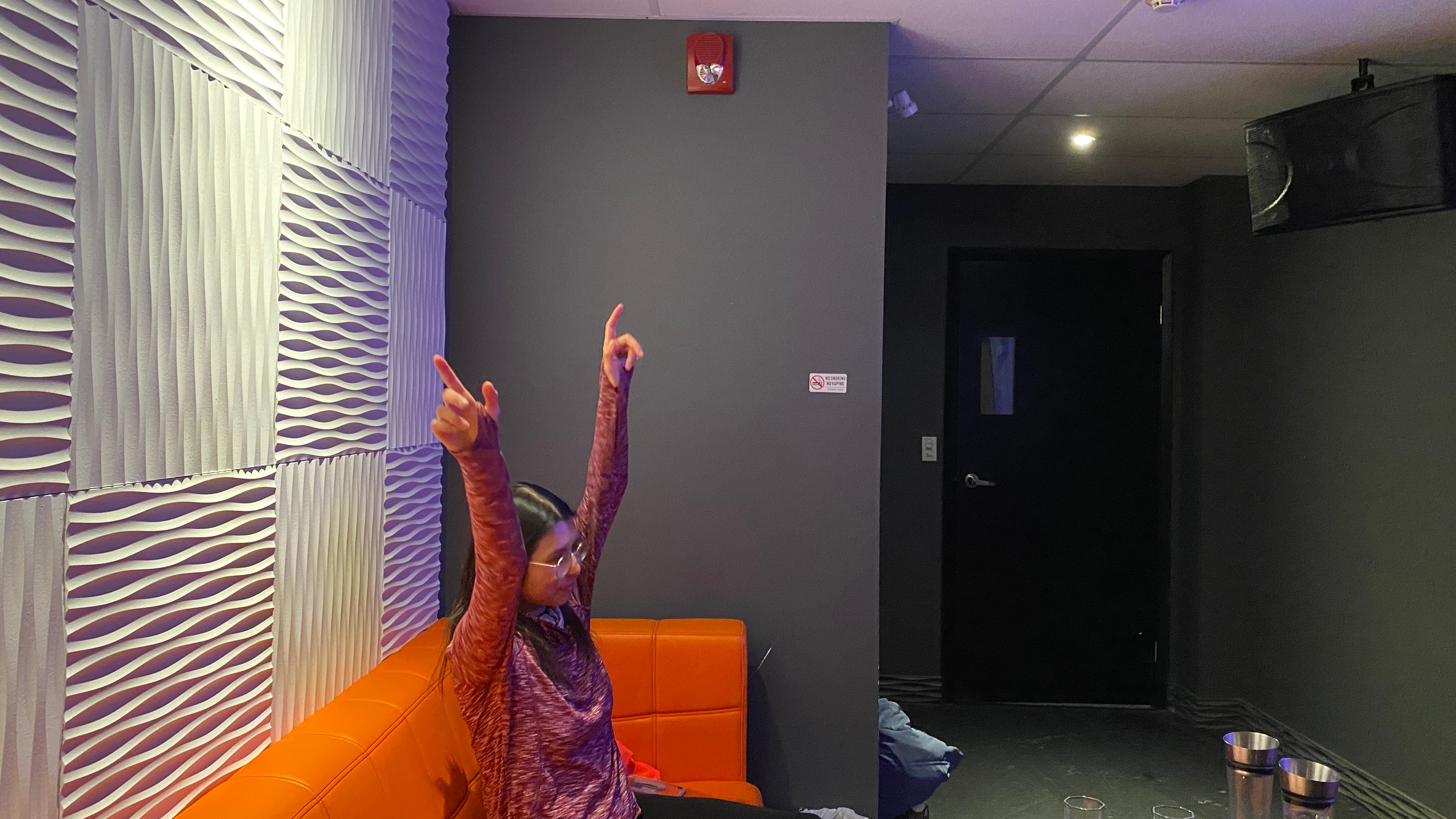
Photo by Julie Hall
Lessons
Julie Hall: To get a sense of your art practices, can you tell me your origin stories? What led you to performance art?
Tess Martens: I was a synchronized swimmer, and when I was 16 I did some standup comedy at our high school coffeehouse. I’ve always liked to do improv and act, but I’m horrible at memorizing lines. I always wanted to do performance at the University of Guelph, but then all my painting profs were like, “No, you’re a painter, you’re a painter, you’re not a performance artist.” I was lucky enough to go to the University of Waterloo for my MFA and just wanted to experiment. Look at me now, I’m a performance artist.
I focus on diving into childhood memories and trauma, and there’s an innocence in my work and a sense of play based on shame and guilt with some humor mixed in. I also talk about gender identity and body politics as well.
Megan Arnold: I was primarily a cartoonist when I was developing who I am as an artist. I was making comics when I was living in London, England, but simultaneously I was getting into drag and performing and making pop music and going to karaoke.
In my final year of undergraduate degree, one of my peers was doing performance art, and I thought, “This is cool, but I wouldn’t do what she’s doing so I guess I’m not a performance artist.” Bridget Moser came in to do an artist talk and I realized, “This is what I want to do.” It took several years before I really dove into it. I would go to karaoke sober and alone to practice being comfortable on a stage. I started mostly doing performance to camera before getting more into performing live.
The pandemic is when I really got into it in earnest when I was living in England. There’s a visa that you can get when you’re under 30 and I knew I wanted to do a Master’s and thought, “I’ll be broke after a Master’s, so I should do this now.” I moved there in 2019, six or seven months before the first lockdown.
JH: And what about England had an effect on your performance practice?
MA: You can see the prop behind me, I have my flying Scotsman. I got really into walking as an artistic practice. I never grew up with animals, but England is where I started noticing these very strong relationships that people had with their dogs, which is what I noticed as I was walking around and kind of getting to know people by their dogs coming up and saying hi to me.
JH: I learn to be assertive by spending time with dogs. People-pleasing is an absolutely dysfunctional relationship to have with a dog. You need to stand up and be like, “I’m in charge.”
MA: They are good teachers.
JH: There’s an anticipation of failure and that’s part of the enjoyment of karaoke, definitely for me. Karaoke can have these triumphant moments of a singer absolutely nailing it, but I think of it as an uphill battle of expectations where a novice performer will underwhelmingly fight for their lives on shitty equipment through a studio-processed and culturally well-known rendition of a beloved song performed by a professional singer. Does performance art feel this way? Does it have that level of scrutiny or are audiences more forgiving because of the strange experimental one-of-kind nature of performance art?
TM: How I approach karaoke is very similar to my practice. A lot of my practice has to do with failure and just putting yourself out there. For my MFA thesis, One Two Three Four, I did Secondhand Emotion, which was a karaoke performance, and the reason I can do performance is the same reason I can do karaoke, because I’m not afraid. I’m just gonna make a fool of myself, I’m just going to be vulnerable and see how it’s received.
MA: I think we’ve found where our work diverges because I’m so scared. I am very, very self-conscious and every time I perform I’m shitting myself. Even just speaking to people and anytime I am engaging with others I’m kind of anxious. Karaoke started as a way to work…not even through it, because I’m not through it, I don’t know if I ever will be…but work with it and sit in the feeling and be like, “Okay, I can choose this feeling and have fun with it.”
I take karaoke kind of seriously because I’m a singer. A lot of the performance I do is very scripted and super timed out to protect myself from failure. With performance, because there’s that control, it’s less scary than just being around people and having to have a regular conversation, because I don’t know what people are going to say and I just don’t know how to engage. I almost exclusively perform alone, and it’s on my own terms. I’m engaging with people on my own terms, and that feels safe. And so does karaoke where we are all doing this thing, it’s my turn to do the thing.
JH: That social contract that comes up in performance art, where there’s the performer and the audience, and even though it’s experimental, the contract still exists. Whereas socializing, there’s no contract; people can do anything, say anything. I’m so curious if there’s anything you’re afraid of in performance, Tess. I don’t think I’ve ever seen you afraid.
TM: I worked with a Mexican-American troop performing in Mexico, and it was really dangerous, we could have been killed because we were doing a political performance. I’m also afraid of anyone getting hurt, especially the witness. I’m also very afraid of crossing lines without meaning to, someone taking it a different way or misunderstanding it, or maybe I misunderstood the action. It’s a control thing too, because I’m trying to control what I’m trying to express through my body and if my meaning is lost in translation, then I would be really upset.
JH: It’s really interesting how we build practices around ways of both challenging ourselves but keeping us safe from those bigger dangers, whether the stress is social conversation or threat of death.
I’m really glad that the word vulnerability came up earlier, because it seems inherent to performance, and I worry that vulnerability is a missing piece in the contemporary social moment. With people streamlined towards conversing with AI instead of relying on their friends or community, we can too easily avoid vulnerability with an anonymous and capitulating chatbot, and it’s concerning me. I’m wondering if, through performance, you’re consciously engaging in vulnerability?
MA: I came to vulnerability in my practice as a cartoonist because I was making diary comics, and it was all in there. With the immediacy of performance, I put up a little boundary, I’ll see if I can abstract it somehow or build a different story around it. That’s how I engage with vulnerability and performance. I think vulnerability is changing my practice again. People know me as a performer and a clown or a comedy person, which I still love. I feel a shift is on the horizon for me at some point, but while performance is the thing that connects me to people, I’m still performing. It’s not quite me.
TM: Yeah, I’m an emotional motherfucker, and you would think that my most vulnerable pieces were when I was nude, absolutely not. One of my most vulnerable moments was a 2023 performance for LEGS in Toronto. I just got fired from a job, and they said it was very personal. They said, “You’re weird. You’re an artist. We just don’t want you, you’re not the right fit.” So, I decided to get a wooden chair with holes in it, like that had bars, and then try to fit myself in the chair. And then I had a sticky note that said, “I’m not the right fit.”
And that one, it was only seven minutes, but it was very vulnerable because it just brought me back to that time where I got totally rejected from the corporate world for not being the image of just an everyday citizen. I am an artist, so I have a little bit of nudity online. Is it tasteful? Who cares?
JH: I think the two of you are probably bodybuilders in experiencing vulnerability. I love that, and I think it’s a dimension of being in safe conflict with people that I find works well with the conflictual aspect of performance art. We’re not out to upset people, but there’s definitely some pushing happening.
MA: Tess, you mentioned that something you’re scared of is someone taking something from your work the wrong way. There’s something about our culture at this time that, it’s just scary, the potential to not be understood. That’s part of why I like to abstract the emotional material that I work with, my audience can take it however they want. I think comedy is also one of those safety mechanisms in which to get audiences engaging with conflict. Comedy and laughter, it’s physiologically really hard to control. If you genuinely think something is funny, you’re probably going to laugh. And if you genuinely think something is funny, then it means that you are implicated in the thing whether it’s a joke or not.
JH: Does the mantra commit to the bit mean something to you? If a performance isn’t working or if vulnerability isn’t a source of motivation or a driver, does telling yourself commit to the bit work for you?
TM: That’s why I do durational performance, my movements become almost subconscious. In My Baroque Body, I was nude for six hours and I did different poses. My commitment wasn’t studying baroque and rococo poses. I reviewed them for 10 minutes and then committed to the bit. It can be something drastic like a six-hour performance or it could be seven minutes with a chair where I’m not the right fit, and just committing to squishing my body into that chair no matter what, to express how I felt of the impossibility of not being myself as an artist.
JH: Do either of you have physiological ways of timekeeping or knowing when your performance is working? I’m not a great singer, but I get this internal shiver when I sing on key. Do you get feedback as you’re performing?
MA: I can feel when I’m in a flow. My work is always so structured. I know the timing really really well. When I’m nailing it, that’s when my body is the most relaxed or at ease. If I’m stumbling, that’s when I notice that things slow down and then I have to get back into the flow.
JH: When I’ve done very serious performance work and the room is disturbingly still, it’s amazing feedback to get. Perhaps the opposite of laughter is a sustained distance.
Tess, I once witnessed you walk into a bar with no karaoke setup, ask the bartender if you could sing karaoke, and he magically got you a microphone and changed the projector to Tina Turner’s What’s Love Got to Do With It karaoke lyrics video, and you just went for it. This was the post-performance of Nutcracker II by Lauren Prousky, and I’m wondering if you performed karaoke to celebrate or transition into the social milieu?
TM: An audience keeps me going. It’s the energy in the room. I don’t know if those people in the bar actually wanted to hear me sing karaoke, but some of them were kind of into it and then some of them were like, “What the fuck is going on?” It doesn’t have to be an active interaction. It can be a passive interaction as well.
JH: Megan, does the crowd have a big influence on what’s happening for you in your performance?
MA: Part of getting into the flow is when the audience is reacting in the same way that I was when I was writing my performance. Sometimes they don’t find it funny, and then that’s the stumble. Karaoke is very different because for me it has no stakes, it’s more about the exhilaration, I’m making this sound with my throat. This is crazy, this is like magic. I would do it if there was nobody there. Part of why I perform is because I get really jazzed about getting attention but not having to talk to people. When I go to karaoke, I will look at who’s there and make judgments about what kind of music they might like so that I can perform for them.
JH: It is kind of funny to pick a song and then look around and be like no one wants to hear this. It’s a terrible choice, but I’m doing it for me.
Speed Round: Funny Questions for Funny People
JH: Megan, what’s funnier to you, your performance practice or karaoke?
MA: Funnier? My performance practice, because I think I’m funny.
JH: I definitely find myself funnier than I should. I feel like I’m my own audience.
MA: Yes, that resonates with me.
JH: There’s a karaoke superstition around the song My Way by Frank Sinatra, whose karaoke singers are disproportionately assaulted compared to other songs, sometimes leading to death.
MA: I’m Filipino and that’s where the My Way riots originated, in the Philippines. Karaoke was part of my life growing up and I never did it because everyone was so good. I think that’s part of why I take it so seriously, I’m trying to make all of my ancestors proud.
___
JH: Would public transit be better or worse with karaoke?
TM: Worse. When I was at the University of Guelph, we used to have a drunk bus that ran at 3:00 a.m. after you went to the bar, and everyone was singing, “DON’T STOP BELIEVIN’.”
MA: I think it would be better. It should be more in more public places. In the Philippines, you can do karaoke everywhere.
TM: Really? So awesome.
JH: There’s a thrift store in Kitchener where you can get 25% off of your purchase if you sing a karaoke song. They have a little karaoke set up right by the cash.
MA: I would get free merchandise every time.
___
JH: So you’re both based in Guelph, and you’ve performed in both Guelph and Kitchener. Can you think of a song that resonates with either city or a song that you would perform in either city?
TM: Don’t You (Forget About Me), by Simple Minds: “WILL YOU WALK ON BY?”
JH: For which city? For both of them, or for either?
TM: Yeah, that’s my main song. I don’t care about where I am, except if I’m in Montreal and they want a French song, I’ll go with Celine.
MA: That’s a really hard question. It’s like when you go to karaoke and you’re trying to think of a song and it’s like you’ve never heard a song before in your life.
___
JH: What karaoke song would you choose if you: were in a hostage situation, delivering an acceptance speech, or performing for your dog?
MA: I feel like Van Halen’s got to be in there somewhere. Probably hostage. Acceptance speech, Vienna, Billy Joel. Then dog, I’d be performing for Farley. He likes soft rock, so maybe like a Steely Dan joint. Only a Fool Would Say That.
TM: Hostage situation, You Are My Sunshine, my only sunshine. That’d be so annoying over and over and over again. Acceptance speech…I’m a Slave for You by Britney Spears. I don’t know why, but Alex [Tess’s dog], what should I sing to you?
MA: What’s he asking for? Precious.
TM: Let me think. What should I sing? You’re looking at me, let me think.
JH Look into his eyes.
TM: Who Let the Dogs Out?
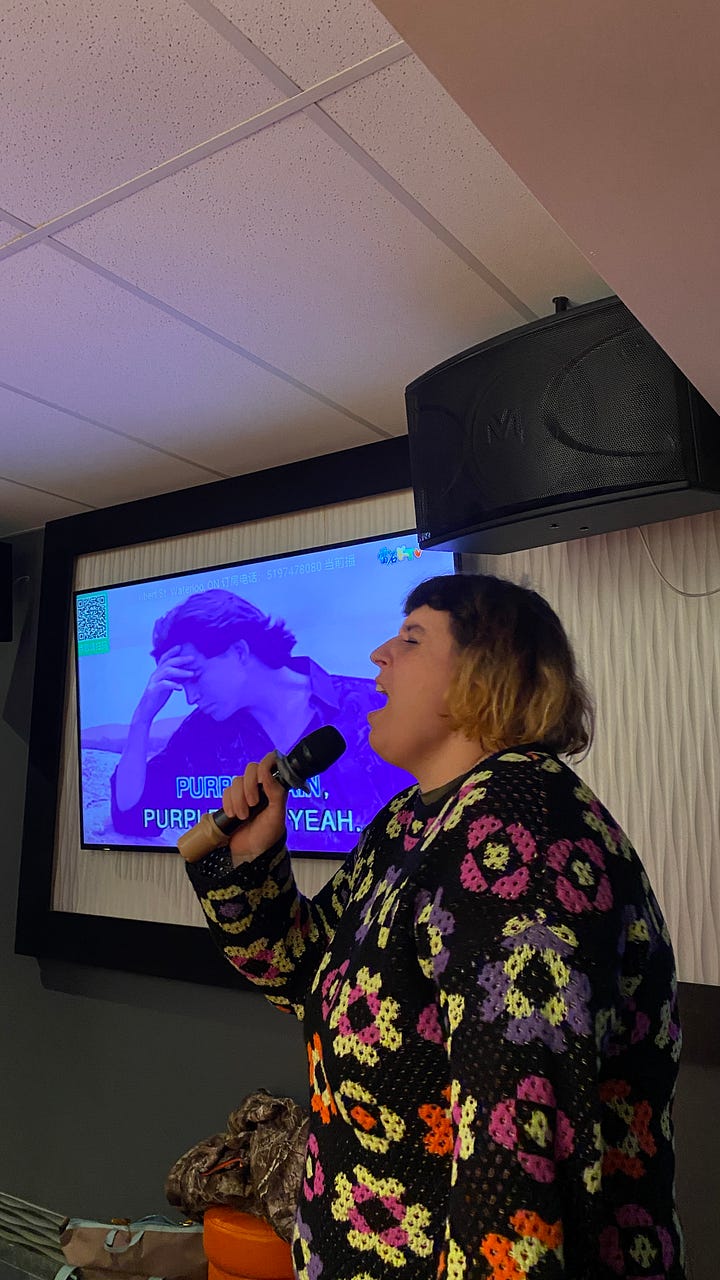
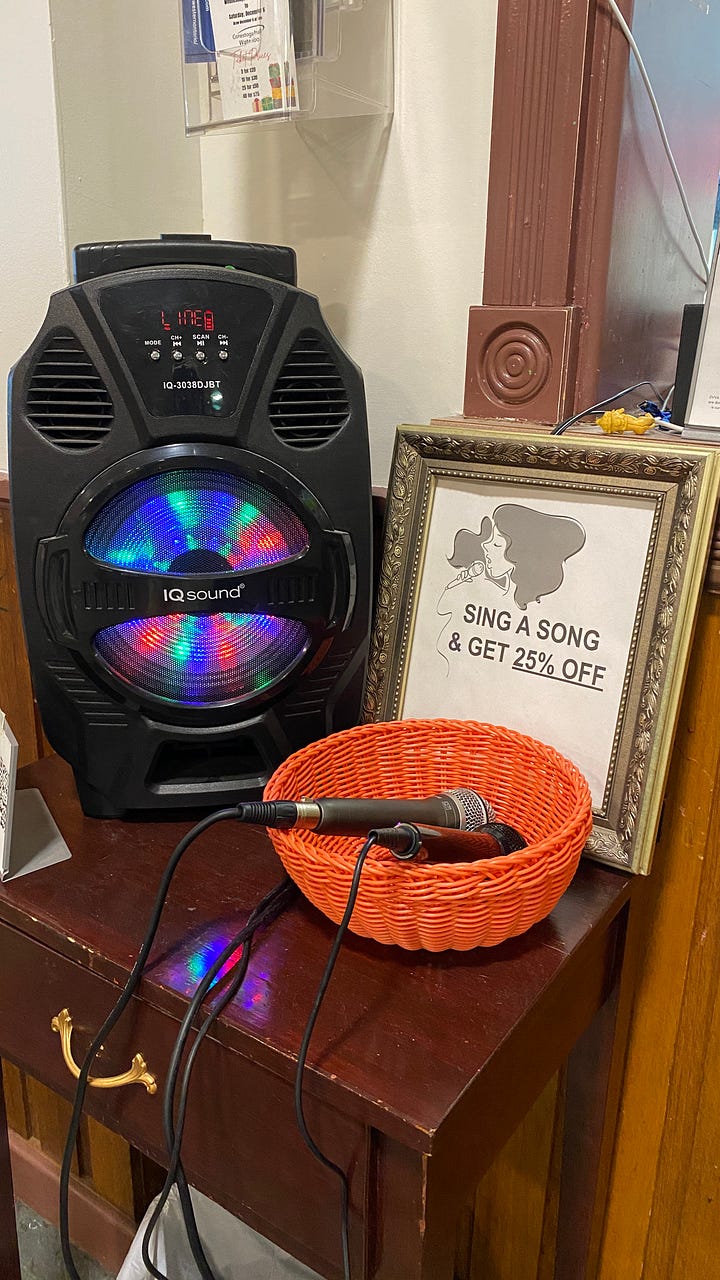
Photos by Julie Hall
What’s Next, Collaboration, and Karaoke
JH: I’d love to hear what you’re thinking about in your art practice, any recent or upcoming projects.
MA: Dogs, that’s my whole practice right now. I’ve been collecting fur from my dog Farley, and [gestures] this is George [pet cat who recently passed away] and I’ve been spinning it into yarn. I don’t know what I’m going to do with it, butI think singing will have something to do with it, because historically, singing while working or doing labour are connected. Your body gets into a rhythm when you do those things together.
TM: I’m going to Mexico City with my collaborator, Holly Timpener, and we’re going to have these tutu skirts on and they match our wash boards on which we’re going to wash dirty sheets for hours.
MA: I’ve tried improv so many times and I can’t get into it. I want to, really badly, but my body will not do the thing.
JH My body won’t dance. I can hang out with a bunch of people and enjoy some tunes and whatever, but you cannot teach me choreography. I don’t think that way.
TM: I feel the same way, but I was a synchronized swimmer, so I guess that was choreography. How did I remember all that stuff? I don’t know. I have the worst memory. That’s why I would never be an actor. For one performance I did, it was Lou Shepard’s Rights of Passage. They had to write the lines on a big board for me to read while they filmed.
JH: No way. Incredible. I bet Lou was a generous and accommodating collaborator. I met him before, in Halifax, when I was a very novice artist…and now I’m very novice at karaoke, very novice at interviewing…
MA: And I think the combination of being novice at two things and then doing them both…
JH It’s my style, learning by doing. I bite off way more than I can chew and… I’M A SURVIVOR.. You could throw me into surgery like, “Just don’t kill them,”I’ll be like, “Okay, yeah, I’ll figure it out.”
MA: Just don’t make me dance.
TM: Should we sing Destiny’s Child?
MA: That would be perfect together.
Julie Hall (@wish_you_webe_hepe) is a visual artist working in soft sculpture, writing, and performance, often collaborating with partner Jacob Irish. Julie loves cooking, cycling, and talking, and is a good project manager in their role as Executive Director of CAFKA. From Halifax, Nova Scotia, they’re currently based in Kitchener, Ontario.
Comments
Nothing yet. Say the first thing.
Sign in to join the conversation.