
I woke up Monday morning to clips of Sunday’s Grammys flooding my feed. That alone tells me the algorithm knows shit about me, and I’d prefer to keep it that way. (It’s also a reminder to not reach for the phone first thing in the morning.) Still, groggy and half-curious, I tapped through a few seconds of several clips with the sound off. I admit I had no idea who most of these people were, but watching them move on mute didn’t leave me feeling out of touch. It left me with a creeping, eerie sense that the ceremony had very little to do with music. How do I even describe it? It was a little Kubrick, a little “Scientology End-of-Year Prom” (as Sufjan Stevens once called his own award ceremony trauma), and a whole lot Soundgarden’s “Black Hole Sun” video—the plasticized faces, glued-on smiles, and deadened, programmed eyes the music video had warned us MTV Generation kids about.
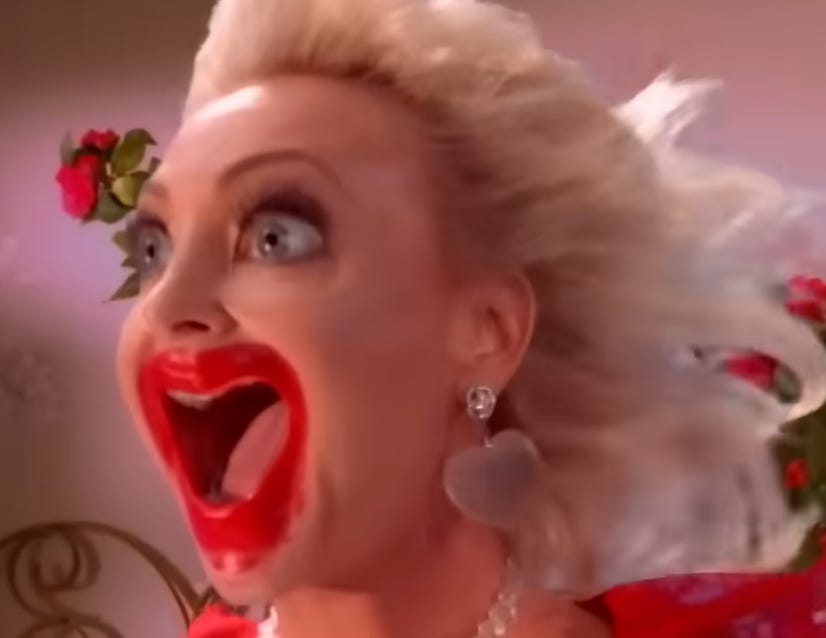
It made me wonder what happened to mainstream pop culture? I mean, it’s always been coated in Dorito dust, but these days it seems particularly gruesome. Or is this just my middle-age rite of passage—shaking my cane at the sky?
Maybe.
And I’ll own that I’m not exactly the spring chicken my Jane Birkin bangs might suggest. But what passes as good, at least in terms of the mainstream, feels like a slog into mediocrity. While I was never much of a Top 40 cheerleader, I wasn’t impervious to its pull either. And a good pop song like “Waterfalls” by TLC or “What a Girl Wants” by Christina Aguilera or pretty much any single by En Vogue could penetrate my hardened indie core. Obscenely mass-produced, sure, but there was an element of magic that was undeniable.
Criticizing the cheapening of culture, though, is nothing new. And unearthing the why and how will certainly take more than a Substack. But the last time I felt this greasiness surrounding pop culture was in 2014. That was when I started to see the shine reveal the rust beneath, and felt that first tickle of cynicism begging me to ask: What are we doing here?
By 2014, the cultural landscape had taken a sharp turn into illusion, making us all active participants. We’d become dependent on digital filters where every photo was magazine-ready, as well as a part of a personal three-act story. The word “curated,” once confined to the art world, now described stupid things like brunch. Social media users were encouraged to see themselves as a brand. Being famous for being famous was no longer a joke but a goal. And the Taylor Swift’s pop-star transition was complete and peddled as a genius marketing plot twist because ‘who could have possibly seen it coming’? There were the predictable three-chord pop progressions, the Oscar selfies, the Kimye nonsense, and the Social Media Challenges, with the narratives set, the opinions assigned, and the responses homogenous. It all felt anathema to my punk rock roots of questioning everything and knowing we were part of some cultural ruse, designed to manipulate and control.
But there was one performance that felt like a quiet revolt against it all: an observation on the existential emptiness in modern American life, delivered with authenticity instead of cosplaying rebellion.
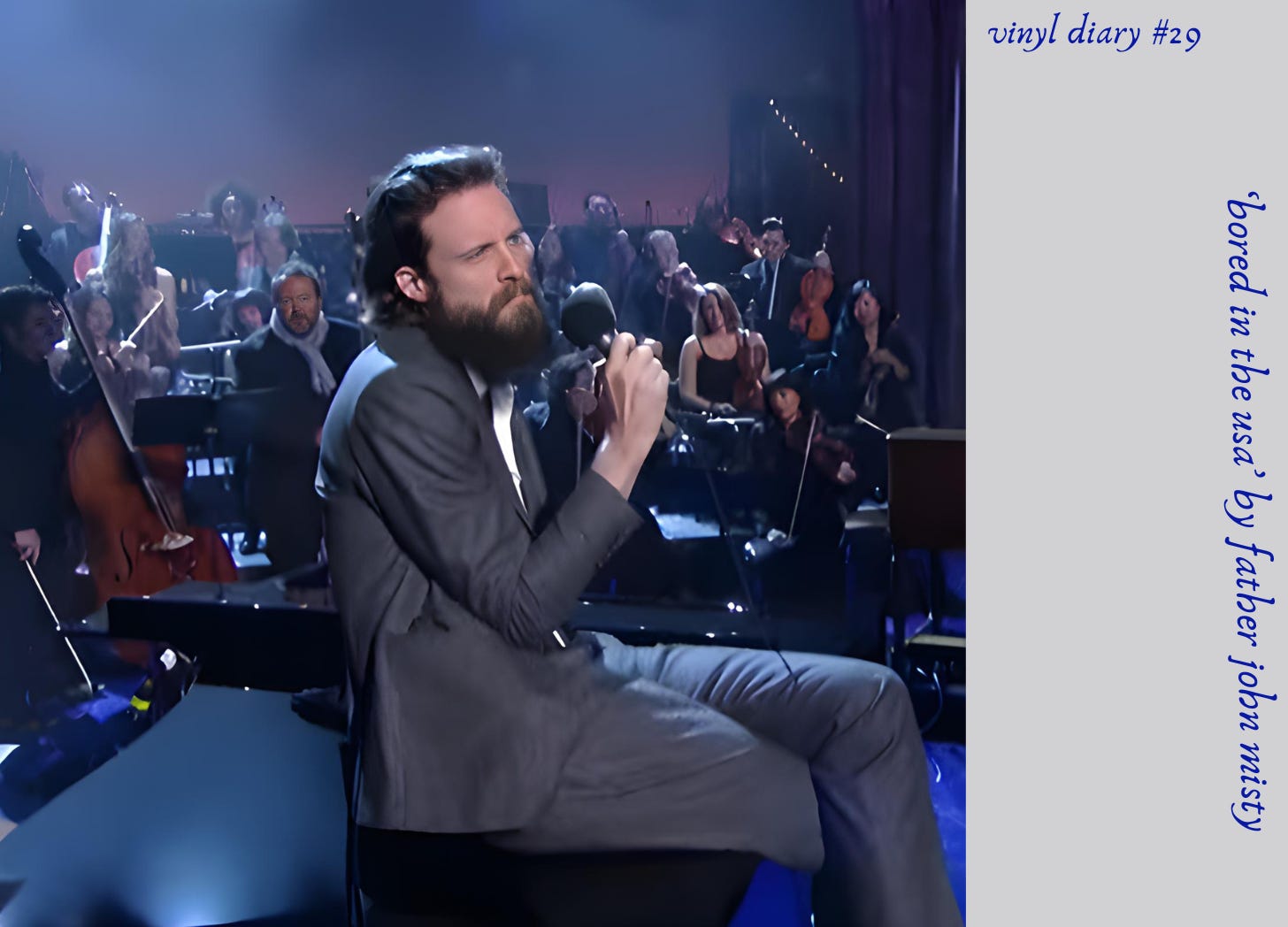
Father John Misty performing “Bored in the USA” on David Letterman tapped straight into the ennui I was feeling. And continues to do so as things like award ceremonies become more of a joke. Except the joke is on us.
So, the performance starts with Letterman announcing his musical guest who I admit, in 2014 I hadn’t heard of yet. On the stage at the Ed Sullivan Theatre, a stark light is cast upon him, the screen’s edges softened by shadows. He sings, “How many people rise and say / ‘My brain’s so awfully glad to be here / For yet another mindless day’?”
And it was the most honest thing I’d heard on TV since the ‘90s. Line, hook, and sinker I was fucking in.
The camera then moves in on his face. Soulful, affected, morose, he continues:
“Now I’ve got all morning to obsessively accrue / A small nation of meaningful objects / And they’ve got to represent me too / By this afternoon, I’ll live in debt/ And by tomorrow be replaced by children.”
It felt incredibly brave for 2014. But today? It would be on another planet of what artists are and aren’t allowed to express.
As he sat in front of the piano, there was no reason to assume he wasn’t playing it, as his body appeared to respond to each note. It wasn’t until he took the microphone into both hands that my mind momentarily glitched from the unexpected. A wider shot quickly resolved it as the singer swiveled toward us, a knowing flicker in his eyes, the piano playing itself.
This was my first introduction to Father John Misty—an artist who has since become the soundtrack to my middle age.
Watching the ivories dance on their own, I grinned at the metaphor that it’s all an illusion, a simulation, if you will, that we’re participating in to stay comfortable. I liked that this soulful, suited singer—with the vocal range of Elton, the sex appeal of Serge, the wit of Harry Nilsson, the soul of Scott Walker—seemed to get both the comedy and cruelty: a paradox of human existence.
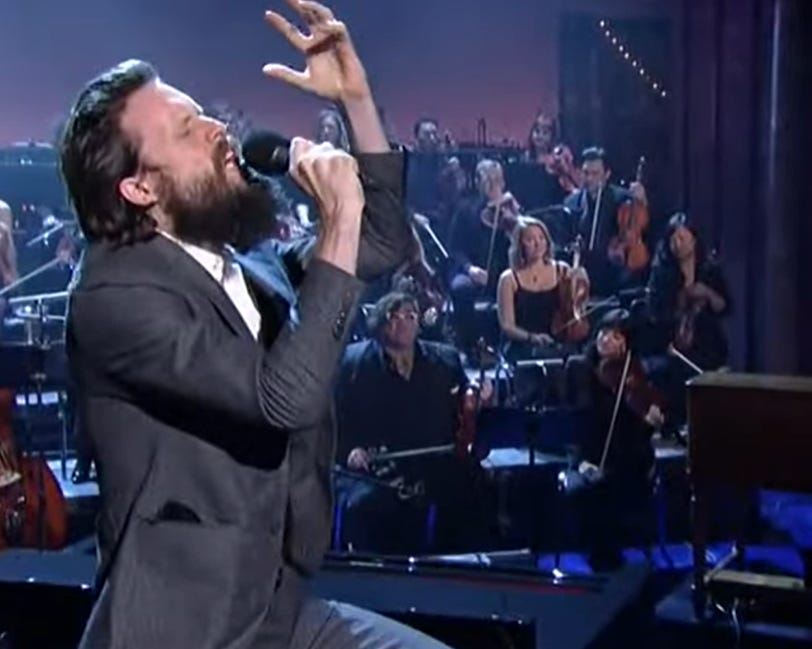
As he sat cross-legged in almost resignation to the realities, the backlights rose to reveal a string quartet behind him, underscoring the drama. In an era where worth was starting to be measured by the digital matrix and fast hooks eclipsed talent, this song stood apart. Unhurried and deliberate, it made my ears work for the payoff by refusing the quick-hit spectacle. Instead it demanded I sit in the discomfort of earning my entertainment. And really, this was and still is an uncomfortable performance in its simplicity and honesty.
“Bored in the USA,” he continued wearily.
The title’s play on words described where we were going as a culture while quietly exposing the machinery behind the performance, the product, the persona. I watched as he made the most of every second of screen time with pure theatre: nonchalance with a hand in pocket one second, then propped up on his knees on the piano and reaching skyward. “Save me, white Jesus!” he sang, and later “President Jesus,” noting our worship of gods both biblical and political. Canned laughter overlaid his vocals punctuated the satire, adding to the uncomfortable yet important performance. (I like to imagine the audience’s faces as I picture the out-of-towners who’d scored tickets to The Late Show hoping for, like, an upbeat, seal-clapping performance of Katy Perry or, like, One Direction, only to be lectured on inconvenient truths of consumerism, domestic trappings, and our complicity, complete with a laugh track. I really do wish they had panned the crowd.)
Revisiting this clip now, over a decade later, I can see this wasn’t a reinvention of his Fear Fun debut persona—all barbed wit and observations about things like Hollywood actresses craving notice—but an evolution into the apocalyptic tableau of intimacy that is I Love You, Honeybear. The transition feels genuine, not manufactured by assholes with degrees in communications. The starlets he once sang about now hardened into caricatures, and mirrored by an America still chasing self-made myths: life coaches, girl bosses, trad wives, internet sleuths, science bros, farm-to-table curators, wellness influencer, slacktivists and slogans, and so on…
We haven’t come a long way in any meaningful sense, but “Bored in the USA” remains a satirical probe, anchoring the willing listener in observing not absorbing the absurdity. It’s a shame that the Grammys didn’t have the courage to celebrate music as confessional and unscripted, making this 2014 performance look avant-garde in comparison.
“Is this the part where I get all I ever wanted? Can I get my money back?”
That line right there is more daring that any nipple piercing dress or clawed manicure. It’s terrifyingly honest, which is what makes it so interesting. But if we’ve learned anything about today’s gatekeepers of culture, is that it’s no longer the point. It’s not about art, baring your soul, but approved messaging. And it’s too bad, really.
So, what we do? Hold onto to these clips of the past with hope for the future, knowing our kids deserve more in their pop culture. That true vinyl idol. But the show is over. The self-awareness long gone. And the illusion of the illusion continues.
I just wish it was more interesting.
If you want more insight on why music is getting worse on a more technical and even emotional level, I highly recommend Rick Beato’s analysis here.
No posts
Comments
Nothing yet. Say the first thing.
Sign in to join the conversation.