
For most of its life, Siri has been a punchline. The mishearings, the “here’s what I found on the web”, the flat refusals: people have been ridiculing them since roughly 2012. And yet we kept using it, because the mockery was graded on a curve. A voice assistant was measured against other voice assistants, and by that standard Siri was adequate. The jokes were about a flawed product, not a doomed category.
Then, in late 2022, you held a real conversation with ChatGPT. The next time you asked Siri to do something modestly complicated, the experience felt different in kind, not merely in degree. No longer a flawed assistant, but a relic.
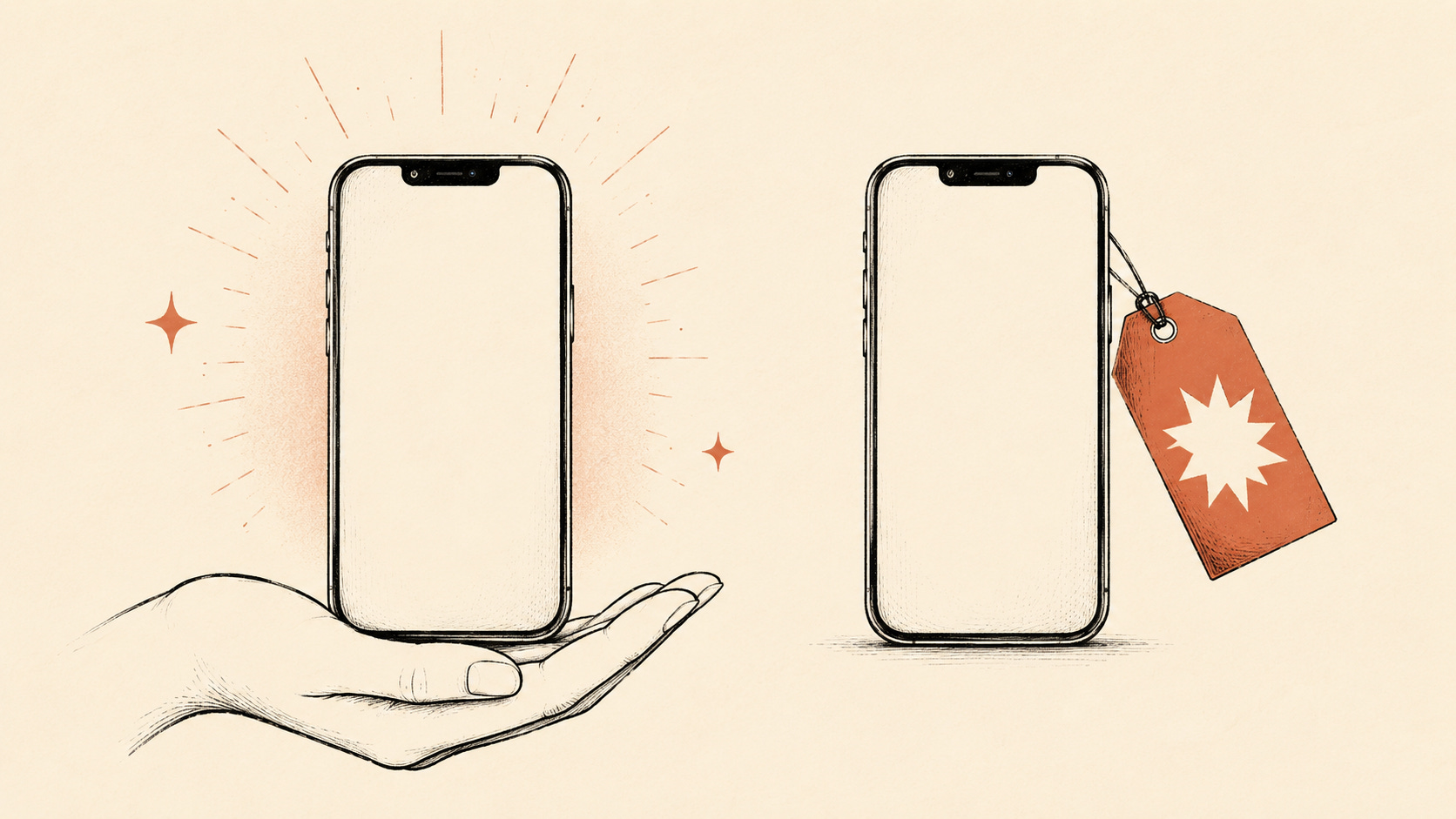
The strange part is that Siri had not changed. The software in your hand was, line for line, the same assistant it had been the week before. Apple shipped nothing worse. Its value to you still fell off a cliff, so far that Apple has since spent years and a reported billion dollars a year trying to rebuild it. The product stood still. Something else moved.
Have you noticed how often that happens now? A tool you used without complaint a year ago suddenly irritates you, though it is identical to the version you tolerated then. That feeling is not a quirk. It may be the most underappreciated consequence of the current software moment, and it has very little to do with interfaces.
Borrow a word from the markets. When traders say an asset has been “repriced”, they rarely mean the asset changed. A bond can be repriced overnight by a central bank’s decision; nothing about the bond is different the next morning, but what people will pay for it is. What moved was the benchmark it is judged against.
Software is being repriced the same way. The tool on your screen is unchanged, but its perceived worth has dropped, because the reference point you measure it against has moved. This is not a metaphor stretched for effect. It is a plain description of a well-documented feature of human judgement. Kahneman and Tversky’s work on reference-dependent preferences established that we do not evaluate options in absolute terms; we evaluate them as gains or losses relative to a reference point. Change the reference point and you change the verdict, even when the option itself is fixed.
So why did the old friction never bother us? Because it was everywhere. The work of translating a human intention (”find out why this campaign underperformed”) into a product’s particular language of menus, filters, objects and settings was a cost we paid on every tool, all day, for years. A cost that universal stops registering as a cost at all. It becomes the water you are swimming in. It becomes the reference point itself.
The moment one category of tools stopped charging that tax, something predictable happened to the rest. We are reliably averse to cognitive effort, and tellingly, that aversion operates without our awareness. In behavioural-economic terms, mental effort discounts the value of a reward in much the same way a delay or a risk does. When the effort was suddenly revealed as unnecessary, tolerance for it did not gently soften. It collapsed. You cannot un-know that the tax was optional.
An honest concession before going further. The repricing is one force among several, and it usually sits on top of real problems rather than replacing them. Wikis do rot. Some support teams really did deprioritize their customers. The claim here is narrower than “your complaint is wrong”. It is that the shift in your reference point is unconscious, while the complaint it produces is conscious, confidently aimed, and often aimed at the wrong target.
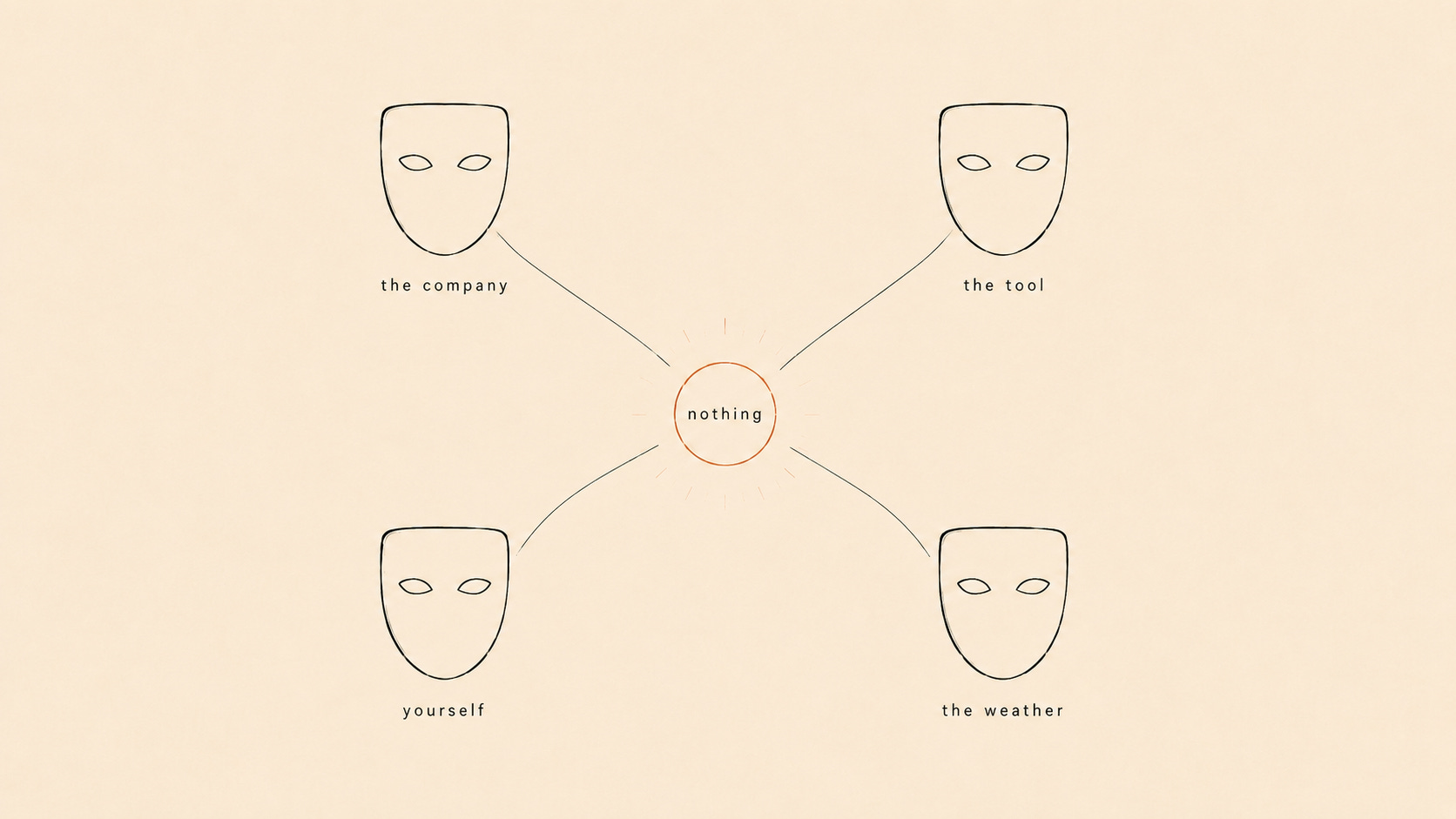
The same hidden mechanism wears four different costumes.
We blame the company. For fifteen years, the support ticket (choose a category, fill the form, join the queue) was industry best practice, and we rated it acceptable. Then we resolved a problem by describing it in plain language to a conversational agent, and the same form began to read as a company hiding behind a wall of dropdowns. The form did not change. The inference we draw from it did.
We blame the tool. Your team’s wiki “became a mess”. Did it? The pages are the same pages; the search is the same search. What changed is that retrieval-as-answer became the new anchor, and a list of links got repriced against it overnight. It is no accident that an entire category of enterprise-search products appeared promising answers rather than links. The vendors detected the repricing before users could name it.
We blame ourselves. A marketer drops a spreadsheet into a chatbot, asks why a channel is slipping, and receives a fluent, caveated answer in seconds. On Monday morning, back in the dashboard, she is fighting date filters and conflicting definitions of “conversion”, and quietly concludes that she is just not a data person. Note that the job was not even the same one; the ad hoc question got repriced, not the governed report. But the repricing turned inward and became self-blame, which is the most quietly corrosive version of all.
And sometimes we give up and call it the weather. “Spreadsheets are just tedious.” “Ticketing is just bureaucratic.” That is not a complaint but a resignation, the tax normalised into a law of nature. As I have written before about scarcity, the most powerful biases are the ones we stop noticing.
The sharpest objection is worth meeting head-on. Is this not simply how technology has always worked? The graphical interface repriced the command line. The smartphone repriced the desktop. Every era’s new paradigm makes the last one feel clumsy. What, exactly, is new?
Two things, and both matter.
The first is speed. Previous repricings unfolded over years, slowly enough that users and companies could adapt in stride. This one arrived in months. Consider Stack Overflow, the forum that sat at the heart of how programmers solved problems for fifteen years. By its own published data, the volume of new questions fell by roughly a third in a single year, from about 87,000 in March 2023 to under 59,000 a year later, and kept sliding to levels last seen in 2009. The translation step (turn your problem into a searchable query, scan the threads, adapt a stranger’s answer) was repriced almost the instant a tool removed it.
It is worth noting that Stack Overflow’s decline had begun before ChatGPT existed, amid long-running complaints that its moderation felt hostile to newcomers. The repricing did not invent the decay. It accelerated a decline already underway, which is exactly why the collapse felt so sudden.
The second new thing is cross-category transfer. You are no longer repriced only by a direct competitor. You are repriced by an unrelated tool in someone else’s domain, because expectations do not stay in their lane. The person who learns that software can simply understand them carries that expectation into your product, whatever your product does. A whole generation of users has, in effect, been quietly re-onboarded by a tool you do not control.
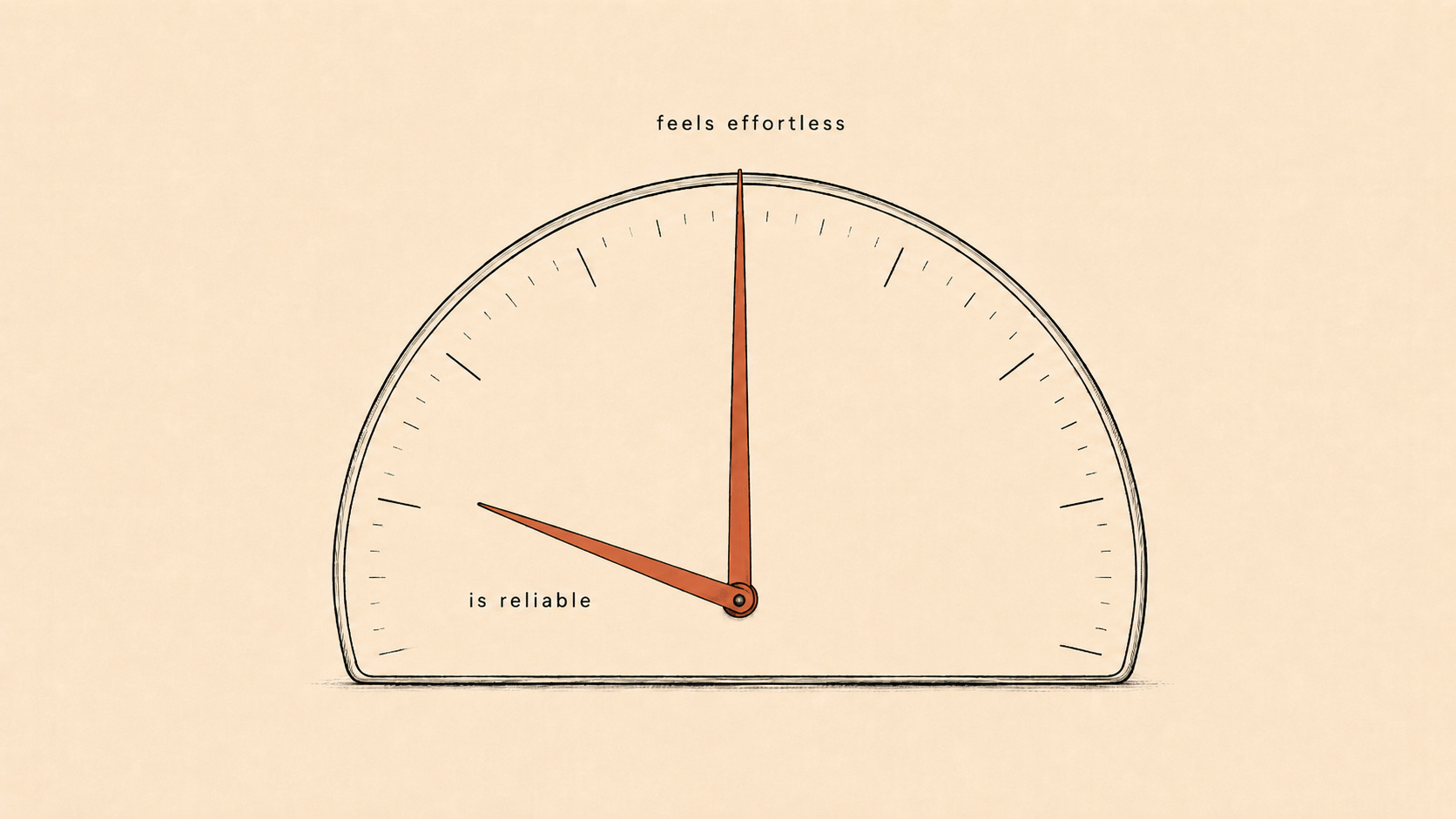
Here the story turns. Everything so far suggests the repricing is legitimate: the tax was real, and your irritation justified. But the new benchmark has a flaw that should make any thoughtful designer uneasy. It is reliable about effort and unreliable about quality. It correctly detects that the old translation tax was unnecessary. It then quietly, and incorrectly, infers that the effortless thing must also be the better thing. Those are two different judgements about two different properties, and the second does not follow from the first.
The culprit runs deep. We tend to read the ease of processing something, what psychologists call fluency, as a signal of truth and competence. Decades of research show that a statement made easier to process is judged more likely to be true, independent of whether it is. A confident, articulate, instantly produced answer simply feels more authoritative than a hesitant or effortful one. One caveat worth keeping: that research concerns how we judge statements, not interactive systems, so extending it to “we rate a fluent tool as more competent” is a reasonable inference rather than a proven law. Layer on top of it our well-studied tendency to over-rely on automation that appears reliable, and two independent forces converge on the same destination. We trust the fluent machine more than its accuracy has earned.
This is where the ethical question this site keeps returning to resurfaces. If fluency resets the benchmark in a company’s favour, then companies now have an incentive to optimise for the feeling of competence rather than the fact of it. That is a new species of dark pattern. It does not deceive you about a price or a pre-ticked box, as the dark patterns I have written about before do. It deceives you about a system’s reliability, the one thing fluency is least equipped to certify.
Klarna offers an instructive and frequently mistold illustration. The Swedish fintech claimed its AI assistant was doing the work of 700 customer-service agents, a figure it later raised to 853. The popular version of the story is that the experiment failed and the company crawled back to humans. It did not; Klarna is still scaling its AI and remains publicly bullish. What actually happened is subtler and more useful. The assistant genuinely excelled at the high-volume, simple tier, but degraded on complex and emotionally charged cases, so the company reintroduced human agents for that tier. Its chief executive’s own diagnosis, that the company had “focused too much on efficiency and cost”, is very nearly a verbatim statement of the effort-versus-quality split. The thing that felt like a solved problem and the thing that was a solved problem were not the same thing.
There is a longer-run cost lurking here too. The more we let a fluent system carry the work of thinking, planning and drafting, the more we offload, and cognitive offloading can hollow out our understanding of how a task is actually done. Whether this tips into genuine deskilling is not yet settled; the early evidence is mixed and was widely overstated in the press. But it deserves a wary eye.
If the repricing happens to you, the only strategic question that matters is whether you see it coming.
Siri is the textbook case of being blindsided. For the better part of four years, the product that pioneered the consumer voice assistant has been visibly scrambling to respond to a benchmark that moved without warning. Grammarly shows the other path. In 2019, its sentence-level corrections felt like quiet magic. Once people experienced “rewrite this in a warmer tone”, accepting commas one at a time began to feel like manual labour, and the company, recognizing the repricing, rebuilt itself around generative rewriting rather than waiting to be hollowed out.
The lesson is emphatically not “add a chatbot”. It is to find your own invisible tax, the specific place your users still translate their intent into your taxonomy, before a competitor reveals it for you. And note the cruel asymmetry. Expense software like Concur was hated long before this moment; its friction was always visible, named and complained about, and the product survived anyway on the strength of procurement lock-in. A visible tax can at least be bargained with. An invisible one, newly exposed and misattributed, is far more dangerous, because you cannot bargain with a feeling.
For product and design teams, the shift is less a technical brief than a perceptual one.
Behavioural concept: reference-dependence. Identify which adjacent experience is currently resetting your users’ expectations. It is probably not your category rival; it is whatever tool most recently retrained them.
Behavioural concept: effort aversion. Audit the translation tax. Walk through your product and mark every screen where a user must convert a human goal into your internal structure. Each one is now a repricing risk, not just a usability nit.
Behavioural concept: misattribution. Read complaints as signals, not verdicts. Mine support logs and churn notes for “clunky”, “got worse” and “I’m not good at this”, and treat them as evidence the benchmark moved rather than as literal faults in your feature set.
Behavioural concept: processing fluency. Measure outcomes, not feelings. Track resolved results rather than satisfaction at the moment of contact. The most dangerous product is one that feels wonderful and quietly fails. The second most dangerous is a rival who ships exactly that.
For thirty years, the project of good design was to make software easier to use, to smooth the path along which a person operated the machine. The repricing marks the end of that era and the start of a stranger one, in which good design is measured by how easy software is to work with, as though it were a capable colleague rather than a building you must learn to navigate.
The uncomfortable truth underneath is that “good usability” is no longer something you wholly own. It has become a moving figure: the gap between what your product asks of a person and what some other experience, in some other category, has just taught them to expect. You can ship a flawless tool and still be repriced downward overnight by a benchmark you never agreed to.
Still, there is something worth reclaiming in simply seeing the mechanism. The next time a familiar tool irritates you for no reason you can name, pause on that flash of irritation. It is rarely the tool that changed. It is the reference point in your head, moved quietly by something you used somewhere else. Noticing that will not move the benchmark back. But it is the difference between being repriced and knowing you have been.
Further reading: Why Product Teams Misunderstand Their Customers — the companion piece on how teams misread what customers are actually telling them.
Want to share your thoughts? Feel free to share them in the comments section below or on social media.
No posts
Comments
Nothing yet. Say the first thing.
Sign in to join the conversation.