
This article was developed as part of a paid partnership with the American Academy of Family Physicians (AAFP).
Shingles has a reputation and, frankly, it’s earned. For a lot of people, it ranks among the most painful things they’ll ever go through, and the pain can outlast the rash by months, sometimes years. Thankfully, we have a vaccine that protects against it, and it works remarkably well. It’s given as two doses, spaced two to six months apart. You sent us a mountain of smart, specific questions about it. Do you need it if you had the chickenpox vaccine? Can you get it early if you’re scared? Do you need it again later? And what on earth is going on with those dementia headlines? Let’s discuss…
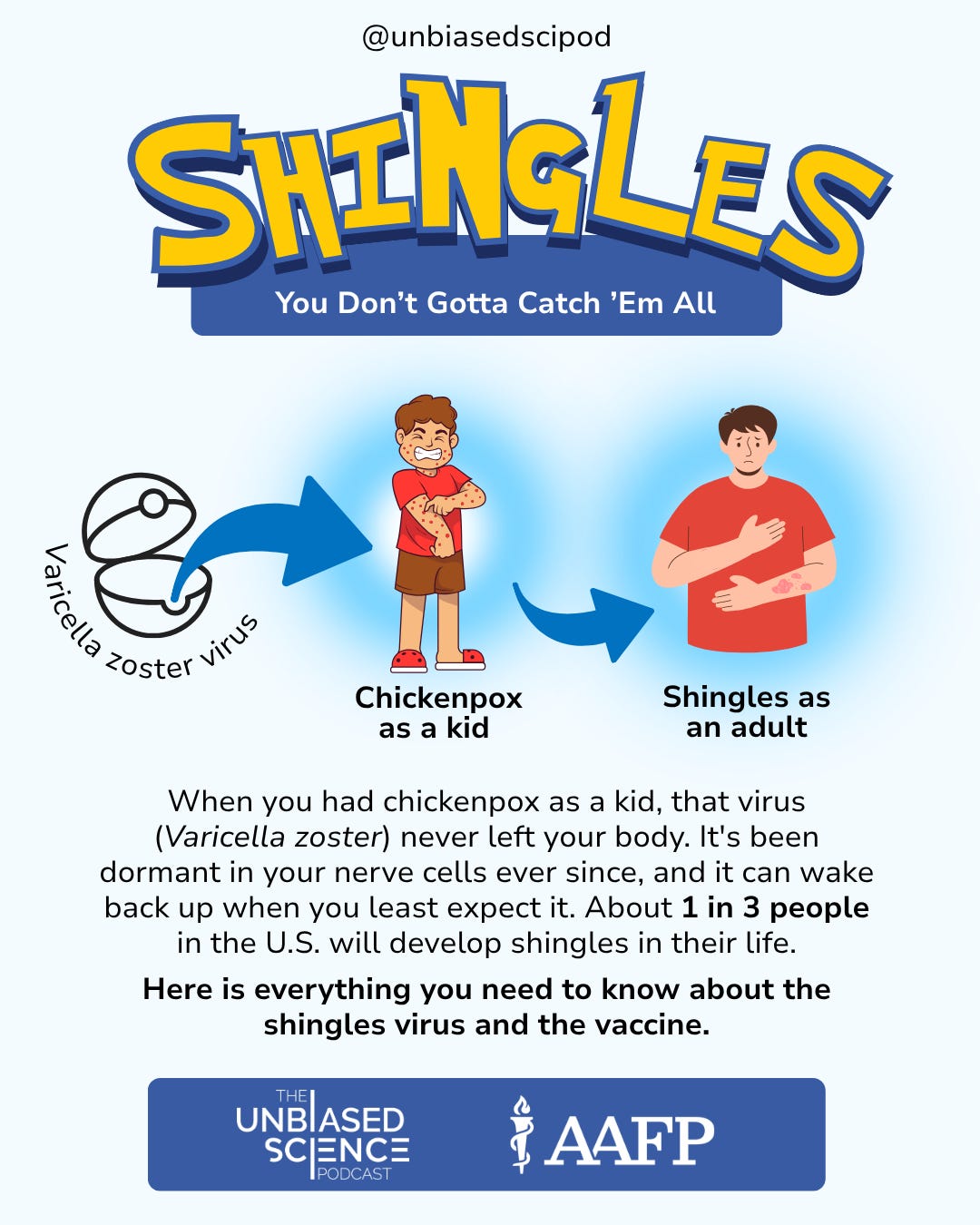
First things first, let’s set the stage. If you had chickenpox as a kid, you are still carrying the virus that caused it. Chickenpox and shingles come from the same bug, the varicella-zoster virus (VZV). After you recover from chickenpox, the virus doesn’t actually go away. It retreats into your nerve tissue and goes quiet, sometimes for decades. Later in life, it can reactivate, travel down a nerve, and surface as shingles, a painful, blistering rash that usually appears in a band along one side of the body. Unlike the itch of chickenpox, shingles often causes severe burning or nerve pain, along with fever and fatigue. About one in three people who’ve had chickenpox will get shingles at some point, and the risk increases with age.
Why does it reactivate? The part of your immune system that keeps VZV in check weakens with age, and can also dip with illness, stress, or medications that suppress immunity. When it drops far enough, the virus can reactivate. Still, it’s not entirely clear why some people get it and others don’t.
You can’t catch shingles from someone who has it, which surprises people. It comes from your own dormant virus waking up. What can spread is the virus itself, through direct contact with the open blisters. In someone who has never had chickenpox or the chickenpox vaccine, that contact would cause chickenpox, not shingles.
We periodically open up question boxes on our Instagram page, and you submitted some great questions that we address below:
I am worried about side effects from the shingles vaccine. Do people usually feel crappy afterwards?
We won’t sugarcoat it. Yes, Shingrix can be a reactogenic vaccine, which is the technical way of saying it can make you feel lousy for a day or two. A sore arm is very common. Some people also get fatigue, muscle aches, headache, chills, or a low fever. Roughly one in ten people feel rough enough to skip their normal activities briefly. Most people experience mild-to-moderate symptoms lasting two to three days after either dose, and the second dose tends to be the tougher of the two.
Those symptoms are a sign your immune system is responding, which is the whole point. They’re short-lived and a reasonable trade for avoiding weeks of discomfort during a shingles episode or the months of painful postherpetic neuralgia that can follow. (Note that not experiencing these effects does not mean the vaccine didn’t work for you. Everyone’s immune system is different, and some people react more strongly than others.) One practical tip people appreciate: avoid scheduling your vaccine the day before something important, and plan for a quiet next day just in case you don’t feel well.
But even if your first dose hits you hard, see the second dose through! People don’t react the same way both times, and you need both doses for full, durable protection.
Did they come out with a new shingles vaccine? And how is it different from the old one?
Yes, and it was an upgrade!

The older vaccine, Zostavax, was available in the US from 2006 to 2020. It was a live vaccine, meaning it used a weakened form of the virus. It helped, but its protection was moderate to begin with and faded fairly quickly over the years.
The current vaccine, Shingrix, is a completely different design. It’s a recombinant vaccine, which means it contains just one engineered piece of the virus paired with an adjuvant, an ingredient that revs up your immune response. No live virus at all, which is why Shingrix is safe for people with weakened immune systems, who couldn’t safely get the older live version.
The performance gap between the two vaccines is large. In studies, two doses of Shingrix prevented shingles in about 97% of adults ages 50 to 69 and around 91% of adults 70 and up. It also cut the risk of long-term nerve pain (postherpetic neuralgia, more below) by 91% in adults 50 and older, and 89% specifically in those 70 and up.
If you got vaccinated before 2020, there’s a chance you had Zostavax rather than Shingrix. Zostavax is no longer available in the US today, but that’s not a problem. It’s safe to get Shingrix even if you’ve already had Zostavax, and doctors recommend doing so, since Shingrix is more effective and lasts longer.
Do I need the shingles vaccine if I had the chickenpox vaccine as a kid, not the actual illness?
For now, yes, once you reach the recommended age. The childhood chickenpox vaccine uses a live, weakened strain of VZV, and that vaccine strain can also, rarely, reactivate as shingles later. The reactivation rate is much lower than with wild-type chickenpox (the virus from an actual infection, as opposed to the vaccine strain). But the people who received the childhood chickenpox vaccine (introduced in the US in the mid-1990s) are only now reaching their early 30s, so the current age-based recommendation applies to everyone, regardless of how they acquired immunity. As that generation ages, the guidance may get more specific, but it hasn’t yet.
Is 40 too young? Why did my doctor tell me to wait? When should I actually get it, and who needs it?
For most healthy adults, the recommendation kicks in at age 50. That’s the point where shingles risk starts climbing meaningfully, and it’s the age the vaccine was studied and approved for in the general population. So if you asked in your 30s or 40s and were told to wait, that’s why. Shingrix isn’t recommended (or typically covered) for healthy adults under 50, and if a younger person receives a dose by mistake, the guidance is not to repeat it and to hold the second dose until their 50th birthday.
The exception is immune status. Adults 19 and older who are immunocompromised are recommended to get Shingrix earlier, because their shingles risk is elevated well before age 50. This includes people who have a condition or are receiving a treatment like chemotherapy, high-dose steroids, a transplant, HIV, or certain autoimmune therapies.
Can I get it before 50 if I’m worried? I’m 47 and watching my 78-year-old father suffer through three months of postherpetic neuralgia. I do not want to wait.
First, this is such a human reason to ask. Watching a parent go through months of nerve pain would make anyone want to move now. So, the straight answer:
If you have a healthy immune system, the recommendation still starts at 50, and most providers will hold to that, both because that’s where the evidence sits and because insurance rarely covers it earlier. The reassuring part is that you’re three years out, not thirty. Researchers have noted that shingles rates in people in their late 40s are creeping toward the rates in people in their early 50s, so there’s active discussion about lowering the age. It hasn’t moved yet. When you are eligible, the vaccine is highly protective against the kind of episode your father is going through. Talk to your doctor about your concerns and family history. If you have any condition that weakens your immune system, say so, because that could change your timeline entirely. Ask to be flagged as soon as you qualify.
Can you tell us more for people over 65?
If anything, older adults benefit most because shingles and its complications become more common and more severe with age. Shingrix was studied specifically in adults 70 and older and still performed strongly, around 91% protection against shingles, plus a large drop in long-term nerve pain. Protection runs a little higher at the start and eases down over time, but stays strong for years (see durability, below). If you’re over 65 and haven’t had the vaccine, you have the most to gain.
Do I need a booster dose or another round later? How long does protection actually last?
No booster dose, and no repeat round. It’s a one-time, two-dose series, with no re-vaccination schedule once you finish. The long-term data back that up: a study published in 2025 followed participants for 11 years and found that vaccine efficacy against shingles was 87.7% in adults 50 and older, measured from one month after the second dose through the end of follow-up, holding at 82.0% specifically in the eleventh year post-vaccination. There isn’t evidence of the kind of waning that would justify a booster dose, and booster doses haven’t been formally studied. That guidance could be revisited as follow-up data continue to extend, but for today, two doses is the full course.
I forgot my second dose. Or I got my first dose, then got a cancer diagnosis (or life happened) and missed it. After a year, do I need just the second dose, or do I restart?
You do not restart. There’s no maximum interval between the two doses, so whether it’s been six months, a year, or longer, you just get the second dose when you can. Dose one still counts. And if a cancer diagnosis or treatment is now in the picture, that places you in the immunocompromised group Shingrix is recommended for, so finishing the series matters even more. Talk to your care team about timing around your treatment.
Does the recommendation change if I already had shingles, even before 50? Am I more likely to get it again if I skip the vaccine?
You can absolutely get shingles more than once. Most people have a single episode, but second and third episodes happen, so a past bout doesn’t take you off the hook. The recommendation is to get vaccinated at 50 and up whether or not you’ve had shingles before. If anything, having had it is a good reason to protect against the next one. One practical note: if you’re in the middle of an active episode, wait until it resolves before vaccinating. And if your earlier episode was in your 30s or 40s and you’re otherwise healthy, the age-50 timing still applies. Again, the one exception to this is if you are an immunocompromised adult, because your shingles risk is elevated before age 50.
Can I get the shingles vaccine while breastfeeding?
Because Shingrix contains no live virus, it’s considered compatible with breastfeeding, and current guidance supports giving it to someone who is lactating and otherwise due. Pregnancy is handled a bit differently: the usual advice is to wait until after delivery, since there’s less safety data during pregnancy. If you’re pregnant or nursing, check the timing with your clinician.
This was the question we got more than any other, so it gets its own section…
Over the past couple of years, a striking pattern has shown up in study after study: people who get the shingles vaccine seem to develop dementia at lower rates than people who don’t. The early, most rigorous evidence came from natural experiments in Wales and Australia, where quirks in vaccine eligibility rules created something close to a randomized comparison, and the vaccinated groups had measurably lower dementia risk. Those studies used the older Zostavax vaccine, which raised the obvious question: does the current vaccine do the same?
In 2026, studies using Shingrix specifically began to answer that. Large analyses of Medicare data found lower dementia rates among vaccinated older adults, with reductions of roughly a quarter to a third depending on the study and population. One analysis of more than 500,000 adults, published in a major internal medicine journal, found about a 24% lower relative risk over four years. The signal keeps appearing across different groups and methods, which is why researchers are paying attention.
Now the caveats. These are observational studies. They can show a strong association, but they can’t prove the vaccine is the cause. People who show up for a shingles shot may also be doing other things that protect their brains, and researchers work hard to adjust for that, though no adjustment is perfect. The natural-experiment designs strengthen the case, which is why the pattern is hard to wave away. Still, a strong, plausible association is not yet proof.
There are real reasons it could be causal. Preventing the virus from reactivating may spare the brain a source of inflammation, and the vaccine’s immune-activating adjuvant may have broader effects. Both are being actively studied.
Where does that leave you? Preventing an agonizing rash and the risk of months of nerve pain is already reason enough to get this vaccine on schedule. Any brain benefit is a possible bonus, increasingly interesting, still unproven, and not the reason to roll up your sleeve. If it holds up, it will be a remarkable bit of good luck on top of an already excellent vaccine.
Shingles is common, it’s painful, and its worst complications can drag on for months. The vaccine that prevents it is among the most effective we have for adults: a non-live vaccine, safe for immunocompromised people, durable for about a decade, and a one-time, two-dose series for nearly everyone.
If you’re 50 or older, or 19-plus and immunocompromised, and you haven’t had it, this is an easy call. Bring your questions and your family history to your next visit and ask whether you’re due!
Many thanks to the American Academy of Family Physicians for sponsoring this Substack article, and for all the work they do! A reminder that we only accept partnerships from organizations we align with and whose work is grounded in evidence. We always retain full scientific and editorial control over our content. These partnerships help make this work sustainable, as do paid Substack subscriptions and tax-deductible donations to our non-profit.
P.S. If you have additional questions, you can comment on this post or email us at vaccines@unbiasedscience.com
Stay curious,
Unbiased Science
Comments
Nothing yet. Say the first thing.
Sign in to join the conversation.