
Last Saturday, my kids and I flew to Florida to see my mom and to spend a week in the water to keep cool from the blazing sun. On night one, just a few hours after we landed, we found ourselves in an emergency room instead. My daughter, Sophia, had shooting pains that started as general stomach discomfort. At first, I assumed constipation or hunger. But she is not one to complain, and I got nervous when she fell eerily quiet and went pale-faced from the excruciating pain. We FaceTimed my husband, Ethan, who happens to be an ER doc (of course the one time I took the kids on a getaway without him). When Sophia said the pain had started around her belly button and then moved and pointed squarely at the lower right quadrant of her abdomen, Ethan advised me to get in the car and head to the ER. Good call from doctor dad. Imaging confirmed appendicitis, which meant an appendectomy, two nights in the hospital, and strict orders that she could not be submerged in water, which is a rough assignment in south Florida in July when the air feels like the surface of the sun.
She is happy and healthy, which is the only part that matters. I am grateful for medicine, grateful for the surgical team that took such good care of her, and grateful that we still got real time with their Babcia. I came home to a longer to-do list than I left with, so let’s discuss...
1. The Cyclospora outbreak, and why your salad is probably fine
I have had multiple friends tell me they are done with salad for the rest of the summer, just to play it safe. That is a completely reasonable response to the information people have been given, and the information people have been given has been a mess. I worked through all of it in an op-ed for CIDRAP published yesterday. Here is the short version.
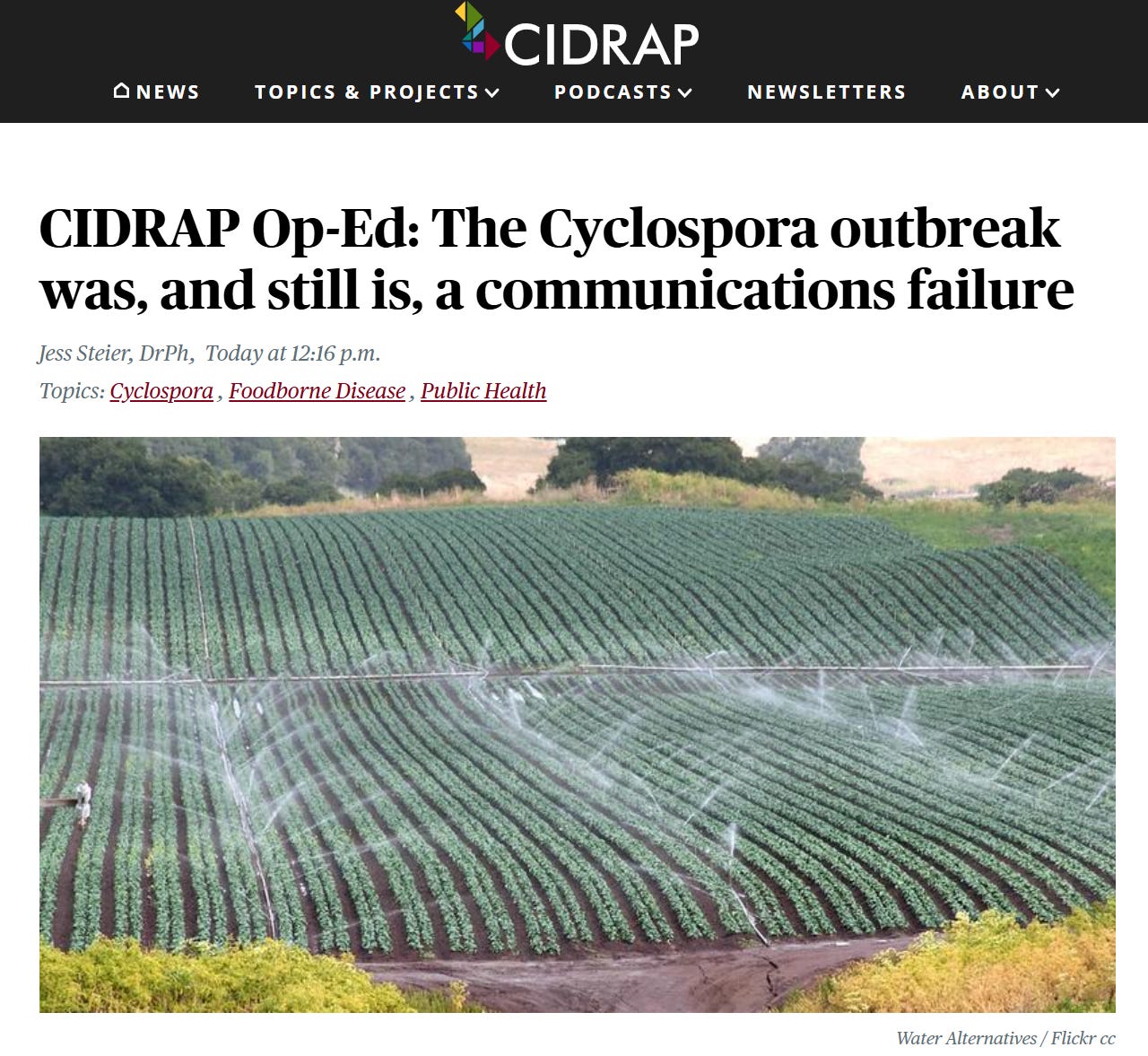
This is the largest documented Cyclospora outbreak in US history and the illnesses are real. Cyclosporiasis is not a 24-hour bug, and untreated it can run for weeks and relapse. The detective work was excellent. Because Cyclospora will not grow in culture, investigators had no clean genetic fingerprint to match cases across states, so they relied on good ol’ interviews and shipping records. Michigan walked 190 people who had eaten at Taco Bell through their meals ingredient by ingredient, and 90% of them had eaten iceberg lettuce, and the FDA traced the paper trail to a single farm in central Mexico that Taylor Farms says accounts for less than 1% of the US iceberg supply. The recall came July 17. Huzzah, that is the system working!
Where does that leave us today? It is extremely likely that the exposures that drove this outbreak happened in June and early July. Confirmed counts are still climbing because it can take up to six weeks to test someone, confirm the result, interview them, and connect them to an outbreak. A number that keeps going up is not evidence that people are still getting exposed. The implicated lettuce was recalled more than a week ago, and lettuce is perishable, so it cleared shelves quickly.
So, why does it feel like the entire country is under lettuce siege? Because several different things got collapsed into one number. The nine-state outbreak tied to iceberg lettuce accounts for 1,947 confirmed cases. The CDC separately reports more than 4,000 confirmed domestically acquired cases nationally since May. It has now been reported in 41 states. Cyclosporiasis turns up every summer in this country, outbreak or no outbreak, and several states say their counts are about where they normally are. North Carolina thinks its own increase is about parsley and cilantro, neither of which has emerged as a national signal, and the state says outright that its surge does not appear connected to the lettuce outbreak. The FDA is separately investigating a cluster of at least 72 people with no identified source at all. Pulling all of that apart into a clear national picture took until the fourth week of July, which is what happens after years of shrinking federal and state food safety capacity.
The cumulative count tells us how many people got sick, how many landed in the hospital, and whether a state needs to surge resources (all very important). What it cannot do is tell you whether you are likely to get sick this week, which is the thing most people are actually asking. Those are two different questions, and only one of them was getting answered in public.
Now, I am NOT saying this outbreak is no big deal. Under-warning is a serious failure, and if I have to choose, I will always err toward telling people to be overly cautious. But over-warning has costs, too. It frightens people who were never at meaningful risk, pushes people away from produce most Americans already do not eat enough of, costs growers a season, and spends down the trust we need for the next warning. Timing is the piece we handled worst here. The case for telling everyone to be cautious was strong in June, when nobody knew the source. We were still saying it in late July, after the source was identified and pulled.
A fair objection is that we still do not have the complete picture. No product sample has held up as positive, and nobody has established how the parasite got onto the lettuce in the first place. What I would say is that 190 food histories converging on one ingredient, and traceback converging on one supplier, are most consistent with a single contaminated product rather than something broader. If that shifts, I will tell you.
If you are immunocompromised, on chemo, or living with a transplant, take this seriously. Cyclosporiasis runs longer for you, it relapses, and it can bring complications that need clinical attention, so staying careful is warranted. If you have had diarrhea for more than a few days, see your doctor and ask specifically about Cyclospora testing, because a lot of routine stool panels do not include it.
For most everyone else, especially outside the nine outbreak states, I do not think a summer without salad is buying you much. The recall covered product from one farm, and it came off shelves more than a week ago. Check the recall list and skip anything on it. And yes, there is risk. There is some risk every time any of us eats fresh produce, and there always has been. For almost everyone, that trade is still worth making.
Our own messaging, mine included, was broader than it needed to be. The detective work supported a narrow message about one product, from one supplier, in a handful of states. What went out was closer to “be afraid of lettuce.”
2. Peptides are about to get a lot easier to buy, and the evidence has not changed
Peptides are everywhere in wellness content right now. They are short chains of amino acids that act as signals in the body, and plenty of them are legitimate approved drugs. GLP-1 receptor agonists, which most people just call GLP-1s, are peptides. So is the oxytocin used to start labor. The ones in question here are a different group, sold for wound healing, joint repair, metabolism, and longevity, with names like BPC-157 and TB-500. None is FDA-approved for any of the uses being marketed, and the evidence supporting the wellness claims being made for them ranges from limited to essentially nonexistent. Almost everyone taking them buys from online sellers, mostly overseas, who label the product “research use only” to sidestep the rules.
On July 23 and 24, the FDA’s Pharmacy Compounding Advisory Committee voted to recommend that six of these peptides be added to the 503A Bulks List, the roster of substances compounding pharmacies are allowed to make and sell directly to patients. (BPC-157 cleared eight to six with one abstention on Thursday, with KPV, TB-500, and MOTS-c following the same day, and epitalon and semax clearing Friday. Only emideltide was rejected.)
Compounding pharmacies make customized medications for individual patients when the commercial product does not fit, like a liquid instead of a pill or a formulation without a particular dye. It was built as an exception to the drug approval process and has grown into a multibillion-dollar business that telehealth companies sit on top of.
The vote was also the second move on these peptides in a year. In 2023 the FDA put them on a list of substances too risky to compound at all. This April, it pulled them back off, a decision HHS Secretary Robert F. Kennedy Jr. said would "immediately begin shifting demand away from the black market.“ Last week’s vote would take them from tolerated to affirmatively permitted.
Candidly, this is concerning to me. Here’s why.
The FDA’s own scientists were far more concrete with the committee than “the evidence is thin.” They flagged a real risk that synthetic versions of molecules your body already makes will provoke an immune response, up to and including anaphylaxis (a severe, potentially life-threatening allergic reaction). That risk exists even when the product is made correctly, and it is not hypothetical. Taspoglutide, an experimental diabetes drug built to closely mimic a hormone the body already produces, generated antibodies against itself in about half the patients who took it and systemic allergic reactions in 6%, including anaphylaxis, and Roche stopped dosing patients in the phase 3 trials in 2010. Manufacturing adds a second path to the same place, because errors can slip the wrong amino acid into the chain. Another issue is that several of these peptides do not dissolve well and can come out of solution, so someone injecting at home may get a different dose every time. And epitalon cleared the panel despite FDA scientists warning that long-term exposure could be carcinogenic. The telomere lengthening being marketed as a longevity benefit is the same property that raises the concern.
All of that assumes we at least know what the drug is supposed to be. An FDA staffer also told the committee there is no standardization for these peptides, and that the agency has encountered products all marketed as BPC-157 that contained different active molecules. Another official was even blunter, saying the agency does not know with any certainty what the substance is. My colleague Dr. Leigh Baxt, who has followed all of this closely, points out that most of the injectable substances already on that compounding list have considerably more safety data behind them than these peptides do.
So, how did anyone get to yes? Leigh listened to the entire BPC-157 session, and the affirmative case came down to clinicians describing patients they believe it helped, and an argument that this list does not require proof of safety or efficacy in the first place. That second argument flips the burden of proof. The question stops being whether there is evidence these drugs work and becomes whether anyone can prove they do not. The BPC-157 vote was also nominally about treating ulcerative colitis, and Leigh says almost nobody addressed that indication, including the members explaining their yes votes.
And people really do swear by these, which I want to take seriously without mistaking it for evidence. Most of what BPC-157 gets used for is soft tissue injury, and soft tissue injuries heal on their own. People also tend to start something new when they feel worst, which is when they are most likely to improve anyway. Sincere, confident testimony is exactly what you would get either way, which is the whole reason controlled trials exist. The randomized data we do have on BPC-157 suggest it may perform no better than placebo.
The committee added eight new members last month, six of whom market peptides, and by Science’s count, at least seven people on the panel are involved in companies that sell them. They voted in favor. I do not need to assume anyone acted in bad faith to think a panel should not be setting market access for products its own members sell.
The strongest argument on the other side came from a committee member explaining her yes vote. She described a patient who brought her a research-grade product bought online that turned out to be cut with MDMA. That is the status quo, and it is dangerous. A licensed compounding pharmacy, with manufacturing standards, a prescription, and a record of where the raw material came from, is a real improvement on that.
Leigh put her finger on why that only goes so far. Compounding changes who is allowed to sell you a drug. It generates no new evidence about whether it works, and it will not produce the large controlled trials that would, because those require a company to file an investigational new drug application and fund years of development. If a peptide sells profitably without any of that, the incentive to ever run them gets weaker.
What worries me most is what patients will reasonably conclude. Brian Lee, a USC physician who voted no, warned the committee that this would not be an FDA approval but that people would read it as one anyway, and that impression is very hard to undo. He also noted that harms like liver injury do not show up in self-reported side effects.
None of this is final. The FDA is not obligated to follow its advisory committees, and a decision is expected in the coming weeks. But if the agency signs off, compounding pharmacies will be allowed to make these peptides, and the telehealth companies that rely on those pharmacies can start prescribing and selling them to you. Easier access is not the same thing as better evidence.
Huge thanks to Leigh, who has been covering peptides for months and sat through every hour of these hearings. Her page and her Unbiased Science podcast episode are both worth your time!
3. Your banana is not destroying your blueberries
A clip from the Mel Robbins podcast made the rounds this week, in which Dr. Rhonda Patrick said she skips bananas in blueberry smoothies. The reasoning is that bananas have high polyphenol oxidase activity, an enzyme that degrades polyphenols, so the banana cancels out what the blueberries are doing for you. My colleague Dr. Kevin Klatt, a nutrition scientist and registered dietitian, went and read the 2023 study behind the claim, and he walked through what it actually measured and where the leap happens. He graciously brought us into the response.
Nowhere in that study did anyone put bananas and blueberries in the same smoothie. The study was about cocoa. Researchers had the same small group of healthy men (eight enrolled, six of whom completed each smoothie day) come back on separate days for a banana smoothie, a mixed berry smoothie, and a capsule with milk, with cocoa flavanol extract stirred into every one of them. What they measured in people’s blood was a compound in plants called epicatechin (and a few other compounds it gets metabolized to). Cocoa extract is a very concentrated source of epicatechin. Bananas aren’t a good source, and neither are blueberries (an apple has much more!). On the banana smoothie day, blood levels were much lower, likely due to the higher enzyme activity in the banana. On the berry day, they were higher, likely because berries have far less of this enzyme than bananas do. Berries were never the focus of the study (cocoa extract was!) and were only there as a comparison for bananas.
Nobody‘s health was measured here. They drew blood over six hours and watched levels rise and fall, which tells you something got absorbed and nothing about whether it made any difference to anyone's health.
Blueberries get most of their health reputation from a different family of compounds called anthocyanins, and those were not measured here at all. So, the actual finding is that adding a banana to an expensive cocoa flavanol-fortified smoothie reduces how much epicatechin you absorb. Whether a banana does anything to the other types of polyphenols in your blueberries is something this study never tested. That headline doesn’t generate buzz nearly as well as “bananas kill the benefits of blueberries.”
The bigger issue Kevin raises is who this content targets. More than 80% of Americans do not eat enough fruit. Advice about optimizing the polyphenol yield of your smoothie is built for people with the time and money to chase every alleged biohack, and it makes a villain out of the one fruit almost anyone can afford and find year-round, while your blueberries keep their fiber and micronutrients no matter what you blend them with. Kevin also points out that the one trial everyone is citing was funded by the company that sells the cocoa extract, which also employed the study’s first author and supplied the extract itself, a depressing reality-check on who is willing to pay for nutrition research at all. His full breakdown (and all of his content) is top notch.
Eat the banana.
Stay Curious,
Unbiased Science
Comments
Nothing yet. Say the first thing.
Sign in to join the conversation.