
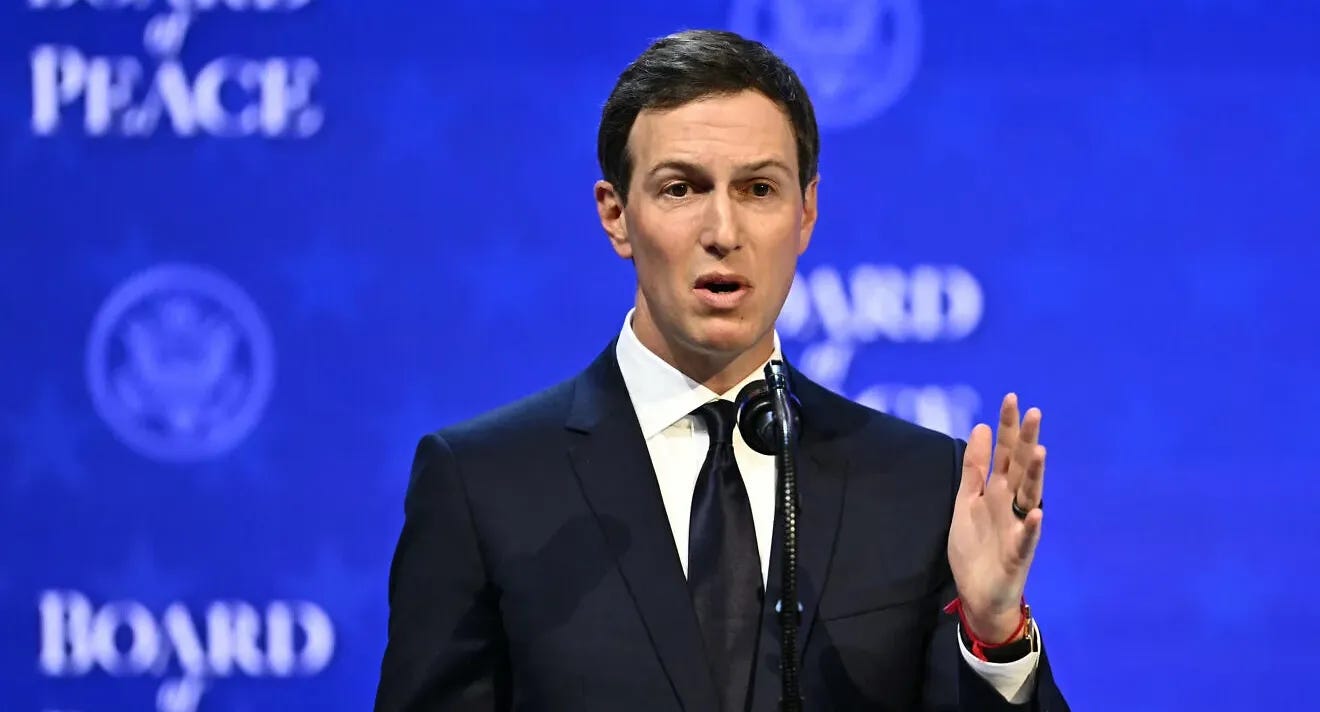
At the World Economic Forum in Davos this week, Jared Kushner unveiled what he called a “master plan” for post-war Gaza: glittering skyscrapers along the Mediterranean, sprawling coastal tourism zones, free-trade corridors, industrial parks, a new port, a new airport, and more than 100,000 housing units in what he branded “New Gaza” and “New Rafah.”
There is just one problem.
The people of Gaza were never consulted.
Presented as a reconstruction initiative, the plan instead reads like a glossy real-estate prospectus — one that treats a devastated, besieged territory as vacant land rather than the site of an ongoing humanitarian catastrophe and mass death.
“There is no Plan B,” Kushner said in Davos, framing the proposal as both inevitable and final.
Since October 7, 2023, Israel’s U.S.-backed assault on Gaza has killed more than 71,000 Palestinians, with thousands more missing and presumed buried beneath an estimated 68 million tonnes of rubble. Entire neighbourhoods have been erased. More than 80 percent of buildings have been damaged or destroyed. Every major hospital and university has been hit. Nearly all of Gaza’s 2.3 million residents have been displaced, many multiple times.
Yet Kushner’s plan offers no clarity on property rights, land ownership, accountability for war crimes, or even where Palestinians would live while their cities are demolished and rebuilt. Instead, it proposes constructing luxury towers and industrial zones directly atop the ruins — and the mass graves — of Gaza.
Trump, speaking alongside Kushner in Davos, made the logic explicit.
“I’m a real estate person at heart,” he said. “It’s all about location. Look at this beautiful piece of property on the sea — what it could be.”
Experts, journalists, and human rights advocates have condemned the proposal as an imperial fantasy that reduces genocide to an investment opportunity.
“This is a plan to erase Gaza’s indigenous character,” wrote Palestinian-American author Susan Abulhawa. “It turns the survivors into a cheap labor force and converts their coastline into an exclusive playground for tourism.”
The redevelopment plan is tied to Trump’s newly announced “Board of Peace,” a body he claims will oversee Gaza’s reconstruction. The 11-page charter does not mention Gaza explicitly and appears to position the board as a parallel international authority — potentially rivalling the United Nations.
Membership operates on a three-year cycle, with permanent seats reportedly costing $1 billion.
The executive board includes Trump as chair with veto power, Kushner himself, U.S. Secretary of State Marco Rubio, former UK Prime Minister Tony Blair, and Israeli Prime Minister Benjamin Netanyahu — despite Netanyahu facing an International Court of Justice arrest warrant for war crimes in Gaza.
Notably absent: Palestinians.
Trump said the board would be “very successful in Gaza” before expanding its mandate elsewhere. Kushner outlined sweeping redevelopment plans without mentioning Palestinian self-determination or statehood.
Hamas condemned the proposal outright. Palestinian civil society groups say they were never approached.
“We were shocked,” said Amjad Shawa, director of the Palestinian NGOs Network in Gaza. “After years of work — and especially after the last two years of devastation — no one consulted Palestinians about Gaza’s future.”
According to Kushner, the plan would raise Gaza’s GDP to $10 billion by 2035, create 500,000 jobs, and attract $25 billion in investment. He did not say who would fund it.
Security, he emphasized, comes first.
Reconstruction would only begin after Hamas is fully disarmed and Israeli forces withdraw — a condition Palestinians fear would leave them defenceless against future attacks. The plan proposes dismantling or absorbing armed groups into a new technocratic body, with selective amnesty for cooperating Hamas members.
Maps shown in Davos divide Gaza into colour-coded zones: residential areas, vast coastal tourism strips lined with up to 180 skyscrapers, industrial zones for data centers and “advanced manufacturing,” and green spaces for parks and agriculture. Rafah would be rebuilt first, followed by Khan Younis, central refugee camps, and finally Gaza City.
Kushner claimed all of this could be completed in two to three years.
What the plan does not explain is where displaced Palestinians would live during reconstruction — or whether they would have the right to return at all.
Critics describe the proposal as a sanitized rebranding of mass displacement.
Owen Jones, a Guardian columnist, described the proposal in stark terms: “This isn’t peace. It’s naked neocolonialism.” He noted that the so-called Board of Peace’s charter “doesn’t even mention Gaza,” arguing that it reads like an attempt to construct an alternative to the United Nations — “a blunt instrument for Trump to exercise American power.” Jones added that Trump would serve as chair in a personal capacity rather than as U.S. president, effectively positioning himself as “Gaza’s emperor.”
Maha Hussaini, head of media at the Euro-Med Human Rights Monitor, told Al Jazeera that decisions made without the meaningful participation of those most affected merely reproduce the same power structures that enabled occupation and genocide. Without justice, she warned, what is labelled “peace” becomes nothing more than a temporary arrangement that leaves the genocide intact — adding that, for Palestinians, there is now “more fear than hope.”
Journalist and Co-Founder of Dropsite News, Ryan Grim, summarized the danger more bluntly:
“Trump has appointed himself lifetime leader of the world -- technically Chairman of the Board of Peace. Term never expires..”
In Kushner’s vision, Gaza is no longer a home, a society, or a people — but a location. A development opportunity. A blank slate.
One created through destruction.
Enjoyed this piece? Support The Tungsten Wire by subscribing — it’s free.
We take no corporate money, no sponsorships, and no pay-to-play deals. Our work is fully independent and fueled by readers who care about honest, uncompromising political commentary and journalism. Subscribing costs nothing, but it helps us grow, beat the algorithm, and bring more eyes to this work.
👉 Subscribe now at thetungstenwire.com — it only takes a second, and it makes a real difference.
No posts
Comments
Nothing yet. Say the first thing.
Sign in to join the conversation.