
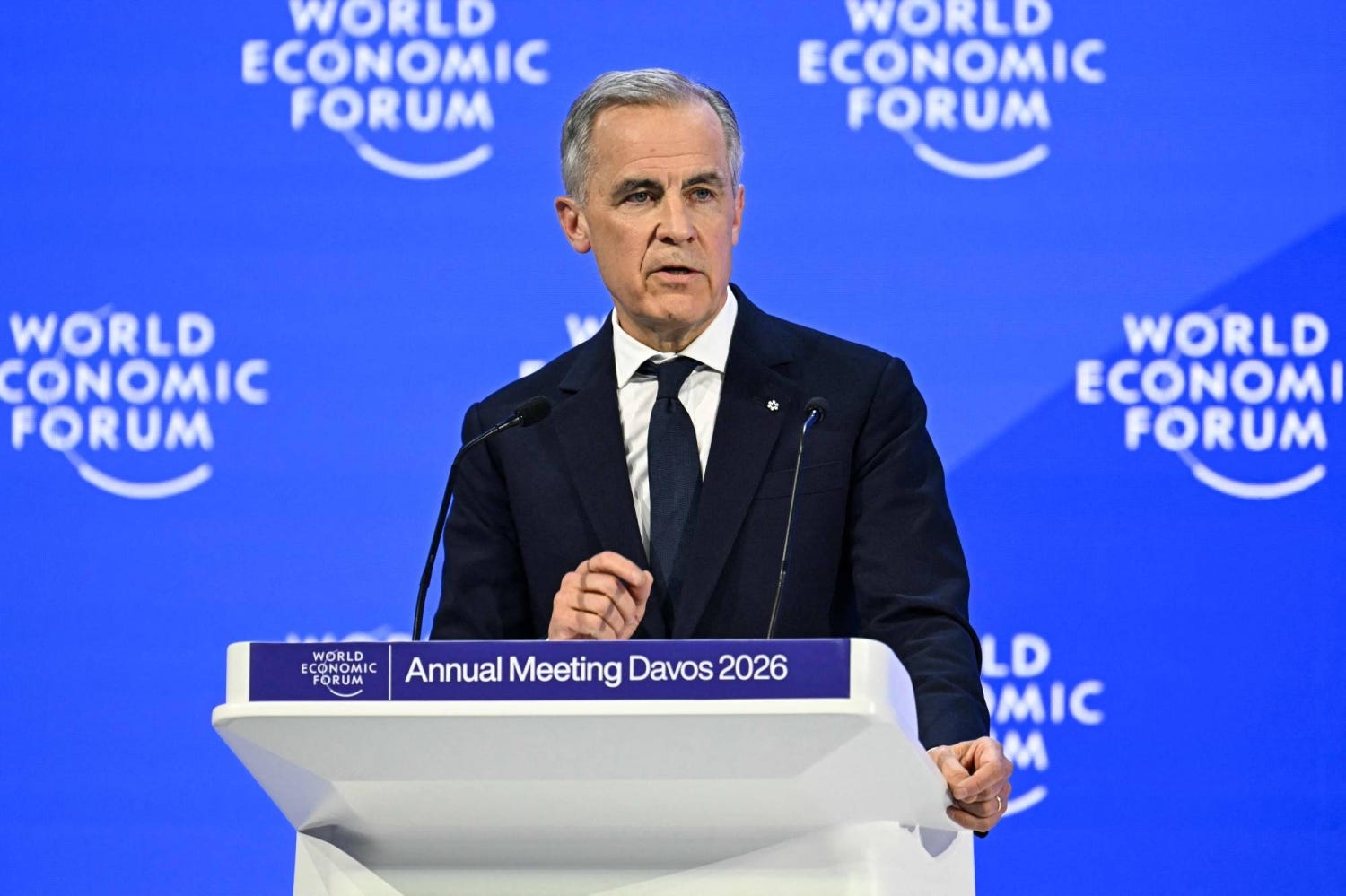
In an unusually candid speech at the World Economic Forum in Davos, Canadian Prime Minister Mark Carney delivered one of the most direct critiques of U.S. power ever offered by a sitting leader of a close American ally. The global order, Carney warned, is not in transition—it is in rupture—and American hegemony is at the center of the break.
For decades, Carney said, countries like Canada participated in what was politely called a “rules-based international order,” even as they understood it to be largely fictitious. The rituals mattered more than the reality. States signalled loyalty to shared rules not because those rules were enforced fairly, but because compliance bought access to trade, finance, markets, and security.
“Middle powers participated in the rituals, and largely avoided calling out the gaps between rhetoric and reality,” Carney said. “In return, we were granted access.”
That bargain, he told the Davos audience, no longer exists.
“This bargain no longer works. We are in the midst of a rupture, not a transition.”
Carney’s critique was pointed and unambiguous. Over the past two decades—and accelerating rapidly under U.S. President Donald Trump—economic integration has been transformed into a weapon. Tariffs are used as leverage, financial systems as instruments of coercion, and supply chains as vulnerabilities to be exploited.
“You cannot live within the lie of mutual benefit through integration when integration becomes the source of your subordination,” Carney said.
The result, he warned, is a world retreating inward: fragmented, volatile, and increasingly governed by raw power rather than shared legitimacy. Smaller and mid-sized states are pushed into competing with one another to be “the most accommodating,” a dynamic Carney dismissed as hollow theater.
“This is not sovereignty,” he said. “It is the performance of sovereignty while accepting subordination.”
Rather than clinging to the language of a rules-based order that no longer functions as advertised, Carney urged countries to name reality honestly—and respond collectively. He called for a third path in global politics, one where middle powers cooperate to resist coercion and actually enforce principles long reduced to slogans, particularly those enshrined in the UN Charter.
“We should not allow the rise of hard power to blind us to the fact that the power of legitimacy, integrity, and rules will remain strong if we choose to wield it together,” he said. “Stop invoking the ‘rules-based international order’ as though it still functions. Call the system what it is.”
Carney’s remarks landed with unusual force. He received a rare standing ovation in Davos, and his speech quickly became a flashpoint in Canada’s evolving relationship with Washington. Trump responded angrily, telling the forum that Canada “lives because of the United States” and scolding Carney directly: “Remember that, Mark, the next time you make your statements.” Days earlier, Trump had posted an AI-generated image depicting Canada and Greenland draped in the American flag.
If the intent was intimidation, it backfired at home. Trump’s rhetoric has helped consolidate domestic support behind Carney, who has framed Canadian sovereignty not as anti-Americanism, but as a refusal to accept permanent vulnerability. Since Trump began openly threatening annexation after the 2024 election, Canadians have cut travel to the U.S., boycotted American products, and prioritized domestic alternatives.
“When the rules no longer protect you, you must protect yourself,” Carney said. “If you are not at the table, you are on the menu.”
Political reaction inside Canada has been strikingly broad. Conservatives and Liberals alike praised the speech’s clarity, with former ministers urging Canadians to put aside partisanship and listen. Polls show Carney maintaining approval above 50 percent, with his Liberals holding a commanding lead—an electoral reversal widely attributed to his willingness to confront U.S. pressure head-on.
Political scientists note that the appeal is not just nationalist, but philosophical. Carney articulated a worldview fundamentally different from Trump’s: one rooted in legitimacy over dominance, cooperation over coercion.
“We’re very values-based,” said Toronto resident Ann Peel. “We’re not just going to roll over because the United States wants us to.”
Carney’s speech also fits into a broader international reckoning. German President Frank-Walter Steinmeier recently warned that the U.S. is turning the world into “a den of robbers,” while Amnesty International has described Trump’s first year back in office as a “human rights emergency” eroding the foundations of free society.
Critics rightly note that Canada, like other Western powers, bears its own responsibility for the erosion of international law—through militarization, selective enforcement of human rights, and complicity in global systems of inequality. But Carney’s intervention matters precisely because it breaks with the tradition of polite silence.
For years, leaders treated Trump like a volatile relative to be managed. Carney chose confrontation—not theatrics, but clarity.
“There’s a sense of pride,” said University of Toronto professor Jack Cunningham. “Carney is the leader who has actually pressed back—and still commands Trump’s respect.”
Whether words turn into sustained policy remains an open question. Carney has already shown tactical flexibility, backing off some trade measures to keep negotiations alive. But at Davos, at least, he did something rare in modern Western politics: he told the truth about power, out loud.
And a lot of people, in Canada and beyond, were waiting to hear someone say it.
Enjoyed this piece? Support The Tungsten Wire by subscribing — it’s free.
We take no corporate money, no sponsorships, and no pay-to-play deals. Our work is fully independent and fueled by readers who care about honest, uncompromising political commentary and journalism. Subscribing costs nothing, but it helps us grow, beat the algorithm, and bring more eyes to this work.
👉 Subscribe now at thetungstenwire.com — it only takes a second, and it makes a real difference.
No posts
Comments
Nothing yet. Say the first thing.
Sign in to join the conversation.