
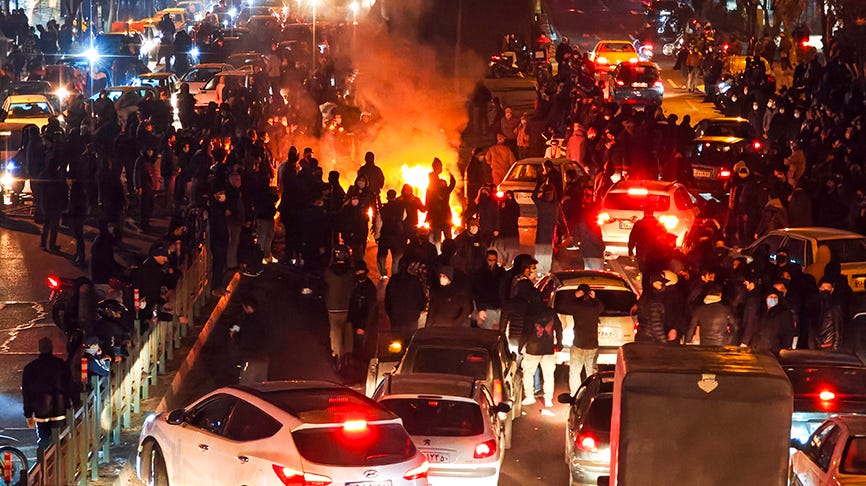
Iran has been under a government-ordered internet blackout for over a week. Because of that, very little reliable information is getting out.
What we do know is this: thousands of people have been killed since the government launched a violent crackdown on nationwide protests that began in late December.
The protests started in Tehran’s grand bazaar, where people were furious about the collapse of Iran’s currency and the rising cost of living. What began as economic anger quickly turned into broader demands for political freedom. At first, the government tried to calm things down with limited fixes, like subsidies for basic goods. That failed. Protests spread to smaller cities and towns, and by early January, a new wave of demonstrations had begun. The state responded with mass violence.
Early videos showed huge crowds in cities like Tehran and Mashhad. More recent footage is far darker: families crying outside overcrowded morgues, people searching for missing relatives, and mourners chanting “death to the dictator” at funerals. Estimates now put the death toll at over 2,500 protesters.
The government says more than 100 security forces have also been killed. State TV shows morgues and grieving families, but always frames the dead as victims of “rioters.” Authorities claim foreign-backed armed groups hijacked legitimate protests.
It would be easy to dismiss this as propaganda — except Israeli officials have openly said Israel has agents operating inside Iran. Reza Pahlavi, son of the former shah and now aligned with Israel’s prime minister, brushed off reports of mass civilian deaths by saying: “This is a war, and casualties are inevitable.”
But this is not a war.
These are popular protests, driven by economic collapse, corruption, and a political system that crushes dissent and blocks real participation. Turning this into a foreign intervention — through airstrikes, covert action, or political manipulation — would destroy the movement and turn protesters into tools of outside powers.
Six months ago, the U.S. and Israel attacked Iran. That war did not free Iranians. It killed more than 1,000 people, displaced tens of thousands, and made the economy even worse.
Despite this, voices in the Iranian diaspora and U.S. politics are once again calling on Donald Trump to “do something.” Trump has spent weeks openly considering strikes on Iran, presenting himself as a potential “saviour.”
That claim doesn’t hold up.
This is the same leader who justifies militarized police killing protesters at home. There is no reason to believe he cares about Iranian lives.
In fact, Trump is directly responsible for much of the crisis the Iranians are facing.
Iran’s economic collapse was triggered by the rapid fall of its currency, caused by U.S. sanctions that cut Iran off from its own foreign reserves. Economists describe this as an imposed crisis, worsened by renewed EU sanctions. This pressure campaign began nearly a decade ago under Trump’s so-called “maximum pressure” strategy — designed explicitly to crush Iran’s economy.
Trump has a pattern: create crises, escalate conflict, then claim credit for “fixing” the damage. He wants deals, leverage, and headlines — not democracy.
His recent actions in Venezuela make this clear. The priority there wasn’t freedom or elections, but access to oil. The same logic applies to Iran. No population would freely vote to hand over its resources to the U.S.
Inside Iran, anger is not only aimed at Supreme Leader Ali Khamenei, but also at the Islamic Revolutionary Guard Corps (IRGC), which many Iranians see as a corrupt power structure that treats the country like a private business.
Ironically, U.S. sanctions have strengthened the IRGC, not weakened it. While ordinary Iranians were crushed by inflation and job losses, IRGC-linked companies used political connections to survive sanctions, buy up state assets cheaply, and dominate the economy.
Sanctions destroyed small businesses, cut Iran off from global banking, and wiped out wages. Wealthy elites protected themselves by investing in property and assets. Everyone else got poorer.
At the same time, the children of the elite — known as “Aghazadeh” — openly flaunted their wealth. This contrast fueled rage.
One of the most powerful early protest images showed young people looting an IRGC-linked supermarket, throwing rice into the air. It wasn’t random. People were targeting the institutions they see as symbols of theft and control.
But economic justice requires political power. And that’s where the danger comes in.
Foreign intervention has always haunted Iran. Trump’s threats, combined with Israel’s attacks and the kidnapping of Venezuela’s president — one of Iran’s few allies — were seen as warnings.
Some Iranians support Reza Pahlavi, believing his ties to Trump could help overthrow the regime. Many others strongly reject him, especially ethnic minorities who remember the repression under his father’s monarchy. Women’s groups, labor unions, and civil society organizations have backed the protests — while clearly warning that foreign intervention would lead to chaos.
When Pahlavi publicly called for protests on January 8, authorities used it as proof that the uprising was being directed from abroad. That gave the state an excuse to escalate violence.
This is the grim reality: both Trump and Iran’s government are treating ordinary Iranians as pawns.
Iran’s leadership is trapped. It can’t fix the economy without sanctions relief. Sanctions relief requires negotiations. And the last time Iran negotiated, it was attacked.
Across Iran’s political spectrum — including people who voted for hard-line candidates — there is deep dissatisfaction. But many are also terrified of war and collapse. They’ve seen what “liberation” looked like in Iraq and Afghanistan.
Repression will not bring stability. It will only deepen division and hatred. And a real war, whether instigated by Trump or Pahlavi, could spark a civil war that the state itself had helped provoke.
Still, Iranians continue to resist.
Every uprising builds on years of organizing that outsiders don’t see. The “Woman, Life, Freedom” movement didn’t fail — it transformed society, forced the state to retreat on social control, and reshaped public life.
Economic justice and political freedom are inseparable. That’s true in Iran, and it’s true everywhere.
Iranians deserve global solidarity — not because they are helpless, but because their struggle mirrors our own. Authoritarianism is rising everywhere.
When protesters in the U.S. say “regime change starts at home,” they are right.
Enjoyed this piece? Support The Tungsten Wire by subscribing — it’s free.
We take no corporate money, no sponsorships, and no pay-to-play deals. Our work is fully independent and fueled by readers who care about honest, uncompromising political commentary and journalism. Subscribing costs nothing, but it helps us grow, beat the algorithm, and bring more eyes to this work.
👉 Subscribe now at thetungstenwire.com — it only takes a second, and it makes a real difference.
No posts
Comments
Nothing yet. Say the first thing.
Sign in to join the conversation.