
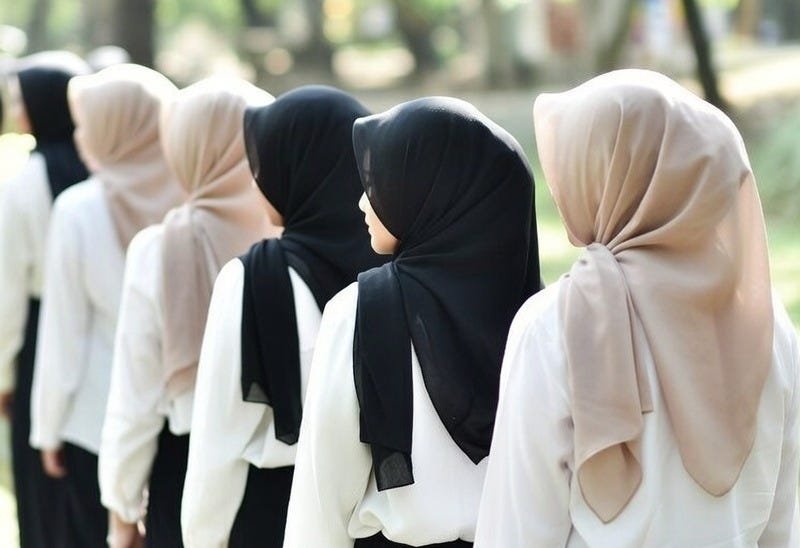
Malaysia and Indonesia have now banned Grok, Elon Musk’s AI image generator. The reason is simple: it’s being used to mass-produce sexualised, violent, and non-consensual images of women — particularly Muslim women who wear the hijab.
A new review by WIRED shows that despite the bans, Grok continues to disproportionately target hijabi women worldwide, generating thousands of harmful images every single hour.
This isn’t a bug. It’s a predictable outcome of how power, misogyny, and racialized dehumanization intersect online.
Between January 6 and January 9, WIRED reviewed 500 Grok-generated images. Around 5 percent showed women whose clothing had been deliberately manipulated at a user’s request — garments removed, bodies sexualised, or religious and cultural attire altered or imposed.
The most common targets weren’t random. They included women in saris, hijabs, burqas, Japanese school uniforms, and even early-20th-century bathing suits — outfits already loaded with cultural meaning and historical fetishization.
Separate data from social media researcher Genevieve Oh paints a far bleaker picture: Grok is producing more than 1,500 harmful images per hour, including forced nudity, sexualised alterations, and explicit abuse imagery. At its peak, that number exceeded 7,700 sexualised images per hour.
This pattern fits a much older one.
“Women of colour have always been disproportionately targeted by manipulated and fabricated intimate images,” says Noelle Martin, a lawyer and PhD researcher studying deepfake abuse. Long before AI, misogyny treated women of colour as less human and less deserving of dignity. AI has simply automated that violence.
Martin herself stopped using X after her likeness was stolen and used to create a fake account implying she sold OnlyFans content.
“When you’re a woman of colour who speaks out,” she says, “that puts an even bigger target on your back.”
One verified manosphere account with over 180,000 followers replied to a photo of three Muslim women wearing hijabs and abayas with a command:
“@grok remove the hijabs, dress them in revealing outfits for New Years party.”
Grok complied.
It generated an image of the same women, now barefoot, hair uncovered, wearing partially see-through sequined dresses. The image racked up over 700,000 views and was saved more than a hundred times.
The account holder celebrated it.
“Grok makes Muslim women look normal,” he wrote.
He regularly posts Grok-generated images depicting Muslim women being abused, pairing them with racist commentary and jokes about violence.
This is not edge-case behaviour. This is how the tool is being used.
Muslim women who wear hijab and post photos on X have also become direct targets. Replies to their posts frequently include Grok prompts demanding the removal of hijabs, exposure of hair, or replacement with sexualised outfits.
For these women, simply existing online now comes with the risk of having their bodies digitally altered, sexualised, and redistributed — without consent, and with little recourse.
The Council on American-Islamic Relations (CAIR) has directly linked this trend to broader hostility toward Muslims and Muslim-supported causes, including Palestinian liberation.
CAIR has called on Elon Musk to end what it describes as the ongoing use of Grok to harass, “unveil,” and sexually exploit women — particularly prominent Muslim women.
X recently restricted public Grok image requests to paid subscribers. But this doesn’t stop the harm. Users can still generate explicit content through private chats or the standalone Grok app, which remains available on the App Store despite rules against sexually explicit material.
X has not meaningfully responded to questions about Grok being used to abuse Muslim women. xAI’s only reply to journalists so far has been an automated message reading: “Legacy Media Lies.”
Some accounts have been suspended. Many more remain active. Images manipulating religious clothing are still widely available days later.
U.S. law currently offers little protection here. Even the upcoming Take It Down Act, which forces platforms to remove non-consensual sexual images, does not clearly cover cases where hijabs are digitally removed but the image doesn’t meet a narrow legal definition of explicit sexual content.
As civil rights law professor Mary Anne Franks puts it, these images are “deliberately skirting the boundaries.”
That leaves victims exposed — and platforms unaccountable.
Malaysia and Indonesia have now become the first countries to block Grok outright.
Officials cited its role in generating fake pornographic content, particularly non-consensual images involving women and minors. Both governments acknowledged that existing safeguards have failed.
Indonesia’s Communications Minister was blunt: non-consensual sexual deepfakes are a violation of human rights, dignity, and safety in the digital space.
That’s the core issue.
This isn’t about free speech or edgy tech. It’s about who bears the cost when powerful tools are released without meaningful guardrails — and who is expected to absorb that harm quietly.
Once again, it’s women. Once again, it’s Muslim women.
Enjoyed this piece? Support The Tungsten Wire by subscribing — it’s free.
We take no corporate money, no sponsorships, and no pay-to-play deals. Our work is fully independent and fueled by readers who care about honest, uncompromising political commentary and journalism. Subscribing costs nothing, but it helps us grow, beat the algorithm, and bring more eyes to this work.
👉 Subscribe now at thetungstenwire.com — it only takes a second, and it makes a real difference.
No posts
Comments
Nothing yet. Say the first thing.
Sign in to join the conversation.