
There was a time when nations were not simply administered, adjusted, and managed at the margins.
They were built.
They were built with intention, with conviction, and with a shared understanding that the future was not something to be passively inherited, but something to be consciously shaped – something worth striving towards, arguing over, and ultimately constructing together.
Somewhere along the way, that instinct began to fade.
We did not lose it all at once. It happened gradually, almost imperceptibly, through a steady narrowing of ambition and a quiet acceptance that the horizon should be brought closer, rather than pushed further away.
We began to settle for less.
Less clarity about what we were trying to achieve.
Less honesty about what was working and what was not.
Less belief that large-scale improvement was still possible.
And in its place, a different story took hold.
We were told that trade-offs were inevitable – that we must choose between growth and fairness, between freedom and security, between prosperity and stability.
We were encouraged, subtly but persistently, to believe that decline was simply the modern condition of advanced nations, something to be managed rather than reversed.
But these are not laws of nature.
They are the consequences of decisions – decisions about how we organise our economy, how we structure our institutions, and how seriously we take the responsibility of long-term thinking.
And decisions, if we are willing, can be changed.
It is not short of ideas, nor resources, nor people capable of building something better.
What it lacks is something far simpler, and far more foundational:
A clear and coherent vision of what it is trying to become.
Not a slogan designed for a news cycle.
Not a manifesto built around electoral timelines.
Not another set of promises that dissolve the moment they encounter complexity.
But a vision that is grounded in reality, structured with discipline, and ambitious enough to meet the scale of the challenge we face.
This is not a document concerned with the next election, or the next round of political positioning.
It is an attempt to step outside that cycle altogether, and to think instead on the timescale that actually matters – the next generation, and the one that follows.
We are building the only platform that turns widespread public participation into national design. This is not a manifesto. It is a citizen-led framework for co-creating Britain’s future.
It begins from a simple but often overlooked premise:
If we design our systems properly – across health, family, economy, and governance – they will begin to reinforce one another rather than pull in opposite directions.
Progress in one area will not require compromise in another.
It will make further progress possible.
The first, Healthy People and Families, recognises that no society can sustain itself if its foundational structures are weakening – if families form later or not at all, if health declines, and if the long-term demographic balance becomes unstable.
The second, A Thriving Economy, focuses on the conditions required for genuine prosperity – not growth driven by speculation or short-term stimulus, but growth rooted in production, enterprise, energy security, and the ability of ordinary people to build, earn, and create.
The third, Freedom, Transparent and Honest Governance, addresses something less visible but equally vital: trust. Because no system, however well-designed, can function if the institutions responsible for it are not seen as legitimate, accountable, and fair.
Each principle is practical.
Each is grounded in a clear chain of reasoning.
And each is designed not as a standalone idea, but as part of a wider system intended to function as a whole.
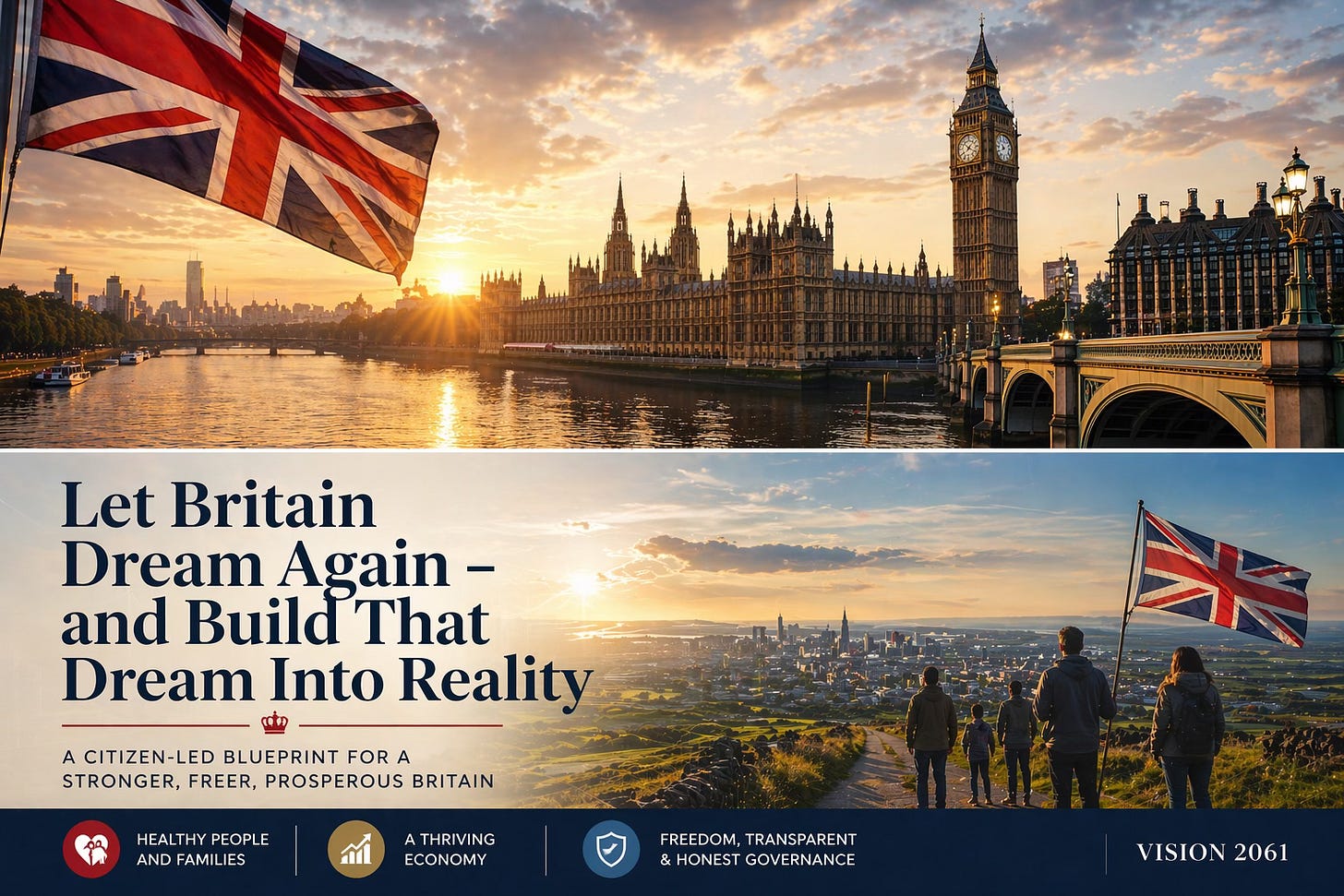
Taken together, the model projects a net national benefit of £845 billion to £1.2 trillion over five years, after accounting for overlaps across health, welfare, productivity, and economic growth.
That figure is significant, but it is not the most important part of the work.
What matters more is how those gains are generated.
Not through a single policy or intervention, but through the interaction of many – through a system that is aligned rather than fragmented, and designed to produce compounding improvements over time.
We tend to argue about individual policies in isolation, as though each exists independently of the others.
We debate fragments, while the system as a whole continues to underperform.
Vision 2061 takes a different approach.
It asks a more fundamental question:
What would Britain look like if it were designed, from the ground up, to succeed?
A country in which families can form earlier, rather than being delayed by structural barriers.
In which health is protected before it deteriorates, rather than repaired at ever-increasing cost.
In which energy is produced domestically, providing stability and resilience, rather than being exposed to external volatility.
In which capital flows into productive enterprise, rather than being drawn into passive or speculative assets.
In which institutions are trusted not because people are asked to trust them, but because they are visibly transparent, accountable, and competent.
And in which freedom is not treated as conditional, but as a foundational principle of the system itself.
It does not depend on perfect conditions, nor on unrealistic assumptions.
It is structural.
And because it is structural, it is achievable – provided we are willing to think and act beyond the constraints of short-term political cycles.
There is a deep and widespread fatigue.
People are tired of noise, tired of promises, and tired of the sense that, despite constant activity, very little changes in substance.
And from that fatigue emerges a quieter, more personal question:
Does any of this actually matter?
Does participation make a difference?
Does engagement lead to change?
Something coherent enough to be understood.
Something grounded enough to be tested.
Something substantial enough to be improved.
It is a starting point.
It is an invitation – not to agree, but to engage.
To read it carefully.
To question its assumptions.
To challenge its conclusions.
To identify what works, what does not, and what could be strengthened.
Because the future of a country should not be determined behind closed doors, nor reduced to a sequence of short-term decisions made under pressure.
It should be shaped deliberately, and collectively, by those who are willing to think seriously about what comes next.
What it has lacked is the framework through which that renewal can be organised and sustained.
We cannot build a different future by drifting into it.
We have to decide what we are aiming for.
And then we have to begin the work of building it.
Read the full Vision 2061 document here.
The Truth Contract – not just more content, but a commitment.
You’re here because the surface story doesn’t hold.
You’re ready to question, contribute, and help shape a future worth showing up for.
This is the contract: Truth. Action. Together.
Add your voice to the conversation. This is how we grow the mandate for change.
Comments
Nothing yet. Say the first thing.
Sign in to join the conversation.