
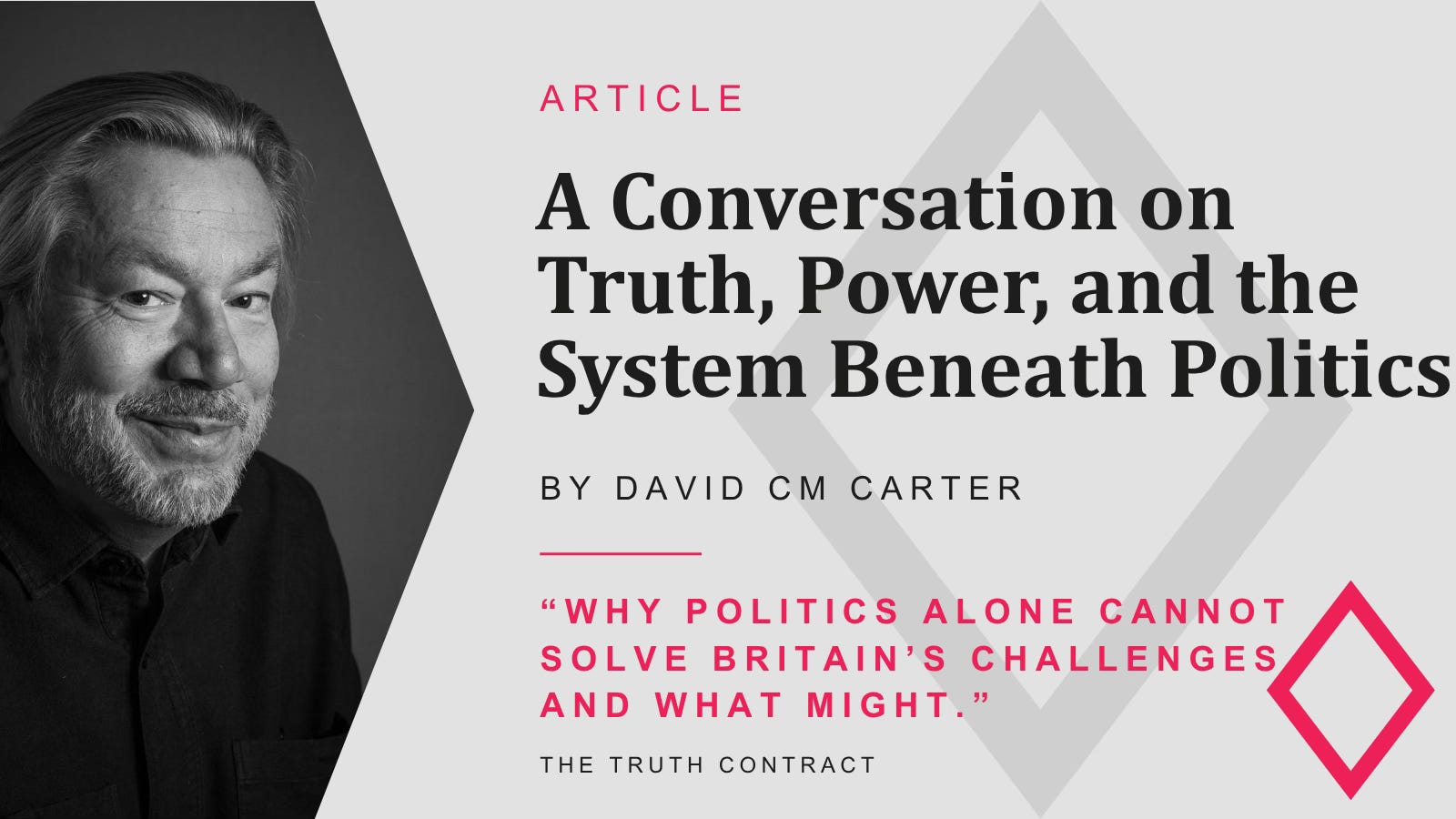
Recently, David CM Carter DCMC, co-founder of The Truth Contract, was invited onto SirToshi’s podcast for a wide-ranging conversation on the state of Britain, the nature of power, and the systems shaping our future.
You can watch the full episode here
What follows is a distilled reflection on the key themes explored in that discussion.
One of the central ideas explored is this:
Politics, as it currently operates, is not where real power sits.
While elections, parties, and public debate dominate the visible surface, much of the underlying system – from the civil service to regulatory bodies to supranational influence – operates with far less visibility and, often, far less accountability.
This is not about party critique.
It is about structure.
If the operating system beneath government remains unchanged, then changing the interface – the political layer – is unlikely to deliver meaningful, long-term transformation.
There is a tendency, particularly in public discourse, to reduce complex national challenges to single issues.
Immigration.
Energy.
Healthcare.
Taxation.
Each matters. None exists in isolation.
As discussed in the conversation, Britain’s challenges are deeply interconnected — economic, demographic, institutional, cultural.
Solving one part, in isolation, does not resolve the whole.
Which raises a more useful question:
What would a genuinely joined-up solution look like?
The work behind The Truth Contract is grounded in a different approach.
Rather than starting with today’s headlines, it begins with a longer horizon:
If we were designing a country for one generation ahead – what would it look like?
This thinking underpins Vision 2061.
Not as a fixed doctrine, but as a framework rooted in first principles:
Sovereignty and accountability
A productive, resilient economy
Healthy populations and sustainable demographics
Energy security and resource stability
Social cohesion and trust in institutions
From there, the work becomes practical:
How do we move from where we are…
to where we say we want to be?
A consistent theme throughout the discussion was transparency.
Not as an abstract ideal, but as a functional requirement.
Today, many decisions that materially affect public life are:
Not explicitly voted on
Not clearly communicated
Not easily traceable
Not openly scrutinised
This creates distance between decision-making and public understanding.
And in that distance, trust erodes.
The proposition explored is simple:
A system that is visible is harder to corrupt.
A system that is opaque invites it.
This led into a deeper conversation around infrastructure.
If transparency is essential…
what enables it at scale?
The discussion touched on the potential role of distributed, immutable systems – digital ledgers capable of recording decisions, transactions, and data in ways that cannot easily be altered or erased.
The promise of such systems is not ideological.
It is functional:
Traceability of decisions
Visibility of flows (financial and otherwise)
Reduction of undisclosed conflicts of interest
A permanent record of what was said, done, and agreed
Whether or not one agrees with the specific technological path discussed, the underlying question remains:
What kind of infrastructure would a truly accountable society require?
Another core theme was the role of the public.
At present, most people experience governance as something distant – something that happens to them, rather than with them.
Engagement is episodic.
Understanding is fragmented.
Influence feels limited.
The direction TTC is exploring is different:
Making complex issues understandable
Presenting competing perspectives clearly
Enabling informed participation
Creating mechanisms for meaningful input
Not as theatre.
But as function.
Because a system designed without public understanding will eventually lose public trust.
The Truth Contract is not a political party, and it is not intended to become one.
The aim is to operate as a turnaround capability:
Bringing together subject-matter experts
Developing integrated, cross-sector solutions
Testing those ideas in public
Refining them through participation and scrutiny
And ultimately:
Making available a coherent, actionable pathway for national renewal.
There is no shortage of commentary about what is wrong.
What is less common is serious, integrated work on what comes next.
This conversation was not about having all the answers.
It was about asking better questions:
Where does power actually sit?
What is visible, and what is not?
What assumptions are we operating under?
What would we build if we started from first principles?
And perhaps most importantly:
What role does each of us play in shaping what comes next?
This summary only touches part of what was explored.
You can watch the full discussion here
The Truth Contract – not just more content, but a commitment.
You’re here because the surface story doesn’t hold.
You’re ready to question, contribute, and help shape a future worth showing up for.
This is the contract: Truth. Action. Together.
Add your voice to the conversation. This is how we grow the mandate for change.
Comments
Nothing yet. Say the first thing.
Sign in to join the conversation.