
Source for thumbail image: Image: "MBTA Providence Line train 864 departing Ruggles" by 4300streetcar is licensed under CC BY 4.0
The United States currently has 49 miles of high-speed rail track. On that track, Amtrak trains can run up to 160 miles per hour, as the geometry is straight and the right-of-way is fully grade separated. All of it lies on the Northeast Corridor, split between New Jersey, Rhode Island, and Massachusetts.
Imagine for a moment that you’re tasked with providing commuter rail service between Providence and Boston. Much of the track supports some of the fastest rail speeds in the country, and it’s fully electrified.
In what reality would the train technology look like this?
Running diesel push-pull trains under wires on mostly straight track? Unserious.
The Providence Line is the busiest commuter rail line on the MBTA’s 12-line network, with nearly 20,000 daily riders, and with Providence ranking as the 13th-busiest Amtrak station in the country, the line clearly deserves better.
At present, the trip from Providence to Boston takes 70 minutes (varies based on trip). The Acela does it in 48 (with far fewer stops). So how can a local line like the Providence Line close the gap if 48 mins is the ceiling? Quite easily, actually.
The basic improvements the Providence Line needs could be made anywhere, but the incredible work of the Momentum Report and the TransitMatters report highlights the changes we all know would make the line far faster (please read and support both organizations).
The current runtime of MBTA #836 is 78 minutes, of which only 36 minutes is actual running. That means 54% of the trip is spent accelerating, decelerating, and stopping at stations.
Of the 12 stations between Providence and Boston's South Station, 6 are currently low-platform, which means everyone boarding has to climb stairs to get on and off the train, slower than simply walking through a wide door that's flush with the platform.
At the extreme, Amtrak can dwell for more than 5 minutes at a low platform with narrow doors; in places like Providence, the Northeast Regional can take 2 minutes thanks to those narrow doors and passenger luggage. The fastest dwells belong to the LIRR, where wide doors and flush platforms let people board and alight in as little as 30 seconds. Compound that across many stops and the delay adds up fast.
Time savings: Converting every platform on the line to high-level alone would save 9 minutes.
It goes without saying that heavy diesel trains take longer to reach cruising speed than a lightweight electric one, same as with cars. Caltrain's electrification is the famous example: what takes a diesel push-pull train (MBTA's technology) nearly 90 seconds to reach cruising speed takes an electric EMU a fraction of that.
And even if the trains stayed diesel but ditched the push-pull setup (a locomotive hauling cars), you’d still see savings, if MBTA’s Providence Line trains looked like the TexRail equipment below.
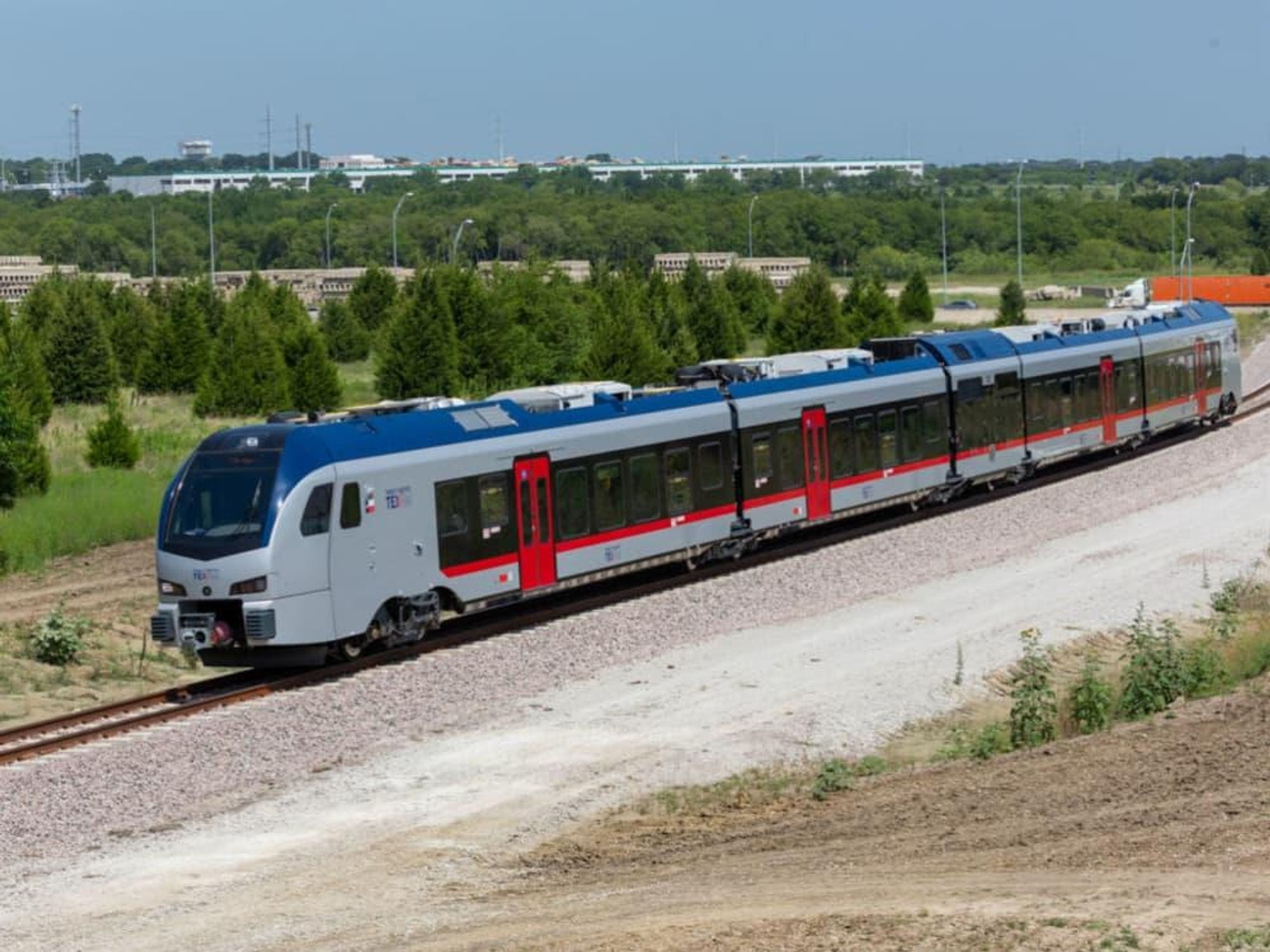
In a perfect simulation, the acceleration savings could approach 60 seconds at every single stop.
Time savings: Converting the current fleet to electric EMUs would save 16.5 minutes on its own.
I almost always run my own calculations on work like this, but given the great work of the Momentum Report and the TransitMatters modernization report, I’ll use their numbers, I’d rather not promote something outside the bounds of their advocacy. So: high-level platforms at every station, and electric EMU trains.
Per my very rough math, at max peak service there are 5 trains running between Wickford Junction/Providence and Boston, producing 20 one-way trips each way to Providence (8 of which continue to Wickford).
If you assume all five trains can run a 47-minute runtime to Providence and a 73-minute runtime to Wickford, with each train needing 10 minutes to turn around at each terminal, the time savings let you run an additional 12 trips in each direction every day.
What is happening on the Providence Line is a microcosm of American transit. We look at METRA, MARC, VRE, and Metrolink, and we accept sluggish, low-platform diesel operations as the natural order of things. But Caltrain’s 57% ridership jump post-electrification proved what happens when an agency stops accepting the status quo. Fixing this isn’t a question of technological limits, it’s a test of political will. We don’t always need to build new multibillion-dollar systems from scratch. Sometimes, we just need to stop choosing to run the systems we already have so poorly.
Sources for this work: Transit Matters Report & Momentum Report
Author’s note: I was formerly contracted with the MBTA. All information in this article comes from fully public sources; none of it was gained from my time at the agency, its employees, or anything not public-facing.
No posts
Comments
Nothing yet. Say the first thing.
Sign in to join the conversation.