
The Tianxian View is the Pune International Centre’s (PIC) weekly newsletter on China. Each week, we bring you handpicked insights into the key developments shaping China’s politics, economy, defence, foreign policy, technology, and climate.

This week, China charges on two fronts. At home, its provinces are charging into a fierce race for the next growth crown; abroad, its green BRI roads are stretching deeper into global markets. From regional power shifts to record clean-energy bets, Beijing’s next map of influence is being drawn fast.
For the first half of 2026, Beijing, Shanghai, and Zhejiang emerged as China’s leading provincial economies. Beijing’s 5.4% GDP growth was driven by services; Shanghai derived over 70% of its growth from finance, industry, and information services, while Zhejiang benefited from modern service industries.
What is Reshaping China’s Provincial Economies?
The latest data show that the country’s economic growth is no longer determined by manufacturing output alone but also by the integration of advanced manufacturing with digital services. Chinese economists argue that digitalisation, the large-scale commercial application of artificial intelligence, and the integration of manufacturing with R&D and modern logistics are reshaping provincial growth patterns. The trend indicates how local governments are aligning their industrial policies with high-quality, innovation-led growth.
However, regional imbalances remain evident. Anhui, Henan, and Hubei registered growth above 5% compared to Hunan’s 2.7% expansion. All three northeastern provinces continued to underperform the national average as the resource-dependent provinces face challenges from traditional industries. The data point to a structural shift in which advanced manufacturing, foreign trade, and modern services are becoming the principal drivers of regional competitiveness. The second half of the year is likely to see provincial governments focused on domestic demand, foreign trade, the upgradation of traditional industries, and the promotion of emerging sectors.
Text within this block will maintain its original spacing when published
Recommended Sources:CCTV - This central province has returned to the top ten in national GDP; the economic reports of 31 provinces in the first half of the year release new signals. [Chinese Version] (July 27, 2026)
Renminbi (RMB) appreciation is now being debated as a potential response to the country’s record trade surplus and external economic pressures. Chinese scholars maintain that RMB appreciation could advance Beijing’s long-term economic transition towards overseas production networks and increased domestic consumption instead of being perceived only as a constraint on exports.
What is China’s New Manufacturing Strategy?
According to Professor Shi Zhan of Shanghai International Studies University, China’s future competitiveness lies in the ‘Made with China’ approach – a model that prioritises international production partnerships over manufacturing within China. Under this framework, Chinese firms would offshore labour-intensive assembly and retain higher-value segments of the production chain, such as advanced manufacturing, component production, and supply chains, within China. Such a strategy would allow Beijing to increase its industrial dominance and supply chain dominance. In this case, the overseas factories will continue to rely on Chinese intermediate goods, and the country can still keep its control over its domestic manufacturing sector.
The argument further contrasts China’s current economic conditions with Japan’s post-Plaza Accord experience and states that China’s property market has already absorbed a significant correction, making the comparison less applicable. Shi argues that RMB appreciation would encourage Chinese firms to invest abroad. It would reduce investment costs and allow them to establish what he describes as a ‘shadow China’, an overseas manufacturing network that remains integrated with China’s domestic supply chains. The proposal argues that expanding the use of the RMB in overseas production networks would deepen the currency’s internationalisation, while stronger demand for RMB-denominated assets could give Beijing additional fiscal room to strengthen social protection and stimulate domestic demand. Although the proposal remains an academic perspective rather than official policy, it highlights growing debate within China over how to sustain economic competitiveness, ease trade tensions, and reshape the country’s next phase of globalisation.
Text within this block will maintain its original spacing when published
Recommended Sources:Sinification - Made “with” China? — Shi Zhan on RMB Appreciation and Building a “Shadow China” Abroad (July 22, 2026)
The Belt and Road Initiative (BRI) increased its green energy financing to US$20.1 billion during the first half of 2026, the highest level since the programme was launched. The surge follows global energy uncertainty due to the Iran conflict, which has reinforced demand for cost-effective and stable renewable energy solutions.
Why Green Energy is Powering the BRI?
Green energy financing under the BRI exceeded its full-year 2025 total, with US$11.8 billion in construction projects and US$8.3 billion in investments. Overall, BRI engagement hit a record US$126.3 billion, with investments across renewable energy, manufacturing, technology, and mining. The acceleration is attributed to volatile oil and gas prices and rising global demand for electricity and AI-driven data centre infrastructure. China’s private sector accounted for 48% of BRI engagement in the first half of 2026, a sharp increase from 13% in 2022.
Official customs data pointed to rising clean technology exports. Africa remained a major recipient of Chinese investment. It climbed nearly threefold year-on-year to US$33.5 billion despite concerns over debt and transparency. In contrast, no new BRI projects were announced in Pakistan or Russia, which points to a shift in geopolitical and commercial priorities. The latest figures underscore the BRI’s transition towards commercial investment, private-sector leadership, and green development.
Text within this block will maintain its original spacing when published
Recommended Sources:Financial Times - China pours funding into green energy deals as Iran war hits oil demand (July 26, 2026)
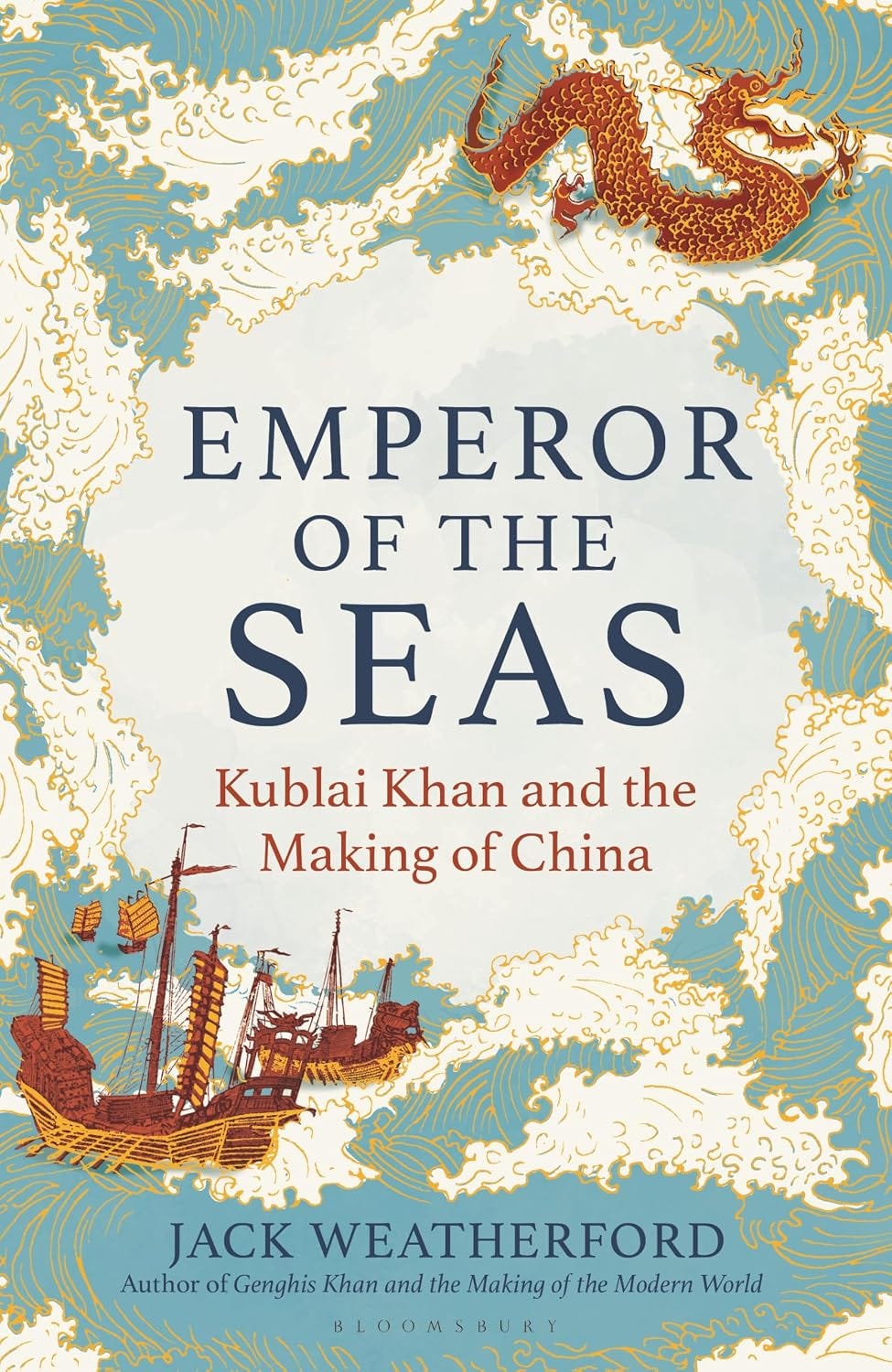
Emperor of the Seas: Kublai Khan and the Making of China by Jack Weatherford offers a reinterpretation of Kublai Khan’s rule and examines his pivotal role in shaping the political and cultural foundations of China. Weatherford challenges the conventional narrative of Mongol conquest and reveals Kublai Khan as a ruler who bridged two worlds—preserving Mongol traditions while adopting Chinese institutions, technologies, and administrative expertise. The book delves into the making of the Yuan dynasty, Kublai Khan’s statecraft, his role in expanding trade and diplomatic exchanges, and his ambition to create one of the most connected empires of the medieval world. Weatherford combines historical depth with an accessible narrative style, making the complexities of medieval Chinese and Mongol history understandable and engaging for a broad readership. For those who are interested in the history of China and the Mongol Empire, Emperor of the Seas serves as an interesting read.

养龙虾
(yǎng lóngxiā)
Yǎng lóngxiā (养龙虾) literally means ‘raising lobsters’ and has recently emerged as an internet slang term referring to the use of AI agents that are expected to work autonomously on behalf of users. The term comes from the nickname ‘lobster’ given by Chinese netizens to OpenClaw, an AI assistant marketed as a ‘24-hour digital worker’ capable of handling tasks automatically. However, early users reported problems such as accidentally deleting emails, exposing private information, and performing unintended actions, leading them to jokingly call themselves the first ‘lobster victims’ (龙虾受害人). The phrase reflects both enthusiasm and anxiety surrounding AI adoption, capturing debates over automation, digital labour, and the risks of delegating personal tasks to intelligent agents. It has gained popularity on Chinese online platforms, where it is used to describe the opportunities and uncertainties brought by the rapid development of AI tools.
Thanks for reading! This post is available for free. Please feel free to share it with others.
The Tianxian View is an initiative of the Pune International Centre (PIC), an independent and multidimensional policy think tank based in Pune, India. This newsletter aims to offer clear, contextual insights into China’s evolving trajectory.
To know more about PIC’s work and upcoming initiatives, follow us on our website and social media handles.
LinkedIn | X | Instagram | YouTube | Spotify
AI Disclosure Statement: Select Mandarin-to-English translations in this newsletter were produced using advanced large language models (LLMs), applying artificial intelligence and machine learning techniques for natural language processing.
Comments
Nothing yet. Say the first thing.
Sign in to join the conversation.