
The Tianxian View is the Pune International Centre’s (PIC) weekly newsletter on China. Each week, we bring you handpicked insights into the key developments shaping China’s politics, economy, defence, foreign policy, technology, and climate.

China’s week was defined by strategy in motion — grand designs for a reshaped global order, blacklists aimed at signalling resolve, and domestic debates that hinted at structural unease. Even the cultural calendar carried diplomatic weight, underscoring how Beijing continues to blend power, narrative, and symbolism.
In response to the Pentagon’s recent expansion of the 1260H list that classifies Chinese firms affiliated with the People’s Liberation Army (PLA), China has introduced new trade and export controls that target dozens of American companies. Beijing has placed 10 U.S. entities, including rare-earth producers MP Materials and USA Rare Earth, on its export control list and has restricted their access to Chinese dual-use products and technologies. Moreover, the Ministry of Finance, PRC, has blacklisted 46 U.S. defence companies from government procurement projects. According to Chinese officials, the restrictions were intended to protect national security and were presented as a defensive response to Washington’s ‘malicious practices.’
Why are Blacklists becoming Strategic Tools?
The latest round of actions and retaliatory responses has securitised economic relations between the world’s two largest economies. It also explains China’s preparedness to weaponise economic interdependence in pursuit of its geopolitical objectives. The development further illustrates how trade restrictions, procurement measures, and entity lists are becoming central instruments of economic statecraft. Although Beijing characterises the measures as defensive, they nonetheless contribute to the trend of economic fragmentation.
Pentagon’s recent expansion of its 1260H list includes major Chinese technology and automotive firms such as Alibaba, Baidu, BYD, and NIO. However, the Chinese measures appear more symbolic than substantive, as many of the targeted U.S. firms have limited commercial exposure to the Chinese market. The selective nature of the restrictions suggests China’s effort to contain the dispute rather than provoking confrontation. Despite their limited and immediate impact, the restrictions state that the strategic competition is no longer confined to military affairs but encompasses control over critical resources and technological innovation.
Text within this block will maintain its original spacing when published
Recommended Sources:Ministry of Commerce, People’s Republic of China - The Ministry of Commerce announced in Announcement No. 23 of 2026 the decision to add 10 U.S. entities to the export control list. [Chinese Version] (June 22, 2026)
CNBC - China imposes trade curbs on dozens of U.S. firms in retaliation for Pentagon blacklist (June 21, 2026)
Reuters - China targets US rare earth and other firms with export controls (June 22, 2026)
On June 17, the State Council of the People’s Republic of China (PRC) released a white paper titled ‘More Just and Equitable Global Governance: Principles, Proposal and Actions.’ The paper positioned the Global Governance Initiative (GGI) introduced by Xi Jinping at the Shanghai Cooperation Organisation (SCO) Plus in September 2025 as Beijing’s framework for international governance. The document contends that the present international system is not equipped to address the emerging challenges with respect to peace, development, security and governance. According to Beijing, unilateralism, protectionism, bloc-based politics, and the erosion of multilateral institutions have contributed to these challenges. The white paper portrays China as a champion of a ‘more just and equitable’ international system and its ambition to reshape the international institutions and norms in ways more conducive to its strategic interests.
Some of the key features of the GGI outlined in the white paper include:
Five guiding principles: sovereign equality, international rule of law, true multilateralism, people-centred governance, and practical action.
Calls for greater representation of developing countries in institutions such as the United Nations (UN), the International Monetary Fund, and the World Bank.
Advocacy for an ‘equal and orderly multipolar world’ and a more inclusive model of economic globalisation.
Support for new governance frameworks that cover emerging domains such as artificial intelligence, cyberspace, outer space, climate governance, and data security.
Promoted a UN-led order and reforms to global governance mechanisms.
Though the document presents China as a proponent of fairness, inclusivity and international law, it overshadows the country’s own governance practices, like accusations of economic coercion, opaque lending practices, digital surveillance exports and selective interpretations of international legal norms. It highlights China’s contributions to global governance through the Belt and Road Initiative (BRI), the Global Development, Security and Civilization Initiatives, BRICS expansion, UN peacekeeping operations, climate governance and the International Organisation for Mediation in support of its claims. The recent white paper functions as much as a strategic narrative as a governance blueprint. It attributes the shortcomings of the contemporary international order to Western power, particularly the United States (U.S.). The GGI, therefore, appears designed not only to reform global governance but also to legitimise China’s preferred vision of global order and strengthen its influence across the Global South.
Text within this block will maintain its original spacing when published
Recommended Sources:CGTN - Full text: More Just and Equitable Global Governance: China’s Principles, Proposals and Actions (June 17, 2026)
Following the discussion on a unified national market (全国统一大市场) last month, the recent commentaries in China’s policy discourse reflect concerns that fiscal distortions and shortcomings in original innovation could undermine China’s long-term economic ambitions. According to an article in China Social Sciences Daily, a modern fiscal system is a prerequisite for achieving Chinese-style modernisation and building a unified national market. The write-up emphasises strict regulation of local tax incentives and subsidies, budget management and standardisation in fiscal governance. It also proposes the establishment of a unified negative list for fiscal subsidies and recommends that local governments compete through improvements in governance and business conditions rather than through selective incentives.
How will a Unified Market affect Local Governments?
The push for a unified national market exposes a tension between central objectives and local incentives. The emphasis on fiscal standardisation reveals the structural challenges within China’s economy. For decades, local governments have relied on tax breaks, subsidies, and aggressive investment promotion to attract businesses and sustain growth. While Beijing promotes these reforms as necessary for market efficiency and fair competition, many local authorities remain dependent on such measures due to declining land-sale revenues and increasing debt pressures. Beyond their stated governance objectives, these measures could accelerate the centralisation of fiscal authority and reshape the balance of power between central and local governments.
A similar concern with long-term development is evident in a recent Qiushi article on future industries and original innovation. It cautions against the risk of industrial enthusiasm outpacing genuine scientific and technological breakthroughs. China continues to face shortcomings in frontier sectors like humanoid robotics, commercial aerospace, biomanufacturing, brain-computer interfaces and artificial intelligence. The article criticises the pursuit of rapid commercialisation and short-term industrial hype and calls for more investment in basic research and interdisciplinary collaboration. The recent literature underscores the importance of institutional reform and original innovation for China’s future competitiveness. Yet questions persist over whether increased central direction can generate the dynamism needed for long-term growth.
Text within this block will maintain its original spacing when published
Recommended Sources:China Daily - Chinese premier chairs State Council executive meeting (May 22, 2026)
Chinese Social Sciences Network - Establish and improve a fiscal system that is compatible with China’s modernization. [Chinese Version] (May 18, 2026)
Qiushi - Strengthening the foundation for future industrial development through original innovation [Chinese Version] (June 16, 2026)
From June 19 to 21, China celebrated the Dragon Boat Festival. It is also known as the Duanwu Festival (Duānwǔ Jié, 端午节), which falls on the 5th day of the 5th month in the Chinese lunar calendar. Though it is celebrated nationwide in China, each region has different historical traditions, local identities, and cultural practices.
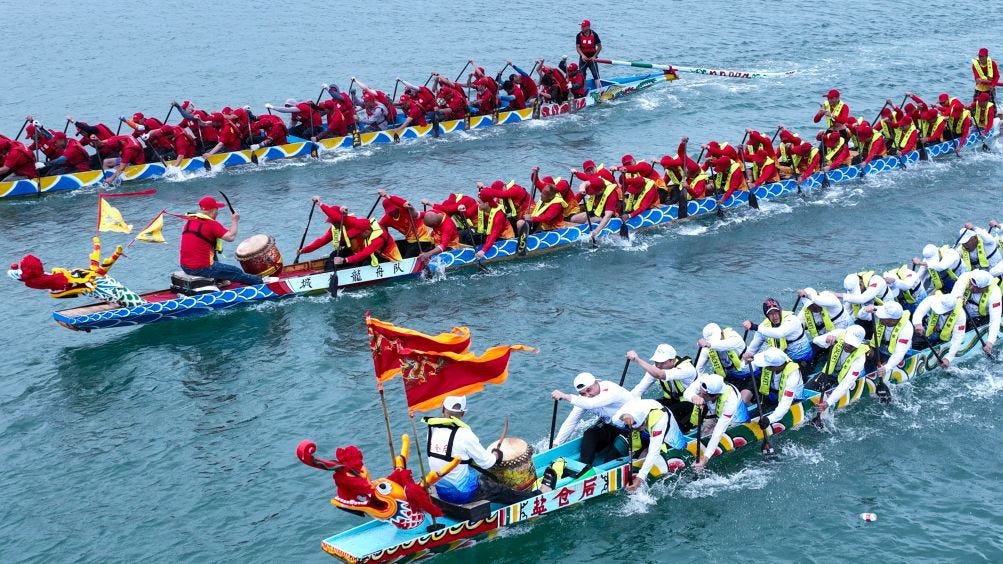
How does China celebrate the Dragon Boat Festival?
In Hunan Province, particularly around the Miluo River, where Qū Yuán (屈原) is believed to have drowned, celebrations focus on memorial ceremonies, poetry recitations, and dragon boat races that honour his patriotism and sacrifice. The festival takes on a different meaning in Zhejiang Province, where some communities commemorate Cáo É (曹娥), a young woman known for her filial devotion. Similarly, parts of Jiangsu Province celebrate the ancient statesman Wǔ Zǐxū (伍子胥) rather than Qū Yuán. Local customs also include eating special regional foods and conducting canal-based races. In major cities such as Beijing and Shanghai, the festival has evolved into a large cultural and sporting event featuring international competitions, performances, and tourism activities. In Hong Kong, dragon boat racing attracts global participants and spectators, making it one of the most international celebrations of the festival.
The Dragon Boat Festival has evolved into a form of Chinese cultural diplomacy. Through overseas Chinese communities and international sporting competitions, Chinese traditions are celebrated across Asia, North America, Europe, and Oceania. The festival demonstrates China’s cultural reach and the influence of the global Chinese diaspora, much like Lunar New Year (Chūnjié, 春节) celebrations around the world.
Text within this block will maintain its original spacing when published
Recommended Sources:AP News - Dragon Boat Festival links modern China to traditions more than 2,000 years old (June 19, 2026)
Britannica - Dragon Boat Festival
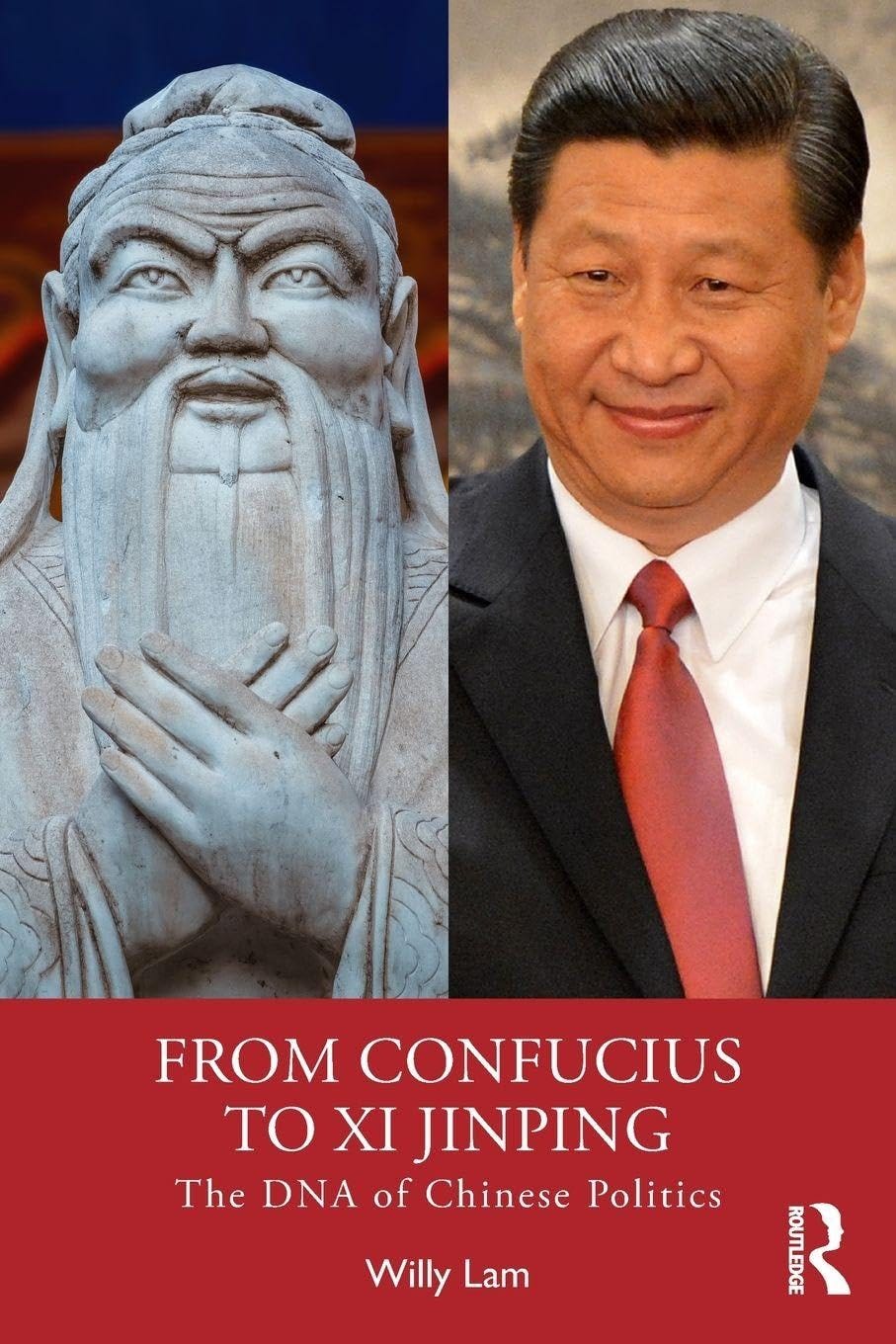
From Confucius to Xi Jinping: The DNA of Chinese Politics by Willy Lam explores how contemporary Chinese governance under Xi Jinping, including centralised leadership, merit-based administration, and the promotion of social harmony, draws on China’s historical and political traditions. It argues that modern Chinese politics is inseparable from the civilisational traditions that have shaped the country’s governance for centuries. Lam situates modern governance within the framework of ancient political philosophy and modern governance. He depicts Xi Jinping as a leader who has revived aspects of China’s traditional political culture. Through its blend of historical narrative, political theory, and contemporary analysis, the book offers perspectives on the gradual evolution of Chinese governance. For students, researchers, and anyone interested in China’s political trajectory, the book serves as a thought-provoking read.

活人感
(huó rén gǎn)
活人感 (huó rén gǎn) literally means the ‘feeling of a living person’ and refers to how natural, human, and emotionally present something or someone feels online. It is used to describe interactions, content, or AI responses that seem relatable, spontaneous, and not overly scripted or artificial. A strong huó rén gǎn suggests warmth, personality, and a sense of real social presence in communication. A weak huó rén gǎn implies robotic, overly formal, or detached interaction styles. The term is often applied in evaluations of AI chatbots and online personas. It is widely seen in user conversations and commentary on platforms such as Zhihu and Weibo, where internet slang is actively shaped.
Thanks for reading! This post is available for free. Please feel free to share it with others.
The Tianxian View is an initiative of the Pune International Centre (PIC), an independent and multidimensional policy think tank based in Pune, India. This newsletter aims to offer clear, contextual insights into China’s evolving trajectory.
To know more about PIC’s work and upcoming initiatives, follow us on our website and social media handles.
LinkedIn | X | Instagram | YouTube | Spotify
AI Disclosure Statement: Select Mandarin-to-English translations in this newsletter were produced using advanced large language models (LLMs), applying artificial intelligence and machine learning techniques for natural language processing.
Comments
Nothing yet. Say the first thing.
Sign in to join the conversation.