
Having It All helps you be more intentional about getting a good deal for yourself in a world where the deck is stacked.
The book makes a data-based case that a variety of factors — including, persistently, the structure of modern work — are the cause of gender inequality — and that until they change, thoughtful individual optimization is a woman’s best available tool (but not the solution).
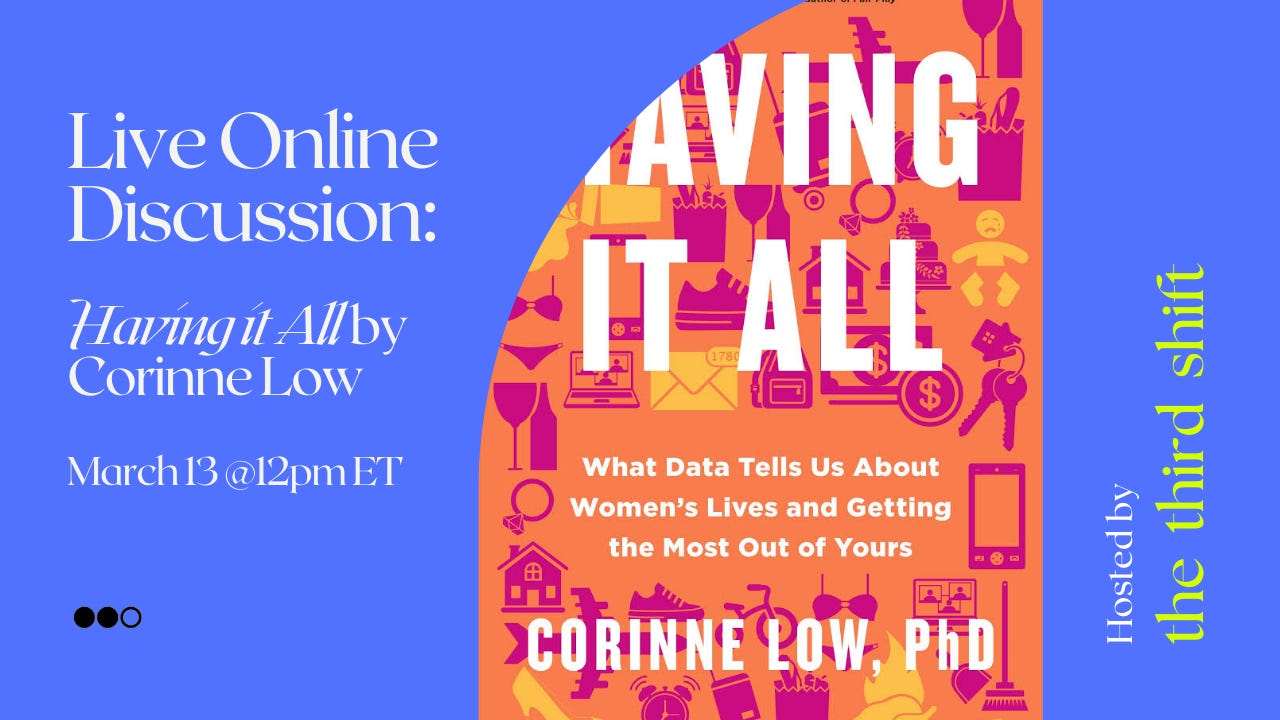
As I noted when making this selection, the dedication of Having It All is “for the women who just can’t do it anymore.” If you follow The Third Shift, you know that dedication landed for me.
Having the data also helps counteract the girl-power optimism tendency of high-achieving women to gaslight ourselves into thinking, “Sure, that might be true for some people, but it won’t be true for me.” I work with high-achieving women coming up against the same structural barriers they expected to run right over, and it’s far better to have planned your life with the facts in mind.
I invited Dana Weinstein to discuss this book because when we met, we were both ex-nonprofit, Princeton alumnae, single MBA students, and in the years since, our paths have diverged: I’m a married entrepreneur with two kids, and Dana is a single Fintech product leader (who flew up the ranks at Visa first.) I thought our perspectives would test Dr. Low’s thesis that the book is for all women.
Here are the ideas from this conversation that have stayed with me:
We’re failing a standard that was never real
The image of the stay-at-home mother as the natural order of things was specific to a narrow slice of mid-20th century white upper-middle-class America. Women in agricultural societies worked an estimated 60 hours a week. Women of color and lower-income women have always worked. The myth persists and creates shame by comparing against a standard that never actually existed for most people.
After women entered the workforce, the shortcuts that made it possible disappeared
The system didn’t just fail to adapt — society also rejected many of the adaptations that had made dual-income households more feasible. Formula gave way to breastfeeding norms. TV dinners gave way to slow food. Latchkey kids gave way to intensive supervision. Screens created an entirely new category of parental vigilance. Taken together, these shifts reintroduce time demands that had, at one point, been partially offloaded — and that land disproportionately on women.
The “glass ceiling” is a household term — but what we should really be talking about is the Squeeze
Peak childcare demands and peak career demands hit at exactly the same moment in a woman’s life. Women aren’t opting out — they are reacting rationally to impossible demands and rarely being given the chance to make a different choice later. Women in “The Squeeze” are being pushed off career tracks that won’t accommodate a temporary season of life (which is most careers) — with very few opportunities to course-correct.
Outsourcing is useful — but not a universal solution.
Buying back time at home requires affordable labor — and the women who historically provided that labor were themselves workers who deserved (and rarely received) fair wages. Plus, in high-cost labor markets, outsourcing doesn’t scale.
The only solution that scales is restructuring work itself. It sounds dramatic, but it has happened, and it works.
The 40-hour work week was created in 1938 as part of the Fair Labor Standards Act because we needed to distribute work across more people. We’ve restructured work before when forced to.
Similar collective or legislative shifts are needed today to address “greedy work” and the uneven domestic burden on women.
OB-GYNs moved from an individual model requiring nights and weekends to a care team model with predictable shifts — and the field went from 7% female to roughly 90% female. They effectively normalized job-sharing and patients weren’t any worse off.
A few things I’m still sitting with after our conversation:
AI may be the forcing mechanism that makes structural change inevitable. If the relationship between hours worked and outcomes produced breaks down, some justification for the greedy job model breaks down with it. If true efficiencies are produced, they could eliminate hours from jobs rather than jobs from companies. Humanity needs an advocate at the table to counter the demand to manifest efficiencies in the form of job cuts.
If true efficiencies are produced, they could eliminate hours from jobs rather than jobs from companies. Humanity needs an advocate at the table to counter the demand to manifest efficiencies in the form of job cuts.
The reason women don’t take the rational optimization view of their own lives — even when the data is right in front of them — is guilt. Mom guilt is why the outsourcing solution doesn’t scale even when it’s economically rational. It’s why women make choices that don’t serve them. It’s the invisible drag on every decision in this conversation.
Low argues that women’s happiness is an inherent right. She goes further: if you can’t justify prioritizing your own happiness as a human being, consider that you’re a better caregiver when you do. She is addressing the guilt without naming it by appealing to women’s need to serve others — which we are socialized to find far more justifiable than serving ourselves. Throughout Low’s data, men who clearly prioritize their own time appear — and for most of them, mom guilt simply doesn’t exist as a concept.
Low clearly argues: the structure is broken, here’s the proof, here’s what to do about it. But even when women know all this, mom guilt is an internal force working against mothers (and to some extent, all women).
Even though the framing of the book is getting yourself a good deal, the truth is that the more realistic take is probably something like: exerting intentionality over which bad deal you end up with. Either way, it’s far better than chancing into something that’s suboptimal for you.
This post is part of the Mental Load Discussion Club, a subsection of The Third Shift where we engage with the books, scholarship, and wider conversation surrounding the mental load. (It’s also where new On the Mental Load podcast episodes are shared with exclusive recaps and analysis, such as this one.)
If you prefer to focus on practical solutions for family operations and opt out of the mental load learning, you can separately unsubscribe from the Discussion Club while remaining subscribed to The Third Shift.
Episode 2: Can Women Really Have It All? Reading Corinne Low’s Having It All
Jennifer Mickel and Dana Weinstein dig into Having It All by Corinne Low, PhD— a data-driven examination of women’s lives and the structural forces shaping their choices. They discuss the “utility function” framework for balancing work, family, and personal fulfillment, the persistent gender gap in household labor despite equal workforce participation, and the brutal “squeeze” period when career and childcare demands peak simultaneously.
Plus: what workplace structures could actually look like if they were designed to support women — and why the myth of the ideal household is still doing so much damage.
Guest
Dana Weinstein, Head of Product & Operations, Tesser Payments — LinkedIn
Resources Mentioned
Having It All by Corinne Low — bookshop.org
Anne-Marie Slaughter, “Why Women Still Can’t Have It All,” The Atlantic — theatlantic.com
HBS study: Rethink What You Know About High-Achieving Women — Reprinted here
About the Show
The Third Shift: On the Mental Load is a podcast about the invisible cognitive and emotional work of running a family — why it’s so hard to see, so hard to share, and what it would actually take to change it. Hosted by Jennifer Mickel, JD-MBA, founder of The Third Shift, and former BCG Principal.
Work with Jennifer
The Third Shift helps families get out from under the mental load. Learn more at thethirdshift.co.
Comments
Nothing yet. Say the first thing.
Sign in to join the conversation.