
About a year ago, a clip from the “And the Writer Is” podcast started doing the rounds. The guest was Russ - one of the genuinely remarkable independent success stories of the streaming era. Built from SoundCloud upwards. Platinum albums. Billions of streams. No major label scaffolding. A legitimate blueprint that he constructed himself, track by track, over years.
The host asked him a simple question: if you had to start from zero today, how would you do it?
His answer: stock up 24 great songs. Release two a month. Post 200 TikToks per song.
Two hundred TikToks per song. Two songs a month. Do the maths and you’re somewhere north of four hundred posts in a month. More than ten a day, every day.
The clip spread the way all clips spread - fast, far, and stripped of everything around it. Stripped of the decade of groundwork Russ had already put in. Stripped of the fact that this was hypothetical advice for a starting artist in 2025, not a replay of what actually built his career. And stripped of something else the interview contained: a note, later in the conversation, that song-a-week is probably too much for the current DSP landscape, and that two songs a month is now his ceiling.
What was a simplistic throw-away answer to a specific question became a template. And the template, handed to thousands of artists in completely different situations, caused real damage at the time and now is even less helpful. What’s next if that’s not “it”?
Here’s what didn’t get discussed at the time. If you genuinely have the capacity to release brilliant music every two weeks for a year (and sustain two hundred TikToks per song alongside it) your music was probably going to find its audience anyway. The content volume wasn’t the cause of the success. It was noise around a signal that was already strong.
Most artists who try/tried to adopt the method don’t/didn’t have the same signal. So they just made a lot of noise. [Sorry]
I’m not interested in pretending that artists should be allowed to just make great music and expect the rest to follow. That has never been and never will be a viable route for musicians trying to build a long-term career. But I do have genuine sympathy with artists who are exhausted by this kind of advice - the “if you wanted it badly enough, you’d just do this impossible thing” logic, wheeled out by industry-bros.
It’s clickbait wrapped in half-truth, and it’s a distraction from the real work. The question worth asking isn’t “how much should I be doing?” It’s “what am I actually trying to build?”
Once an artist or manager is oriented around that question, everything downstream changes. The release cadence question answers itself differently. The content volume question answers itself differently. Not because there’s a universal right answer, but because the answer comes from the strategy rather than from someone else’s template.
TikTok’s algorithm has become significantly less predictable over the past eighteen months. Posting strategies that produced real traction in 2023 and 2024 don’t reliably deliver anything now. Frankly, what worked in Winter 2025 isn’t even relevant now. The platform is more volatile, more crowded, and less responsive to volume alone.
But here’s the harder truth: the algorithm shift didn’t break a good strategy. It exposed a fragile one.
Artists who built audiences through volume-led approaches are sitting on numbers that don’t convert. Followers who arrived through a trending audio clip, a meme format, a viral moment - and who have no meaningful connection to the music or the person behind it. A large TikTok (or Instagram) following built this way isn’t worthless. But it’s a different thing entirely from an audience that actively cares. And confusing the two is one of the more expensive mistakes an independent artist can make.
On Instagram, a similar pattern is visible. This is the main thing! The big shift…
The platform (or maybe more fairly the audience) has made more room for less frequent, higher quality content - which, whatever its algorithmic causes, is a healthier creative environment than the relentless churn that preceded it.
None of this means abandon TikTok or Instagram. Quite the opposite, it means use them differently. Use them to deepen relationships with people who already know you, not just to find new ones. Use them as the start of a journey toward something more durable. And excitingly, feel free to invest a bit of real creativity there.
There’s a particular kind of confusion that sets in when we try to understand thing by measuring the wrong stuff.
Follower count was the metric that mattered, until it clearly wasn’t. Then engagement rate became the smarter measure. Now even engagement rate can mislead you. A flood of comments saying “this is so real” tells you almost nothing about whether those people will come to a show, buy a record, or still be listening in three years. It’s not a mad place to look for signs but the quality of the engagement is the key!
The metrics that built habits - and that platforms still surface most prominently - are often measuring the wrong thing. An artist with 800 email subscribers, a 60% open rate, and people who regularly reply to their emails is sitting on something significantly more valuable than an artist with 40,000 TikTok followers and declining reach. Those numbers don’t reflect that yet. Which is exactly the problem.
Caveat: I want to be clear about the limits of my perspective here. I’m not claiming to understand what’s working at the level of major label campaigns or sophisticated international marketing operations with large specialist teams, a bespoke influencer campaign strategists and a guy in the corner with 10 burner accounts. What I’m confident about is what’s working at grassroots level - and the pattern is consistent. Anything that feels like a hack is getting found out. Anything that’s volume without quality is producing diminishing returns. Anything inauthentic is losing ground to artists who are doing something genuine, specific, and on brand.
Note: The release cadence question also resolves differently once you’re building for depth rather than width. Releasing every two months and doing it properly - with real communication to the people already paying attention, a genuine moment around the drop, something that rewards your most engaged fans first - will compound faster than releasing every two weeks and hoping one lands. That’s not permission to be lazy. It’s permission to be intentional.
Five examples. None of them revolutionary. All of them effective.
The content strategy
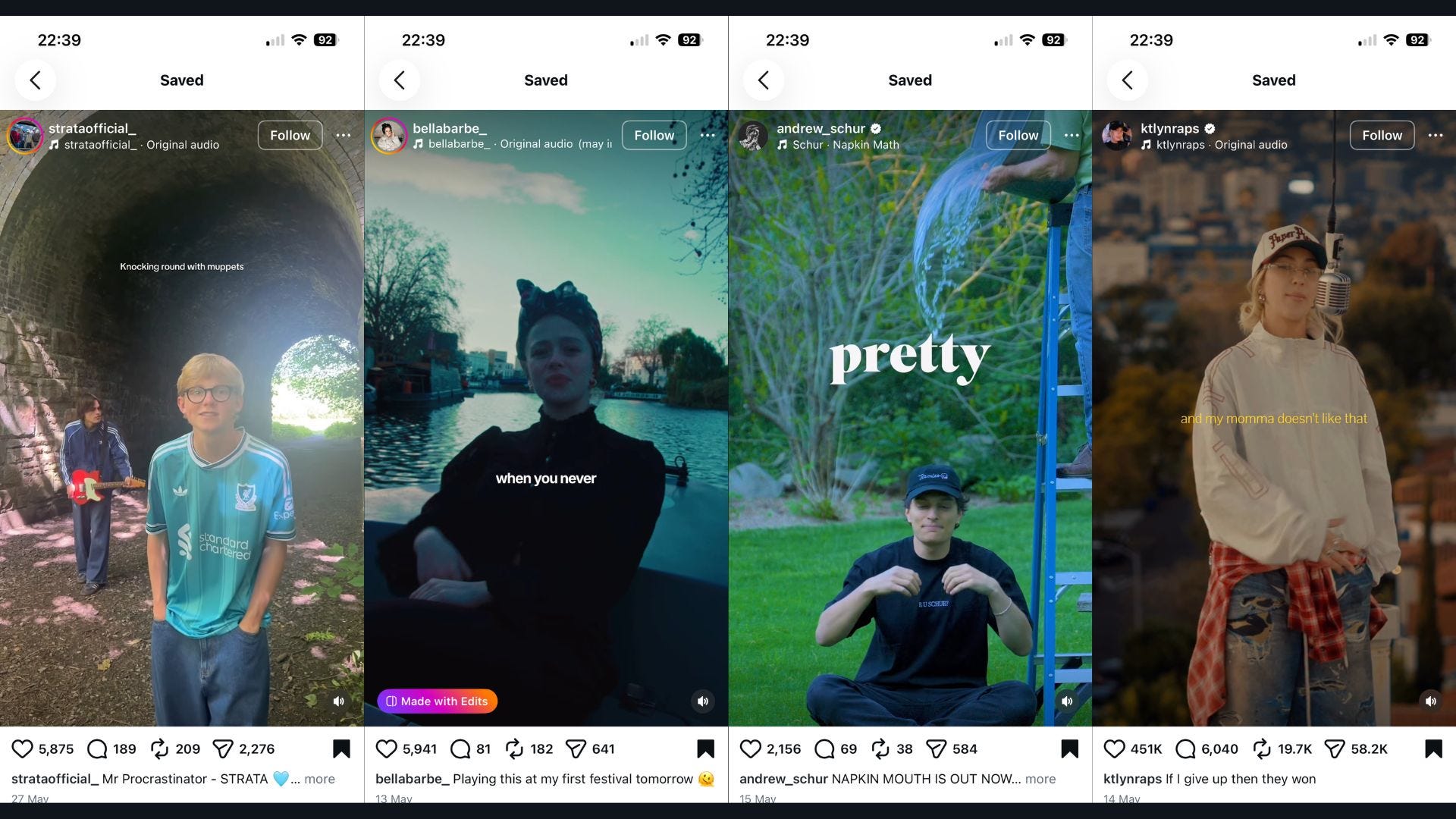
Not new as such but allowing time for some properly vibey content is back. Lean in to some creativity, draw from some trends, take a little time… It doesn’t necessarily have to be super high fidelity, but it doesn’t have to be about volume. Drop some content that you feel is an extension of the artistic project and not just part of the daily grind. Look at some of the amazing content you’ve been enjoying from other artists and “let yourself go”.
The tracklist email
You changed your album. Three songs didn’t make the final cut. Before you announce anything publicly, you email your list. You explain the decision honestly - what changed, why those tracks didn’t fit, what the album became as a result. You share one of the dropped tracks as a private download, for subscribers only.
Twenty people reply. Some of them have been following you since your first release. That’s not a metric. That’s a relationship. And those twenty people will talk about you differently to everyone they know.
The TikTok live launch follow-up
You do a TikTok live for your single drop. The viewing numbers are modest - but that’s not the point. Everyone who was there gets a personal follow-up. Not a mass email. A direct message. “You were there for the single. We’d love you to be there for the album.”
The conversion rate on that message will be significantly higher than any ad campaign you run. Because you’re not asking a stranger. You’re inviting someone who already showed up.
The morning voice note
The morning of release. Before the Spotify link goes live, before anything goes on socials. A sixty-second voice note goes to your mailing list. What the song is actually about. What you were going through when you wrote it. What you hope it does for the person listening.
Yours first. Theirs before anyone else’s. That sequencing matters more than most artists realise.
The merch decision
You’re pressing a limited run. Instead of deciding on the artwork yourself, you take two options to your most engaged followers and ask them to choose. You credit them in the packaging.
A small thing. A disproportionate impact on how those people talk about you - because they helped make it.
What you’re actually building
None of this is a case against social media. TikTok and Instagram are still where discovery happens for a lot of artists, and ignoring them is its own kind of mistake.
The point is orientation. The artists who will be in the strongest position in three years are not necessarily the ones who cracked the algorithm. They’re the ones who used the algorithm as a starting point and built something the algorithm can’t take away - a direct relationship with people who genuinely care about what they’re making.
A mailing list. A community. The person who replies to your voice note at 7am on release morning. Those things compound in a way follower counts don’t.
The playbook has shifted. The underlying principle hasn’t. Do something genuine. Do it with intention. Make sure the people who already care feel that care returned. Let the rest follow from there.
No posts
Comments
Nothing yet. Say the first thing.
Sign in to join the conversation.