
The biggest step you’ll ever make in your whole music career might be that first track you release. And coincidentally, it’s the thing almost nobody’s paying any attention to. Which is simultaneously liberating and a little frustrating.
That weird dichotomy is precisely the sort of thing you need to get used to in this industry.
But here’s what actually matters right now: that absence of an audience is permission, not punishment. Permission to move. Permission to get things wrong, learn fast, and iterate without thousands of people watching and judging every call you make. The real risk here isn’t messing up a perfect moment. It’s staying stuck, convinced everything needs to be flawless before you let yourself press go.
So get your ducks in a row. Then get moving.
What follows is a straightforward, colour-by-numbers checklist for setting up your debut release properly. It’s not the arduous slog people make it out to be. There are a few hoops to jump through, sure, but they’re entirely manageable. Do this right and you’re not just giving this release its best shot. You’re laying foundations for everything that comes after.
A quick assumption before we start: this guide picks up once you’ve got one finished track and some artwork ready to go. Everything else builds from there.
Below is a quick video signposting a couple of great experts you can speak to about your project if you’d like, using The Team Around You platform.
⇾ Nadia Sheikh: a very successful independent artist Profile
⇾ Charlotte Carpenter: a similarly successful independent artist who’s run her own label Profile
This is the service that will deliver your music to Spotify, Apple, TikTok, Instagram and so on. You’ll find dozens of comparison guides ranking distributors usually fixated on price and tools. I’m not convinced that’s super helpful. I worked in digital distribution for 10 years. The gap between paying £20 a year and £50 a year is not the decision that should keep a serious artist up at night. What should keep you up at night is what happens when something actually goes wrong.
And something will, eventually, go wrong. A delivery doesn’t land on time. A release turns up on Spotify but not Apple Music. Your royalty statement looks like it was written in a different language. The question that genuinely separates a good distributor from a bad one is simple: when you message them, do they get back to you?
This is where I’d point you towards TuneCore’s professional tier, which includes same-day support for queries, and Symphonic Distribution, which pairs strong tools with competitive pricing and that same reputation for actually responding when artists need help. Both have earned a track record for being there when deliveries go sideways, and that’s the exact moment a distributor’s value either proves itself or quietly evaporates.
CD Baby gets an honourable mention here too. It runs on a commission basis rather than a flat subscription, which can make it good value if you’re releasing early and infrequently. It also means CD Baby has skin in the game: they’re taking a cut of what you earn rather than charging a flat fee regardless of outcome, so your success is quite literally their business.
Beyond support, there are two tools worth checking for before you commit: live analytics (can you actually see what’s happening with your release in real time, or are you waiting days for numbers to trickle in) and royalty statementing (is it clear, or does it read like a tax form designed by someone who hates you). All the options I suggested have these things sorted.
One platform I’d actively steer you away from is DistroKid (sorry). It’s the default for most beginners because it’s cheap and everywhere, but the feedback I keep hearing from artists, again and again, is the same: when something goes wrong with a delivery, support is slow or simply doesn’t show up. For your first release, when you’ve got no track record and zero buffer for mistakes, that’s exactly the moment you can’t afford a distributor that goes quiet on you.
You need to deliver the music four weeks before the release date!
The reasoning is straightforward. Most distribution platforms take a few days to process and deliver a release once you submit. If something goes wrong, and on a first release something often does, that eats into your buffer fast. A four-week lead time means you’ve still got room to fix problems without your release date shifting underneath you.
It also buys you something specific: time to get your music into Spotify’s backend three weeks before release, which is the window you need for the playlist submission tool. Miss that window and you’ve quietly lost an opportunity before your track has even gone live.
This isn’t a beginner-only rule either. Once you’ve done this a few times, things are less likely to go wrong because you’ll actually know what you’re doing. But the four-week lead time stays exactly the same. It’s not a training wheel you get to take off.
Less than you’d think. You’ll need your songwriter details, which most artists completely forget about until the submission form is staring them in the face. You’ll need this information every single time you deliver music, so get comfortable having it on hand.
You’ll also see fields for an ISRC code and a UPC code. Fill these in yourself if you happen to have them, but don’t bother chasing them down. Your distributor will generate both for you.
For this very first release specifically, you’re creating a brand new artist page rather than selecting an existing one from a list. Every release after this, you’ll simply pick your artist page from a dropdown. But this first time, you’re building it from scratch, so take the extra care to get it right.
After more than a decade working closely with the distribution side of this business, the same handful of mistakes account for nearly every problem I’ve seen.
Artwork not meeting spec is the single biggest one. Metadata that doesn’t line up with what’s on the artwork! If your artwork says one thing and your metadata says another, expect a rejection, and expect it at the worst possible moment.
The third is artists writing things into the title field they’re not allowed to include, most commonly “feat.” or a featured artist credit typed straight into the track title rather than entered where it actually belongs. Distributors flag this immediately and bounce it back to you, costing you time you don’t have if your lead time was already cutting it fine.
include the four weeks lead time, get your artwork to spec, and none of this touches you. Ignore the lead time and any one of these can shove your release date backwards.
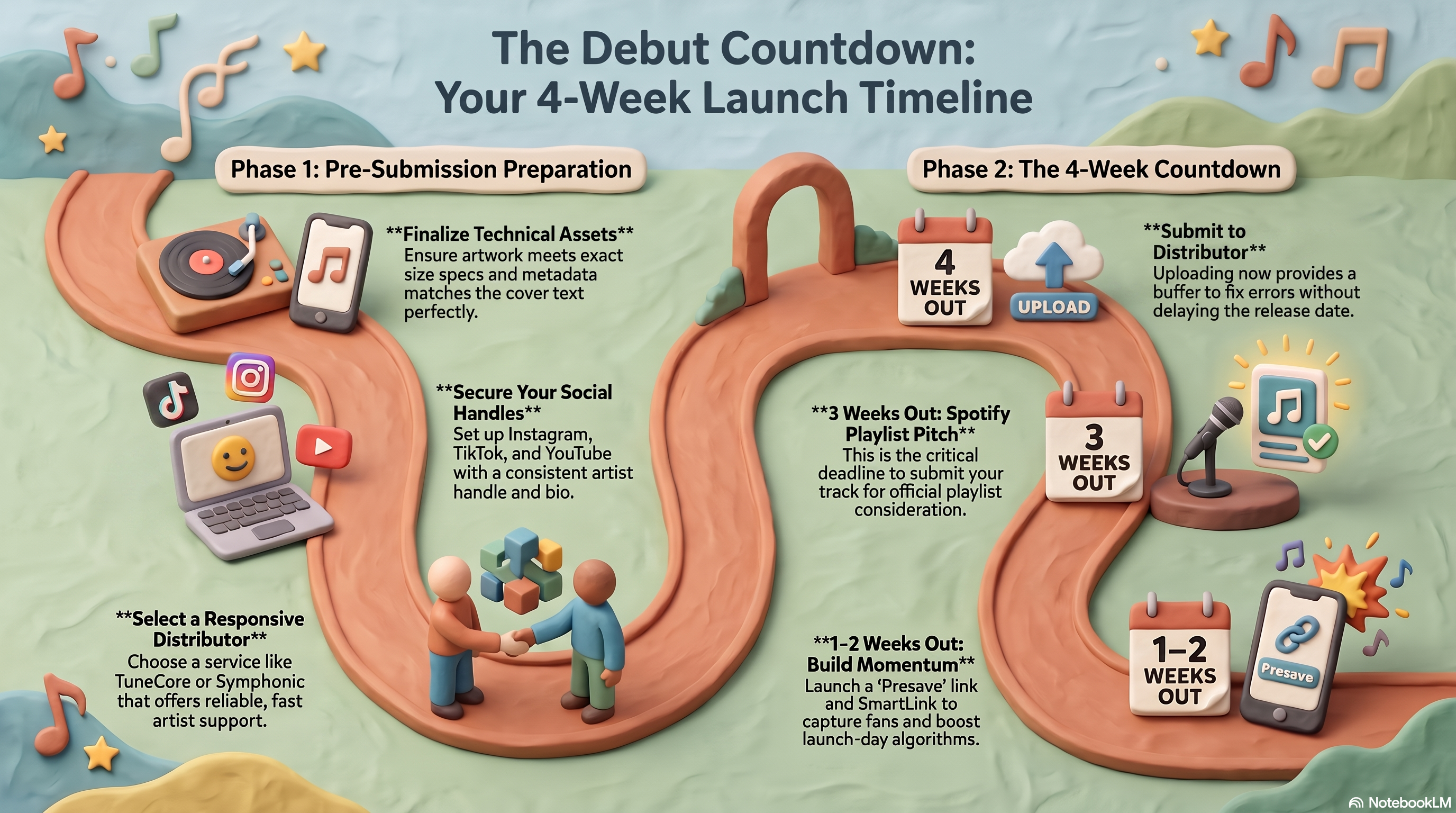
You need a presence on Instagram, TikTok, and YouTube Shorts. Nothing fancy. A bio, a profile image, and a consistent handle.
For your handle, use your artist name, or your artist name followed by the word “music.” That’s the whole decision. Don’t overthink it.
Your bio should be one line. Maybe two if you absolutely must. Keep it simple and factual. If you’re a rock band from Sheffield, say you’re a rock band from Sheffield. Don’t try to be clever or cryptic about it. People landing on your profile for the first time need to know exactly what they’re looking at within about three seconds, not solve a riddle.
Use the same profile image across all three platforms. Consistency matters here, even when you’ve only got five followers and one of them is your mum.
That’s the whole job. Done.
Here’s the problem with your first release: you want to build momentum before launch day, but there’s nothing yet for anyone to actually listen to. You can’t ask people to get excited about music that doesn’t exist.
Presaves solve this neatly. A presave is a link that lets fans automatically add your upcoming release to their library the second it goes live. They click, they authorise it through Spotify, and on release day the track simply appears in their Liked Songs without them lifting a finger.
This does two useful things. First, it keeps the connection warm. If someone gets excited about you through your content before there’s a release to point them to, a presave means they won’t drift off and forget. Second, it hands Spotify an early signal that people are genuinely interested, which can help with algorithmic placement in your first week.
Most distributors will let you create a presave directly. If yours doesn’t, tools like Feature.fm and Linkfire will do the job instead.
Wherever you’re promoting yourself, whether that’s Instagram, TikTok, or your own website, you need a single link in your bio that funnels people somewhere useful. That’s your SmartLink.
Keep it simple. Three destinations, maximum: somewhere people can actually listen to your music, somewhere they can sign up to your email list, and somewhere they can pay you directly if they want to (Bandcamp works well for this since it covers both downloads and merch in one place, though there are other options out there).
The point isn’t to bury people in choice. It’s to give them one clear path: hear the music, stay in touch, support you directly if they’re keen. Everything beyond that is noise.
When you’ve got no audience yet, most of the standard marketing playbook simply doesn’t apply to you. But plenty of tactics still do. Don’t get hung up on what you can’t pull off. Focus on what’s genuinely possible with what you’ve actually got.
Two examples worth stealing. Grab a mate, head out and busk the track on the street, film yourself playing it, capture people’s reactions, stick a QR code on a poster, and let passers-by scan it to sign up to your email list. Or invite a small group over, decorate your front room properly, do a live performance, film the whole thing, and offer a couple of spots as a giveaway to people who’ve been engaging with you early on social media. Both create real footage, real engagement, and real email signups, all for the cost of your time and a bit of imagination.
These are examples, not a checklist you’re obliged to complete. There are plenty of approaches that work when you don’t have much reach yet, so don’t get fixated on the tactics that only make sense for artists who already have an audience. The constraint you’re working with is actually useful. It forces you to get creative with what you’ve got instead of throwing money at a problem money can’t fix yet.
Email is the single most powerful marketing tool you have, and it’s also the most underestimated. A genuinely engaged email list is how you build a real relationship with your audience, and that relationship is the foundation everything else gets built on.
Start capturing emails from day one. Anyone engaging with your presave link, your SmartLink, or your early marketing efforts should have an easy, frictionless way to sign up.
Once people are on the list, keep it simple. One email a month. Share something genuinely valuable, whether that’s free content, an update, or whatever feels natural to what you make. Don’t ask for anything in return. Don’t pitch tickets, merch, or streams directly. If people are engaged with you, they already know what to do. Just give them something worth their time and let them decide.
We’ve written a properly structured email marketing strategy that takes you from zero to hero on this exact subject. Get stuck in. There’s nothing stopping you getting your ducks in a row on the email side right now, well before you’ve even released anything.
Article on Email Marketing Strategy
Live music is one of the strongest audience growth tools you have. It’s every bit as powerful as anything in the digital space. But it’s also genuinely involved. You’re leaving the house, pulling together a band or collaborators, booking venues, juggling logistics. It takes real time to build properly.
Don’t let it become a reason to delay your release. Get your first track out. If you can layer live shows in early, brilliant. If you can’t yet, release anyway. Live can come later. It isn’t going anywhere.
The most common trap of all: sitting on a genuinely great track, convinced you need a label deal before you’re allowed to release it properly. That’s backwards. The way you actually get a label interested is by proving you can release music and build an audience without one. Sitting on tracks waiting for someone else’s validation is just delaying the work that actually moves the needle.
You’ll see paid marketing presented as an option for first releases. Spotify ads, Meta ads, TikTok ads. In almost all situations, I’d actively discourage it.
Here’s why. Paid marketing only works once you’ve got a foundation to build from: a locked-in content strategy that’s been running for a while, an engaged organic audience already responding to you, real data on what’s actually resonating. Without that, you’re not amplifying something proven. You’re just guessing, with your own money on the line.
There’s a second problem too. Jumping to paid too early teaches you bad habits. You skip the hard graft of understanding organic growth, so when you genuinely need to scale later, you won’t know how. Meanwhile, your budget evaporates with nothing real to show for it.
Get your organic game tight first. Build a real audience. Then, once something’s already working, paid marketing becomes an actual accelerant instead of an expensive experiment.
If you manage to do all of this in the build-up to your first release, you’ve genuinely done a fantastic job. Most people don’t get through all of it, and it holds them back far more than they realise.
But there’s one thing we haven’t covered here that matters more than everything else combined: the track itself has to be genuinely great. None of this works if the music doesn’t land.
With a first release, you’re often still learning. Still figuring out how to get the best out of yourself in the studio. Still learning what proper mastering actually sounds like. If there’s one reason to slow your release down, it’s this one. Not analytics, not metadata, not lead times. Just making sure you’re genuinely happy with how the track sounds.
And remember, this is a starting point, not a finish line. You’ll get better at every part of this as you go. Pay attention to what works and build on it. Look at what doesn’t and adjust. That’s the whole game.
Hopefully, this is the start of something special. Good luck!
No posts
Comments
Nothing yet. Say the first thing.
Sign in to join the conversation.