
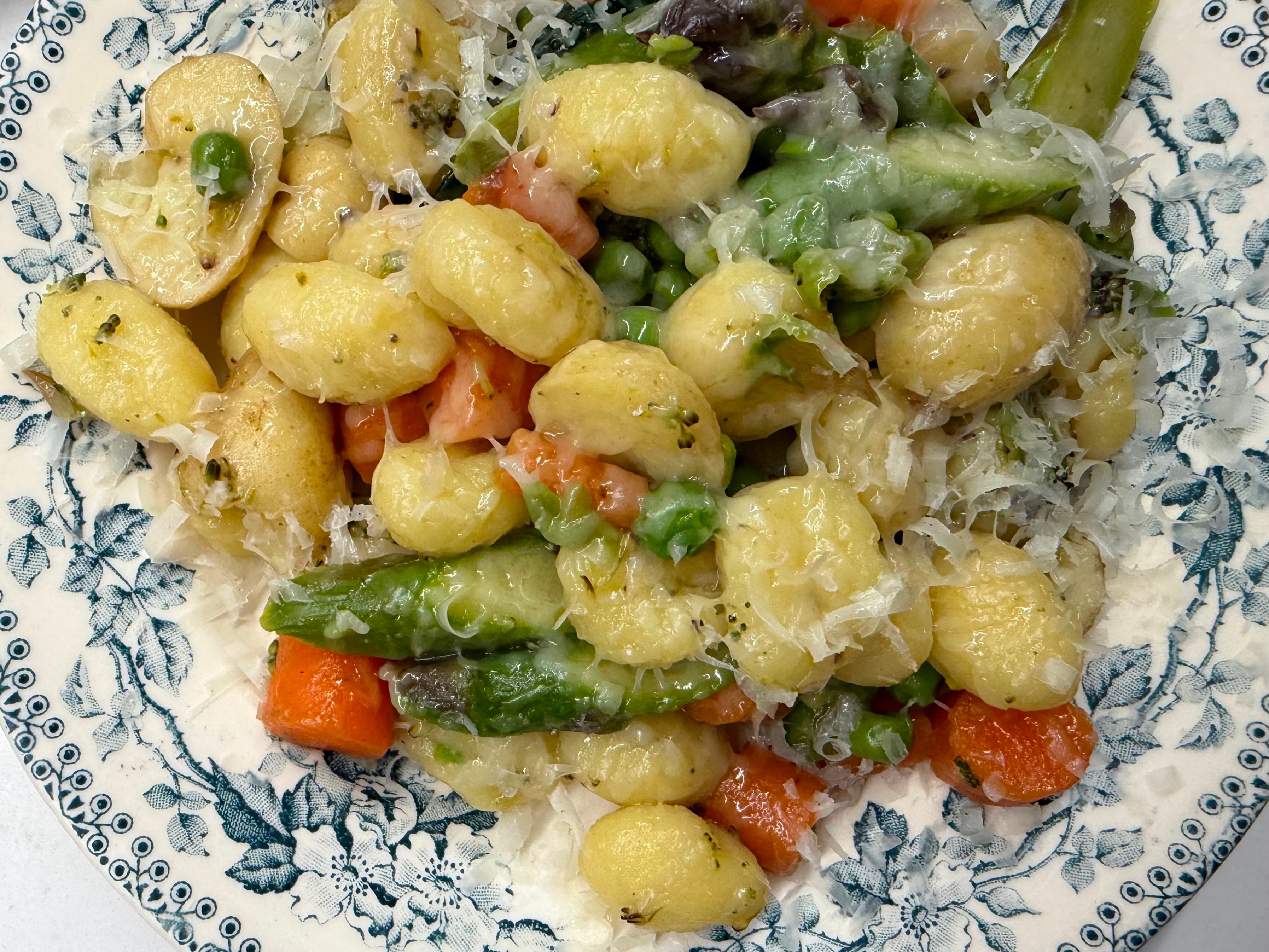
When the evenings still need a sweater but the markets have started to turn, this is our go-to dish. It’s adapted from Rosa Jackson’s Niçoise, the cookbook that has become a reference for the food of the South of France. Rosa runs the Les Petits Farcis cooking school in Nice, named after the stuffed vegetables that are everywhere there in summer, and her book is the one we cook from more than any other lately.
The recipe is called Ragoût de Légumes du Printemps, a spring vegetable stew. Rosa’s own line about it is the one we keep coming back to. Cook the vegetables with as little liquid as possible, so they retain all their color, flavor, and nutrients. Use the recipe as a guideline rather than a formula. Choose the smallest, sweetest vegetables you can find.
The dish, as Rosa writes it, is spring onions, skinny carrots, fingerling potatoes, asparagus, and peas, softened together in a Dutch oven with thyme, a smashed clove of garlic, and just enough stock to barely cover the bottom of the pan. The peas go in at the end, two minutes only if they’re fresh. The whole thing comes together in about twenty minutes.
She serves it warm, with a drizzle of good olive oil, fleur de sel, a handful of arugula, and Parmesan shavings on top. As a starter or a light lunch.
What we do is serve it over gnocchi, which turns it into a proper dinner. The gnocchi cook in salted water for a minute or two until they float, then go straight into the pan with the vegetables, the broth coating each piece. A handful of grated Grana Padano on top at the end. That’s it. That’s the dish.
We made it again this week, on one of those evenings where you put on a sweater because the kitchen window is open and the spring air still has some bite to it. There’s something about cooking from the South of France in London on a chilly evening that feels like the right balance of seasons. The flavors are bright and warm, full of the Mediterranean, but the dish is substantial enough to suit a night when you actually want to be inside.
What we love most about Rosa’s book is that you cook through it all year. The recipes are organized by season, which is the only honest way to write about Niçoise food. The cuisine is so closely tied to what is growing that recipes outside their season feel like a different cuisine entirely. Right now we are in spring, and the book opens to vegetables like this. In a few weeks we will be in summer, and the pages turn to ratatouille, pan bagnat, and the stuffed vegetables the school is named for. By autumn, daube. By winter, Swiss chard pie and lemon tart.
David Lebovitz wrote a beautiful note about the book when it came out. Chef Alain Ducasse called it probably the best introduction to Niçoise cuisine. They are both right. The recipes are clear, the writing is warm, and Rosa has the rare quality of being a serious teacher without being precious about it. She just wants you to make the food properly.
If you do not have the book yet, this is the one to have for the next few months as everything comes into season.
We will be down on the Var coast this late spring and summer, deep in this kind of cooking. More from there soon.
xx
Comments
Nothing yet. Say the first thing.
Sign in to join the conversation.