
It’s easy to be deceived by handwriting and all its beautiful imperfections: wonky grammar and misspellings scrawled across ruled diaries and loose paper. Free of typeset or editorial review, the ink looks like blood from the writer’s hand, but it is no less immune than printed text to the little fibs and fears that shape words before they leave our mind. Overcoming the embarrassment of intrusion, a reader can fall quickly into a false sense of intimacy and the deception is complete.
In this project—a work of criticism, not biography—I have tried to be cognizant of that deception in embracing the task of the critic: to appreciate and make meaning of someone else’s life and work though my own. I have imagined how it would be to move about the world as a character called Thornton Wilder through his scribbled and printed words. I have mined the overlap in our life experiences and considered the divide between our generations. This is an undertaking that I could spend the rest of my life doing, given the immense trove of material and lingering questions he left behind. But I have focused largely on his major plays, and know that I have barely scratched the surface.
This brief foray into his world was made possible by the endorsement of the American Theatre Critics/Journalists Association and the financial support of Foundation ATCA’s Helbing Mentorship Program, which promotes the voices of emerging LGBTQ arts writers through scholarship, mentorship, and professional development. The publication of The Bridge of San Luis Rey in 1927, when Wilder was 30, enabled him to make a living from his writing (and the adjacent opportunities that resulted from it), though he had written extensively (perhaps obsessively) for many years before. Almost 100 years later, the challenge of making a living as a writer, especially as a critic, has not gotten any easier. Opportunities like the Helbing Fellowship are vital to writers, and I am especially grateful to its steering committee—Christopher Byrne, Jay Handelman, Billy McEntee, Gerard Raymond, Frank Rizzo, and Martha Wade Steketee—for their encouragement, feedback, and mentorship through this project.
I am also indebted to the Wilder family, who have made his papers available at Yale University’s Beinecke Rare Book & Manuscript Library, and Penelope Niven’s comprehensive biography, Thornton Wilder: A Life, which served as a critical entry point to Wilder’s world. Their willingness to make Wilder’s work, diaries, and correspondence available to the public is a model in stewarding a literary legacy and a gift to researchers. Reading and reflecting on Wilder’s words has been an exercise in self-exploration, too, and I’m very grateful to them for that opportunity.


The theatre is a living form. I wonder what will become of Wilder’s plays as the economics of producing theatre become increasingly precarious (Our Town calls for nearly two dozen performers) and as the major plays approach release into the public domain. Wilder’s letters indicate he sensed Our Town’s growing reputation for sentimentality and was dismayed at the dismissal of what he saw as humanity’s enduring tendencies as nostalgia. When Show Boat was released into the public domain, Target Margin Theater deconstructed and reconstructed the work into Show/Boat: A River. When Our Town, then The Merchant of Yonkers, then The Skin of Our Teeth are released into the hands of the public, I wonder what theatermakers will do with them, and what we will learn about their writer in the process.
Could George Gibbs become a tomboy, or the drug store a gay bar? Could Henry Antrobus’s tumultuous relationship with the world and his father be reshaped by accentuating a different kind of repression? Could Horace Vandergelder become Hortense Vandergelder? Wilder free-wheeled with Euripides, Molière, Johann Nestroy, and Henrik Ibsen. Will others do the same with him?
“You know as well as I do that the dead don’t stay interested in us living people for very long,” says the Stage Manager in Our Town. “And they stay here while the earth part of ‘em burns away, burns out; and all that time they slowly get indifferent to what’s goin’ on in Grover’s Corners.”
Life goes on in Grover’s Corners, and December marked fifty years since his death. Imagine how much has changed since then in the ways we organize for LGBTQ rights, or how we talk about ourselves and our experiences, or how we envision ourselves in the public. What would he think of it? What would he think of us?
“We all know that something is eternal,” the Stage Manager says. “And it ain’t houses and it ain’t names, and it ain’t earth, and it ain’t even the stars…everybody knows in their bones that something is eternal, and that something has to do with human beings.”
The humans have kept living, and the theatre keeps evolving.
For the purposes of this work, maybe it’s not actually the Stage Manager who says it best, but Sabina: “The end of this play isn’t written yet.”
This is the final post in a larger collection, A Walk on The Wilder Side: A Queer Reading of Thornton Wilder, available on Substack and to view here:
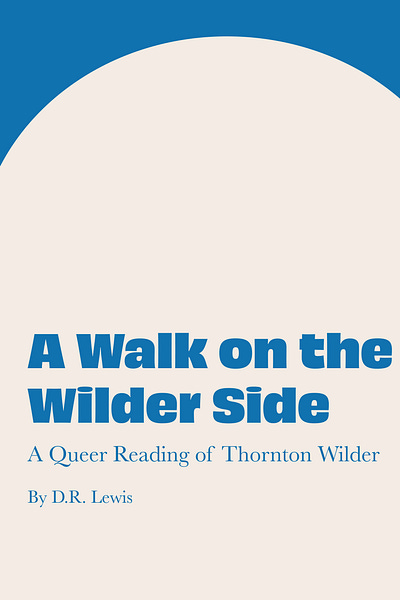
Download the full PDF version of the report by D.R. Lewis here.
Quotations and excerpts from The Angel That Troubled the Waters and Other Plays © 1928, The Merchant of Yonkers © 1939, The Journals of Thornton Wilder, 1939-1961 © 1985, Wilder’s Classic One Acts © 2011, Three Plays: Our Town, The Skin of Our Teeth, and The Matchmaker by Thornton Wilder Reprinted by arrangement with The Wilder Family LLC and The Barbara Hogenson Agency, Inc. All rights reserved.
No posts
Comments
Nothing yet. Say the first thing.
Sign in to join the conversation.