
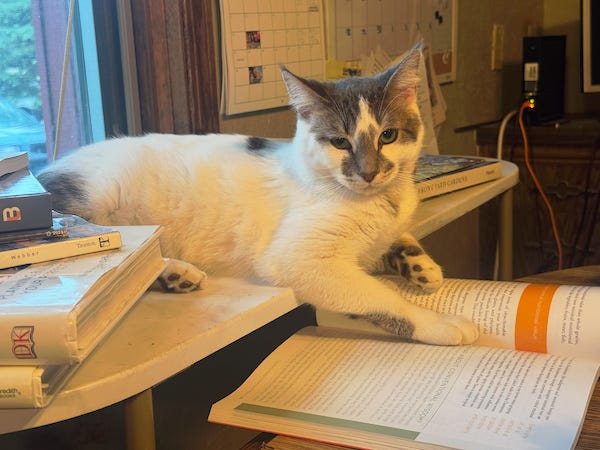
I just finished reading The Correspondent by Virginia Evans. I finished it, as I try to finish many of my books, in an environment that allows me to relish the ending. In bed. Good lighting. Early morning. No distractions except perhaps a cat in the crook of my arm and three more upstairs questioning where their morning breakfast is, followed by perplexing meows and an occasional hiss toward each other. Which is to say, I try to be present when I read! Absent of distraction. Completely immersed in the story and the characters.
This, however unfortunate, is not how I always read the first chapters of a book—or even the first 400 pages. I begin a book focused but soon become more immersed in the distractions of living. Phone calls. Facebook. The low hum of a distant television. The real world butts in—war and Epstein. And what the hell is going on with my errant pickleball serve and why can’t I keep my eyes open for more than five paragraphs and before I know it I am either sound asleep upright on the couch or I am seeing the pages, the words, the phrases, the letters and yet I may as well be reading Swahili for all my lack of comprehension and focus. I am not present. At all. And isn’t that, after all, one of the great lessons of reading? Learning to be present.
And as also generally happens with a good book, I will eventually get to the end and the characters are all mixed up in my head. I read enough in my focused state at the end of the story to puzzle them back so they fit almost neatly back into the story. However, all those wonderful moments and details before the ending have dispersed into thin air, still somewhere in my memory because they were there at one time. Right? I mean, I read them, somewhat? Albeit not clearly and definitely lacking focus.
The most wonderful thing about this realization with finishing The Correspondent was the entire point of the book was being present—in the moment of our children’s and our loved one’s lives. Being there for them. Focusing our attentions on what matters. Putting down the paperwork and clearing the mind and taking that plunge into the lake when our 8-year-old son begs for our “precious” attention and time. Or when your 12 year old daughter wants to play catch or if even your pets want a little time and consideration.
One-on-one time. Whether with a child at the beach, on a hike with a best friend or with a book in our hands. Focus. Being present. Clearing of the mind and then opening of the heart to new possibilities and future memories. Memories as real as when Anna Karenina (spoiler alert) jumped in front of that train (or did she fall? Do I remember this correctly?). THIS is what literature does—the value of a book, I thought as I closed the last page of The Correspondent is that it teaches us to be present, and if we can be present in the lives of fictional characters perhaps we can learn to be ever more present in the lives of our loved ones.
Our ability to close off the world in the pages of a good book may also teach us how to open up our hearts and minds to be present in the real world – which is a valuable lesson in this age of rapid change and distraction. We may disappear in the pages of a good book but we always reappear a little better for wear and even more focused on the world that we discover when we come back.
I encourage you to read The Correspondent, not as I did, but as all books should be read. Lost. Completely immersed. Shut off from the drudgery and tensions of modern day living. Then come back to the world, a different person, a bit stronger and more capable to welcome (and handle) the reality that awaits you.
Currently, I have one book almost read (Virginia Giuffre’s memoir – Nobody’s Girl), one book half read for a second time (The Inner Game of Tennis) and two books of fiction waiting patiently for my attention. One of them is George Saunders’ novel Vigil, and the other, Theo of Golden by Allen Levi.
How I approach these books I hope will be much like I am trying to approach life (and retirement) – in a secluded and quiet spot without any distractions. Good light. Clear and open mind. Whether I succeed or fail I do know that when I close that last page I will be a better person, a changed person, someone who has new memories and friends drawn from the words and characters of a book. Hopefully I can remember them all but if I can’t, there is always another book waiting patiently for my time and attention. And I do know, in spite of my lapsing memory and distracted focus, I am always affected and moved by having those words swimming somewhere half-forgotten inside my head. I am a better person.
Comments
Nothing yet. Say the first thing.
Sign in to join the conversation.