
Why don’t facts work anymore? It’s a question we keep coming back to. We have more information than ever, more scientific studies, clearer evidence – and yet we can’t agree on what needs to be done. Polarization is growing. People talk past one another. Conversations stall. Some see systemic collapse coming – ecological, economic, social – and shout warnings about what will happen if we don’t act now. Others hear only threats to everything they hold dear.
This is often explained as differences of opinion. As political conflict, ideology, values, or a lack of knowledge.
But research points in another direction. It’s about the nervous system. About how different people quite literally perceive different realities. About the fact that we are biologically calibrated for different things. Some nervous systems are built for openness – for detecting change early, navigating uncertainty, moving into the unknown. Others are built to preserve what works, protect the group from dissolving too quickly, keep identity intact.
In evolutionary terms, both were necessary. In today’s society, we have turned them into enemies.
I want to explore the tension between the open and the closed. Between intuition and analysis. Between diversity and conformity. Between purpose and growth. Between the group and the individual. In earlier texts, I have written about the primal group – about how we have broken the sequence that holds collective intelligence together – and about the wayfinder, the function that sees first, senses the future in the body, the one who is like me. But to understand why the world feels stalled right now, I also need to understand the guardian. The one who holds. The one who slows things down. The one who protects.
Because it turns out that the wayfinder and the guardian are not opponents. They are a pair. And when they lose contact with one another, both they – and the world – are lost.
This is where the story begins.
I can’t write from inside the guardian the way I can write from inside the wayfinder. I can only approach him through observation, through attempts at empathy, by sensing what happens in me when we meet.
For me, the world has always seemed built for him. For what can be measured, categorized, controlled, repeated. For what is already recognized. For what follows lines, rules, schedules, definitions. I stand somewhere else – in possibility, in the in-between spaces, where things don’t always have language yet. Where change is felt as desire in the body before it can be explained.
That is why every change I have tried to bring about has felt like a struggle. Changes agreed upon from many directions have still proven impossible to carry through, because they move toward a system whose primary task is preservation. And the harder I have pushed, the tighter the system has closed around itself.
Over time, I have internalized the guardian. I hold inner conversations with him every day. He is there when I wake up, when I write, when I pause. When I doubt. And especially when I rest. Then he sits down beside me on the sofa and stares. Not with anger, but with a kind of matter-of-fact disappointment. As if he knows what I ought to be doing, and is waiting for me to realize it myself.
He has never introduced himself by name, but I know who he is. A composite of people I have met over the years, all speaking with the voice of authority. Of systems. Of rational realism. And yes, I have always imagined him as male, because his qualities so clearly align with what we tend to label as masculine: control, order, discipline, boundaries, performance.
It’s not that I never do what he tells me to do. On the contrary. I have spent my entire life trying to fit inside his frame. Creating structure. Delivering. Completing. I have been admired for my ability to be clear, but it has often been a shell I built to survive. The guardian in me demands it. He demands that I prove my right to exist through productivity, usefulness, reasonableness.
What is strange is that it is both a struggle and a dependency. He holds my day together. He defines what is real. And in a world where my own signals are often subtle, emotional, rhythmic, fleeting, it can sometimes feel safe to have him there. It is like living with both fire and ice in the same body.
I understand that the guardian reacts to me because I instinctively react to him. Immediately. A tightness in the chest. Something closes me off. I can’t imagine that this is something I have chosen, or something shaped by experiences I have gathered over time. This is who I am.
I lived for a long time inside this conflict without understanding it. I saw the guardian as an adversary. As the force holding the world back, standing in the way of everything that needed to change.
But when I first encountered research on neurological differences - on how the amygdala responds differently to threat, on how some nervous systems seek novelty while others seek safety - it felt like a release. I began to understand myself differently. To see that my openness is not a marker of performance, but a biological configuration. That my need for movement and change is not restlessness, but the way my system orients itself in the world.
I also began to understand the guardian differently. To see that his resistance is a nervous system doing exactly what it is meant to do: protect, preserve, warn of risk.
And in a way, I could also release myself from a certain burden of responsibility - the idea that the planet’s problems are necessarily mine to solve. At least not by focusing only on solutions that make sense to me. Because if half of humanity cannot take them in the way I present them, then it isn’t only their problem. It is also mine.
So, carefully, I’ve begun trying to sit in the guardian’s chair. Because I’m starting to sense that if I don’t understand him, he won’t understand me, and together we understand nothing at all about how the world actually works.
I try to see the world through his eyes. I listen to the kind of news broadcasts aired in prime time, with headlines about violence, chaos, ever more boundary crossings. I read comment sections where anxiety is expressed bluntly and without filters. I notice how advertising speaks. I observe which cultural expressions might feel foreign or threatening if you don’t already feel at home in them - new pronouns, new family structures, new ways of organizing work or community.
I try to summon this within myself. Moments when I have felt genuinely unsafe, when the world moved too fast for me to keep up. When my identity felt questioned. I notice how the body reacts then. How I close in on myself. How clear thinking becomes impossible.
If a constant biological signal were moving through my body, telling me that the speed of change is too high for my nervous system to integrate without breaking, I would not be myself. I would be someone else. Someone who has to protect themselves.
When the world moves faster than identity can keep up, the body reacts. That is what the research shows. And that reaction is not irrational. It is functional.
And the question I have carried for years - “How can they not see what’s happening?” - begins to answer itself. It isn’t a choice for him. He doesn’t choose not to see. He can’t, because the way I speak prevents him from doing so. Because I am standing in a different place in my thinking process than he is.
And I begin to understand. I don’t agree. But I begin to understand. I find it uncomfortable. But I begin to understand.
What has been most decisive for me - what has opened something entirely new - is not only what they see differently. It is when different questions arise in their thinking. That the root of polarization is not necessarily what we think, but the order in which thinking begins.
The open nervous system can zoom out. It can see itself from the outside and perceive the world through patterns, possibilities, the future. It handles abstraction, complexity, and meta-perspectives with ease.
The closed nervous system zooms in. It experiences the world from inside the body - through identity and safety. Through proximity, order, and the concrete. It has a harder time shifting perspective, a harder time engaging with abstract threats, a harder time perceiving systemic risks that are not tangible.
Research also shows that people with a more closed or conservative orientation, on average, react more strongly to threats - anxiety, conflict, norm violations, social instability. And this is not a flaw. In evolutionary terms, this kind of nervous system is precisely the one that notices when the group is starting to unravel, reacts to change that comes too fast, and prioritizes order over experimentation.
In early human groups, both were necessary. The wayfinder lit the fire. The guardian made sure it didn’t burn the camp down. They were a pair, not enemies.
But it isn’t only what they see that differs. It’s when different questions enter their thinking.
We often assume that people share the same mental starting point when something happens - a new fact, a threat, a proposal for change - and that differences emerge later in the reasoning. But for many people, it’s the opposite. The difference is already there in the very first moment, in which question is activated first.
In deeper psychological theories of cognitive functions, this has long been described as the sequence in which different kinds of questions arise when we try to make sense of the world. And that sequence matters.
For the wayfinder, the first impulse is often: What is possible? What is coming? What pattern do I see? For the open orientation, the future question comes first. Possibility. Risk. Direction. Only later - often much later - does the question of how this will actually work in everyday life appear.
For the guardian, the first impulse is the opposite: What do we know? What works? What is safe? What are we at risk of losing? Reality must feel stable first. Facts need to settle. The consequences for one’s own life must be graspable. Only then is there room to lift the gaze.
What is crucial is that these questions are not merely prioritized differently - they arise at different moments in the thinking process.
The wayfinder may have moved past the “what works today?” question in three seconds and already be deep into “what might happen in five years.” The guardian is still in “what does this mean for my life right now?” and has not even reached the future question yet.
This is where the misunderstanding emerges. When the open orientation speaks about the future, it often experiences the closed one as unwilling to see. But the closed orientation is still in an earlier step of thinking. When the closed orientation insists on concreteness and order, the open one experiences this as backward or insensitive. But the open orientation has already passed this step and experiences it as self-evident.
So when the wayfinder speaks of climate collapse, she is calling out from step seven in her thinking sequence. The guardian is still at step two and experiences being skipped over, ignored, or blamed for not “seeing.”
But the guardian cannot see at that moment - not because he is stupid or unwilling, but because his thinking does not begin there.
Research shows that moral intuition comes before rational thought. We feel first, then we explain. And for the guardian, certain moral values are not just important; they are structuring. Loyalty to the group. Respect for authority and tradition. A strong attachment to what has carried the group through history. These values are not secondary. They are foundational. And they must be in place before abstraction can be taken in.
Understanding these cognitive sequences is therefore a prerequisite for being able to speak about change at all without tearing one another apart. If we want the larger conversation to move forward, we have to stop speaking as if everyone is standing in the same place and start asking: which step are you in right now - and what would need to happen for you to take the next one?
Only then can the future become shared.
There is a widespread feeling that we talk more than ever, yet still get nowhere. Climate, migration, the economy, democracy – the conversations are intense, emotionally charged, often technically sophisticated. And still, we remain stuck.
Today, much of the public conversation is led from the earliest stages of the sequence. From seeing, pattern recognition, and future analysis. From abstraction. From warning. These perspectives are necessary, but they are not sufficient. When they meet people who are in later stages – where the questions are instead about safety, identity, and continuity – the result is not dialogue, but friction.
This is why facts so often bounce off. The information addresses the wrong step in the other person’s process. It says “look at this,” when the receiver is really asking “what does this mean for my life?” or “what am I about to lose?”
Research shows this clearly: when information is experienced as threatening a person’s identity or group belonging, resistance increases. That is how the nervous system defends itself.
In a functioning context, there are roles that hold the sequence together. Someone who translates early seeing into shared meaning. Someone who creates enough safety for change to even be considered. Someone who negotiates between what must be preserved and what must be transformed. When these functions are missing, the same voices try to do everything – and fail.
What then appears as political polarization is in fact a systemic effect. We have lost the functions that allow different steps in the thinking sequence to meet and complement one another. Instead, wayfinders and guardians are forced to shout at each other across a widening gap.
So what might the guardian invite me into? A kind of stability, perhaps. An ability to hold on to routines, to find joy in traditions and order. A grounding weight. A capacity to see risks I tend to overlook - practical risks, human costs, consequences my rapid pattern-seeing misses.
A stronger sense of group identity. A deeper responsibility toward what already exists, toward the people who already live here, toward the structures that do function, even if they are imperfect. Someone who stays when everything else is moving. A grip on reality. The capacity to follow through. I open things up; the guardian brings them to completion.
And perhaps the guardian, in turn, could appreciate that I open the world and glimpse new possibilities. New ways of thinking about the future and about development. Maybe he wouldn’t have to carry the entire burden of risk alone if I could see it earlier and warn in time. I could contribute creativity and a touch of magic. A conviction that shows change can be beautiful, not only dangerous.
If we were to offer this to one another, if we were to move closer, I would do everything I could not to make him feel unsafe. I would slow down. I would be clear about what I see and why it worries me, but also about what I want to preserve. I would promise to listen. To think more carefully about consequences. To understand that my future must first become his present, before it can become our future.
Because I long for safety, too. And perhaps the guardian longs for more possibility.
When I understand this - really understand it, not just intellectually but in my body - something shifts in me. I stop seeing the guardian as an enemy. I begin to see him as the other half of what is needed for the world to work.
We are born with a biology and a sex that already shape parts of who we are and how the world will meet us. We are born into a family and a culture that imprint us early on. Over time, we develop values and norms, language and symbols. Some of us are tightly woven into the collective; others hardly at all. But beneath all of this, there has to be something that unites us - regardless of how we are wired, or which culture, ideology, or politics we identify with.
We all want to feel safe. Not necessarily comfortable, but stable enough to think clearly.
We want to belong. To feel at home in a context, in a place, in a community where we matter.
We want to feel needed. To know that our knowledge, experience, or presence makes a difference to the whole.
We want to live in a world that is comprehensible - where we recognize ourselves, and where change doesn’t move so fast that cause and effect dissolve.
We want meaning. A sense that what we create, protect, or build is connected to something larger than ourselves.
These are human needs that have remained the same for thousands of years. If we were to pause there for a moment - at what is shared beneath everything that divides us - something might begin to stir. Perhaps we would remember how humans shaped futures before there were words for civilization. How there were wayfinders who sensed where the group needed to move, observers who felt shifts before they had language, storytellers who wove experience into meaning, guardians who protected, actors who translated everything into action and everyday life, and leaders who could hold all these forces in balance.
Then we might remember that we were never meant to be competing individuals, but complementary roles.
And perhaps it is in the meeting between the wayfinder and the guardian - when they finally see one another again, not as enemies but as halves of the same whole - that we can begin to find our way back to ourselves.
I'm writing this into a book called The Starting Point. If this text meant something to you, your pre-order helps make that real. And it tells me I'm not alone.
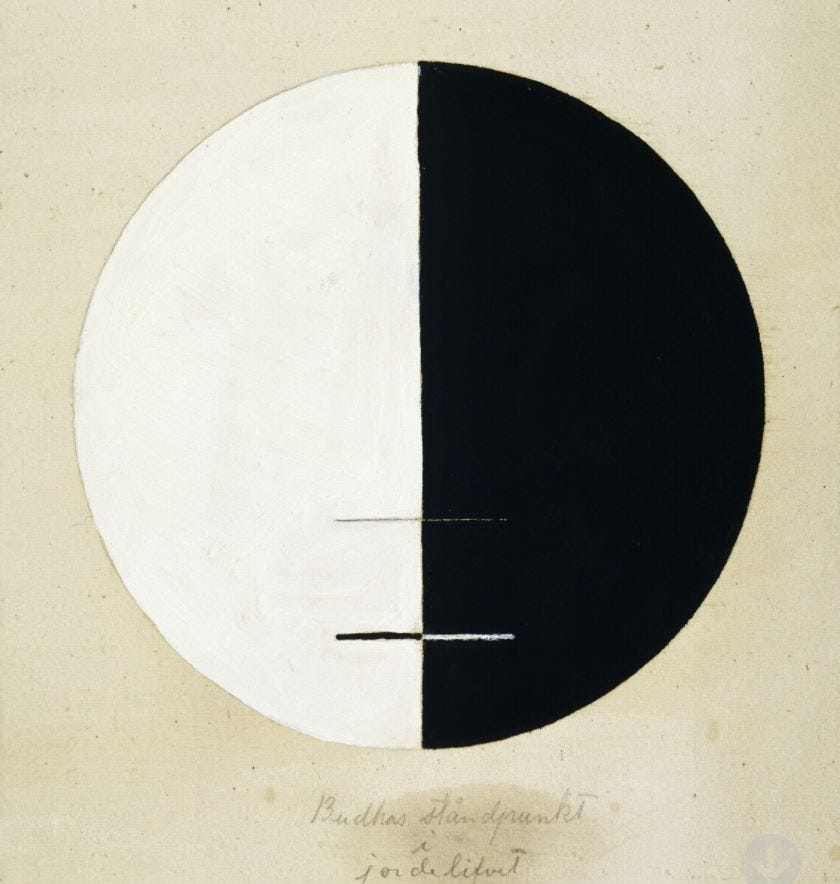
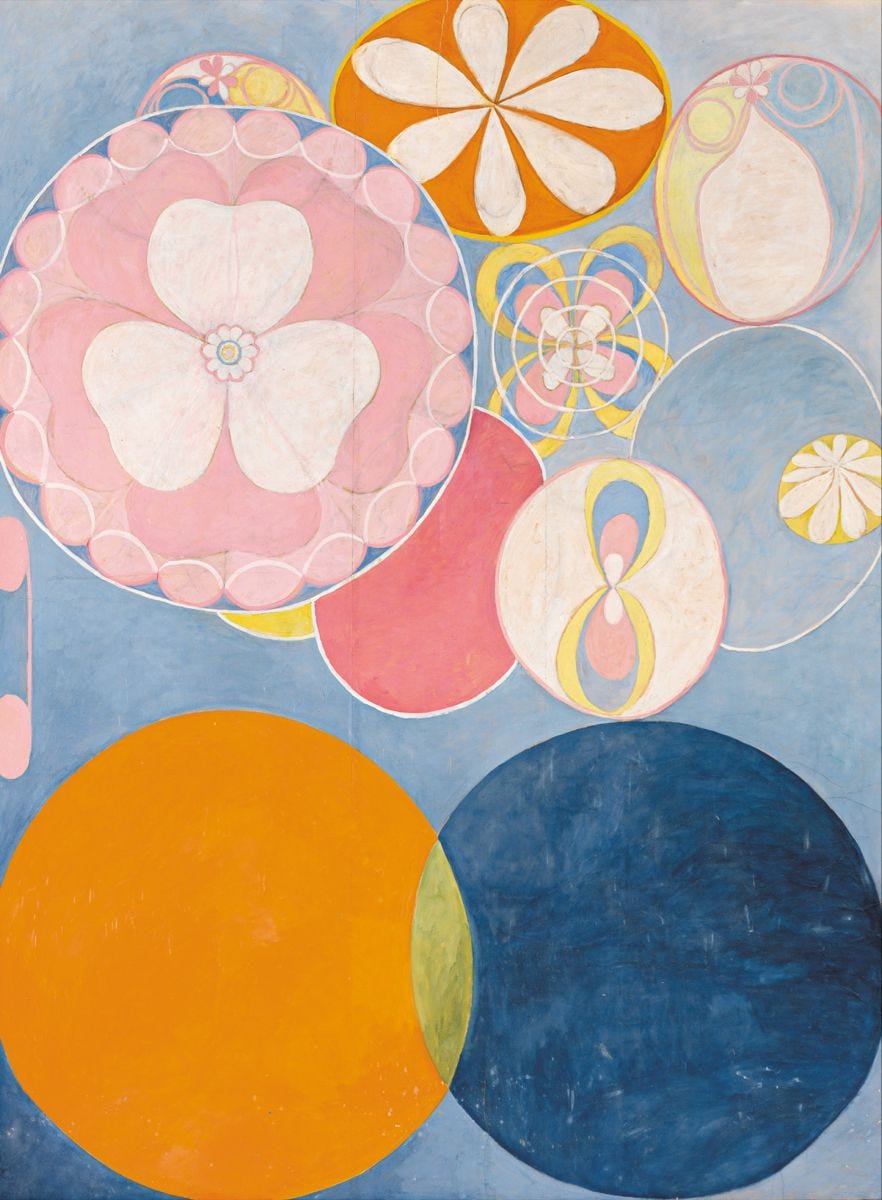
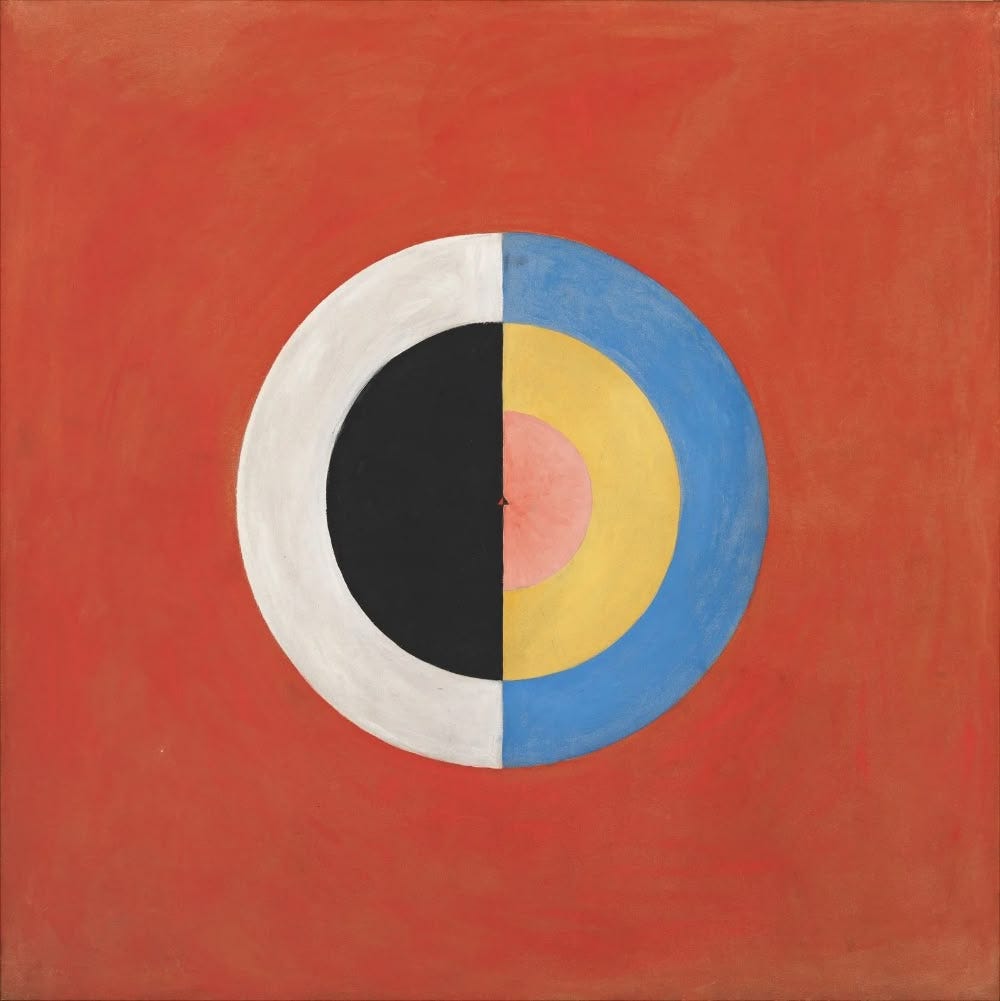
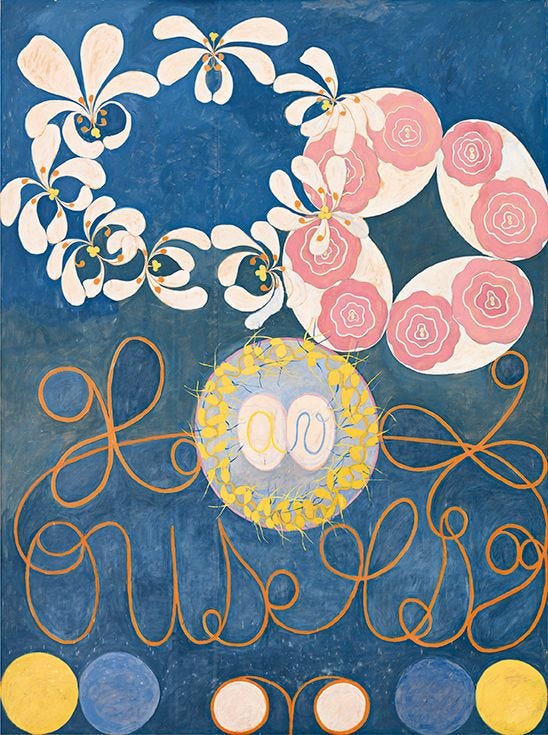
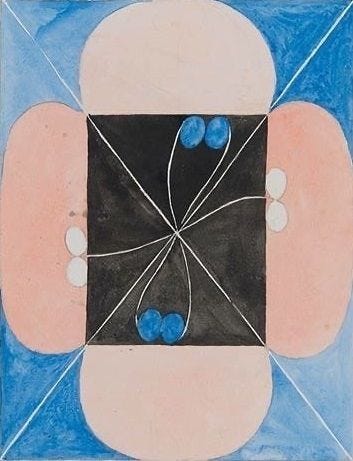
Hilma af Klint painted the invisible long before anyone understood what she was seeing. In the early twentieth century, she created hundreds of works devoted to dualities: masculine and feminine, matter and spirit, chaos and order, the open and the closed. Her paintings did not treat opposites as enemies, but as pairs - held in relation, dependent on one another.
Here, opposites appear not as fixed positions, but as movements: emergence and dissolution, expansion and contraction, order giving way to excess and returning again. Colors, spirals, and forms drift between control and flow. The duality is not tense or confrontational, but rhythmic - like breathing.
Hilma lived with the conviction that reality cannot be explained, only experienced. That there are forces, patterns, and connections beyond the rational - and that these unseen structures still shape how we live, orient, and make sense of the world.
I can’t prove that what I write is true. But I can’t dismiss how true it feels - in my own experience and in the patterns I keep noticing. I offer this as a possibility, not a claim.
Comments
Nothing yet. Say the first thing.
Sign in to join the conversation.