
A newly introduced IOC Strategic Dialogue transitional stage will launch in March 2027 to determine the 2036 host city.
The updated framework aims to eliminate speculative, hyper-expensive bidding wars.
Early data indicates the condensed timeline creates a distinct structural advantage for centralized, cash-rich sovereign wealth portfolios.
The International Olympic Committee’s (IOC) 146th Session in Lausanne has finalized a structural overhaul of the selection process for global mega-events. Under the new “Fit for the Future” framework championed by President Kirsty Coventry, the IOC has instituted a transparent, corporate-style pipeline for the 2036 Summer Games.
Institutional De-Risking via the Selection Pipeline
For decades, bidding to host an Olympic Games was a speculative financial gamble. Municipalities spent tens of millions on architectural renders, only for host nations to frequently inherit billions in post-event debt.
The 2026 Lausanne reforms completely restructure this model. By altering the selection timeline, the IOC is executing a corporate-style de-risking strategy designed to vet sovereign budgets much earlier in the cycle.
According to Future Host Commission Chair Kolinda Grabar-Kitarović, the newly defined milestones will provide “greater clarity and a clear timetable for governments.” However, the true impact of the reform is a major shift in how states must mobilize capital:
The March 2027 Financial Gate: To survive the initial executive shortlisting phase, interested nations can no longer simply pitch concepts; they are required to submit core legal and national financial guarantees.
The Accelerated Evaluation Runway: Bidding groups have less than nine months to synchronize municipal zoning, federal treasury backing, and international compliance files before the Future Host Commission conducts its first physical evaluation site visits.
By enforcing rigid milestones, the IOC is insulating itself from the political volatility typical of Western democracies, where long-term multi-billion dollar expenditures are frequently derailed by local referendums, coalition collapses, or shifting public sentiment. The framework inherently favors sovereign entities capable of guaranteeing massive, long-term capital deployments with absolute domestic alignment.
The Geopolitical Asymmetry of “Existing Infrastructure”
A core pillar of President Coventry’s “Fit for the Future” agenda is the strict requirement that any future Olympic project directly align with pre-existing regional development plans, heavily penalizing the construction of temporary or underutilized “white elephant” venues.
While designed to promote environmental and fiscal sustainability, this regulation introduces a stark, structural asymmetry on the current global chessboard:
1. The Front-Loaded Capital Advantage
Nations that spent the previous decade aggressively building out their sports infrastructure portfolios find themselves with a massive head start. For example, the Qatar Olympic Committee has noted that Doha already possesses 95% of the required sports infrastructure built out from its recent hosting cycles. Because their venues are built, operational, and climate-controlled, sovereign funds do not face an intense construction crunch to satisfy the March 2027 evaluation criteria.
2. The Scale vs. Chronological Crunch
Conversely, emerging markets or traditional Western hubs intending to build ground-up infrastructure face a severe chronological squeeze. The Indian Olympic Association (IOA) formally welcomed the transparent framework, citing its alignment with sustainable planning. However, to anchor their multi-city bid in Ahmedabad, Indian planners must now compress decades of infrastructure financing and federal guarantees into a tight multi-month window to comfortably survive the initial 2027 filter.
The Tension Matrix: Regulatory Transparency vs. Sovereign Monopolies
While the German Olympic Sports Confederation (DOSB) and other European bodies praise the reforms as a logical step toward predictability, the new timeline exposes a fundamental friction point in the modern global sports economy.
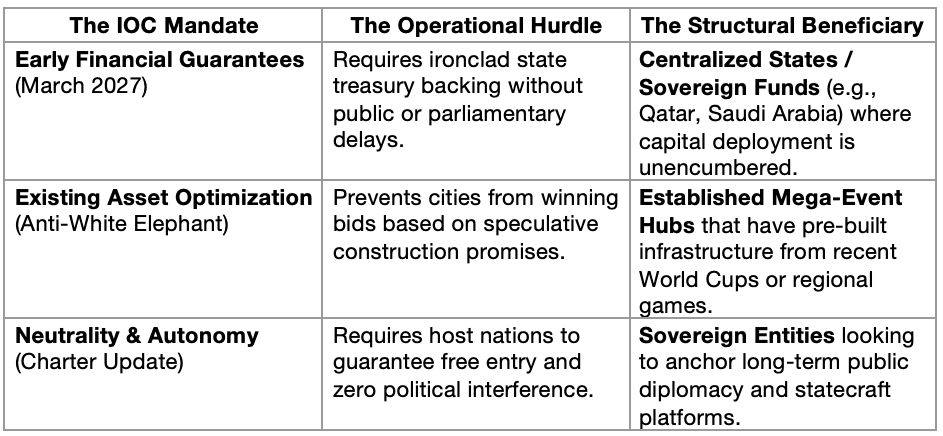
The data implies that the IOC’s quest for absolute financial security has inadvertently narrowed the playing field. The countries best positioned to clear the new hurdles are no longer just those with the highest tourist appeal, but those with the highest degree of centralized political stability and immediate liquidity.
Conclusion
The 146th IOC Session has successfully transitioned Olympic hosting from an urban marketing exercise into a complex discipline of macroeconomic statecraft. The newly minted mid-2029 election timeline dictates that the viability of an Olympic bid is determined years before the flame is lit. For global sports investors, sports ministries, and corporate partners, the Lausanne decree proves that infrastructure legacy is no longer an afterthought in a successful bid—it is the baseline prerequisite for even entering the room.
No posts
Comments
Nothing yet. Say the first thing.
Sign in to join the conversation.