
Before I get started, I have a quick request for all you lovely subscribers out there: please take part in some new research for The Sponsorship Effectiveness Forum. We’re partnering with the IPA to set the first real benchmark for sponsorship effectiveness since 2018. Whether you’re a brand, rights holder, or agency, it only works if people like you take part. It’s ten minutes, and you’ll get early access to the findings ahead of the IPA Effectiveness Conference in October.
For brands https://www.surveymonkey.com/r/FBYJQ2J
For rights holders https://www.surveymonkey.com/r/3J2JWLF
For agencies https://www.surveymonkey.com/r/3RQJMST
When I first joined the integrated creative agency Iris in 2019, I was invited to do a ‘Stop and Think’ presentation to the strategy team. Desperate to prove my chops to the bona fide Strategy Directors whose company I somehow seemed to have blagged my way into, I swiftly read Adam Morgan and Mark Barden’s A Beautiful Constraint and gave a presentation on it.
Fortunately, the presentation went well, and I managed to prove I deserved the job (to myself as much as anyone else). But the idea at the centre of the book has stuck with me ever since.
It is a simple one: stop viewing constraints - such as a lack of time, budget, or resources - as roadblocks, and instead use them as stimuli for better solutions. When you embrace this idea, a limitation is not the enemy of good work. Handled right, it is the enabler of it.
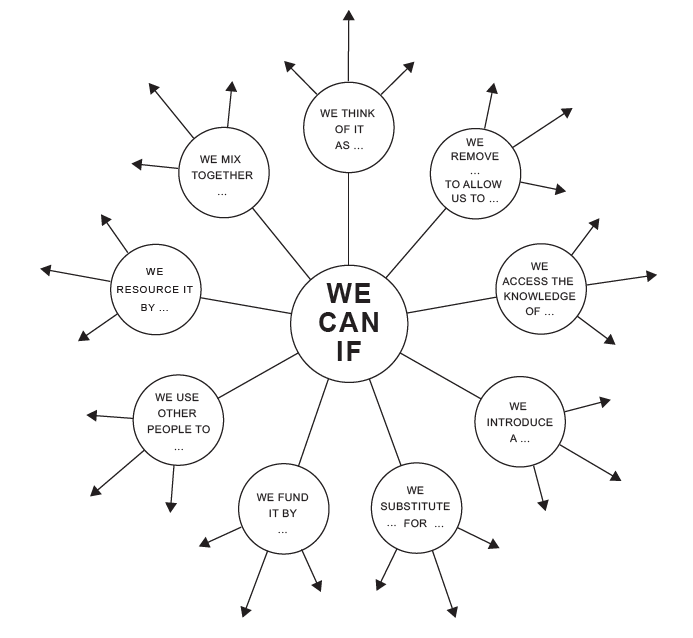
The book’s key call to action is to swap ‘we can’t, because’ for ‘we can, if’. The constraint stops being the thing that wrecks the plan and starts being the starting point for a better one.
I have had a lot of time for that idea ever since. And it came to mind when I began researching the commercial history of the English football team. One might assume that partnering with England works pretty much like partnering with a club.
But there is one fundamental constraint: a national team can’t sell the front of its shirt.
FIFA prohibits commercial sponsors on the front of national-team match jerseys, and the only non-national branding it allows is the kit manufacturer’s logo, deliberately kept small. This is because FIFA wants the exposure at its own tournaments reserved for its own partners. If England turned up at a World Cup with a rival brand splashed across the shirt, every pitch-side board that FIFA sold to Coca-Cola, adidas, or Visa would be worth less.
So national federations’ shirts stay clean to protect FIFA’s golden goose, and the brands that pay tournament money keep what they paid for. This is the constraint at the heart of the Football Association's commercial history.
It’s a beautiful constraint in Morgan and Barden’s exact sense. The ban was a gift. Not to the FA’s revenue line, which has spent fifty years smaller than it might have been. But, ironically, it was a gift to effectiveness. Because the ban on the easy option kept pushing England’s sponsors, decade after decade, towards things that actually build brands: fame, breadth, a cultural relationship, and an asset people will physically buy.
For the first part of the story, there is no sponsorship at all. Umbro, the Cheshire firm founded in 1924, had been making England’s kit since the early 1950s. At the 1966 World Cup, the tournament England won, Umbro clothed fifteen of the sixteen teams on the pitch. But none of those shirts carried a maker’s logo.
Then, in 1973, German club Eintracht Braunschweig put the Jägermeister logo on its shirts and the first shirt sponsor in football existed.

Jägermeister UK@JagerUK
Did you know Jägermeister was the first brand to sponsor a soccer team, Eintracht Braunschweig in 1973? #JagerFacts

2:46 PM · Jan 20, 2014
7 Reposts · 5 Likes
The authorities hated it. In England, the football establishment spent the rest of the decade refusing to allow shirt sponsors at all, even as clubs, squeezed by inflation and falling gates, were desperate for the money.
That fight, the clubs versus the blazers, is its own story (and one Ill return to sometime). But the national teams sat outside the debate, because they had stumbled into something different and, as it turned out, more durable.
When England failed to qualify for the 1974 World Cup, the FA sacked Alf Ramsey, the man who had won the thing eight years earlier. They brought in Leeds’ Don Revie, who set about changing everything, including the kit.
Revie had appointed a small sportswear firm from Leicester called Admiral to supply Leeds’s kit the year before; Admiral had spotted an opportunity nobody in football had taken seriously: the replica market.
Its 1973 deal with Leeds was revolutionary. Admiral became the first brand to pay a club to place its logo on a football shirt, and the first to sell replica kits to fans. When Revie took the England job in ‘74, he took Admiral with him. The firm signed a deal with the FA, which led to England breaking the same new ground for national federations that Leeds had broken for clubs.
But the innovation didn’t stop there. Admiral’s designs were loud by the standards of the day, collared, striped in red and blue, built to look good on the colour televisions that were just then becoming affordable in British homes.
They were designed by a woman called Lindsay Jelley who, by her own account, knew absolutely nothing about football. But she did know about fashion, which was why the shirts looked like nothing the game had produced before. People bought them. Children wore them. The England shirt stopped being something only eleven men wore on matchday and became something the whole country could put on every day.
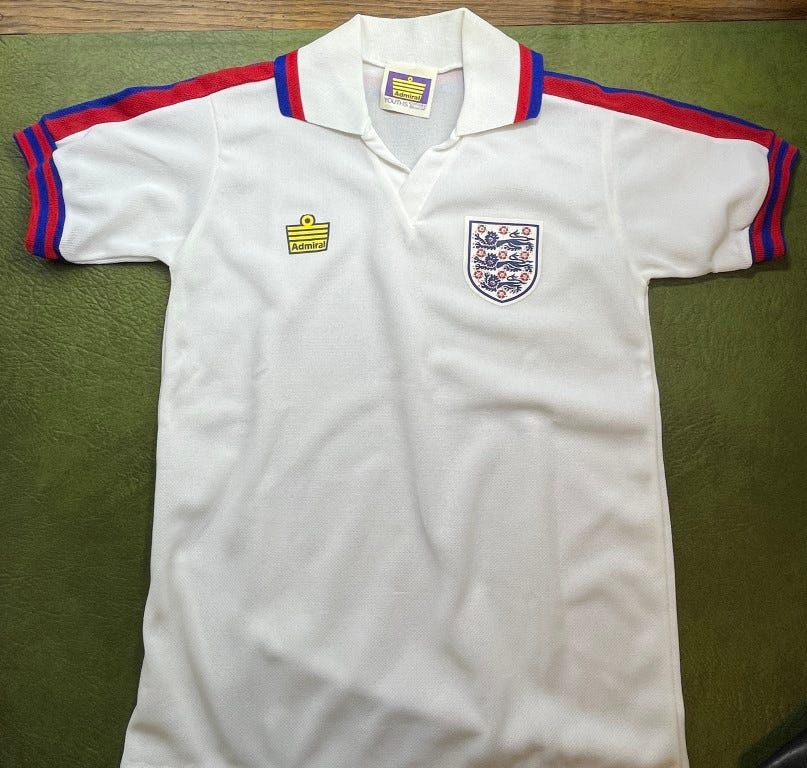
From an effectiveness perspective, it was a masterstroke from the Football Association. The first commercial deal England did gave birth to a distinctive asset in the purest Byron Sharp sense: a thing that was unmistakably England, that built mental availability every time someone wore it down the street, and that the public paid for the privilege of advertising. In much the same way as adidas’s Official Match Ball partnership with FIFA, Admiral didn’t buy attention. They manufactured an object that generated it, and sold the object.
The Admiral story does not end well, which is part of why it teaches so much. The company was modest and privately owned, but it suddenly found itself in competition with adidas. It took over £1m in orders (c. £7m in today’s money), and over-reached with a failed investment in a German factory that cost it dearly. By 1980, the receivers were called in.
Side note: unfortunately, ITV’s Get Shirty documentary about the rise and fall of Admiral isn’t available to stream, but I might start a campaign to get it back online. It looks like a hoot. There’s a podcast interview with the film-maker, Andy Wells, available via YouTube, and he’s also turned the story into a book.
Admirals travails aside, the success of the deal had shown the FA, and the game, that the shirt itself was a hugely valuable asset.
After Admiral, Umbro resumed as England's kit maker around 1984 and held the contract through what most people remember as the golden age of the England shirt, the back half of the eighties and the whole of the nineties. Italia 90 and the tears. Euro 96 and the three lions on a shirt that fans still hunt down on resale sites today. The grey 1996 away kit. The sky-blue third shirt worn once, against Turkey, and mourned ever since.
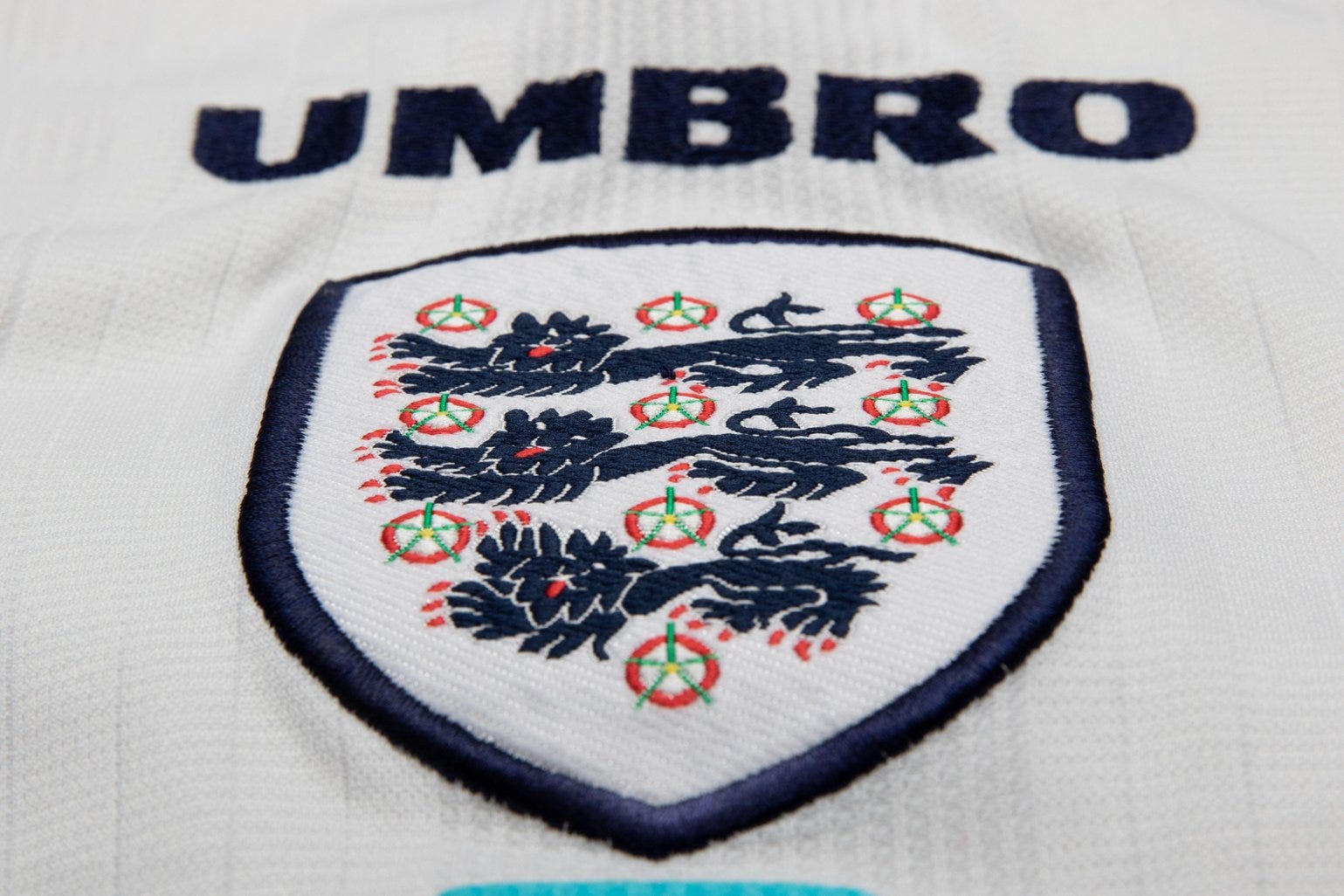
This is the period where the manufacturer relationship matured from making kit into making culture's wardrobe. The kits were distinctive, they were tied to summers the country lived through together, and they were buyable. The replica was doing exactly what Admiral's had done, just at far greater scale, on the back of a team that, for a few summers, carried the nation's hope further than it had in a generation. Umbro's double diamond became, for a while, part of what England looked like. What Umbro could not do, what nobody could do, was put anyone else's name on that shirt. Which meant that all the other brands who wanted a piece of England had to find another door.
For four decades the only commercial relationship the England team had was with whoever made the kit. Then, in the mid-nineties, the FA worked out it could sell the team itself, separately from the shirt, as a sponsorship property. Whiel it couldn’t offer front of shirt rights, it could sell access and association - the right to call yourself a backer of England and to wrap your marketing around the team without ever appearing on it during play. Green Flag, the breakdown firm, was first, around 1994, in a deal worth roughly four million pounds over four years.
Nationwide arrive in 1998 and stayed eleven years, which makes the building society one of the longest and least celebrated relationships in the whole history. The initial deal was around fifteen million pounds, with later renewals nearer twenty million over four years, and it ran until 2010 and the wreckage of that summer's World Cup in South Africa.
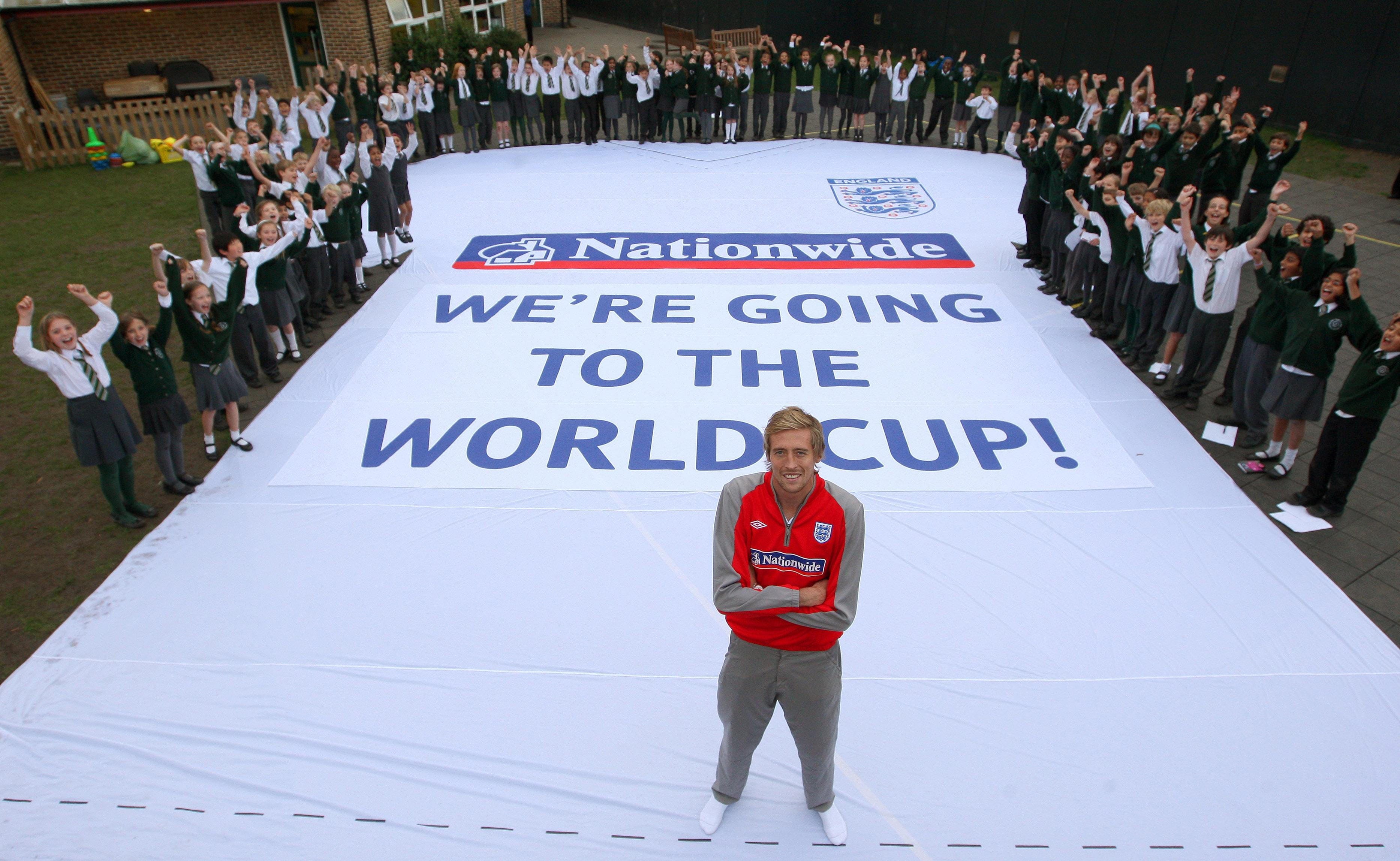
Eleven years is a long time in a category that often churns every tournament cycle. It is also, not coincidentally, long enough for brand effects to compound. The boring, durable, decade-long deal is exactly the kind that Binet and Field would tell you to want, even if it’s not one that anybody would write nostalgia pieces about.
In 2001 the FA tried a different structure, the FA Partners model, five brands sharing England and FA Cup rights with no single title sponsor above them. Umbro, Nationwide, McDonald's, Carlsberg and Pepsi, each buying a slice, none owning the whole. It ran to 2006, is the antecedent of the sprawling roster the FA runs today, and was the moment the commercial model stopped being one big relationship and became a portfolio.
The brands that got the most out of England in this era understood something the brands that struggled did not. You are not buying a winning team. England, for most of this history, has not been a winning team. You are buying the country's relationship with the team, which is a different and far more reliable asset.
Carlsberg understood it. A lager brand whose entire English identity was built on tournament summers, on the pub, on the ritual of hope and the ritual of disappointment, did not need England to lift a trophy. It needed England to be the thing the country gathered (and drank) around, win or lose, and England has always been reliably that.
From an effectiveness perspective, Carlsberg was one of the first brands to commit to significant TV advertising to promote its partnership (principle 7 of the sponsorship effectiveness manifesto: activate with conviction and scale). At UEFA EUROs 2004, the brand executed its most integrated campaign at the time, with heavy TV bumper idents, print ads, and in-store promotions.
By World Cup 2010, it launched £30m media campaign that relied heavily on rousing, emotional TV ads (classic showmanship, I must check in with System1 - I’m sure it score well).
Vauxhall understood this too. The carmaker had first gone near football backing Euro 96, and in 2011 it replaced Nationwide as England's lead sponsor on a deal worth c. £6m pounds a year, covering not just England but the other home nations, all twenty-three sides including the women's and disability teams. It ran to 2018.
Again that beautiful constraint forced the Vauxhall’s hand. It couldn’t buy the shirt, so it bought everything around it, the training-ground access, the player time, the perimeter boards, the right to drive every England moment back to a Vauxhall showroom.

England@England
CONGRATULATIONS! @WayneRooney @toni_duggan and @SBerahino - @VauxhallEngland Players of 2014 the-fa.com/SSQzjx

5:28 PM · Jan 8, 2015
6 Replies · 177 Reposts · 104 Likes
In both cases, the constraint forced the brands into ‘we can, if’ thinking. Denied the shirt, they bought as much access as possible. But, most importantly, they recognised there was an opportunity to sponsor not just the ritual, but the relationship between England’s team and its fans itself.
Creatively, that took both brands into the emotional space that we know is most effective for long-term brand building and value creation. It was a smart move: the relationship doesn’t ultimately depend on the team winning, which makes it the most valuable asset the FA has.
Because, let’s face it, England’s men’s team is volatile. I’m writing this 24 hours after the 0-0 draw with a physical and well-organised Ghana team - a pertinent reminder that it can and always has come crashing down, eventually. And that is the risk sitting under all of this for any partner.
When the underlying property is volatile, the most valuable thing you can own is a something that is insulated from the volatility. A sponsor anchored to the relationship and whose creative leans into the ups and downs, has de-risked itself against the one variable it can’t influence. And that insulation is useful precisely because England, of all teams, will let you down eventually.
I say this as a country-before-club football fan. I have literally dreamed of us winning the World Cup since Mexico ‘86. I live in eternal hope that I will one day see England lift the trophy.
But while the semi-finals of 1990, 1996, the two European finals, and the Lionesses’ victories are the highs, the repeated disappointments of the 2000s, the chronic underperformance of the ‘Golden Generation’, and the defeat to Iceland in 2016, are the lows. A brand that buys England has to understand that it’s buying both.
Heartbreak is, after all, the most English part of the whole thing.
I’m going to leave it there, as this has turned into a bit of a beast. There’s plenty more to come: the arrival of Nike from 2013, the purpose era, and how the rise of the Lionesses opened up a whole new chapter. See you next week.
No posts
Comments
Nothing yet. Say the first thing.
Sign in to join the conversation.