
Meta has published its philosophy for the AI future, and it cites nothing at all.
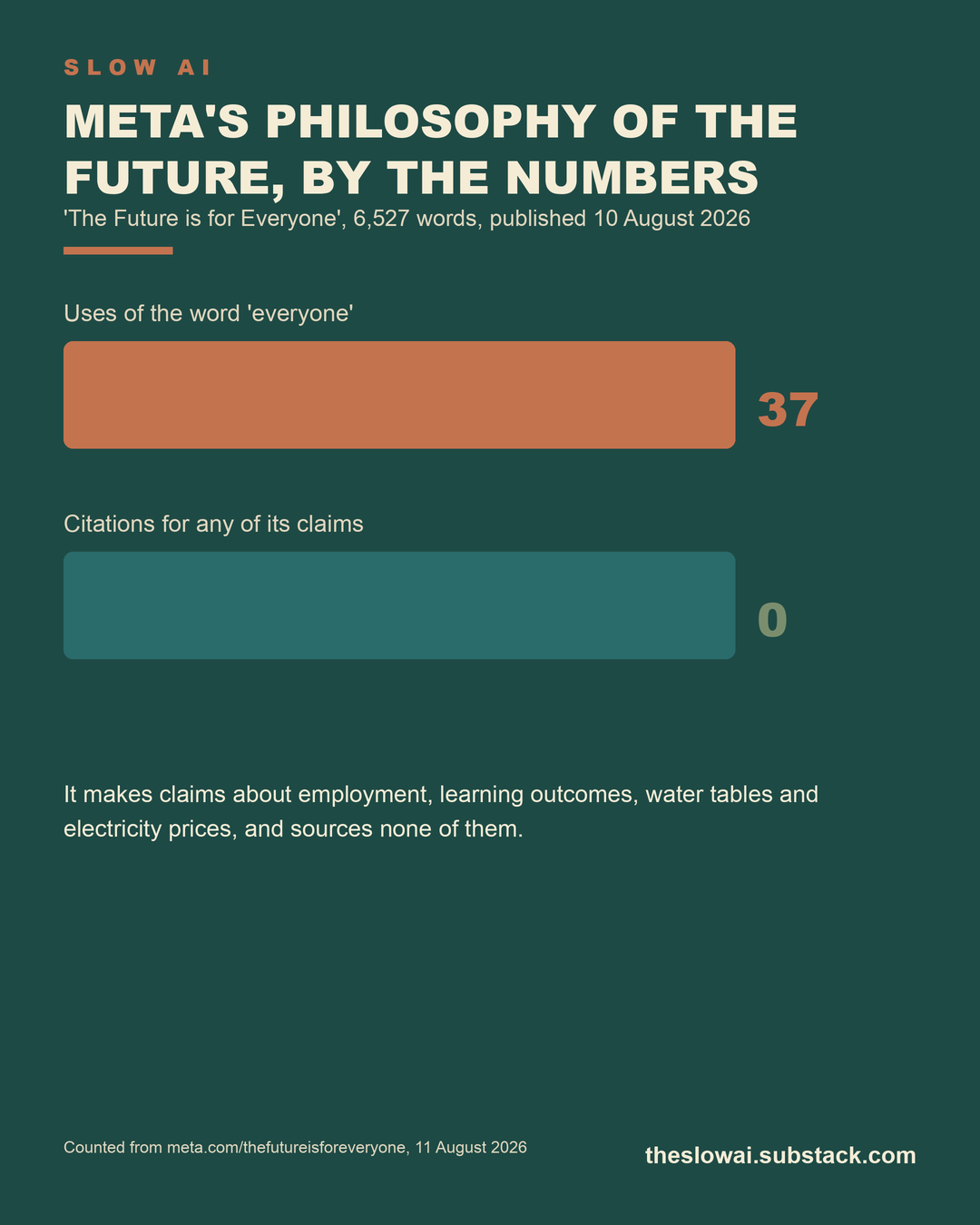
Not one footnote. Not one link. Not one reference to anybody else’s evidence, in over six and a half thousand words that make claims about your job, your children’s education, your private messages, and your electricity bill.
The word ‘everyone’ appears thirty-seven times.
Quote three claims from Meta’s document and set each against the published evidence.
Show you what happened in the one town Meta offers as proof.
Explain why a document with no evidence still gets believed.
If someone forwarded you the Zuckerberg manifesto approvingly, please send them this post.
The document went up on 10 August at meta.com/thefutureisforeveryone, and it is signed ‘Mark’.
This manifesto is written by the man who decides what Meta ships, so its claims about the world can be checked against the world.
One bullet says Meta
“continues to be strongly supportive of open source”
and, four lines later, that it
“will resume releasing some open source models soon.”
A company that has to resume something has stopped doing it. Meta paused its Llama 4 Behemoth model in 2025 and has not shipped an open-weight frontier model since.
“It will have strong privacy and security options so you can trust it to handle all of your personal content knowing that no one else can access your information, similar to how encryption works on WhatsApp.”
In October 2025, Meta told users:
“We will soon use your interactions with AI at Meta to personalize the content and ads you see.”
That took effect on December 2025, in what Meta calls ‘most regions’. The UK, the EU, and South Korea are exempt, and that protection came mostly from the General Data Protection Regulation (GDPR). For over a billion other people, their conversations have been treated as ad inventory since December.
The WhatsApp comparison also breaks down. WhatsApp messages are end-to-end encrypted. However, a message addressed to Meta AI is not, because tagging the assistant takes that message out of the encrypted envelope so the model can read it.
At the 35th USENIX Security Symposium , researchers from KU Leuven, IMDEA Networks, and Radboud University will present ther research on how Meta Pixel scripts on ordinary websites opened silent local connections to the Facebook and Instagram apps on Android phones, tying a person’s browsing to their logged-in identity, through Incognito mode and around Android’s permissions. Meta stopped this behaviour on 3 June 2025, the day the researchers first went public with this research.
There is also further precedent for this. Back in 2019 the Federal Trade Commission fined Facebook $5 billion for deceiving users about who could access their personal information.
“Everyone will have a personalized tutor and coach with a PhD in every subject and unlimited patience to help you learn anything you want. Students will have extra help in areas they need it that is currently only available to those whose parents can pay.”
Zuckerberg has made this promise before. Through the Chan Zuckerberg Initiative he backed Summit Learning, a personalised learning platform built with Facebook engineers: $99 million into Summit by April 2019, and $125 million into the organisation that ran it between 2019 and 2022. By the 2018-19 school year, a quarter of the schools that started had dropped it. Students in Brooklyn walked out. It was wound down in 2023, having struggled to produce evidence of any of the learning gains it promised.
In 2025 a team led by Hamsa Bastani ran a field experiment in PNAS with nearly a thousand high school maths students in Türkiye. They deployed two AI tutors. One mimicked a standard ChatGPT interface. The other was built with safeguards, giving teacher-written hints instead of answers. Both raised marks while students had them, by 48% and 127%. Then the researchers took the tutors away. Students who had used the standard interface scored 17% worse than students who never had AI at all.
The authors’ word for how those students had been doing using AI is ‘crutch’.
Another piece of peer-reviewed research points the other way. Gregory Kestin and colleagues at Harvard, in Scientific Reports, gave physics undergraduates a purpose-built AI tutor and measured roughly twice the learning gains of an active-learning classroom, in less time.
Both results are real, because both setups were completely different. The Harvard tutor was engineered by physics educators, with scaffolds, pacing, and hallucination guards built in. The tutor that made students worse behaves like a normal chatbot. Meta’s document does not say which kind it is building, although I think we all know which type of tutor Meta AI replicates in WhatsApp today.
Slow AI came out of over a decade of asking what actually helps people learn. If it is useful to you, the book collects these arguments in one place.
“I predict that this will not only lead to much greater economic growth, but also more employment over time rather than less.”
Two paragraphs before he writes:
“Recent statistics suggest it may be more likely that individuals' capability growth could match or outpace automation, in which case people will gain the ability to do many new things before their current jobs change.”
Reader, no statistics follow.
In January 2025, on Joe Rogan’s podcast, Zuckerberg predicted that in 2025 Meta would have:
“an AI that can effectively be a sort of midlevel engineer.”
In October 2025, Meta cut around 600 roles from its own AI unit.
The economics is unsettled, and Meta writes as though it were not. Daron Acemoglu and Pascual Restrepo, in the Journal of Political Economy, found that one additional robot per thousand workers reduced the employment-to-population ratio by 0.2 percentage points and wages by 0.42% across US commuting zones. Industrial robots are not language models, and that study settles nothing about this wave. Yet it remains the best measurement we have of the last time a general-purpose automation technology moved through an economy.
Acemoglu won the Nobel in economics in 2024. His forecast for this wave, in Economic Policy, puts the gain in total factor productivity created by AI at no more than 0.66% over ten years.
Compare this to Zuckerberg’s promise of
“much greater economic growth.”
There is a single piece of hard evidence in the manifesto, and Meta chose it carefully.
“For example, in Richland Parish, Louisiana, where Meta is building a large data center, teachers received a $50,000 bonus this year because of the increased tax revenue from our investment. The superintendent told us that teachers are now moving there from across the country and he believes it will become one of the nation's best school districts.”
This is true. Teaching staff received bonuses of $50,935, up from $10,200 the year before. Support staff received $17,472, up from $3,323. In a rural parish where salaries run from roughly $29,500 to $52,300, that is about a year’s pay. Nobody should be sniffy about it, and the district is entitled to be delighted.
The money came from a 1% parish sales tax created in 1968 and dedicated to education. It landed because Meta’s contractors are buying construction materials, furniture, and fixtures. Sales tax on construction runs while there is construction. Superintendent Sheldon Jones said:
"We anticipate elevated bonuses for the duration of the Hyperion construction project"
Development is scheduled to run until 2030.
Zuckerberg also writes:
“We help keep electricity prices low by building our own energy-generating infrastructure wherever we invest.”
In Richland Parish, the utility Entergy is building this generation. It has won approval for a large build-out of power plants and transmission lines to serve the site, with Meta covering the costs for fifteen years. Entergy separately wants to buy a gas plant in Texas for $1.8 billion, a purchase that would cost the average customer about $8 a month.
The teachers’ windfall is scheduled to stop in 2030. The gas plants, the transmission lines, and the substations will still be on the system, and on the bills, likely for long after Meta’s earliest exit date.
Meta has announced a $1 billion fund for the communities it builds in. Meta’s net income last year was $60.5 billion.
The bill for everyone’s future is arriving in Richland Parish.
Zuckerberg’s central argument deserves better than dismissal. He says a single benevolent superintelligence is not a safe design, that concentrated power has a poor historical record, and that people should be able to direct powerful tools towards their own ends. I agree with all three, and the version of that argument made by someone with nothing to sell would be worth reading.
The trouble is that it arrives as the justification for one company distributing one product, written by the one person who controls it, with the evidence removed.
If I had handed this in as a first-year undergraduate, my professors would have laughed at me. Six and a half thousand words of assertion with nothing underneath it.
Zuckerberg is not an undergraduate physics student. He is one of the most powerful men in the world, and this is his account of what he intends to do with that power. Which is why none of it is funny.
What do you think should be in an AI manifesto for everyone? Tell me in the comments below so maybe we can co-create something that actually represents multiple communities rather than just one multi-billion-pound corporation.
Go Slow.
Comments
Nothing yet. Say the first thing.
Sign in to join the conversation.