
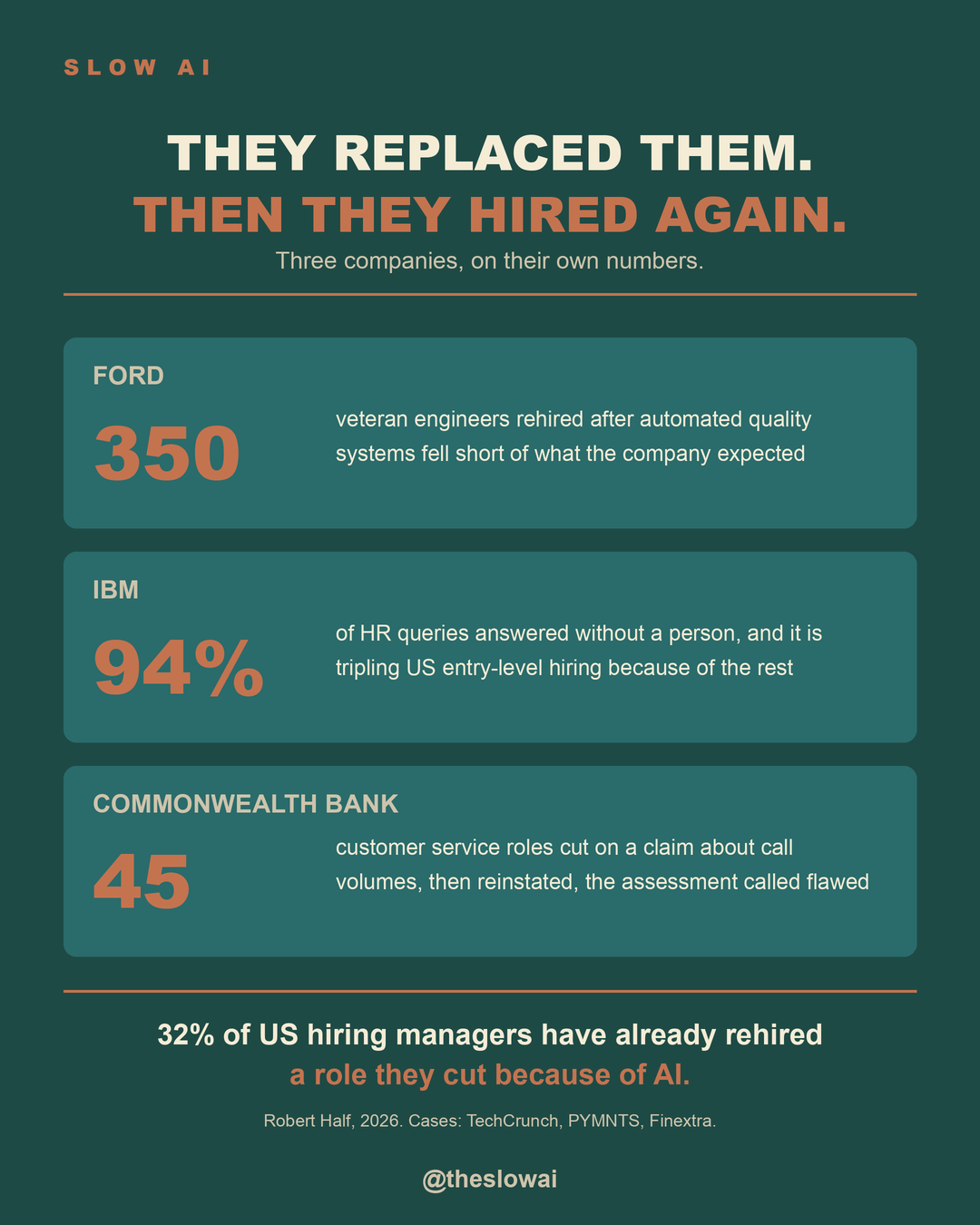
Ford spent years handing vehicle quality checks to automated systems, and let go of the veteran engineers who used to do that work. In June it put 350 of them back on quality. Charles Poon, Ford’s vice president of vehicle hardware engineering gave the reason:
“Mistakenly we thought that by just introducing artificial intelligence and ingesting the design requirements that we had, that that would produce a high-quality product.”
Poon is describing an arithmetic error, and Ford is not the only company to have paid for one this year.
Show you what three companies paid to find out.
Work out what the three reversals have in common.
Give you three questions for finding the part of your job nobody counts.
The same week Poon spoke, Ford took the top spot among mainstream brands in the J.D. Power Initial Quality Study, which it had not done in sixteen years.
This was a company that had leaned harder and harder on automated quality systems and kept being disappointed by what came out. To address this, Ford went looking for 350 experienced engineers, some former employees, and put them back on quality.
Ford CEO Jim Farley says falling warranty and recall costs are:
“contributing to literally hundreds and hundreds of millions of dollars of a tailwind for Ford on cost.”
That is the number the rehiring has to be judged against.
IBM’s internal HR agent, AskHR, now answers 94% of employee questions without routing them to a person. That is a real success and they are entitled to be pleased with it.
In February, IBM’s chief human resources officer Nickle LaMoreaux announced the company would triple its entry-level hiring in the United States:
“And yes, it’s for all these jobs that we’re being told AI can do.”
IBM calls the remaining 6% the complex cases that need human judgement. These are the requests that do not fit the policy, the situations where following the rule would be the wrong thing to do, the cases where somebody has to take into account individual needs alongside organisational governance.
Somebody in your organisation is currently writing a business case that counts what the automation produces and not what the people were absorbing. This post is for them.
Commonwealth Bank of Australia cut 45 customer service roles in 2025, saying an AI voice bot had reduced call volumes by two thousand a week. In reality, the bank was offering staff overtime and putting team leaders on the phones. It reversed the redundancies and admitted its own assessment had been flawed.
In June this year, job hiring service Robert Half found that 32% of US hiring managers have already rehired for a role they cut because of AI. Likewise, in April 2025, Orgvue found that 39% of business leaders had made people redundant because of AI, and that 55% of those admit wrong decisions were made about these redundancies.
If this is the sort of thing you think about, my book goes further into it.
None of these three companies found that the technology could not do the work.
What each of them got wrong was the arithmetic. They counted what the automation produced and did not count what the people had been absorbing, because one of those things appears in a system and the other does not.
The 94% is visible. Ticket volumes, handling times, throughput. The 6% shows up as an absence: the recall that did not happen, the complaint that never escalated, the mistake somebody caught on a Tuesday at 16:55.
Ford’s 350 engineers were invisible in exactly that way until the warranty bill turned up.
This is where the free section ends.
Below the line: what the 6% consists of in seven named professions, the three-question test for finding your own, what to do when a manager cannot see it, and why the people most exposed are not the ones everybody is worrying about.
Comments
Nothing yet. Say the first thing.
Sign in to join the conversation.