
Happy Friday, writing friends!
In this week’s podcast, Bianca chats with Molly Fader, author of Lady X about the writing trick that landed five agent offers! 👀
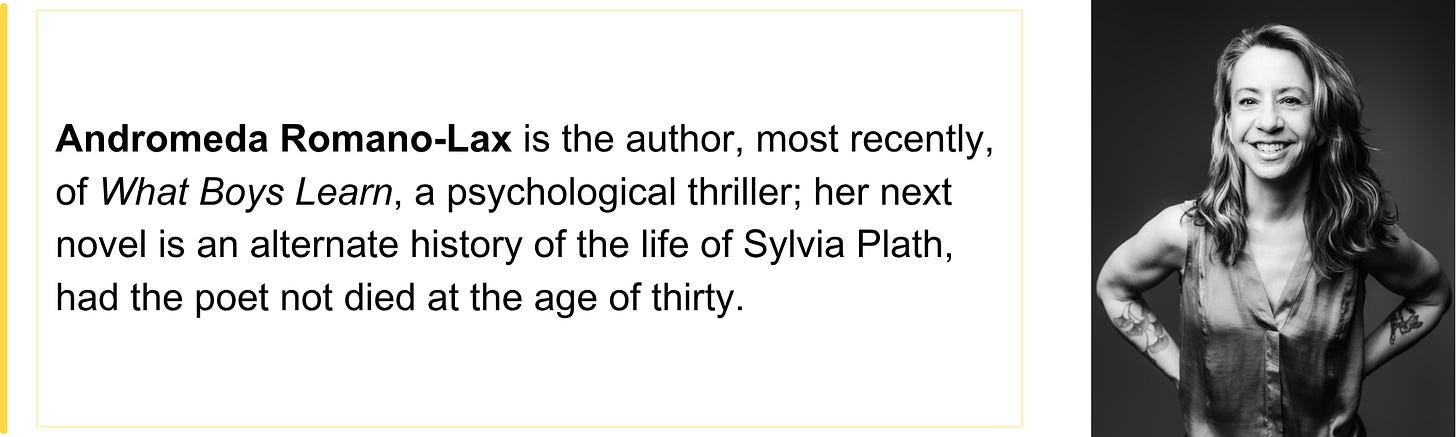
Andromeda Romano-Lax, author of What Boys Learn pens an excellent essay about thriving as a multilane author:
“When I started writing fiction twenty years ago, all of my favorite superstar authors wrote across the genres without forfeiting their lofty “literary” labels: Margaret Atwood, Ian McEwan, Kazuo Ishiguro, T.C. Boyle. If all of them could jump between gritty realism and fantasy, noir, or historical fiction, why couldn’t I?
Who are your role models? Find them. Read them, noting whether their apparently eclectic oeuvres are in fact unified by voice, worldview, or thematic concerns. Study their relationships with fans, and how they respond—or don’t—to their detractors. Authors who write multi-genre books get bashed more often by readers who want them to stay in one lane. Reviewers often fail to “get” some novelists when they veer off onto a new genre track.”
Then, Gloria Chao, author of The Mortal Enemy Murder Club, answers today’s Q&A. We especially love what she has to say about chasing trends:
“I personally think the best work comes from writing the book you envision and not thinking about the trends. The market changes so fast that it doesn’t make sense to write to it, and it usually results in a worse book.
A good agent will see what’s special about you and your writing and help you figure out how to position it. My best advice is to write what’s most entertaining to you, to own what makes you unique, and to think about the market after you have a full draft.”
Join Bianca, CeCe and Carly in Calgary next month from the 14th to the 16th of August for When World’s Collide. They’ll be taping BWH live, as well as speaking on various panels and teaching classes. You can find out more here.
Finally, the registrations for the Beta Reader Match Up are open again!
That’s all for now. Thanks for reading! ❤️
The Shit No One Tells You About Writing Team
P.S. Still not sure about upgrading to paid? Check out our Tuesday Teaser below to see what you’re missing!
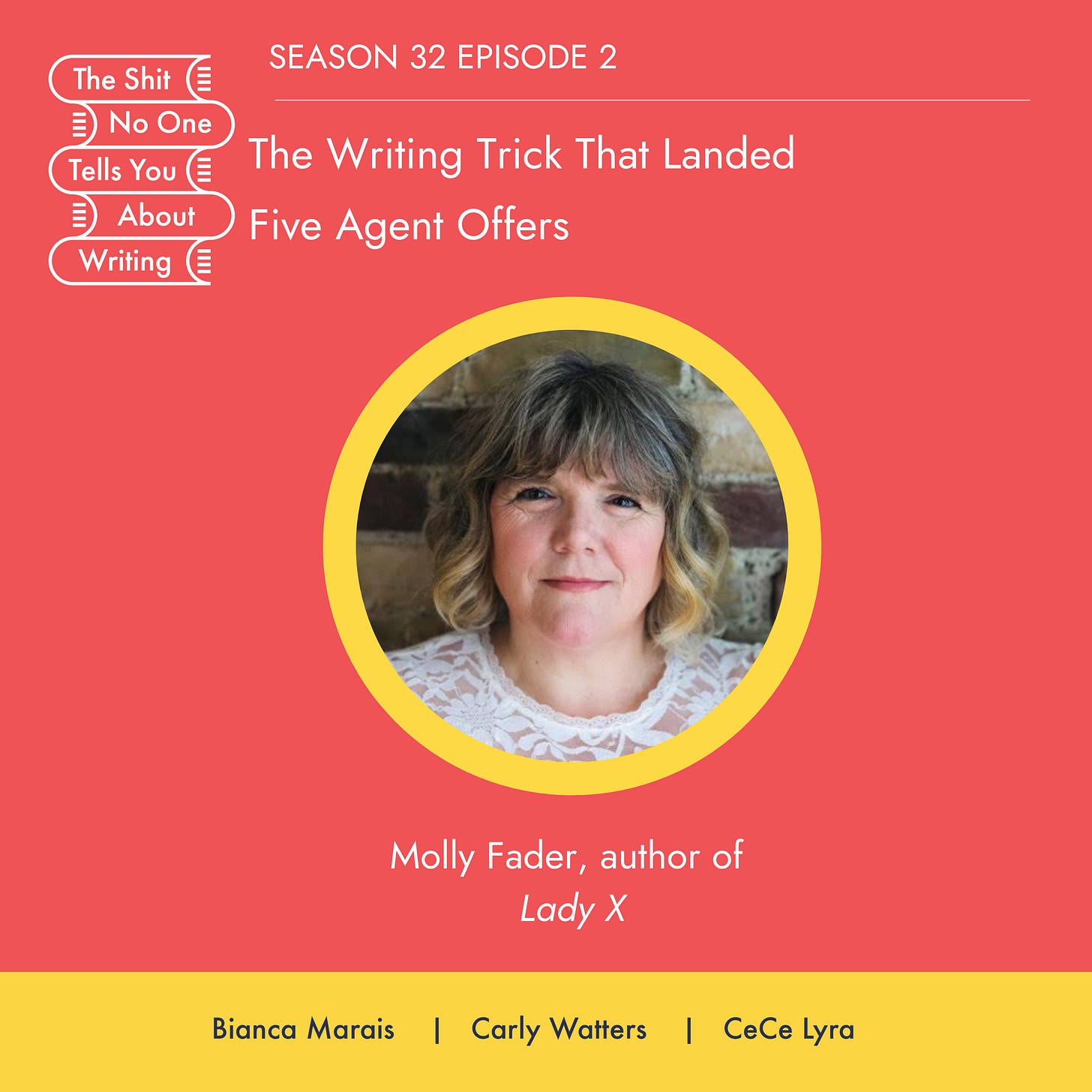
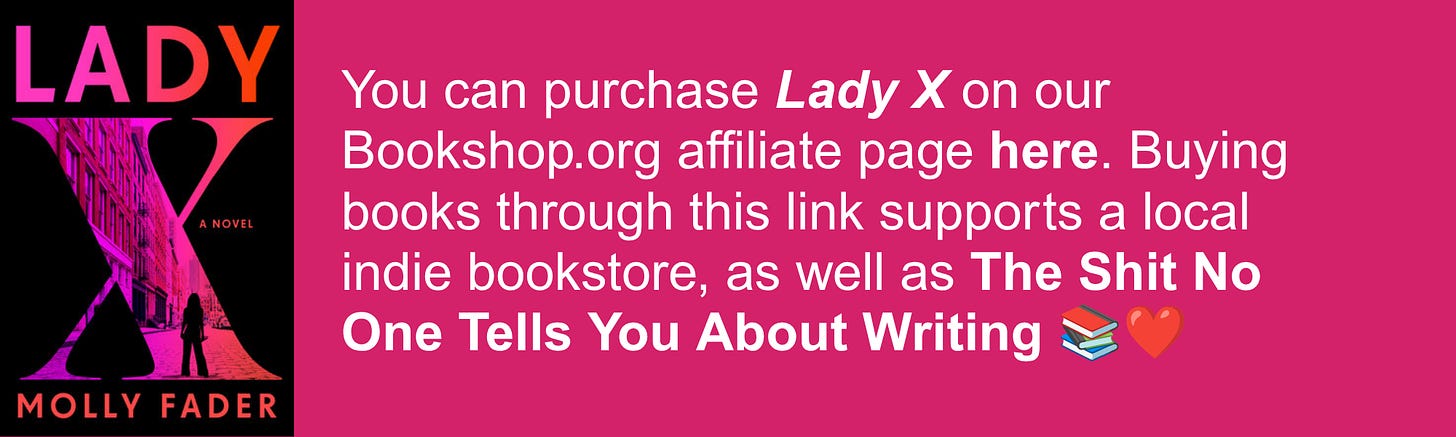
This week on the podcast (listen to it here or watch it on YouTube!), Bianca Marais interviews bestselling author Molly Fader, to discuss her latest novel, Lady X. Molly shares the surprising publishing journey behind it—including parting ways with a longtime agent, refining the perfect log line, and finding representation with a new agent who championed the book. Molly talks about dual timelines, ensemble casts, prologues, and the challenge of balancing multiple storylines. The interview also explores themes of female rage, generational change, activism, and how real-world events inspired a story about women refusing to stay silent.
“I agree a hundred percent on the rules about the prologue. That said, I’m also very much a sucker for a prologue. So you’re right. If it’s trying to fix some really crummy first chapters, you’ve just created a mess.”
-Molly Fader
More information about Molly can be found here. She’s also on Instagram!
Some of us love chocolate ice cream. And some of us love a world in which we will get to taste endless new flavors, whether they are lavender, tropical guava, or maple cardamom candied pecan.
Marketers don’t question that novelty flavors have a place next to top-selling vanilla and chocolate, but we are told that the book industry is hard on multilane authors, because authors need a reliable brand and the best way to grow a readership by sticking to one genre. Ask Taylor Jenkins Reid if that’s true. (We’ll get to her soon, but for now let’s say: yes—and no.)
First, let’s admit that most of us can’t plan our books entirely around marketing, anyway. Many of us are struck by a premise, character, image, or question. Then we try to find the best way to bring those elements to life, whether in the genre we’ve studied most closely or the one we believe will best serve the story.
My debut novel, The Spanish Bow, told the tale of a standoffish Catalonian cellist struggling to remain true to his ideals during the Spanish Civil War. No one was more surprised than me when that manuscript netted a six-figure advance and another high six figures in foreign rights sales. That life-changing experience taught me to follow my heart.
Since then, I’ve published six other novels in genres ranging from historical fiction to speculative fiction and more recently, two thrillers—including one, The Deepest Lake, a Barnes and Noble monthly pick that sold better in paperback than all my previous books. If I’d followed the conventional advice of staying within one genre, I would have missed out on recent financial success.
Even so, being a multilane author is—let’s just say it—taking a risk in a marketplace that would rather have more strawberry and less black licorice or even pistachio. (What’s wrong with pistachio?) Are you determined to do it anyway? Here’s my advice.
MINDSET
R. F. Kuang, author of Chinese military fantasies like The Poppy War and a contemporary satire about publishing called Yellowface told The Guardian, “I’m never going to write a project in the same genre twice, because there are just too many forms of storytelling that I want to experiment with, and not enough years in my life.” For Kuang, her role as a storyteller comes first.
Another equally agile author, Taylor Jenkins Reid, is less a story purist than a skillful pivoter. Reid’s first four romance novels didn’t sell well. Then she shifted toward “famous women” novels like Daisy Jones & the Six, about a rock star, Carrie Soto is Back, about a tennis star, and Atmosphere, about an astronaut—glamorous, emotional stories set in varying time periods, featuring women with fascinating careers. Reid’s goal was to escape the midlist, and she did, landing on a new, wildly successful formula and sticking with it, at least for now.
If the multilane life is for you, the first mindset shift is knowing that it’s possible. To this, add the self-knowledge of what you value most. Is it artistic freedom? Maximum productivity? Big sales and a big readership? Smaller devoted readerships that may not cross over?
STUDY YOUR ROLE MODELS
When I started writing fiction twenty years ago, all of my favorite superstar authors wrote across the genres without forfeiting their lofty “literary” labels: Margaret Atwood, Ian McEwan, Kazuo Ishiguro, T.C. Boyle. If all of them could jump between gritty realism and fantasy, noir, or historical fiction, why couldn’t I?
Who are your role models? Find them. Read them, noting whether their apparently eclectic oeuvres are in fact unified by voice, worldview, or thematic concerns. Study their relationships with fans, and how they respond—or don’t—to their detractors. Authors who write multi-genre books get bashed more often by readers who want them to stay in one lane. Reviewers often fail to “get” some novelists when they veer off onto a new genre track.
In a 1986 New York Times review that I’ve read every few years when I need a pick-me-up, Margaret Atwood’s The Handmaid’s Tale was judged neither credible nor sufficiently complex. “Lacks imagination,” Mary McCarthy quipped. You’d never guess the novel would not only prove culturally prescient but also go on to sell more than ten million copies and be adapted into an Emmy award-winning Hulu series. What if Atwood had stuck to the realism lane she had been traveling via her earlier novels?
FACE THE MARKET REALITY
By focusing on bestselling multi-genre authors, I don’t mean to give the impression that multilane means more profitable. For most writers, it usually doesn’t. Changing lanes to find one that sells better—and then staying there—is common and sometimes rewarded. Wandering across the eight-lane genre highway usually isn’t.
There’s a reason that Pulitzer Prize-winning James author Percival Everett, who laughs at the concept of genre while perversely demonstrating genre’s power in the form of westerns, thrillers, historical fiction, and satire, was published by Graywolf Press for many years, switching to Doubleday only in 2024, following the success of the Oscar-winning American Fiction film, based on his novel Erasure. Most big publishers wouldn’t tolerate Everett’s experimental iconoclasm. His twenty-four novels have been published by twelve different presses, most of them decidedly small. (If you read James and loved it, as I did, how many other Everett novels can you name?)
I debuted with a large publisher and then shifted down to the medium-sized Soho Press, where my editors allow me to switch lanes frequently. Many of my psychological thriller peers who publish with bigger houses are expected not only to stay within the crime category, but to write book after book that hew to even more specific subgenres, styles, and even settings. If being multilane is your goal, you will need both an agent and an editor who support your vision.
BE BRAND PROACTIVE
Being multilane means being both realistic and responsible for the cost of your creative range. Not everyone needs to use pseudonyms for their different genre identities, but some do—even J.K. Rowling, a.k.a. Robert Galbraith.
What else can you do to help readers recognize you for what you offer, aside from predictability? Do you need to talk to readers even more directly, via socials, newsletters, or at conferences and conventions? Will you choose different publishing paths—even self-publishing—for off-brand experiments?
Do you refuse to accept the notion of “brand” at all? I hate to say it—but if so, that may be your brand.
Vanilla and chocolate ice cream sell best, yet ice cream companies continue to bring out weird flavors because humans enjoy novelty and a subset of consumers actively prefer unusual combinations. Authors often swerve between lanes because we are creative, and combining new ideas in fresh ways is the very essence of creativity. Many readers opt for familiarity—and at the same time, authors like R.F. Kuang, Taylor Jenkins Reid, and Percival Everett have chosen to publish books some of their readers will reject.
If you pick your story first, and your way of telling it second, then you’re multilane by temperament in a way that defies pure market logic. How to convert that temperament into success is up to you.
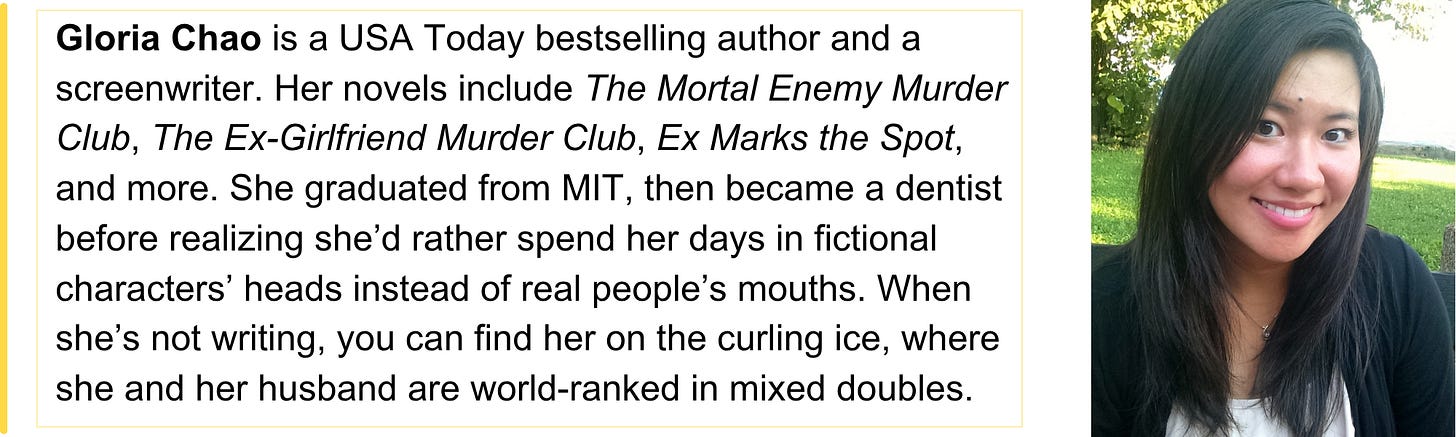
TSNOTYAW: What’s something about your life as an author that people don’t know, or make incorrect assumptions about?
Gloria Chao: Because my first novel, AMERICAN PANDA, was inspired by my life (I was a dentist-turned-writer telling the story of a girl whose parents want her to become a doctor), many readers assume that much of that book and my subsequent books are true. And while I do take a lot from my life, the majority is fiction. The hilarious part is, the pieces that are true are often so wild that readers guess wrong! For example, in THE EX-GIRLFRIEND MURDER CLUB and THE MORTAL ENEMY MURDER CLUB, the protagonist’s mother sends her ridiculous packages because she’s single—including a Glen Powell cutout to put in her window to protect her HOME ALONE–style and a Life Alert because “she could fall down and not be able to get up”—and these are, surprisingly, taken from real life. A wonderful cherry on top of this journey has been hearing from readers who have experienced similar things, including getting a Life Alert from their parents!
Do you focus single-mindedly on one book at a time or do you intersperse writing something new while revising the novel you’re primarily working on?
I like to focus on one book at a time, but when I’m fortunate enough to have multiple deadlines, it’s not possible. I’ve learned the importance of taking notes on my current draft, especially for books with multiple points of view like WHEN YOU WISH UPON A LANTERN and RENT A BOYFRIEND. When writing these, I tried hard to distinguish the two voices, and I needed comprehensive notes to be able to slip back into each POV, especially after time away. I also love to write inside jokes between the characters as well as between the characters and the readers, so I keep a list of them to bring back in as I’m writing. Recently, with EX MARKS THE SPOT and my forthcoming novel, tentatively titled DUMPED, I’ve written very large casts—with a big summer program in EX MARKS THE SPOT and a reality TV dating show set of contestants and crew in DUMPED—so for these, I took detailed notes on the characters. EX MARKS THE SPOT also involves a treasure hunt through Taiwan, which required an extensive outline on the puzzles, how they connected to the larger hunt, and how they connected to the rest of the narrative.
What’s your current favorite craft trick?
To have fun! Writing THE EX-GIRLFRIEND MURDER CLUB and THE MORTAL ENEMY MURDER CLUB has allowed me to completely lean into the comedy because of the humorous nature of the premises (in THE EX-GIRLFRIEND MURDER CLUB, three women discover they’re dating the same man and band together to get revenge, only to find his body and become the #1 suspects; and in THE MORTAL ENEMY MURDER CLUB, the girls are back but have to save their worst enemy from murder). When I’m introducing a new piece of information, I ask myself, What’s the funniest, most entertaining way I can accomplish this? And it leads to scenes like Kathryn Hu learning about her boyfriend’s other girlfriend by walking in, half naked, on him proposing to her, and Kathryn and the other girlfriend (now best friends in the sequel) talking about Kat’s new boyfriend and the size of his thingamajig without realizing that everyone else can hear them.
What inspires you to keep writing? Both on an everyday level and an ‘I’m starting a new book’ level?
For both everyday writing and starting a new book, what keeps me inspired is an idea I can’t stop thinking about with enough plot and character to sustain an entire novel.
For example, WHEN YOU WISH UPON A LANTERN is about a girl whose family owns a wishing lantern shop in Chicago’s Chinatown, and when she learns that the store is struggling, she teams up with the boy from the mooncake bakery next door to grant secrets for the customers in secret. This book balances a childhood-friends-to-lovers romance with feuding families, multigenerational friendships, secret wish-granting, and a tight-knit community the readers feel a part of. This was also my love letter to my culture, featuring some of my favorite traditions, holidays, food, and folk tales. And I wrote the book with the goal of writing a contemporary story that feels like magic, with the magic coming from kind acts for others. I wanted to remind readers and myself that even though it’s rare, magic can be found in the real world. And sometimes you have to make your own magic. With this book idea, there was so much to get excited about and a bountiful well of details to fill the story with.
What is your advice to new/aspiring authors who are told not to write to trends and then struggle to find representation because of inability to fit into the market?
I personally think the best work comes from writing the book you envision and not thinking about the trends. The market changes so fast that it doesn’t make sense to write to it, and it usually results in a worse book.
A good agent will see what’s special about you and your writing and help you figure out how to position it. My best advice is to write what’s most entertaining to you, to own what makes you unique, and to think about the market after you have a full draft. Sometimes this does mean that there will be heavy revisions—I rewrote my debut novel, AMERICAN PANDA, three times for new adult, women’s fiction, and then finally young adult because I wanted to set it in college, and back in 2016, that didn’t fit into the market anywhere. And with RENT A BOYFRIEND, the characters are 19 and 21 years old—which is old for a young adult book, but it was necessary in order for the main character to feel the pressure to hire an actor to introduce to her parents as her fake boyfriend—and I had to have discussions with my editor about how to make this book work for YA.
What hopes, goals, or expectations did you have at the start of your career? Have any come true? Have your goals and expectations changed?
When I changed careers from dentist to writer thirteen years ago, my main goal was to get an agent and a book deal. And since publishing my first book, my goal has been to continue publishing books for as long as the industry will have me. I didn’t foresee my screenwriting career or becoming a bestselling author, and while those weren’t necessary, they have certainly been the cherry on top. Now my goal is still to continue publishing books, and also to enjoy every step of the journey. This career involves many highs and lows, and I’ve learned it’s important to celebrate every milestone you can. The most recent milestone I have been enjoying is that I’m working with Wendi McLendon-Covey (star of ST. DENIS MEDICAL, THE GOLDBERGS) and her production company, Strong Beach Productions, on adapting THE EX-GIRLFRIEND MURDER CLUB series to film, which is again beyond the wildest dreams I had when I began this journey.
If you don’t have an MFA or comparable education: how did you develop your craft? Do you feel like an MFA would’ve benefited you?
I do not have an MFA or any creative writing education. I developed my craft by reading and paying attention to what I liked and didn’t like. Depending on the book I’m writing, I have different goals. With AMERICAN PANDA, because it was inspired by my life, I wanted to write honestly about my experience. With THE EX-GIRLFRIEND MURDER CLUB, THE MORTAL ENEMY MURDER CLUB, and the forthcoming DUMPED, I wanted to write what I thought was most entertaining. With RENT A BOYFRIEND and WHEN YOU WISH UPON A LANTERN, I wanted to capture the beauty of first love. And I let these goals drive character and plot decisions.
I cannot speak to the counterfactual scenario, but I can say that it’s certainly possible to become a published author without a writing degree. I think we all have innate storytelling instincts, and by reading a lot, thinking about story, and figuring out what we enjoy as a reader, it’s possible to learn the most important parts. And a lot of it is trial and error and being willing to rewrite your story as many times as needed. There isn’t one road to becoming a published author, and if I can do it, so can you.

In next week’s newsletter exclusively for our paid members, we’ve got ….
Sarah Adler, author of Wild Goose Chase, discusses what ‘high concept’ really means in publishing. In her author video, she also shares a practical exercise for generating stronger story premises, discusses the difference between premise and plot, and argues that a great high-concept idea only works if you fully deliver on it from the first page to the last.
Then, Natalie Moss, author of The Night Hunter pens a wonderful essay titled Landscapes with Teeth:
“And yet, for all the glorious obsession available in the craft world I think one element gets talked about a little less often: setting. It’s a big loss because to me, setting matters just as much as plot or character. They’re three sides of the same very odd, very lopsided, and probably structurally unsound coin.
So I sat down and went back through all of my favourite books set in wonderful places and tried to see what they had in common. After that, I created a short checklist of things to try when writing that perfect setting for your novel.”
You’ll want to check out Natalie’s checklist as well as a few excerpts she shares from some incredible novels.
Our Meet Your Dream Agent profile is of Tali Shammas from Storm Literary Agency:
“My first 24 hours open, I received 1,000 queries. I closed to queries for a little while to catch up and recently reopened. At this point, my inbox has been open for about two weeks in total and I have received about 2,000 queries. I haven’t requested any partials yet, but according to QueryManager, I have requested 47 fulls. That’s approximately a 2% request rate.”
Keep reading to find out if you and Tali would make a great fit!
Tuesday’s Q&A is with Catherine Ryan Howard, author of Buyer Beware. Her answer about knowing when a book is ready to query made us laugh:
“I wouldn’t advise anyone to do what I did which is a long story involving me implying a book was written that wasn’t, lying to an agent that I was about to go on vacation for a very suspicious-sounding 3 weeks, and then me crapping out 50k words in that same timeframe. My 10-years-later, professional, experienced, sane advice is to imagine that your manuscript is about to be read by your dream agent. They’ll only read it this one time. They do and they say no. What’s your reaction? Do you think (a) well, I gave it my best shot, there was nothing else I could have done, we’re just not meant to be together or (b) shit, I KNEW I should’ve changed that thing at the end! Obviously, if it’s (b), it’s not ready.”
We totally get it. Querying can make you do some stupid 💩! 😂
Finally, don’t forget that registrations are open for the next Beta Reader Match Up!
Not yet a member? For just $10 USD a month or $120 USD a year you get:
an exclusive newsletter on Tuesdays featuring bonus author Q&As and other exclusive content from industry experts
access to Carly Watters and CeCe Lyra’s written notes on queries from the podcast’s Books With Hooks feature
monthly bonus podcast episodes, AND
regular Ask Me Anythings / Q&As with Carly, CeCe, and Bianca Marais.
If that doesn’t kickstart your writing journey, we don’t know what will!
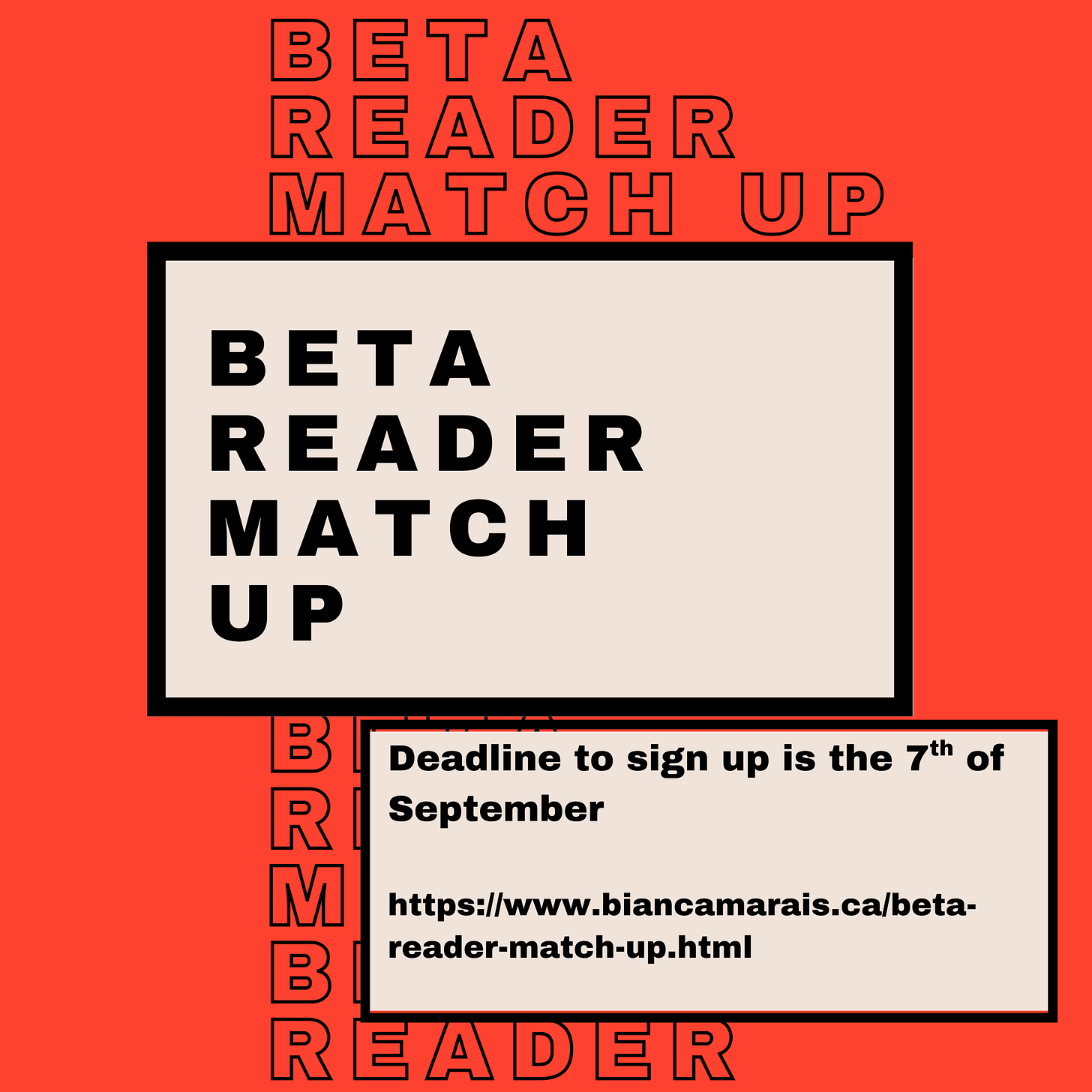
Are you looking for beta readers, some of whom might potentially become writing group members down the line? Are you wanting to be matched up with those writing in a similar genre and/or time zone, so they can critique your work as you critique theirs at the same time?
Your manuscript doesn’t have to be complete to sign up!
On the 8th of September, Bianca will match you up with between 2-6 other writers in similar genres and/or time zones depending on how many writers sign up. After that, it’s up to you to set up a date when you’ll either all meet up virtually to discuss your work or just send each other your written critiques. Whatever works best for you!
Important Instructions:
Submit 3000 words in a Word document before midnight ET on 7 September. If they aren’t opening chapters, you need to provide a summary so your beta readers have context for the submission. You may ask 2-5 specific questions within the same document for your beta readers to address.
The summary and questions don’t form part of the 3000 words.
Cost: US $25
Please note: NO AI whatsoever may be used to critique each other’s work!
More about the match up here!
That’s all for this week’s news! If you enjoyed it, why not share the love? 🥰
Share The Shit No One Tells You About Writing
Tune in again next week for more invaluable wisdom from our wonderful hosts! Until then, happy writing! 😍
❤️ The Shit No One Tells You About Writing Team
Our work takes place on land now known as Toronto and Ottawa and we acknowledge that these are the traditional territories of the Mississaugas of the Credit, the Anishnabeg, the Chippewa, the Haudenosaunee, and the Wendat Peoples as well as the unceded, unsurrendered territory of the Anishinaabe Algonquin Nation. Toronto is covered under Treaty 13 and the Williams Treaties. We respect and affirm the inherent and Treaty Rights of all Indigenous Peoples across this land and acknowledge the historical oppression of lands, cultures, languages, and the original Peoples in what we now know as Canada. We invite you to learn more about the land you inhabit, the history of that land, and how to actively be part of a better future going forward together at Native Land or Whose Land.
Cece Lyra is a literary agent at Wendy Sherman Associates. If you’d like to query CeCe, please refer to the submission guidelines at www.wsherman.com. Carly Watters is a literary agent at P.S. Literary Agency, but her work on this podcast is not affiliated with the agency, and the views expressed by Carly on this podcast are solely that of her as a podcast co-host and do not necessarily reflect the views, opinions, policies, or position of P.S. Literary Agency.
Comments
Nothing yet. Say the first thing.
Sign in to join the conversation.