
Few cinematic debates ignite passions quite like the infamous scene from “Star Wars: Episode IV – A New Hope” involving Han Solo and the bounty hunter Greedo. The question has been argued by fans for decades: who shot first? But what if we approached this pop-culture puzzle with the meticulous lens of forensic shooting reconstruction and crime scene analysis?
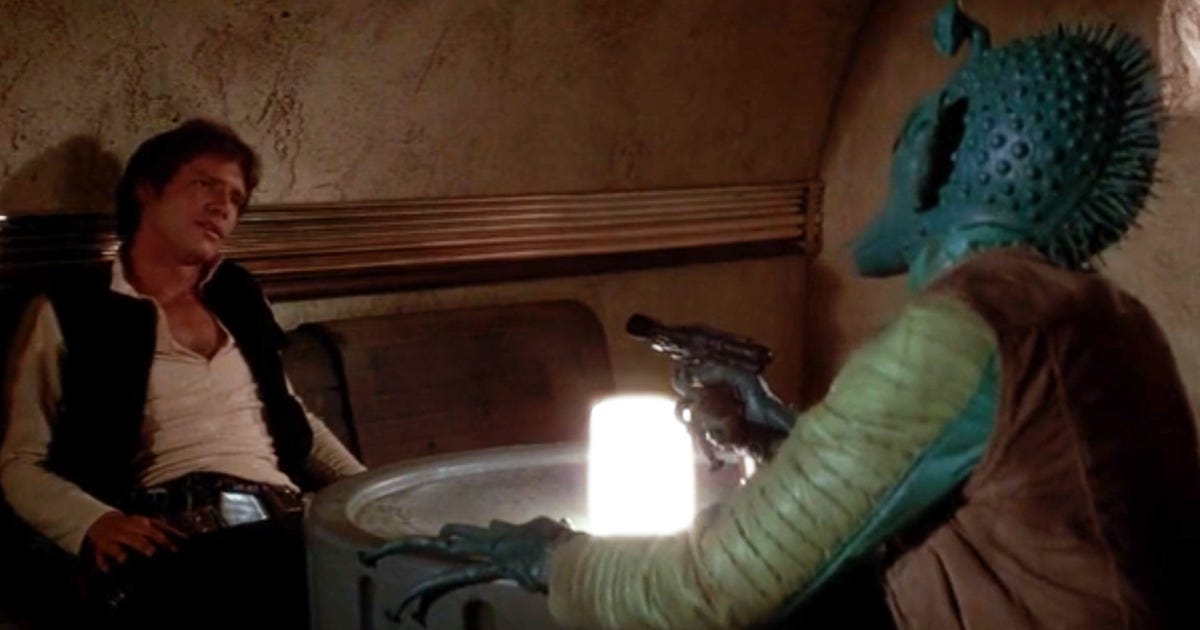
In the dimly lit Mos Eisley Cantina, Greedo confronts Han Solo, their conversation tense and charged. Greedo, the over confident bounty hunter, toys with Solo, who coyly stalls for time giving him an advantage. A sudden flash, a blaster bolt, and Greedo slumps onto the table. The scene has been edited multiple times, sparking ongoing debate about whether Han acted preemptively or in self-defense.
Shooting reconstruction relies on physical evidence to establish the sequence of events accurately. It involves systematically analyzing and interpreting the scene to determine the position and actions of individuals involved during the event. This forensic process typically includes:
Trajectory Analysis: Examining the angles at which projectiles or energy bolts (in sci-fi scenarios) strike their targets or surrounding surfaces. The trajectory analysis helps experts determine the shooter's position and potential movement at the moment of discharge. By tracing backward from points of impact, forensic specialists can approximate the shooter's location and potentially other positioning information.
Blaster Residue Patterns (analogous to Gunshot Residue): Residue patterns offer critical clues about the distance and angle from which a weapon was discharged. For firearms, this includes particles expelled from the muzzle and other ports of a firearm, depositing distinctive patterns on nearby objects or individuals. These particles and patterns can be examined through chemistry methods for elementals analysis or examination of the pattern itself for muzzle to target distance determination. In fictional contexts like Star Wars, blaster residue would leave scorching or burn patterns. Significant research is needed in analyzing these marks to determine if they can significantly clarify the range of fire and confirm or refute witness accounts.
Witness Statements and Video Evidence: Eyewitness testimony and visual records from video surveillance or recordings are crucial but must be meticulously evaluated. Memory distortion, perspective issues, or video editing can affect accuracy. Forensic experts cross-reference witness accounts and video evidence with physical findings to validate or challenge reported sequences of events.
Trajectory Analysis:
Greedo and Han sat across a small table, their blasters poised under or just above the tabletop. Greedo’s blaster points at Han’s chest, while Han’s is subtly angled upward beneath the table. To determine who shot first, we’d look at the angles and potential impact marks. If Greedo fired first and missed (as later edits suggest), a blaster bolt impact mark would be visible near Han, altering the environment clearly. When we take the “surveillance” footage frame by frame we can view this in better detail.
Witness and Video Evidence:
Eyewitness testimony and visual records from video surveillance or recordings are crucial but must be meticulously evaluated. Memory distortion or editing can affect accuracy. Forensic experts cross-reference witness accounts and video evidence with physical findings to validate or challenge reported sequences of events.
Within the context of our forensic examination, we have unique video evidence available. However, the reliability of this evidence depends heavily on the specific version of the scene under analysis. The original 1977 release shows no visible laser bolts witnessed by the audience—only the sound of a blaster firing and Greedo falling forward onto the table, followed by Han calmly rising and exiting the cantina. This strongly suggests Han fired first, as there was no indication Greedo ever discharged his weapon.
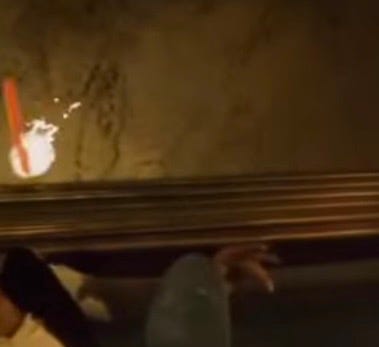
In the 1997 remastered version, a laser bolt is digitally added, clearly showing Greedo firing first but missing Han. By 2011, the Blu-Ray remastered version further complicated the analysis by showing laser bolts from both Greedo and Han. In this version, Greedo’s bolt narrowly misses Han, while Han’s shot, fired skillfully from the hip, strikes Greedo dead center. This variation introduces a new layer of complexity and calls into question the reliability of witness (viewer) observations due to multiple edits.
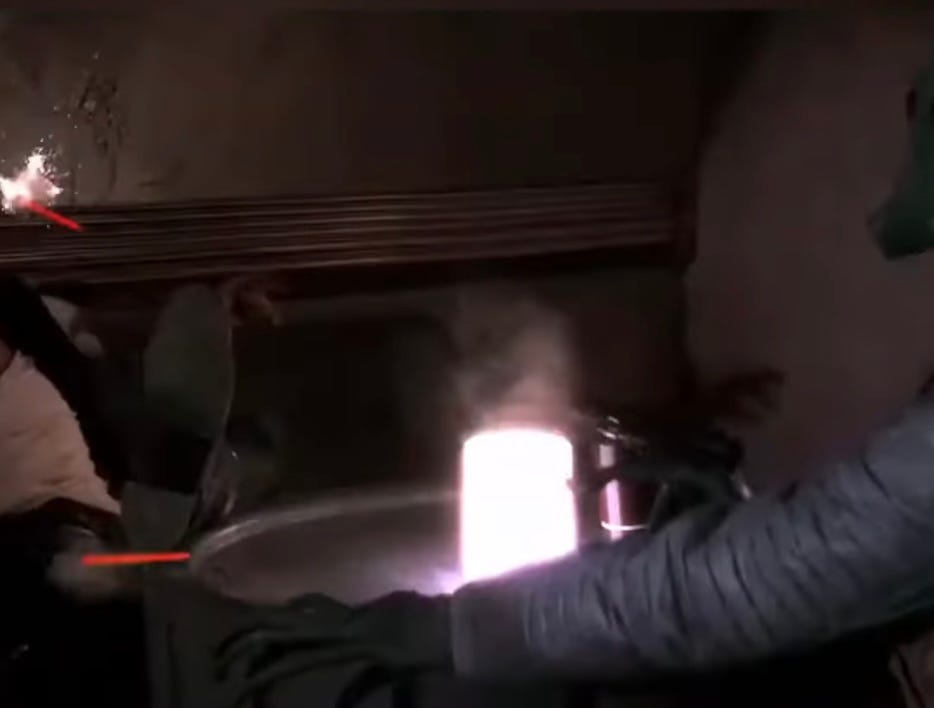
An additional forensic consideration arises regarding the nature of laser weaponry depicted in Star Wars—blaster bolts, traveling at or near the speed of light, raise the question of observational limitations. Could observers truly see a laser bolt in flight? Despite this theoretical limitation, the 2011 footage clearly depicts straight-line ballistic trajectories, enabling forensic analysts to accurately reconstruct the events by analyzing their partially captured flight paths.
Residue and Impact Patterns:
The original 1977 footage shows a single bolt from Han striking Greedo. Later versions add a Greedo shot missing wildly. Forensically, Greedo’s miss would leave a visible scorch mark, not easily explained away. Yet, no distinct environmental damage consistent with Greedo’s missed shot is initially visible in the original scene, suggesting Han’s preemptive strike as the most plausible event based solely on early evidence.
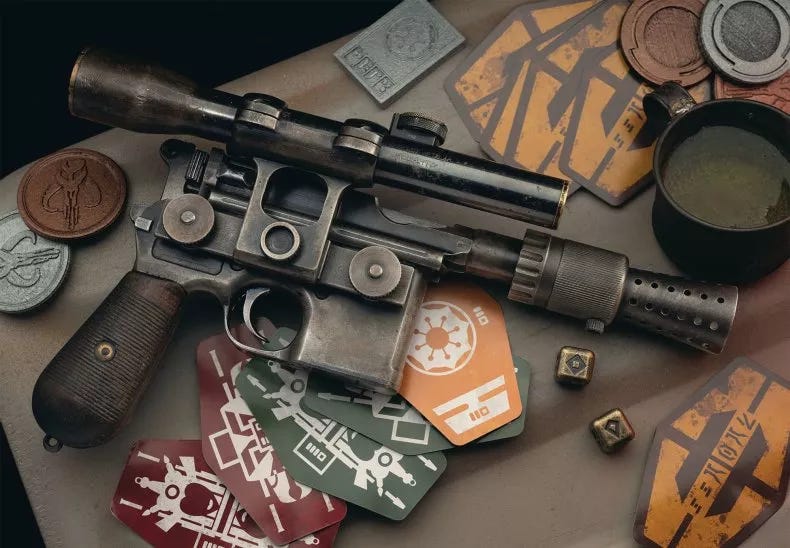
Initial observation of the incident scene would suggest that Han shot first, supported by the absence of any initial evidence indicating Greedo discharged his weapon. However, upon further forensic analysis of digital video evidence from later remastered versions, it appears Greedo may have indeed fired first, albeit inaccurately. Both individuals clearly positioned themselves to shoot first, reminiscent of a classic Old West—or, in this case, space western—scenario of a quick draw.
Forensic analysis cuts through narrative ambiguity, providing clarity: Han Solo’s action appears preemptive, tactical, and decisive—a calculated risk by a rogue who understood precisely when to strike. Regardless of who fired first, it remains a clear self-defense scenario. Should Han Solo find himself apprehended by Imperial forces, I would gladly serve as the shooting reconstruction expert on his behalf and confidently recommend several exceptional criminal defense attorneys.
Ultimately, forensic reconstruction not only settles a pop-culture debate but highlights the power of evidence-based analysis in understanding complex, disputed events, even in a galaxy far, far away.
No posts
Comments
Nothing yet. Say the first thing.
Sign in to join the conversation.