
In academia, the notion of “novelty” often evokes a sense of wonder. We celebrate the eureka moments, applaud innovative experiments, and idolize bold theorists. Yet, the very same ecosystem that praises novelty can also work against it, creating hidden roadblocks and sometimes outright hostility towards unconventional research. This is especially true when fresh ideas challenge longstanding assumptions. In a system that simultaneously cherishes and resists true innovation, how do we—researchers, scholars, students—become the academic rebels who refuse to be silenced?

When Novel Ideas Meet Stubborn Orthodoxy
Innovation in research isn’t just a thrill; it’s an essential driver of societal and scientific progress. Sometimes, however, the peer-review process and entrenched orthodoxies can turn that thrill into frustration. A case in point is the experience of a team of engineers from Columbia University who uncovered a new layer of fingerprint analysis. Their research didn’t upend the uniqueness of fingerprints; rather, it added a nuanced perspective on fingerprint curvature—a potentially groundbreaking insight for the forensic sciences. Instead of embracing this advance, certain corners of the forensic community balked and flat-out rejected the work. The first journals they submitted their research to declined their submission - The message was clear: “What everyone knows can’t be wrong.”
Undeterred, the research team pressed on. They published in Science Advances, a prestigious journal that recognized the rigor of their methodology (Original Press Release). Almost immediately, discussions that had been buried under skepticism were ignited, showcasing that sometimes the biggest breakthroughs come from persistently pushing new ideas—even in the face of initial rejection.
Examples of Paradigm Shifts in Other Fields
Earth Sciences: Alfred Wegener’s continental drift theory was ridiculed for decades because it challenged the established belief that continents were fixed. Today, plate tectonics is fundamental to geology.
Medical Research: The discovery that ulcers could be caused by bacteria (and not just stress or spicy food) was initially dismissed. It took persistent work—and self-experimentation by one of the researchers—to force the medical community to accept Helicobacter pylori as a culprit.
Physics: Quantum mechanics was once deemed “too bizarre” to be taken seriously by many classical physicists. Now it’s the backbone of modern physics and technology.
The pattern is clear: transformative concepts often begin as heresy before becoming accepted principal. WWGD: What Would Galileo Do?
From Rejection to International Headlines: A Personal Account
Perseverance is key to transformational research or the success of unconventional concepts. How do I know this? From my own similar experiences. During my PhD research, I challenged the idea of "far out" by studying bloodstain patterns in a zero-G (microgravity) space environment. This research was certainly novel, in that the concept of Space Forensics or as I like to call it AstroForensics is in its infancy, there has been no other published research that specifically discusses the topic. When I submitted this research to what should have been a receptive journal—The Journal of Forensic Sciences and then Science & Justice—I was surprised by the dismissive response. They deemed my work “premature” and “speculative,” insisting that space exploration wasn’t “mature” enough to warrant such studies. It was an experience that laid bare a recurring dilemma in the academic world: the refusal to entertain possibilities that lie even slightly beyond current norms.
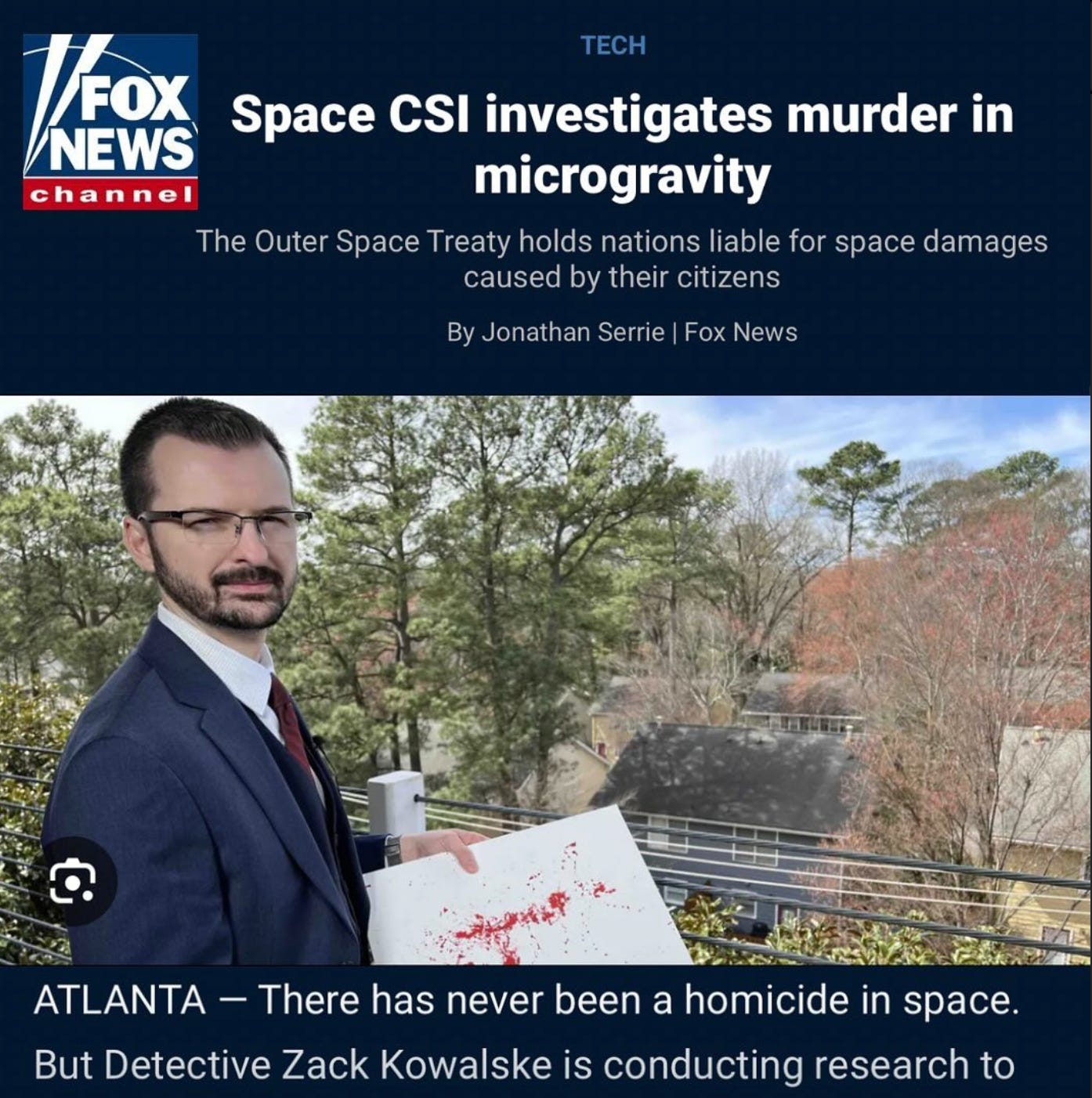
This is the part of innovation or research that does not get enough spotlight, the need for will and determination. The artical was finnally picked up and published in Forensic Science International: Reports. This time, the work drew significant attention—ranging from Fox News to the New York Post—and sparked wide-ranging conversations among both the scientific community and the general public. This isn’t just an anecdote of personal triumph; it’s a cautionary tale of what can happen when gatekeeping blinds a community or organization to potentially transformative ideas.
The High Stakes of Rigor vs. Rigidity
Journals and the peer-review process serve a legitimate purpose: to safeguard the quality and integrity of scholarship. To refine and produce the best product of research. Rigorous review ensures that experiments are well-designed, data is accurately interpreted, and conclusions are supported by evidence. However, there’s a fundamental difference between rigor and rigidity:
Rigor: Encourages systematic approaches, thorough methodology, and transparent data analysis.
Rigidity: Rejects innovative perspectives simply because they deviate from accepted norms, stifling curiosity and dismissing early-stage but potentially groundbreaking ideas.
When novelty is met with rigidity instead of constructive skepticism, the result is a chilling effect. Early-career researchers, especially, may lose faith in their ability to contribute meaningfully if they encounter repeated dismissals—leading them to shelve valuable inquiries just to avoid the risk of rejection.
Beyond Academia: Real-World Consequences of Stagnation
The stakes are higher than academic pride. In forensic science, the disciplines that shape court decisions, influence criminal investigations, and impact legal outcomes have far-reaching social implications. These effects can be viewed in influcing aspects from convition integrity to global progress. If the field remains closed to new methodologies—like refined fingerprint analysis or advanced bloodstain interpretation techniques—evidence may be misread, potentially leading to wrongful convictions.
The criminal justice system relies on the public’s trust that forensic methods are scientifically sound. Inflexible thinking can erode that trust if future revelations expose outdated or flawed techniques. Fields like space exploration and microgravity research are inherently collaborative. The refusal to entertain these frontiers can isolate a discipline from global partnerships, slowing collective progress.

Becoming the Academic Rebel
What can you do if you find yourself at the threshold of innovation, only to be met by a guarded editor, a skeptical peer reviewer, or a narrow minded supervisor?
Seek Alternative Outlets: Don’t let a single rejection define the fate of your research. Explore different journals, multidisciplinary platforms, or open-access venues more open to risk-taking.
Engage the Public: Share your findings through social media, public lectures, or mainstream media. Public engagement can sometimes spur academic circles to reconsider their stance.
Network with Like-Minded Researchers: Collaborations often provide additional credibility and resources. Join forces with colleagues who share your vision, whether they’re in your field or beyond it.
Refine, Don’t Retreat: Honest critique can be a gift. Distinguish between fear-driven gatekeeping and constructive criticism. If the feedback is valid, incorporate it and resubmit.
Stay Persistent: Remember that nearly all transformative breakthroughs faced resistance. Keep the long view in mind; what seems “too radical” today might become standard tomorrow.
A Call to the Next Generation
Let this be your rallying cry: Don’t let established norms quell your curiosity. If you’re exploring how blood moves in microgravity, analyzing microscopic variations in fingerprints, or venturing into any uncharted territory, your work matters precisely because it questions the status quo. Academic rebels aren’t just troublemakers; they are the visionaries who propel us toward progress.
The next wave of scientific revolutions will come from those bold enough to ask, “Why not?” rather than “Why?” We can’t afford to be complacent with what we “know” while ignoring what we’ve yet to discover. Within publishing, if your chosen journal rejects your idea, move on. Find a publication that gives you the space to explore, or create that space yourself. If you're in the inception phase of a project and just trying to get it off the ground, find that spark that lights your fire about it and share that with your supervision. The goal here is to effectively communicate Why it's important and Inspire their curiosity too. Your bold, “crazy” questions are the lifeblood of scientific advancement. They push entire fields forward, challenge outdated norms, and ultimately benefit society at large—whether you’re developing a new forensic technique or unlocking mysteries of the cosmos.

Final Thoughts: Defend the Frontier, Not the Fortress
Academic institutions often pride themselves on being at the forefront of knowledge, yet too often they function like fortresses protecting the old guard. It’s up to us—especially those just stepping onto the academic stage—to turn these walls into doorways. We must do more than merely protect the legacy of established knowledge; we must expand its boundaries.
Be a rebel. Find your own paths, break down barriers, and transform objections into opportunities. When the critics say, “Not yet,” let that be your cue to forge ahead. Because only by challenging what is “accepted” do we reach for what is possible—and eventually, make it real.
Thanks for reading The Science Detective! This post is public so feel free to share it.
No posts
Comments
Nothing yet. Say the first thing.
Sign in to join the conversation.