
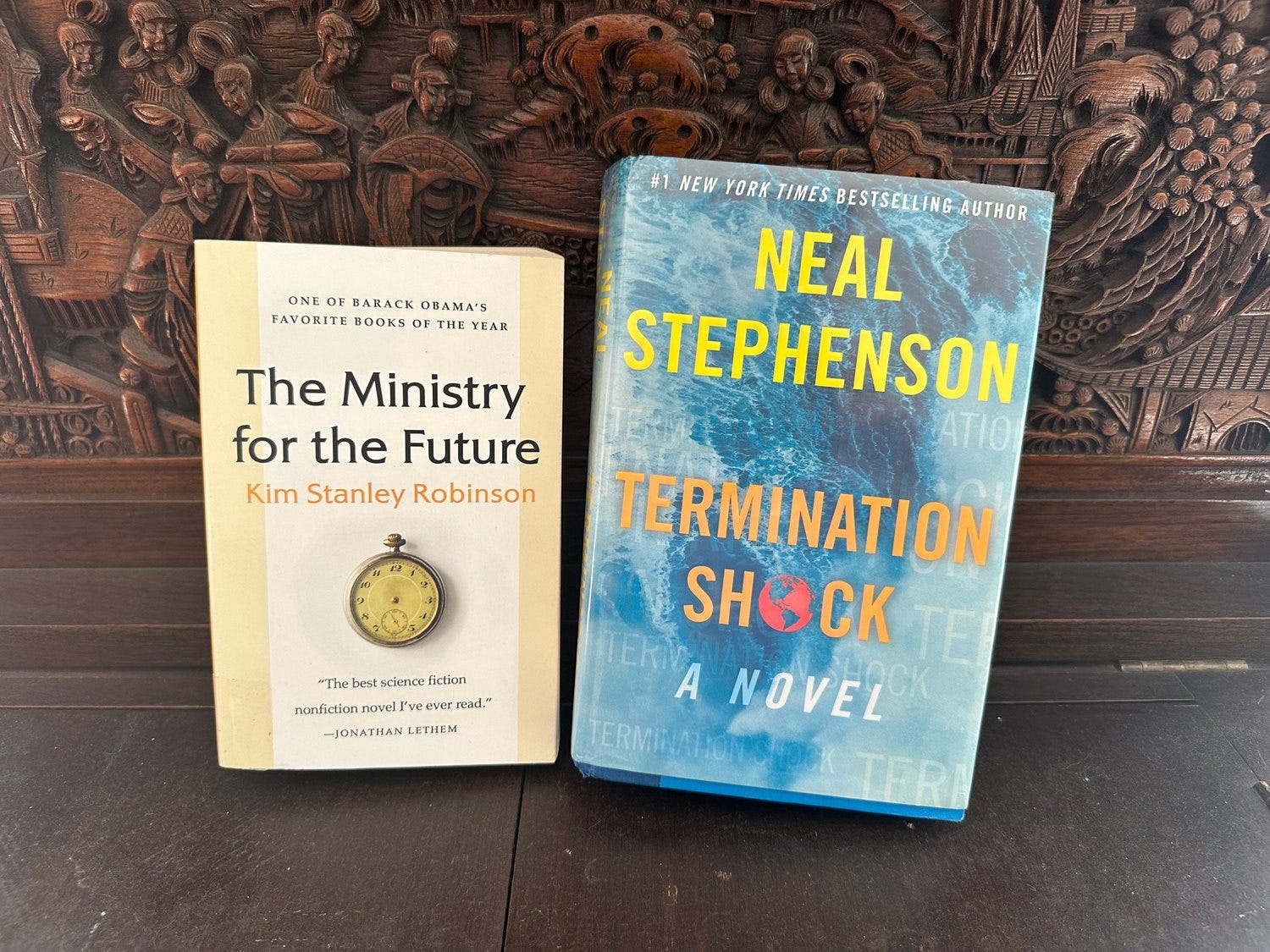
I promised book reviews of Termination Shock (Neal Stephenson) and The Ministry for the Future (Kim Stanley Robinson). And those are at the end of this substack. However, while these are worthwhile books for fellow climate-obsessed readers, I am not actually excited about recommending either one. So I am starting instead with a short list of science fiction and fantasy books that I would recommend to anyone who is interested in those genres (and even some people who aren’t).
I have been into science for as long as I can remember. Some of that may be due to having a dad who was a professor of chemical engineering. Some of it may be due to some inherent interest in puzzles and logic and figuring out how things work. And some of it may be due to having fallen in love with science fiction fairly early on in my life. Favorite SF authors of my youth include Ursula K LeGuin, Isaac Asimov, Arthur C Clarke, Robert L Forward, David Brin1, Orson Scott Card, Hal Clement2, Larry Niven3, and Douglas Adams.4 Oddly, as I’ve gotten older, I feel like more of my reading has moved into the fantasy realm, but I can’t put my finger on exactly why. With that introduction out of the way, here are five recommendations5:
Becky Chambers, The Galaxy, and the Ground Within. Cozy science fiction is rarer than cozy fantasy, but Chambers pulls it off nicely. Galaxy is the fourth book of the series, but works well as a standalone about a group of aliens trapped in the space equivalent of a B&B learning about each other’s traditions.
Martha Wells, Murderbot. I discovered Martha Wells through her brilliant The Death of the Necromancer mystery fantasy novel, but the Murderbot Diaries is definitely the highlight of her recent work. The series follows a security robot with a taste for soap operas. In the TV adaptation, the clips of the soap opera The Rise and Fall of Sanctuary Moon were the best parts.
Arkady Martine, A Memory Called Empire. Politics, poetry, cultural assimilation, murder… this book and its sequel are both brilliant and original (and apparently, influenced by Armenian history, which I learned when I was today years old by reading the Wikipedia page).
Connie Willis, Bellwether. I just discovered that Connie Willis also writes political commentary, but my first exposure to her was the brilliant but dark time travel novel Doomsday Book.6 She followed that up, in big contrast, with the similarly brilliant but hilarious To Say Nothing of the Dog (set in the same universe). Bellwether, on the other hand, is a near future novel about a scientist studying chaos theory and a scientist studying fads and the hijinks involved in their day-to-day work at a bizarre corporation.
C.S. Friedman, The Madness Season. C.S. Friedman made her name with the great fantasy trilogy Coldfire (it has a bit of SF trapping the same way that Pern has an SF overlay), but The Madness Season about a vampire being abducted by aliens may be my favorite book of hers. The book is much less ridiculous than that sentence.
My fantasy list is so much longer than my SF list, that it was really difficult to narrow it down to five. It was hard to leave out Naomi Novik, Brandon Sanderson, Robin McKinley, S.A. Chakraborty, Holly Black, and many others… but here are my somewhat arbitrary five recommendations:
Robert Jackson Bennett, A Drop of Corruption. Biological magic. Kaiju. Political commentary.7 A murder mystery with a detecting duo in the vein of Holmes and Watson (though apparently more like Wolfe and Goodwin, a book series I have not yet read but probably should look into). I probably bought a half dozen copies for friends (apologies if I didn’t get one for you, Dear Reader), and I am so looking forward to getting my hands on A Trade of Blood, the third book in the series which was just released.
Katherine Addison, The Goblin Emperor. Not much action. A lot of politics and talking. There is something about competent and kind governance that just gets to me… might it be the contrast with our current government?
Lois McMaster Bujold, Penric & Desdemona. Bujold’s Vorkosigan series is great, but her World of Five Gods is just consistently my cup of tea. The Penric novellas are short and easy reads, and are a go-to for a comfort re-read.
T Kingfisher, Paladin’s Grace. It was hard for me to choose which of Ursula Vernon’s books to recommend. Watch out for some of her darker horror novels, as they are a little bit of a shock to the system when expecting something in the vein of her White Rat books (generally featuring romances between emotionally tortured paladins of a dead god and highly competent middle-aged women who together kick some butt). A nice change of pace from romantasy about immature teenagers (Ilona Andrews also does a nice job featuring romances between mature adults).
Adrian Tchaikovsky, City of Last Chances. My understanding is that Tchaikovsky had such trouble trying to sell Empire in Black and Gold (his first Shadows of the Apt novel), that he decided he would write the next two books in the series before trying again, in the hopes that would make the book more attractive to a publisher. Now, he is oddly prolific and diverse in both science fiction and fantasy. City of Last Chances is a series of vignettes about small gods set in a city occupied by an efficient military bureaucracy that thinks that magic is most worthwhile when it is converted into an energy source.
I decided to cheat on my self-imposed limit of five fantasy books by creating a new category: books that include concepts from economics.
Sir Terry Pratchett was a brilliant writer, and by all accounts a good person. His books were full of laughs, and yet they often had hidden depths. He had several books that fit my econ theme. First, a quote that I’ve actually used in class before, the boots theory from Sam Vimes, Ankh-Morpork watchman, in the book Men at Arms:
“The reason that the rich were so rich, Vimes reasoned, was because they managed to spend less money. Take boots, for example. … A really good pair of leather boots cost fifty dollars. But an affordable pair of boots, which were sort of OK for a season or two and then leaked like hell when the cardboard gave out, cost about ten dollars. … But the thing was that good boots lasted for years and years. A man who could afford fifty dollars had a pair of boots that’d still be keeping his feet dry in ten years’ time, while a poor man who could only afford cheap boots would have spent a hundred dollars on boots in the same time and would still have wet feet.”
In the environmental area alone, this could apply to being able to weatherize a house, buy an efficient car, or any number of other issues… and many of these were addressed by Biden’s IRA, an underappreciated policy. The other Pratchett book that I’ll highlight in this theme is Making Money, about the banking system (a sequel to Going Postal). Who would have thought that a book about banking could also be so fun!?
Daniel Abraham, The Dagger & the Coin. Warning: Daniel Abraham gets pretty dark. The series deals with religion and war and power, but one of the main characters is a banker who uses financial instruments to leverage institutions to help her causes. The books are very well crafted, and enjoy turning some common tropes on their heads.
The main event. I think it is hard to write climate fiction at epic scale that maintains scientific and political plausibility. Plausibility means that it isn’t an end of the world setting — no Waterworld or The Day After Tomorrow. It means that there isn’t a single mustache twirling villain, but rather a whole set of institutions and incentives that make it hard to decarbonize (mind you, there ARE villains who have deliberately lied in order to deceive the public, much like the tobacco industry as documented in Oreskes and Conway’s Merchants of Doubt, but it is more diffuse villainy). It means that the problem can’t be solved by a single band of plucky heroes à la Armageddon. So it is impressive that Kim Stanley Robinson and Neal Stephenson managed to pass these plausibility bars while writing readable novels.
The Ministry for the Future opens with a deeply disturbing scene of a killer heat wave in a town in India. Climate change may not be world-ending, but it can be deeply devastating at the local level. There have been a number of historical heat-related mass death events (Chicago 1995, Europe 2003, Russia 2010, Europe 2026 (paywalled)), and Robinson’s opening event is a plausible step worse than any of those. The rest of the novel follows a number of characters around the world as they (and their nations) come to grips with what is necessary to put a brake on climate change, while interweaving some very wonky references. The opening sentence of Chapter 3 is, “Article 14 of the Paris Agreement under the United Nations Framework Convention on Climate Change called for a periodic taking stock of all the signatory nations’ carbon emissions…”. Chapter 20 starts by discussing Gini coefficients (inequality, conspicuous consumption, and the bad behavior of the elite are themes throughout). Chapter 32 is a discourse on discount rates (which I will get to in Lecture 4 of my class series).8
The book also touches on some interesting geoengineering ideas, including ways to potentially slow down ice sheets that have already started accelerating in order to slow the rate of sea level rise, à la some of the weirder ideas I covered in my own geoengineering substack.
In any case, Robinson puts the same attention to detail and deep reliance on plausible science and economics that underlay his Red Mars novel about Martian colonization, both of which are impressive masterworks (though perhaps character development and readability suffered a bit in service of academic rigor).
While geoengineering was a side plot of The Ministry for the Future, it is front and center in Termination Shock by Neal Stephenson. “Termination shock” is the term used to refer to what would happen in a world where we became reliant on solar radiation management to keep the planet cool, and then for whatever reason stopped dumping cooling aerosols into the stratosphere leading to an unprecedented rate of warming. Where a heat wave in India was the most prominent disaster in The Ministry, Termination Shock focuses more on sea level rise because one of its main characters is the Queen of the Netherlands. The prime solution is solar radiation management as led by a billionaire — because, as we’ve seen from Make Sunsets, it is entirely possible for a few rich individuals to start a geoengineering project on their own.
Like Ministry, Termination Shock has a wide set of main characters scattered around the planet, as is appropriate for trying to address a global problem. It also has wonky references scattered throughout, though I don’t think it devoted an entire chapter to discount rates (I could be wrong). And like Ministry, it is a masterwork of plausible science, but not so much in terms of characterization and readability.
I’ve covered about a dozen books that I would highly recommend to almost anyone, plus two books which are suited for a more limited audience. The Cli-Fi novels do succeed in plausible depictions of the climate problem and how it might be addressed, but at the cost of character development and pacing. That might be a reflection of the real world, where solutions are slow and full of compromises and committee meetings. But the quote I’ve actually used to inform environmental economics in my classroom is from a fantasy book where a character is musing about boots.
If you look in the acknowledgments of Heaven’s Reach, you will find my name is buried in there because he let members of the Caltech science fiction society review his book before publication. Sadly, Heaven’s Reach is far from the best book in the series.
He taught at my high school, but not while I was there.
Someone recently said “On the one hand… on the other hand… on the grasping hand…” The Mote in God’s Eye obviously made an impression on them too.
Some of the books by these authors may stand the test of time, but others may be dated, and some of the authors are definitely problematic as individuals.
Five is my wife’s favorite number. It was really hard to stop at five.
Also, Doomsday Book was prescient in describing how society might shut down in a modern pandemic.
Don’t worry, the political commentary isn’t shoved in your face, though it is described in a bit more detail in the afterword of the book.
I sent a photo of that chapter to some of my colleagues when I found it. Much like I sent a photo of a footnote from An Immense World by Ed Yong about the fact that oil companies used to use vultures’ amazing ability to detect ethyl mercaptan to locate gas pipeline leaks. Fortunately, my friends put up with me and my weird interests.
No posts
Comments
Nothing yet. Say the first thing.
Sign in to join the conversation.