
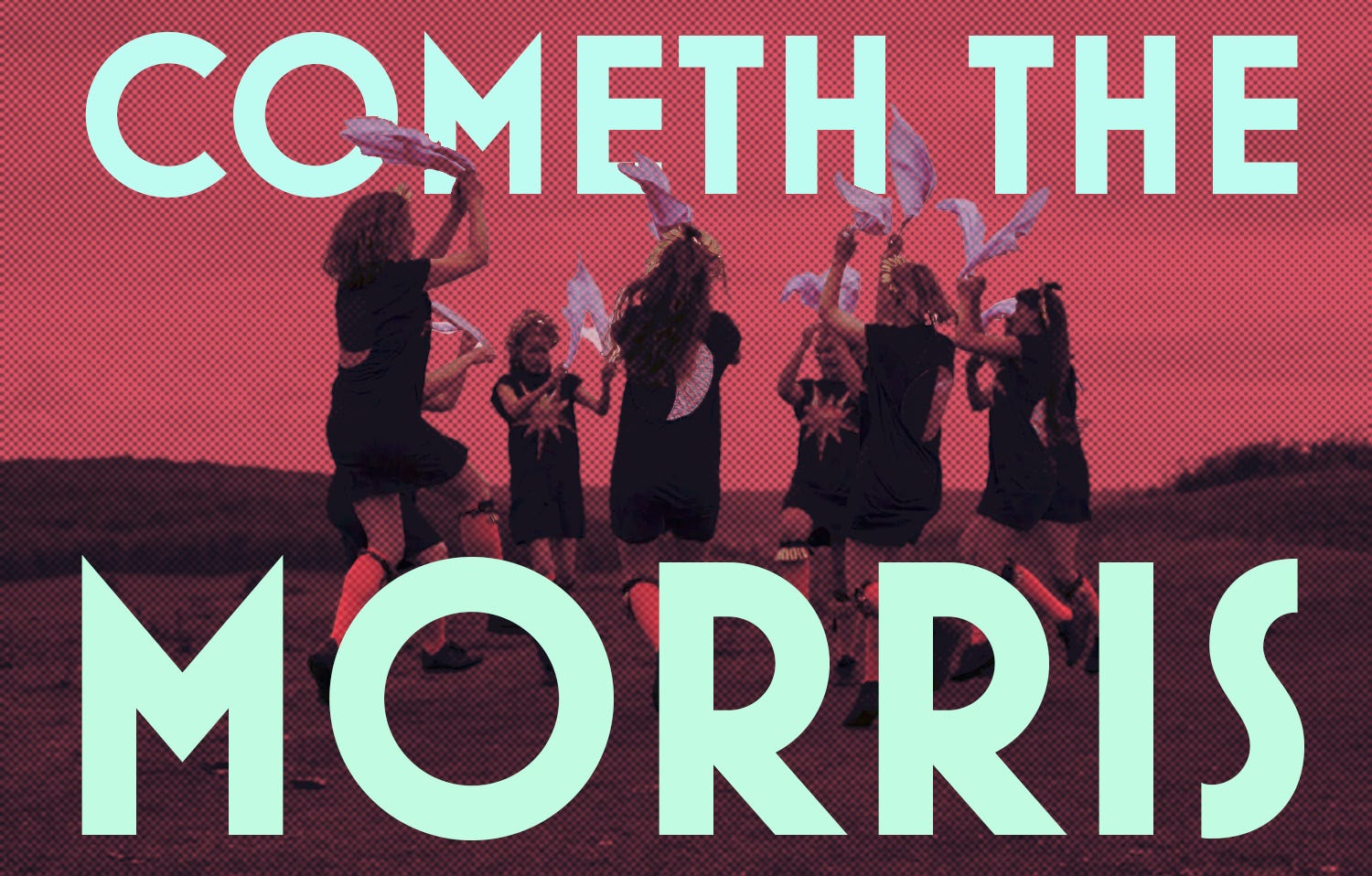
Today we look at the revival of Morris Dancing in modern English society, and how its ritual elements address the existential anguish engulfing our lives.
Picture this: you are sitting in the pub garden of an old English boozer, either out in a rural country idyll or the bustling concrete of an urban garden - your choice. From within the pub you hear a bellowing chant and a roar, and amidst a cacophony of jangling little bells a bunch of men pour out into the street in front of the ale house, all clutching in each hand a brilliant white handkerchief. They are likewise all clad in white, bedecked with bells and bright coloured baldricks and all sporting impressive beer-sodden greying beards.
Lining up in two rows facing each other, and driven on by a jolly bobbing accordionist, the men leap into a tightly controlled and choreographed dance, weaving in and out of each other, prancing with a weightlessness that defies their heavy physiques and waving their hankies in perfect unison. To one side of them a line of cars impatiently waits, fuming at the vehicular obstruction posed by these jolly jiggers.
By tradition the country is divided between those who adore these quaint old fuddy-duddies and those who roll their eyes, walk away in abject embarrassment.
At least that is how it used to be, for things are changing in the world of the Morris Dancer… something powerful is stirring in the hearts of many of the inhabitants who encounter these mysterious Morris.
There is, however, a rift between the iconic expectation and the lived reality. Certainly there are still hankies and sticks and bells, but there are also richly coloured costumes, fantastical beasts and most importantly… women.
[Actually - and without launching into a potted history of something I don’t really know that well - it was only when, in the early 20thC, that one Cecil Sharp took an interest in folk traditions and began to meticulously record them, that women became marginalised to the point of exclusion from what had been a gender-open folk tradition. Our modern notions of ‘Morris Men’ is itself an aberration in the history of this folk practice, put about by the leading figure in preserving that very tradition…]
What is beyond dispute is that a dying tradition has, in recent years, been undergoing a revival, with new Morris ‘sides’ popping up all over the place, a renewed engagement by women in the dances, and a far more positive appreciation of the gaiety of the artform by the wider community.
Some of it is down to these ladies, Boss Morris, who are pioneering a progressive Morris revolution.
Ironically, by recording and documenting the dances of the early 20thC, Cecil Sharp managed to set the dances in stone. These dances, for which there are variations for every region, were a living tradition. When they became recorded, there seems to have been a risk that the ‘living tradition’ was just in the practice, not so much in the fluid evolution of the dances themselves, capable of changing and shifting to the needs of each generation.
The team at Boss Morris are breaking the mould of possible costumes, they are reconfiguring dances, and they revitalising the tradition by opening up its potential.
I started Morris Dancing around the end of 2024, and even after my first practice, I was unaware of these magnificent and undoubtedly very cool women. I was drawn to it because I was curious that there seemed to be a solid ritual under-pinning to it all.
Let me give you the hints at what I saw: People coming together for a single purpose, to enact a series of choreographed movements, dressed in specific uniforms , adorned with specific regalia, equipped with symbolic artefacts used solely for the purpose. Accompanied by music, the ‘dances’ have heavy repetition of motif like actions, moments where symmetry is deliberately broken, before realignment happens…
Oh, and also the Morris dancers, each in their own ‘Side’ will do things like go and dance at sunrise on the summer solstice, or the equinox, or mayday, somewhere special to them and without any audience.
Do you see what I mean… It’s pretty damn ritualistic.
This fascinated me and my ‘ritual lens’. What do the different dances mean, I asked a friend and fellow dancer. “They don’t mean anything”, he said, “they are just dances”. I was shocked. But I would learn the truth of it and the power of ‘just dances’ to almost override more contrived and ritually meaningful actions… and it was really quite the eye opener.
It was early summer and my Morris side decided to celebrate with a series of dances along the river after which we derive our Morris name, ‘Ouse Valley Morris’. We would begin at a small town bandstand before we danced beside the huge recycling plant, then we would walk up the river to a beautiful wooden bridge. There we danced a ‘procession’ (The Winster Processional) before dancing riverside… then heading to the green in a tiny hamlet, dancing again, before continuing over to the next nearest village and dancing in the carpark of the local pub.
A modest day. But at each pause to dance, more and more people joined our walk, until we had gathered quite the contingent by the time we reached the pub.
But what impressed itself upon me in a really deep way was how, by performing the same four dances (The Winster Processional, Black Joke, Lads a’bunchem, and Constant Billy) at each location something unseen and unconscious was beginning to happen. We had planned the route beforehand, so it was not a mistake that we danced outside the recycling plant. Whether we like it or not it is a dominant part of the landscape and occupies a place in the psychogeography of the locals, meaning it is a place of power however you look at it. Similarly, though lesser known, the little bridge is one of the only crossings of the river, aside from a main road at the river mouth and another main road at the upper end of the valley. The bridge as a liminal space is itself a mid point halfway down the valley.
So it was that, as we stopped at each location and performed the exact same series of dances, we were making connections between those places through the repetition of the dances. We were finding our feet both in the dances and in the spaces where those dances happened, surrounded by river birds, buzzing creatures, fluffy clouds and the valley walls of rolling downland. We were tapping into something, and in turn, something was tapping into us. We danced for the joy of the locations, and it felt on an inarticulate level we danced with the genius loci of each place - those resident spirits that exist within immaterial substrata but who are personifications of the flesh of the place itself.
I feel so much more connected to the Ouse Valley than I did before, like I have really been there. I was, in the afterglow of the day really rather surprised at the impact it had had upon me.
Morris Dancing is not a barn-dance, or a ceilidh, where groups can engage in communal activities for social occasions like weddings. This connection to the seasons, to the cycles of the country around us… to the calendar, to the movements of the sun and the moon… to places of psycho-geographical significance… this makes it much more than simply a human communo-social activity.
For me, the cornerstone of ritual activity is its ability to help us create meaning through the symbolic linking of things. Alignments between things are examples of how we link things together - the dawn sun rising over the horizon to seemingly touch a specific standing stone forms a perceptual alignment that is significant to those in that alignment - there is meaning for those in the time and place to see it.
When we engage in deliberate activities to mark specific points in the year, we make similar alignments. And then our actions of marking those specific points, brings them into relationship with each other… soon a web of interconnecting lines passes between dancers and the places and times they dance in - the dances themselves being the central medium that give shape to these meaningful moments. These are the rituals of observation, of embodied presence and connection with the psychogeography of the world surrounding us.
What the different movements ‘mean’ within the ritual is almost neither-here-nor-there, for what matters is that people have spent time learning and synchronising their movements to enact them at these special moments.
Now, of course, there is space for new dances to arise in which the movements do have correlations with the different times, different locations or qualities around them… but the fact that they do not necessarily, brings its own power.
Rituals are serious things. Sure they are often absurd, even laughable when seen from outside. But participants of rituals typically take them seriously, especially if they are facilitating them on behalf of a wider community.
The people I have met during Morris Dancing are a diverse bunch of individuals. Some are there because they want to learn to dance, others are there because they want a different social circle, some are there because they are interested in the Morris itself, and others simply need some exercise that somehow ends up in the pub. There is joy in the activity itself. It doesn’t need to be deep and meaningful to everyone there… and there lies the difference to that to that of ritual participation (when its to the point of rehearsing). If you mess something up in a ritual it is automatically meaningful - everyone watches the misplaced glass fall from the altar to shatter on the floor just as the priest finishes a potent declaration. It is taken as a sign, an omen to be interpreted.
When someone misses a step in Morris dancing, no one cares. It’s that simple. The pressure is not the same and as such the joy and levity is allowed to flourish. Afterall no-one is doing it out of duty like we find in formal ritual.
So makes it a different experience, and I can tap into something strangely primal while others can just have a good time…
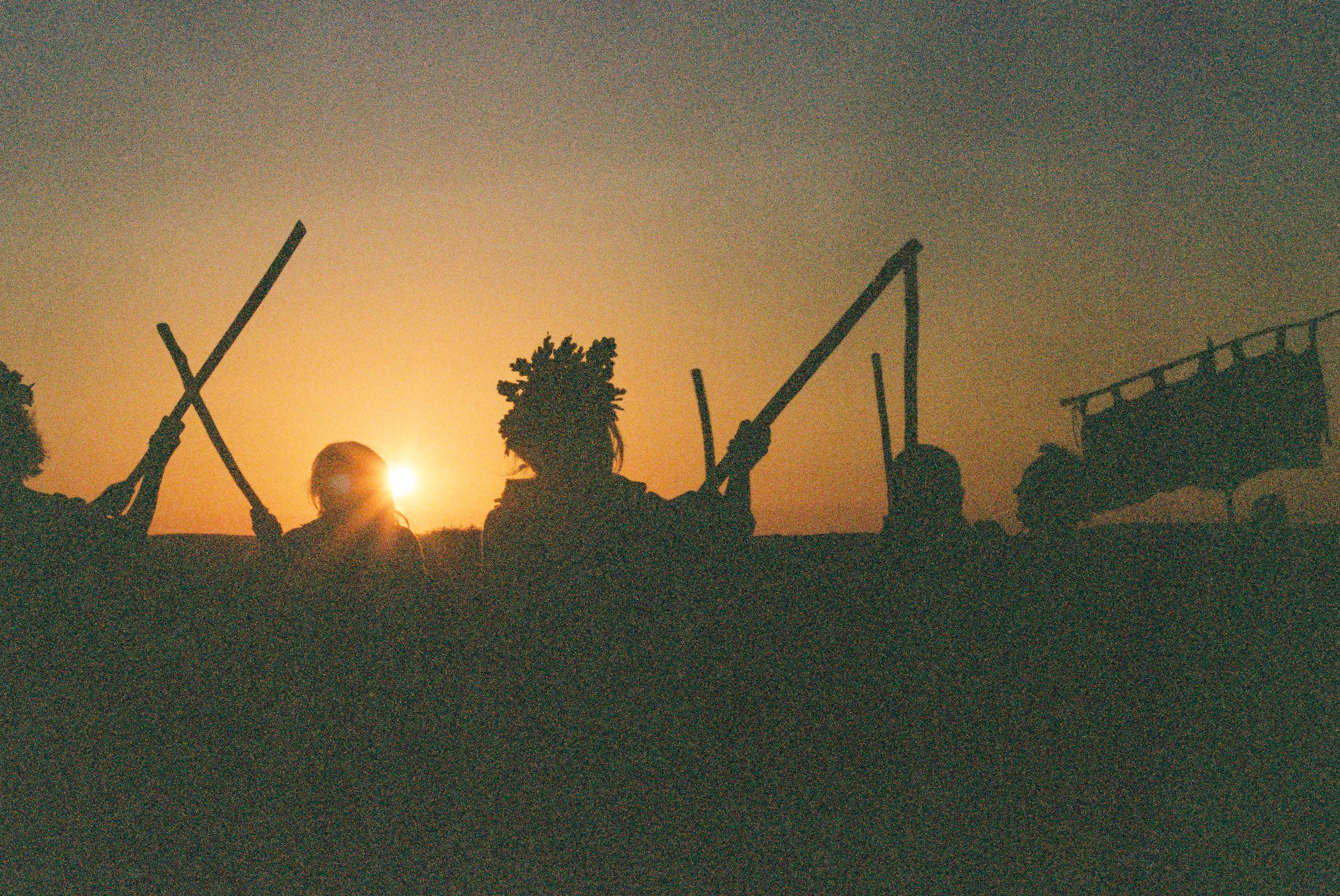
And then… there was the occasion at dawn of the solstice this year, when myself and 7 other Morris dancers - all newbies - decided to go up onto the cliffs near where we live and at 4.45am, dressed in our bells and waving our sticks, ‘danced in’ the rising sun.
Even those who were there for the fun of it felt that something personally significant had happened. It was joyous, filled with nervous laughter and smiles and… it was DEEP. Seared into our various souls, memories of us humans and the sun on the horizon both mediating between the land and sky. We were the sun and the rising was us. And we were connected with each other.
It was a deeply enriching and nourishing experience - and just one example of such - and it was, without doubt, a ritual… a folk ritual.
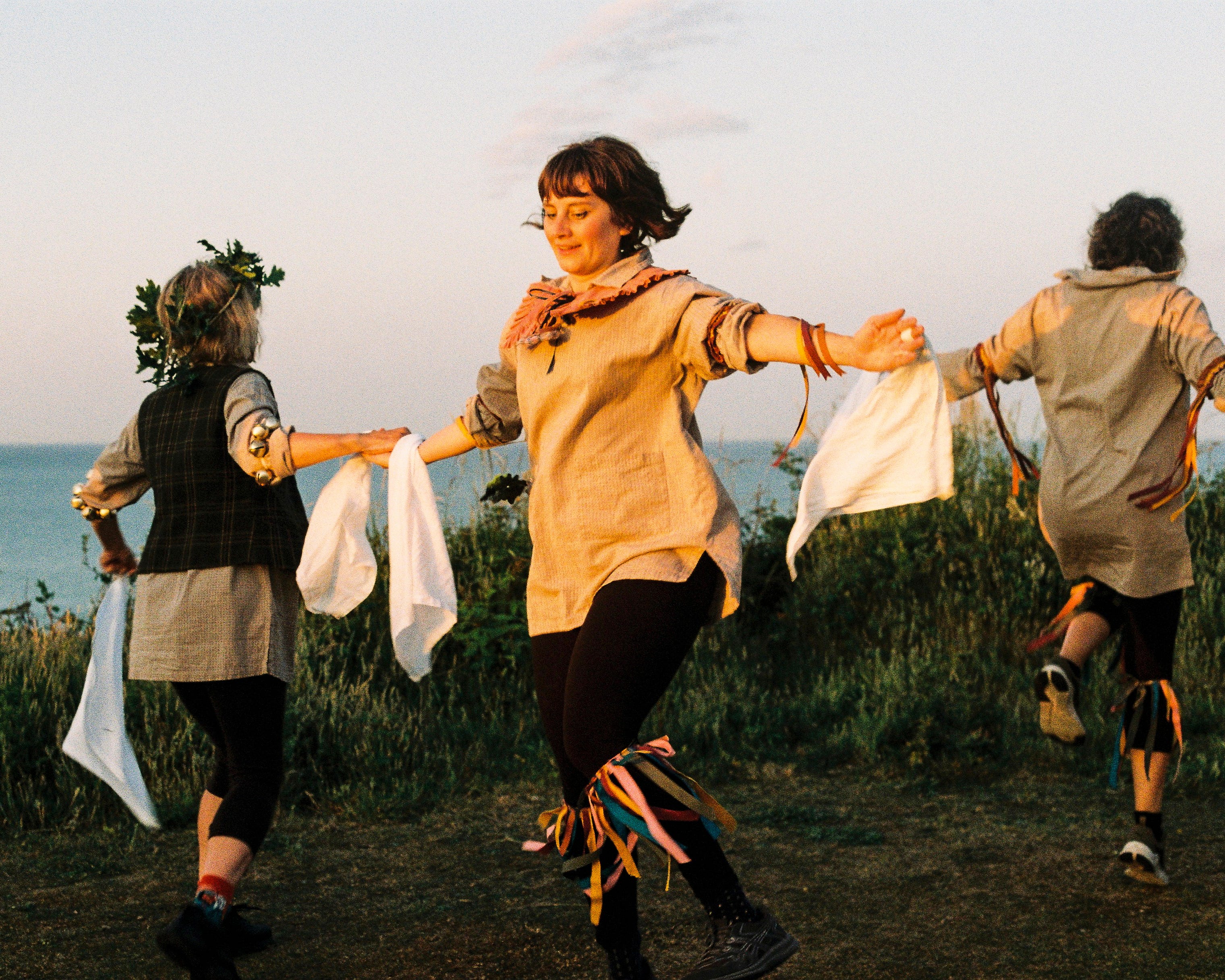
The resurgence in, not only Morris Dancing, but ‘folk horror’ folklore and folk crafts all seems to be a desire for us to tap into something ‘authentic’ that is situated in a sense of legacy and living tradition. Something that eschews the ‘living in the future’ of perpetual media and technological advancement, but also not something that is entirely stuck in the past, but is rather a thing in the present that is informed by the past and the joys of connecting directly, bodily, with time and place.
Folk traditions are streams of activity that are contextually created by the times and place they have emerged in, while also remaining vital and capable of change and adaptability as the needs of their communities shifts.
And there, within that, is a key word: community. ‘Folk’ is not the term of an individual, but of a collective. The ‘common folk’ who participate in folkish activities are not a separate clergy, they are not gatekeepers, and as such folk traditions are traditions in which the common folk can engage, and through that engagement encounter the connections with each other, with time and place… and through that the individuals can find themselves part of something bigger. Part of something that modern day things like ‘social media’ have promised to give us, all the while making people feel isolated, lonely, and living virtual lives.
Our capacity to encounter the psychogeography of where we live is not reserved for rural idylls. Nor is the capacity to find wonder and deep connection linked only to the nice places. And Morris Dancing is not the only way into it either. I mean, naturally I’d champion you going and doing a ritual in your special places - more than meditating, actually doing something with intent and without obvious causal function, where the activity is a dynamic excuse for spending some time with a space.
And really, it needs not be as ‘showy’ as Morris Dancing with its silly costumes, its silly dances and bells… but it should be a little ‘silly’. Over-coming that ‘silliness’ is part of what transforms a meaningless action into something capable of carry considerable deep meaning.
You might try talking to landmarks, saying hello to each lamppost you pass, taking a moment to appreciate alignments between landmarks and vantage points. Burying a part of your sandwich, or pouring out some water… you might find that the lampposts start talking back to you… you might find some food mysteriously appears at your own home, you might just end up falling in love with a piece of land you never expected to… you might just begin to feel connections that you never previously realised.
Or you could just have a good old dance all the way to the pub.
Cheers
Ulysses Black
Comments
Nothing yet. Say the first thing.
Sign in to join the conversation.