

January was a great month of cultural consumption for me. It felt varied. Nostalgic, trippy, thinky, and even a little spiritual. Oh, and lots of lols (ummm, apparently it’s extremely millennial to use “lol” at the end of every other sentence. So sue me. I love to lol!!)
I even read three whole books last month (which is three more than the month before, so congratulations to me!) I’ve included the one I loved the most.
I forgot to include a poem last month, so you’re getting two this time. For those who can’t stomach verse, RELAX, they’re at the end of the post. You won’t be subjected to literary romantic whimsy until then. That said, I do encourage you to give them a chance. I deliberately choose poems I think are accessible. <3
Let’s get into it.
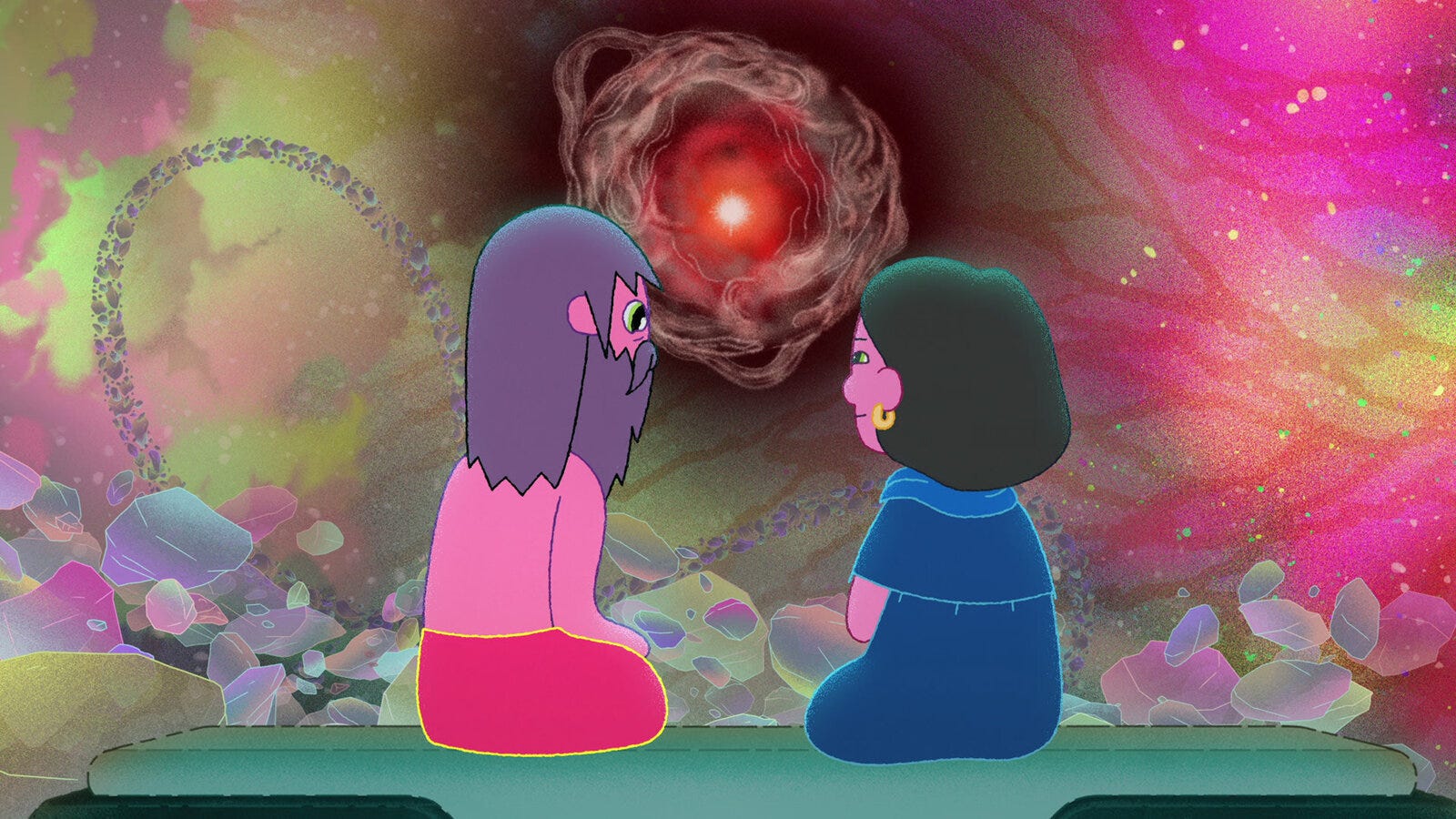
The Midnight Gospel, Season 1 Episode 8, “Mouse of Silver”
Netflix
The Midnight Gospel isn’t new. It was released in 2020. And yet it still feels slightly niche and undiscovered.
Episode eight is a meditation disguised as a cartoon. It’s a conversation between mother and son about grief, forgiveness and personal growth, smuggled inside a psychedelic exploration of the circle of life.
The animation is frantic, absurd, almost childish, while the dialogue quietly dismantles you. Death, regret, addiction, self-blame, and love are all held in the same trembling hand. Nothing is resolved. Nothing is fixed. And somehow, that’s the point.
The psychedelic presentation can almost convince you it’s something only someone high on mushrooms would want to watch. While it is certainly optimised for that experience, I can confirm that, at nine months pregnant, I watched it sober as a nun and LOVED IT. He high, don’t be high, either way it’s a great watch.
What struck me most was how accessible and devastating the conversation between mother and son is.
Longtime readers may remember me writing about my friend Lucy, and how she opened me up to conversations about life, death, love, and consciousness. I often wonder where I would have encountered those ideas without her. Whether I might have stayed fixed in a narrower worldview without the gateway drug of a trusted, sensible person who loves me, and whom I love, gently introducing these concepts without dogma.
Now I have an answer. This episode.
It’s strange, tender, and deeply human. You don’t need to watch the preceding seven episodes. Each stands alone. I can’t recommend it enough.
Looks like I’m not alone because when I googled imagery to insert into this article, I found this New York Times review of the episode, calling it “a healing meditation on mortality”.
Heart the Lover
Lily King (2025)
This book is everywhere at the moment, and for good reason.
It’s a lyrical novel that explores first love, longing, and emotional fixation. It’s written in an intimate, almost confessional style, more concerned with interior experience than plot. The book captures how love can feel total and consuming, especially when you’re young – how desire, identity, fantasy, and self-worth can blur together.
For me, the most affecting part wasn’t the final act (which is more adult and closer to my current life stage) but the first two thirds, which explore the young love stuff. It felt very Normal People. Early twenties, studying, figuring out how to live inside emotions you’ve previously only encountered through books.
I felt 22 again reading it. Reading it felt like falling in love – really falling in love – for the first time.
The final act rang deeply true as well. The idea that we can love again with the same intensity, but in a fundamentally different and healthier way, without erasing or belittling the importance of the people who first carve their initials into our hearts.
URGH. I could cry just thinking about it.
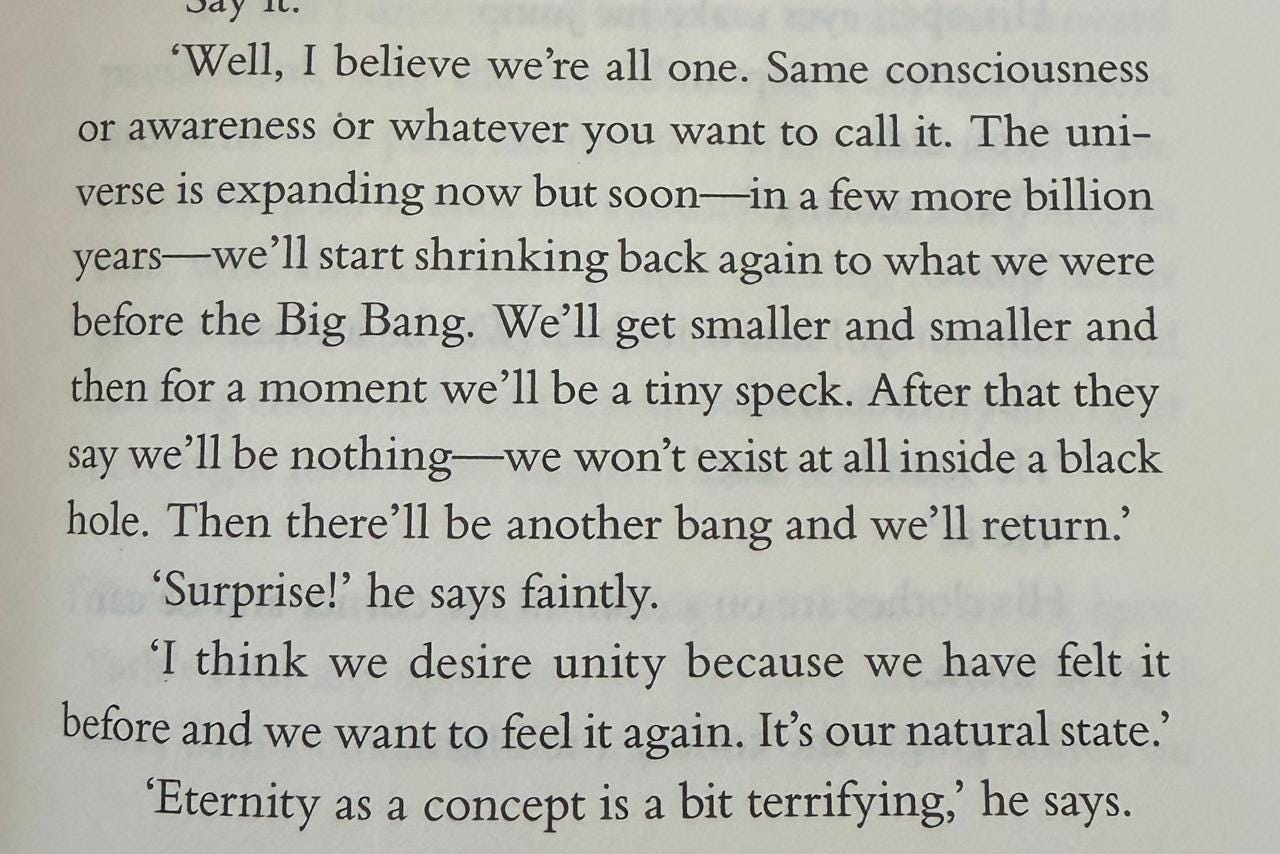
There’s also a passage where the protagonist, Jordan, describes her understanding of consciousness that I loved. From a cerebral, almost cynical sort-of character, it showed how the passage of time (and specifically facing death and illness) can transform us. It also reminded me how much confirmation bias we bring to reading. Before holding a similar worldview, I might have skimmed past it, or attributed it entirely to the character rather than the author.
At this point in my life, though, it made me feel a tenderness towards King herself, as I wondered whether we shared a similar perspective.
Is Comedian Robby Hoffman the Last American Dream?
Talk Easy with Sam Fragoso
I loved Robby Hoffman’s stand-up special, Wake Up, on Netflix, so I went searching for podcasts featuring her. I needed more of her no-bullshit takes on wealth, success, and identity.
I also loved Sam Fragoso’s interviewing style and hot-chocolate voice, and will be adding Talk Easy to my regular podcast rotation.
My algorithm clearly clocked what was going on, because shortly afterwards I was served Robby’s SubwayTakes with Kareem Rahma.
I particularly enjoyed the chutzpah required to refuse to bring food to rich people’s houses while wearing a Prada jacket.
Love you, Robby. x
American Boy
Marcelo Hernandez (Netflix)
As the mother of a half-Latino child, raising said child in Latin America, I had a real soft spot for this stand-up special.
Hernandez’s set centres on his relationship with his mother and his upbringing in the United States as the child of a Cuban woman and a Dominican man. I saw a lot of my husband’s relationship with his beautiful mum in the telling.
When I relayed some of the jokes to my husband, he howled with laughter and gave a full-bodied YES! in recognition. (like Hernandez joking ““I never talked back. I talked forward… very quietly.”).
In an era of gentle parenting (authoritative over authoritarian) to which I largely subscribe, this special made me reflect on whether we’ve drifted too far into permissiveness. Despite our best intentions, the language of emotional validation can sometimes blur into a style of parenting that lacks clear boundaries.
On Armchair Expert, Hernandez talked about how much he benefited from the firm boundaries his mum set for him.
Seeing the genuinely warm, deeply respectful and loving relationship he has with his mother, alongside what appears to be a well-adjusted, thoughtful adult man, made me wonder whether he isn’t right. Is it just me or is it kind of crazy that it’s borderline controversial in 2026 to believe that it’s right to show your child their actions have real consequences on other humans? I dunno, but it has me scratching my head a little.
I mean, I look at my husband – a man raised by a strong Latin woman who is unafraid to set boundaries, and who loves her children with an open, boundless devotion that seems to balance the former, and I think yeah I agree with that 20-something comedian!
For what it’s worth, if my sons end up anything like my husband I will never stop congratulating myself, so there’s something to this parenting recipe.
Is Daycare Bad for Kids Under Three?
Elena Bridgers, Motherhood Since Yesterday
I’ve recently become exhausted by the sheer volume of motherhood content being fed to me on Substack. I thought it was what I wanted, but much of it feels highly opinionated and overly rooted in personal experience to the point of solipsism. Every mother’s journey is singular, and also the same same same same same, which has made much of this content feel tedious to me.
AND THEN I FOUND ELENA BRIDGERS’ SUBSTACK!
The work she produces on Motherhood Since Yesterday is unmatched on this platform, in my opinion. I don’t know whether she has a formal academic background in anthropology, but her research and methodology are rigorous enough that I feel comfortable calling her an anthropologist.
She describes her work as:
“Exploring the science, evolution, and culture of motherhood, with a focus on how things were done for 95 percent of our existence as a species, when we lived as hunter-gatherers.”
I’ve become particularly interested in childcare under the age of three lately. I’m coming at this from a different position than many of my peers in Australia or the United States, because we are incredibly fortunate to have a nanny here in Mexico who is a qualified nurse and an all-round beautiful human being. She began as a night nurse and has continued to support our family as my son has grown. She now cares for him during the day while I work, or (let’s be honest) sometimes rest. I am nine months pregnant, after all.
From this position, I’m not forced to choose between institutional daycare and my career or sanity. And yet, I still worry about my son “missing out” on time with me in favour of another caregiver who is not his mother, even though that caregiver is deeply attuned, has known him since birth, and truly loves him.
Lately, I’ve been considering enrolling him in daycare later this year. At 14 months old, I can see how alive he is around other people, and increasingly so around other children. I genuinely think he would have a bomb time at a high-quality daycare.
And yet, there are women like Erica Komisar making sweeping claims on world-famous podcasts that sending your child to daycare under the age of three is tantamount to neglect. You can read Elena’s assessment of Komisar’s “bad science” here and here – which actually attempt to apply some academic rigour to her claims while also paying her credit wherever credit is due. Very civilised.
Bridgers’ writing examines how children were cared for in hunter-gatherer societies, and in doing so validates what I feel to be true at a body-level. That my son has healthy attachments to me, his father, his nanny, and other consistent caregivers, and that being cared for by a trusted adult (who is not family) for part of the working week is not damaging him. It is likely benefiting him.
And as for the question of daycare under 3? There is no zero-sum answer or a magical age where it suddenly becomes acceptable of beneficial. One should observe their own child and take into account the unique circumstances of their nuclear family unit and the childcare options available to them. Basically, it’s not one-size-fits-all and thus wandering around with a megaphone shaming parents is just not it. Boo to that Erica lady.
Bridgers work is presenting me with a bridge back to my own intuition, which is truly the greatest source of wisdom any mother has. I cannot wait to devour her entire back catalogue.
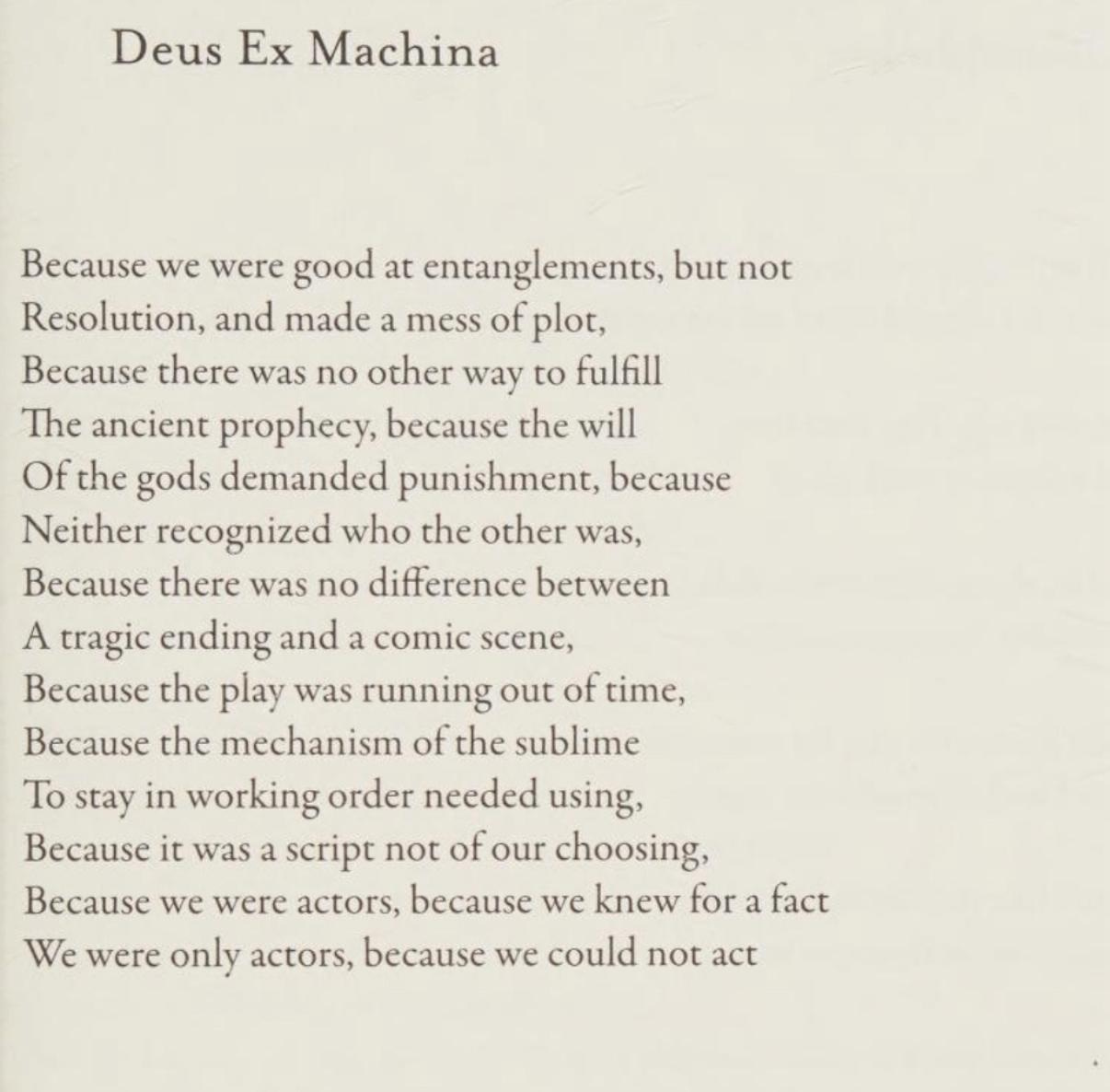
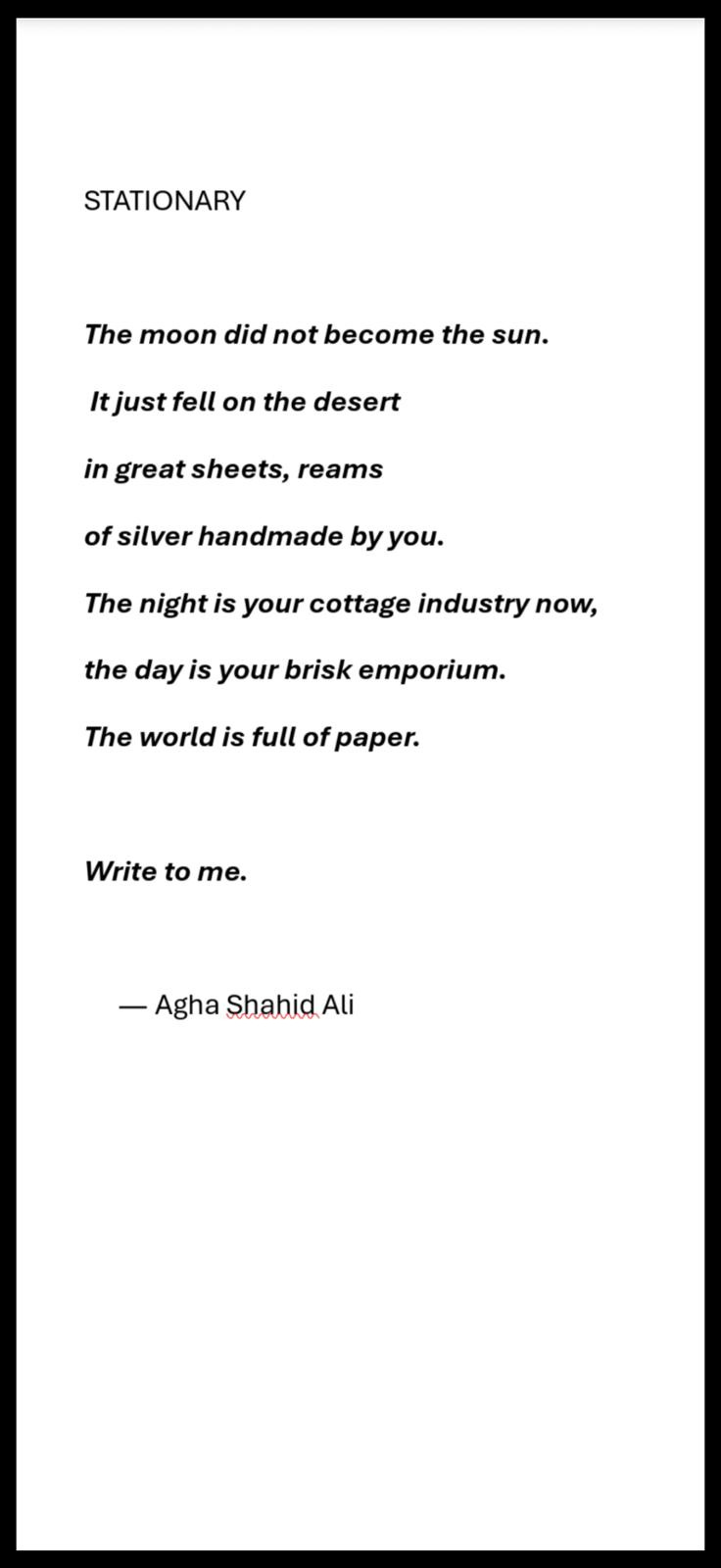
Two poems to sit with.
Deus Ex Machina by A.E Stallings
Stationary by Agha Shahid Ali
That’s all for this week, folks! See you next week for the Weekly Return (an essay by moi).
Comments
Nothing yet. Say the first thing.
Sign in to join the conversation.