
How much do you keep in cash?
That is probably one of the least common questions in the investment world.
Yet I believe it is one of the most important.
This year, I have probably had more than 200 conversations with other investors and have also had the chance to speak publicly about investing in several interviews. Still, the question about cash allocation in a portfolio comes up surprisingly rarely.
You have probably heard that cash loses purchasing power and that it does not make you money.
From my experience, keeping a healthy cash position can actually improve your long-term results indirectly - by keeping your emotions in check, allowing you to take advantage of real market opportunities and supporting your investment discipline.
It also helps you stay in the investment “game”.
And staying in the game is crucial if you want good decisions to compound over time.
In this article, I explain why I believe cash is one of the most important tools in investing and how to take advantage of that.
Disclaimer: This is not investment advice and every investor should adjust cash levels to their own preferences

John Coates and Joe Herbert carried out research on real traders in the City of London and found that cortisol levels increased with market uncertainty, volatility and changes in traders’ own P&L.
Their research showed something important: financial risk was not only something traders saw on their screens. Their bodies were reacting to it chemically.
Other research has shown that prolonged increases in cortisol can change financial risk preferences, while stress can impair functions of the prefrontal cortex involved in planning, working memory and cognitive control.
So the financial stress you expose yourself to can influence the environment in which you make investment decisions.
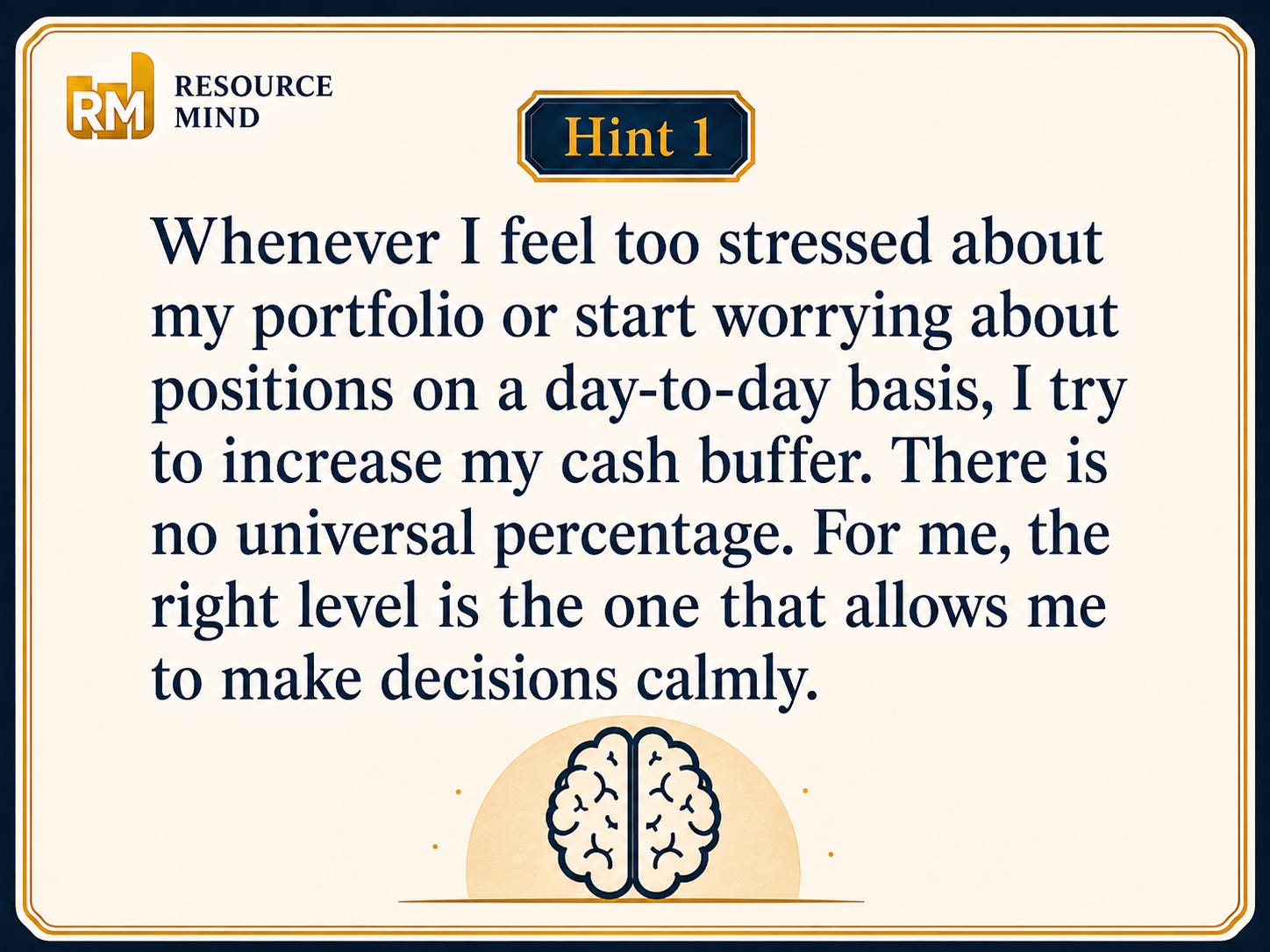
If you are 100% invested and the market moves strongly against you, you will most probably experience much more stress than someone with significant liquidity.
Fear can make you freeze, panic, sell at the wrong moment or simply stop thinking clearly.
That is human nature.
The table below compares two extremes — being fully invested and being almost entirely in cash while searching for opportunities.
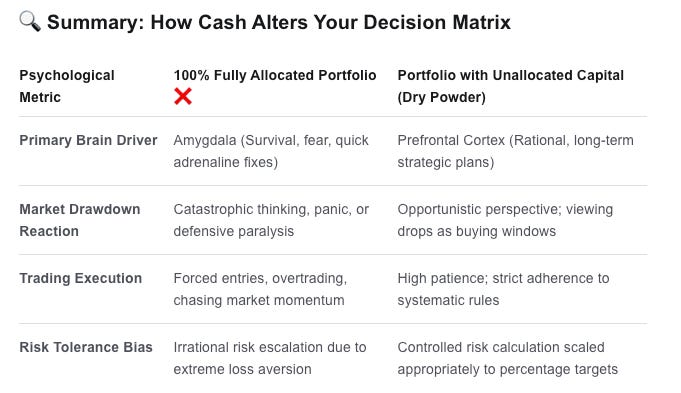
Source: Synthesized from neurofinance and behavioral finance frameworks based on
D. Kahneman & A. Tversky (Prospect Theory / Dual-Process Theory) and A. F. Arnsten (neurobiology of stress on prefrontal cortex function).
During my investing career, I have tried almost every level of exposure. There were periods when I was fully invested, periods when I was over-invested using more capital than I actually had, and periods when I kept 30%, 50% or even around 70% of my portfolio in cash.
The difference in how I behaved was significant.
I remember going through the COVID flash crash while being fully invested. I was watching my portfolio fall rapidly, but at the same time I could not take advantage of extremely cheap prices in some of the stocks I wanted to buy.
I was patient and I stayed in the game but with almost zero flexibility I made many stupid mistakes that cost me a lot and I couldn’t take advantage of the lower prices.
On the other hand, when I had a large cash position, I approached market weakness completely differently.
I could wait.
I could think.
And I did not need to react to every market move.
Over the last five years, there were two years when my portfolio increased by more than 150%.
So I am certainly not arguing for permanently sitting on the sidelines.
But those years also included periods of significant drawdowns and psychological pressure.
High returns don’t remove emotions from investing.
Having liquidity simply makes those emotions easier to manage.
And if you are patient and dig deeper, almost every year gives you a few outstanding risk/reward opportunities.
You just need to have capital available when they appear and the ability to stay calm and act rationally when the opportunity becomes visible.
The famous investing saying is: “buy low, sell high”.
Almost everyone knows it.
So why is it so difficult to actually do?
One reason is very simple:
In order to buy low, you need to have cash when prices are low.
Imagine three types of investors starting with $100,000.
One invests the entire $100,000 into stocks.
The second invests $70,000 and keeps $30,000 in cash.
The third invests $50,000 and leaves $50,000 in cash.
Now assume the market falls by 30% with none of the investors making any trades:
the first investor now has $70,000 and no cash. If they want to buy some stocks they need to sell some other shares. That can be emotionally difficult.
The second investor now has $49,000 in shares and $30,000 in cash. They can take advantage of lower prices without selling anything but it may require investing most of the cash buffer to have a meaningful impact on the portfolio.
The third investor now has $35,000 in shares and $50,000 in cash. Most of their portfolio is now in cash, giving them substantial flexibility to take advantage of the lower prices.
Now let’s assume that all cash is being invested back into stocks and that the market comes back to the entry level. All of the investors will now be fully allocated but their portfolio will be worth, respectively: $100,000 for the first one, ~$113,000 for the second one and ~$121,000 for the third one.
If we assume bigger price changes like 50% the effect will be even more prominent.
This is why I increasingly look at cash as optionality.
It may look least attractive when everything is going up.
But it can become extremely valuable when markets are weak and everyone suddenly wants liquidity.
Another point is that market crashes usually coincide with weaker economic conditions and a weaker job market.
In that situation, cash is not only investment ammunition.
It can also be used as a personal buffer.
And someone who is fully invested may be forced to sell at exactly the wrong moment.
Of course, there is also a cost of keeping a significant part of the portfolio in cash.
If the market rises by 20%, 30% or 50% without a significant correction, the fully invested investor will achieve better results.
But from my experience, even during strong bull markets there are sectors and individual companies or special situations with very attractive risk/reward. And investors with cash can take advantage of them.

Discipline is one of the most important parts of successful investing.
A clear plan helps and knowing why you own something helps.
But cash itself can also become part of your investment discipline.
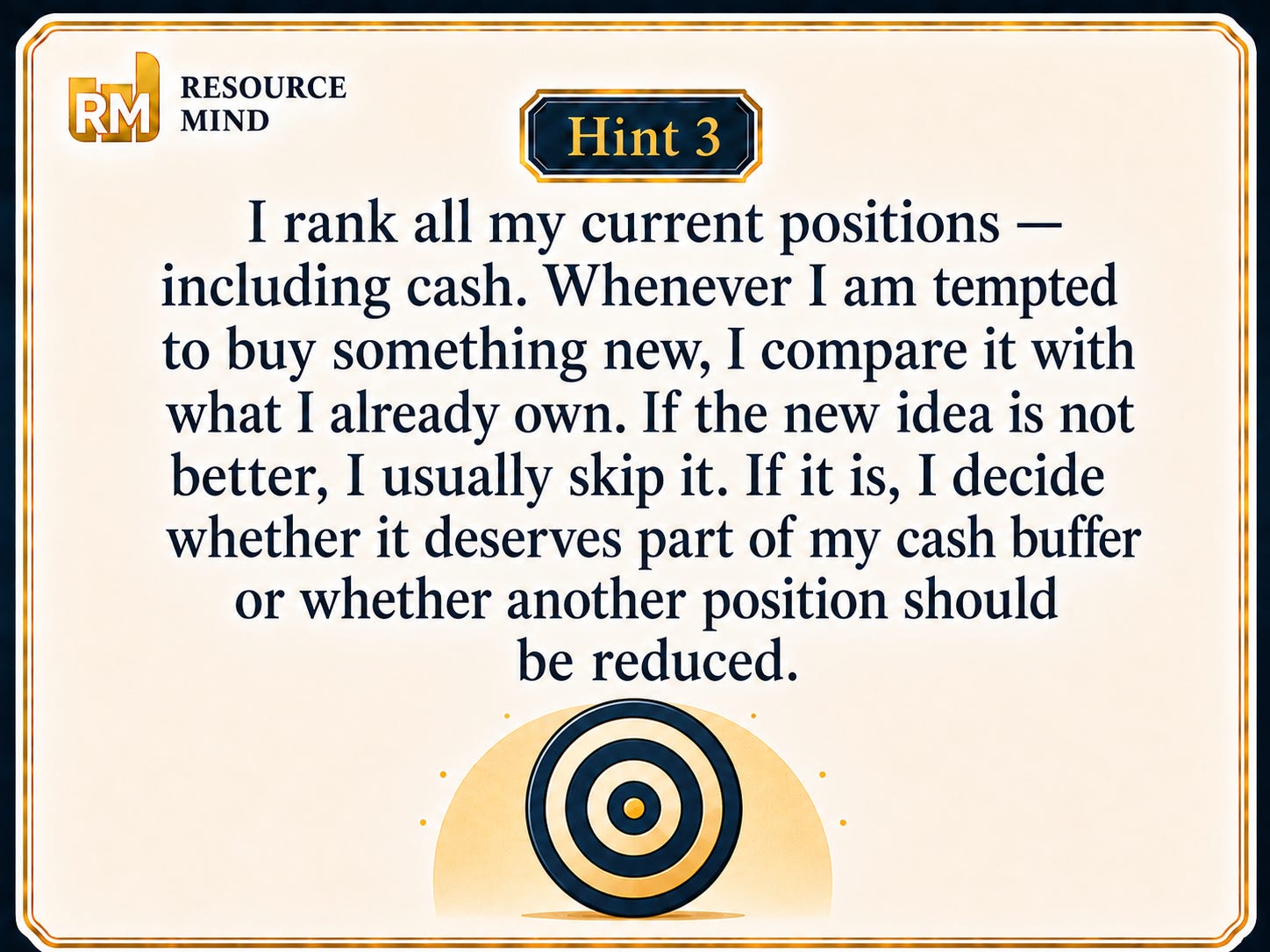
When you decide that you want to keep a liquidity buffer, every new investment has to compete not only with your existing positions but with the value of keeping your optionality.
Now the question before buying a new position is: Is this opportunity good enough to give up part of my liquidity?
That is a higher bar and I believe it is a good thing.
The point is that you don’t need to invest all the money you have.
You can simply wait.
And the fewer investments you make, the more selective you can become.
And being more selective usually improves the average quality of your decisions.
There is another reason why I think cash is especially important for less experienced investors.
Investing is not about maximizing the returns over the next 3 months.
It is about staying in the game long enough for good decisions to compound.
This is also why I am very cautious about investing with borrowed money.
Leverage can look fantastic and work very well for some time — until the market moves against you. And when it does, it can hurt even very experienced investors and traders.
If you invest $100,000 and lose 30%, you still have $70,000 and can decide what to do next.
If part of your portfolio was financed with debt or margin, the same market move can force you to sell.
And once you become a forced seller, being right about the long-term thesis may no longer matter.
The biggest investment opportunities often appear during periods of fear.
You want to enter those periods with the ability to act - not with your broker forcing you to sell.
That is why survival comes first.
You need to protect yourself financially, but also psychologically.
The strategy that can produce excellent theoretical returns is useless if you cannot stick with it during difficult periods.
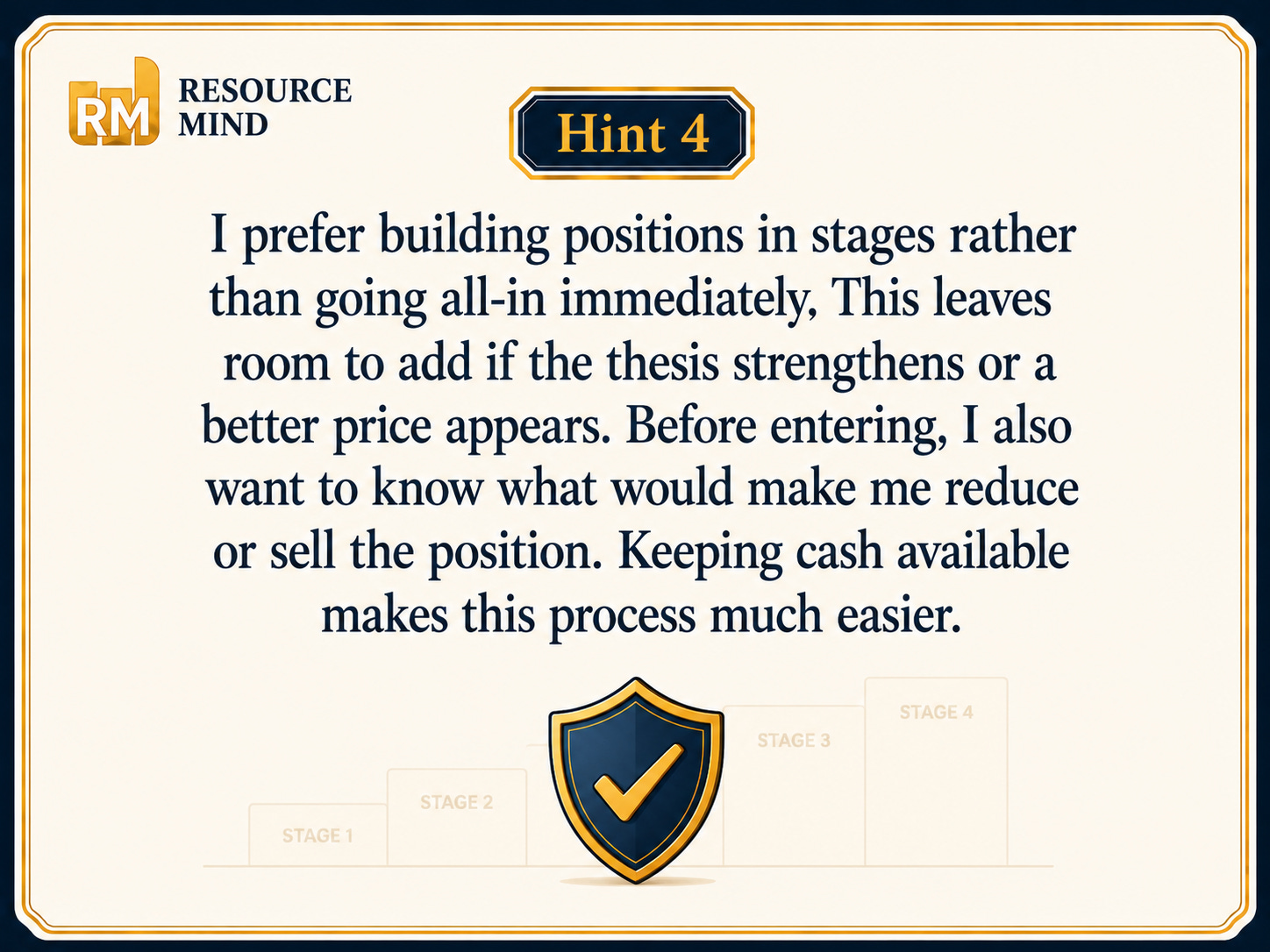
I am not trying to tell you how much cash you should keep in your investment account.
There is simply no universal number.
Someone who has a stable cash flow from other sources, such as a full-time job or real estate, and a very long-term investment horizon, measured in decades may feel comfortable keeping almost all of his/her investment capital allocated.
Someone investing in cyclical sectors, small-cap stocks or special situations may value liquidity much more.
It is also important where you keep cash for investment purposes.
Many brokerage accounts now pay interest on unallocated cash. And if you prefer, you can also keep it in the short-term government bonds or Treasury bills.
I think that every investor should consciously decide what role cash plays in their strategy.
For me, cash increasingly serves three purposes:
it improves my psychology and discipline
it gives me optionality
it helps me stay in the game so that my good decisions can compound over time.
In the market, you don’t get paid for being fully invested. You get paid for making good decisions and staying in the game long enough for those decisions to compound.
No posts
Comments
Nothing yet. Say the first thing.
Sign in to join the conversation.