
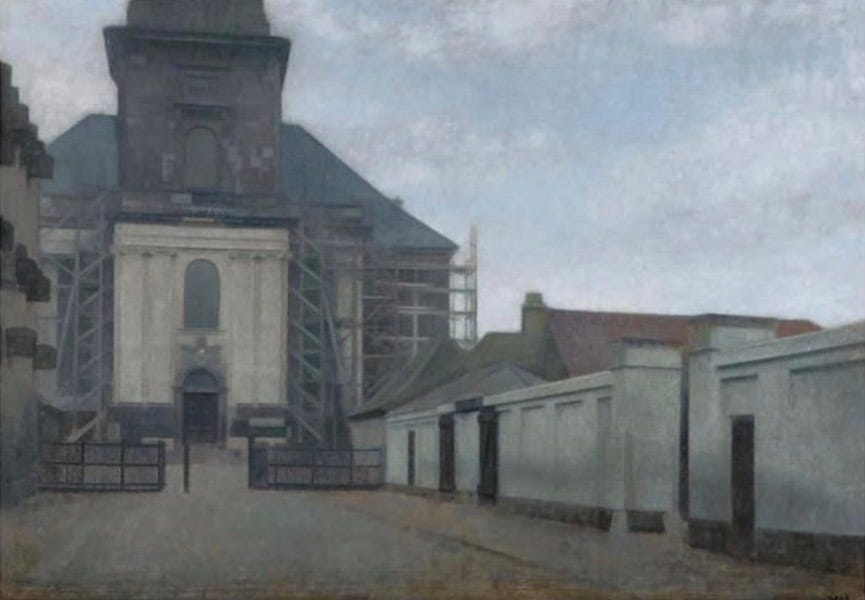
In 1907, Hammershøi stood in Strandgade and photographed the street he lived in. The photograph survives, blurred and damaged in development, now in the Hirschsprung Collection. On it we can see Christians Kirke, the church at the western end, the busy working quarter of Copenhagen on an ordinary day, scaffolding flanking the entrance and some people beside it.1
Then Hammershøi began to edit. He marked the crop in pencil, cutting off the church’s tower. He then narrowed the perspective, in order to pull the viewer closer, letting the church’s mass darken. And finally he removed every human figure. A city as a silent, static world abandoned by humanity was quite unusual not only in Danish but also in Nordic art from that period. Whether the emptiness is an atmosphere or a decision is worth exploring. Scholarship has mapped where this emptiness might have come from: Kasper Monrad traces the possible influences, from Symbolist dead cities to photography, but the lineage is not a reason. The question the photograph forces is the one the literature leaves strangely open: why paint a city this way at all?
Comments
Nothing yet. Say the first thing.
Sign in to join the conversation.