
Horror vacui literally means the fear of empty space. The idea goes back to Aristotle who argues that “nature abhors a vacuum” and therefore an empty space cannot physically exist. In art it describes an intense dislike of emptiness, not a single inch of canvas should be empty, no breathing space whatsoever, fill it all. It was still the reigning look at the turn of the century, in Art Nouveau above all, and it was becoming a great bone of contention. In Vienna the architect Adolf Loos, who wrote an essay called Ornament and Crime, argued for the clear surface against an ornament-loving city, deeming decoration useless, dated waste of space. To Loos horror vacui was a primitive, compulsive urge to cover surface with decoration, to him and many others who craved real change in art and design this could never be part of any high art form and only signaled cultural underdevelopment.
By trade Höch appeared on the wrong side of that argument. From 1916 to 1926 she worked in the handicrafts department at Ullstein, design embroidery and knitting patterns for Die Dame and Die Praktische Berlinerin. Loos’s essay which coded ornament as primitive, criminal, and by clear implication feminine came out in 1913 hoping to instigate a more minimal approach in future art and design. In 1918 Höch published an article arguing that embroidery had a claim on modern design and could evolve just like the painting into abstract motifs. There was more than one way to arrive at modernity in arts and in 1920 Höch did it with her kitchen knife filling the space à la horror vacui style, covering surface edge to edge with cut-outs.1 Instead of the pattern Höch covered it with meaning, cut out from commercial print Loos would have quarantined as utility.
“We had all been laced into a corset, and now we were let out into freedom, and what went on in that time is without precedent […] So I had not gone over to anything, but saw one task, my task, in trying to capture this turbulent time in pictures. And so it came about: Cut with the Kitchen Knife…”
—Hannah Höch2
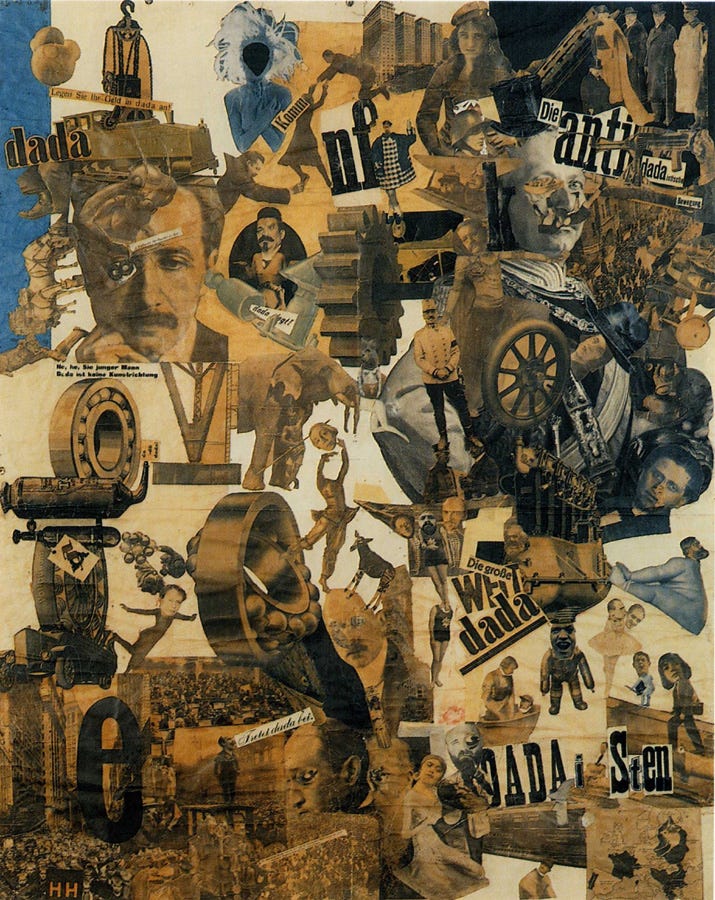
Of course, the kitchen knife acts as a metaphor, Höch always used scissors and blades to cut out her images. What she was trying to say in the title was: kitchen is the woman’s space from which she chose to launch her attacks on the Weimar’s bloated materialistic male-dominated culture. Höch joined the satirical anti-art Dada movement. Through Cut with the Kitchen Knife she established herself as an independent voice in this mostly male-dominated group. Every inch of this is doing something. Let’s look closer.
Comments
Nothing yet. Say the first thing.
Sign in to join the conversation.