
In case you missed the announcement last week: I recently built a free Readiness Assessment for JI ECM Providers. DHCS created readiness assessments for correctional facilities and county behavioral health agencies, but never one for JI ECM Providers, so I made one! It scores organizations across three foundational areas, flags gaps, and suggests next steps, all in just a few minutes. You can take it here and read more about it here.
Welcome back to The Reentry Read!
If you have been operating as an Enhanced Care Management (ECM) Provider for any length of time, you know that Medi-Cal and managed care plan enrollment must be verified before providing ECM services. Otherwise, you will not receive reimbursement.
This fundamental concept also applies to services that are provided to individuals while they are incarcerated. But there is an important caveat you should know about that differs from community-based services.
First, a reminder:
Medi-Cal-covered pre-release services provided to eligible individuals while they are incarcerated are reimbursed through the Medi-Cal Fee-for-Service (FFS) delivery system, whereas ECM services provided to individuals in the community post-release are reimbursed through the Medi-Cal managed care delivery system.
There is probably already a process in place at your organization to verify that an individual is enrolled in a particular managed care plan (MCP) before ECM services are provided to them. This could be through a special portal the MCP gave you access to. Your organization might also be receiving referrals directly from the MCP after they have already verified that the individual needing services is one of their members.
Regardless, this is NOT the process you should be using to verify incarcerated individuals are eligible to receive pre-release services.
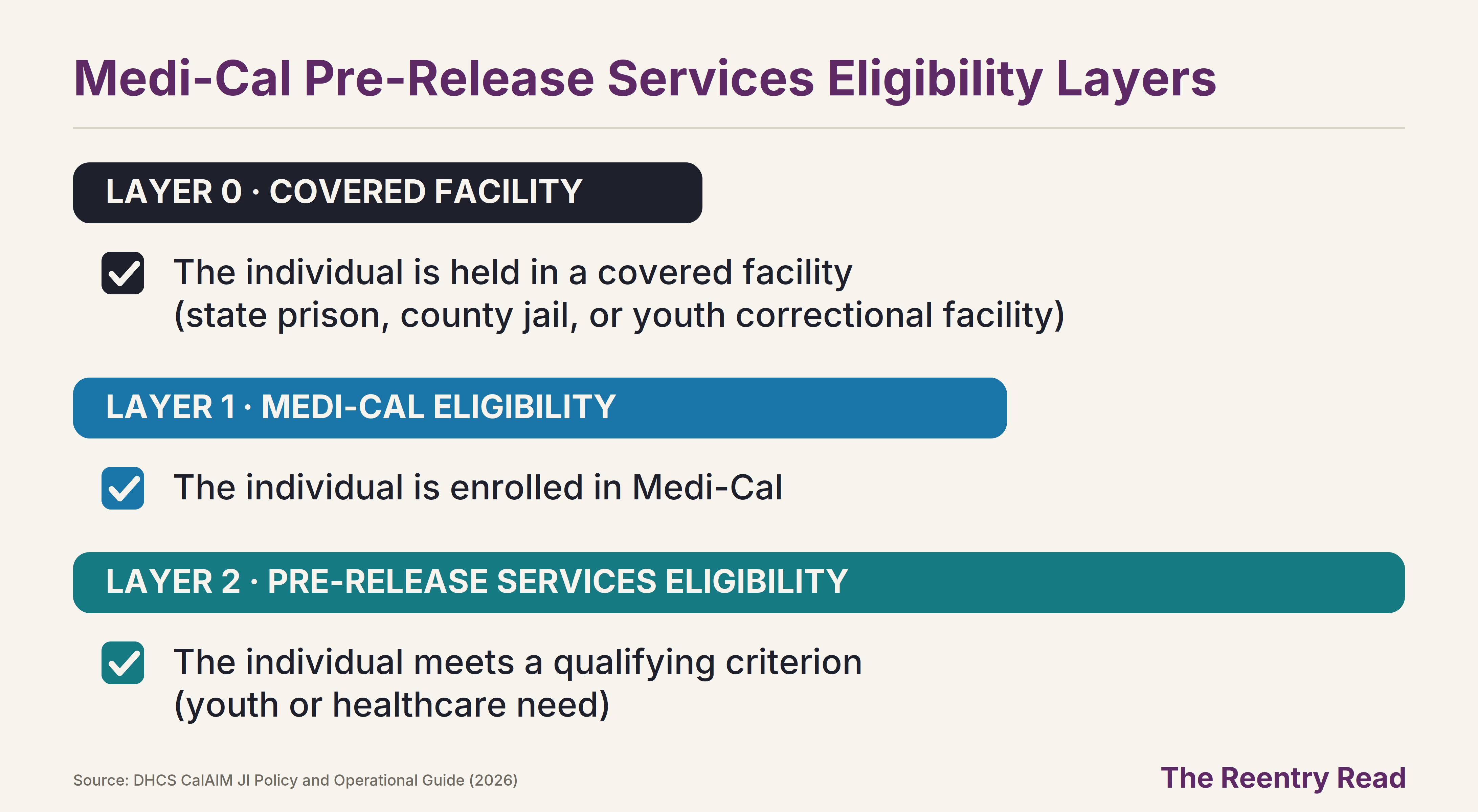
Before we get into the Medi-Cal verification process for incarcerated individuals, you need to understand that there are two coverage layers at play during incarceration: Medi-Cal eligibility and pre-release services eligibility.
Medi-Cal Eligibility: Incarcerated individuals must be enrolled in Medi-Cal to receive pre-release Medi-Cal-covered services. No exceptions. If they are not already enrolled in Medi-Cal during incarceration, correctional facilities are required to support individuals to enroll, but that is an entirely separate discussion that I will cover in another issue. For the purpose of today’s discussion, we should view Medi-Cal enrollment as the first layer of eligibility for pre-release services.
Pre-Release Services Eligibility: The second layer of eligibility addresses whether incarcerated individuals on Medi-Cal are eligible to receive pre-release services. Individuals who meet the youth criteria are only required to be on Medi-Cal, whereas adults must additionally meet a health-need criterion. Everyone must be in a covered facility: state prison, county jail, or youth correctional facility.
Correctional facilities are responsible for verifying whether individuals booked into their facilities are enrolled in Medi-Cal and if they are eligible for pre-release services. Once this is determined, correctional facilities must report their findings to the state through the JI Screening Portal. This web-based portal also enables correctional facilities to “activate” pre-release services, basically turning on the 90-day coverage window for eligible individuals.
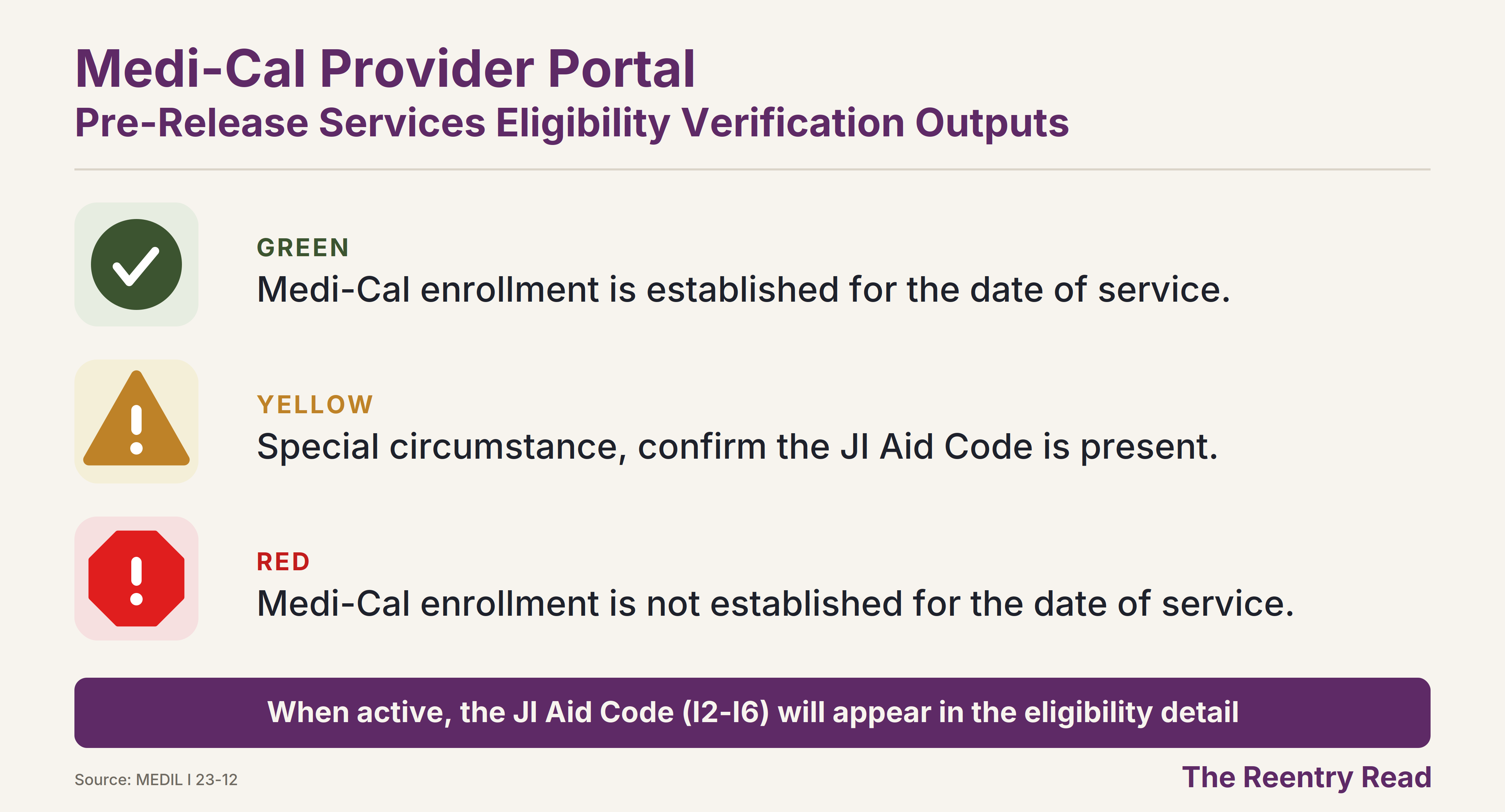
Activation within the JI Screening Portal triggers a special “JI Aid Code” to be assigned. (Technically there are five of these codes, I2 through I6, assigned automatically based on the individual’s underlying Medi-Cal eligibility. Which one appears doesn’t matter to you. What matters is that one of them is active.)
The JI Aid Code is the golden ticket. If the JI Aid Code is active at the time a covered pre-release service, such as a warm handoff, is provided, the service is reimbursable by Medi-Cal. If there is no JI Aid Code present at the time of service, the Medi-Cal claim will be denied.
Here’s the takeaway: if your organization bills Medi-Cal for services provided to incarcerated individuals, it is essential that you have a process in place to verify pre-release services eligibility (an active JI Aid Code) before you provide services. Otherwise, your claims may be denied.
How do you verify that there is an active JI Aid Code? Once your organization enrolls as a Medi-Cal Provider with DHCS (through the PAVE Portal, the enrollment step we covered in an earlier issue), you are provided access to the Medi-Cal Provider Portal. You can run eligibility in the Medi-Cal Provider Portal using an individual's Medi-Cal benefits card number and issue date, which will need to be provided to you by the correctional facility or the MCP. Running eligibility in the Portal will provide the JI Aid Code if it is active, among other information, and a handy color-coded output indicating the individual’s Medi-Cal coverage status.
For step-by-step instructions on how to verify eligibility for pre-release services via the Medi-Cal Provider Portal, check out this DHCS training.
If you are using an electronic health record or case management system, you might also be able to access the JI Aid Code and confirm pre-release eligibility there. However, I strongly encourage you to double check the information generated by your system against the Medi-Cal Provider Portal at least a few times to make sure it is providing you with accurate information.
One final note to help those of you stressing out right now because you do not currently have a process in place to verify pre-release services eligibility. You should only be receiving pre-release referrals from the MCPs and correctional facilities for individuals who have been deemed eligible for pre-release services and who have an active JI Aid Code.
In theory, that means a missing verification step may not have cost you much yet. In practice, MCPs and facilities do not always verify before they refer, so I would not count on it.
Just like with community-based services, eligibility verification is an important service provision step. Put one in place today. Every dollar counts.
As always, I would love to hear from you. If something in here raised any questions, or if you would like to share your experience, please reach out.
Thanks!
Rebekah
The Reentry Read is intended for educational purposes and reflects interpretation of published DHCS guidance. It is not legal, compliance, or regulatory advice, and provides no guarantees of Medi-Cal enrollment, managed care plan contracting, or reimbursement outcomes.
No posts
Comments
Nothing yet. Say the first thing.
Sign in to join the conversation.