
Thank you to everyone who joined Office Hours last week! We had a robust conversation spanning JI Aid Codes, pre-release billing, employing individuals with lived experience, and more. There was strong interest in a follow-up session. More to come on that soon.
Welcome back to The Reentry Read!
This week I’m talking dollars and cents. Specifically, reimbursement for care management services provided to justice-involved individuals under Medi-Cal’s Fee-for-Service (FFS) delivery system. This is the way your organization gets paid for the Care Management Bundles before managed care kicks in and Enhanced Care Management (ECM) begins after release.
To be successful with Medi-Cal FFS billing, there are a lot of technical aspects to navigate: claims formats, service codes, modifiers, RAD codes, and so on. Structurally, it is not too dissimilar to submitting managed care claims, but they go to the state, not the Managed Care Plans (MCPs). I’ll dig into some of these weeds in future issues, but today I’m going to cover the big picture: three milestones of the Medi-Cal FFS reimbursement process.
MILESTONE 1: Get PAVE Enrolled and Track the Application Submission Date
To receive reimbursement for Medi-Cal-covered services under the FFS delivery system (separate from managed care), your organization must be enrolled as a Medi-Cal Provider with the state Department of Health Care Services (DHCS). This is accomplished through the Provider Application and Validation for Enrollment (PAVE) portal.
Only certain types of organizations are eligible to enroll through PAVE to provide Care Management Bundles. You can review this list on page 18 of the Medi-Cal Provider Manual Justice-Involved (JI) Pre-Release Services section. Or, take the 5-minute JI ECM Provider Readiness Assessment to get tailored feedback regarding the CBO’s eligibility. If you are a Community-Based Organization (CBO), check out the prior issue where I discussed nuances relating to your provider type.
From a billing perspective, it is important to keep track of your organization’s PAVE application submission date. The submission date is the earliest date of service you can bill for, provided the application is complete when submitted and ultimately approved. If your organization accepted pre-release referrals before your PAVE application was approved, it may be possible for you to get reimbursed for these services.
MILESTONE 2: Provide Covered Services to Eligible Individuals
Once your organization is enrolled in PAVE, two conditions must be met for a service to be reimbursable: it has to be a Medi-Cal covered service, and the recipient has to be eligible to receive it.
Under the JI Reentry Initiative, there is a defined set of pre-release care management services known as Care Management Bundles. They include the development of a Health Risk Assessment and Reentry Care Plan, care coordination activities, and a warm handoff between the pre-release care manager and post-release care manager if they are different. Care Management Bundles are reimbursable under FFS Medi-Cal when they are provided to individuals who are eligible for services under the JI Reentry Initiative.
Individuals who are eligible for pre-release services under the JI Reentry Initiative have a special Medi-Cal code assigned to them called a JI Aid Code. These codes are activated by correctional facilities once eligibility is determined. Pre-release services, including the Care Management Bundles, are only reimbursable by Medi-Cal when the individual receiving them has an active JI Aid Code on the date of service. This is why I recommended in last week’s issue that you confirm a JI Aid Code is present before accepting pre-release referrals.
MILESTONE 3: Submit Timely Claims
Your organization can be PAVE enrolled and deliver covered services to eligible individuals, and still miss out on reimbursement if billing is not timely. The Medi-Cal FFS billing process begins by submitting a claim for reimbursement for services rendered, and there is a strict submission timeline.
The Medi-Cal FFS claims submission timeline is based on the month of service. Whenever possible, claims should be submitted within 6 months of the month of service. If it is an eligible and “clean” claim, submitting it within the 6-month window keeps it eligible for full reimbursement, up to 100 percent of the Medi-Cal rate. After that it is considered late, and all or part of the reimbursement is at risk.
If a timely claim (within the 6-month window) is denied, there is an appeals process that has its own timeline. You have 90 days from the date on the Remittance Advice Details (RAD) to submit your appeal. The RAD explains why the claim was denied. Depending on the timing, you might also need to submit a Claims Inquiry Form (CIF).
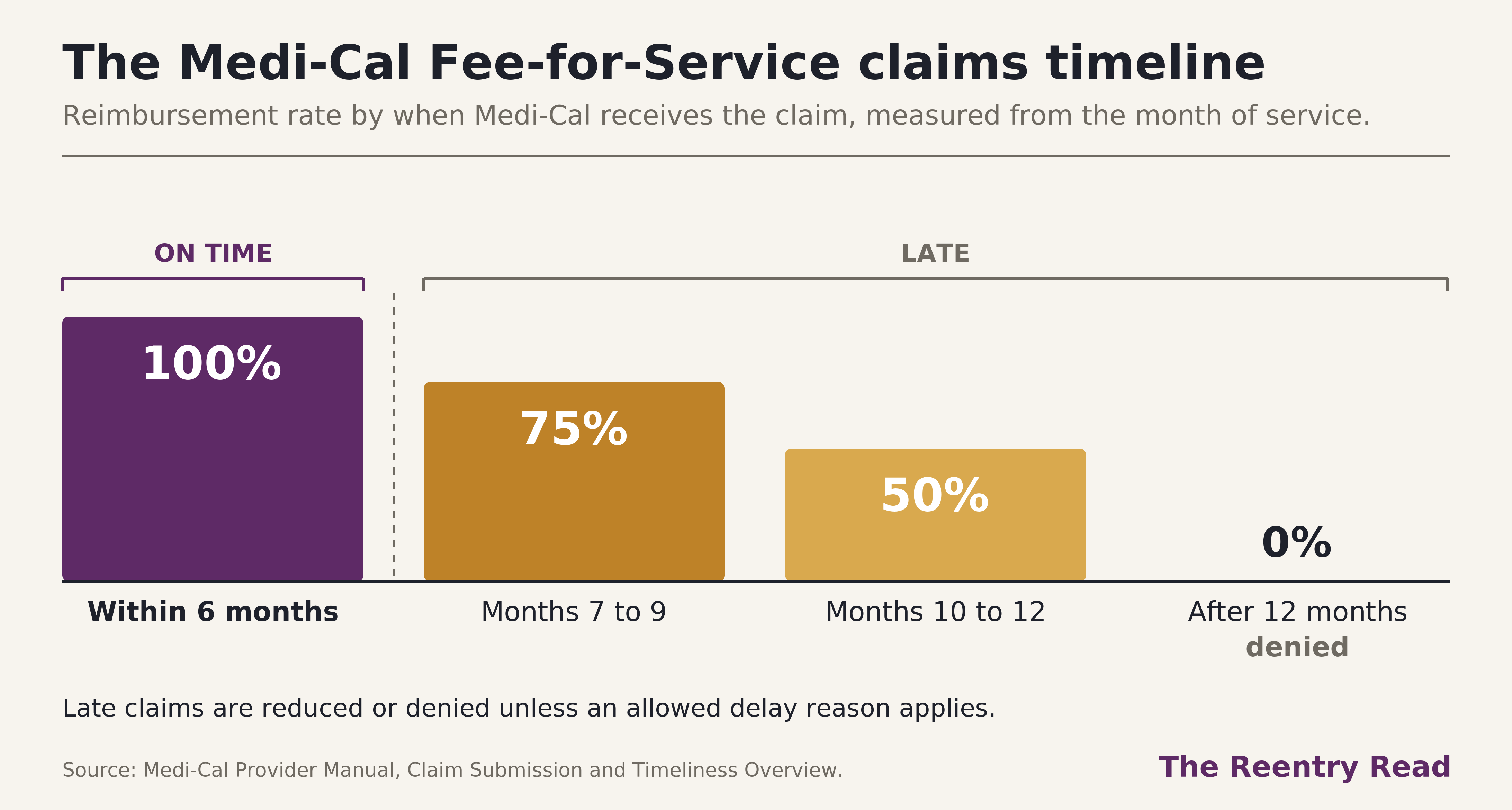
For full guidance on the Medi-Cal FFS claims submission timelines and process, review these sections of the Medi-Cal Provider Manual:
Billing is one of the least exciting aspects of being a Medi-Cal provider, but it is critical for program sustainability. It is easy to ignore, or push off to another day. Don’t. You could be leaving money on the table, or risk losing out on it altogether.
There is much more to unpack about Medi-Cal billing, and I’ll keep doing so in future issues. In the meantime, resolve to take one step towards Medi-Cal billing today.
If you are still waiting on your PAVE application to be approved, track the submission date and start preparing claims for services provided as of that date.
If you are PAVE enrolled but haven’t started billing, now is the time to figure out how to do so.
For those already billing, make sure you are following up on any denials in a timely fashion.
As always, I would love to hear from you. If this issue raised questions, or if you want to share how Medi-Cal billing is playing out at your organization, please reach out.
Thanks!
Rebekah
The Reentry Read is intended for educational purposes and reflects interpretation of published DHCS guidance. It is not legal, compliance, or regulatory advice, and provides no guarantees of Medi-Cal enrollment, managed care plan contracting, or reimbursement outcomes.
No posts
Comments
Nothing yet. Say the first thing.
Sign in to join the conversation.