
A quick reminder before this week's issue in case you missed it. Last week, I shared an invitation to free office hours for JI ECM Providers on Monday, August 3rd, 2pm-3pm. You can register here. I look forward to seeing you there!
Welcome back to The Reentry Read! We’ve reached the final stop in our walk through of the new Policy and Operational Guide for the Justice-Involved Reentry Initiative. So far we’ve covered the care management models, the Community-Based Organization (CBO) Medi-Cal enrollment pathway, and how JI ECM Providers get assigned.
Today’s three topics are a different kind. They sit one step removed from your day-to-day work, in an agreement you don’t sign, a federal law about detained youth, and a service delivered through another agency. Each is worth knowing about.
The MOU between correctional facilities and managed care plans
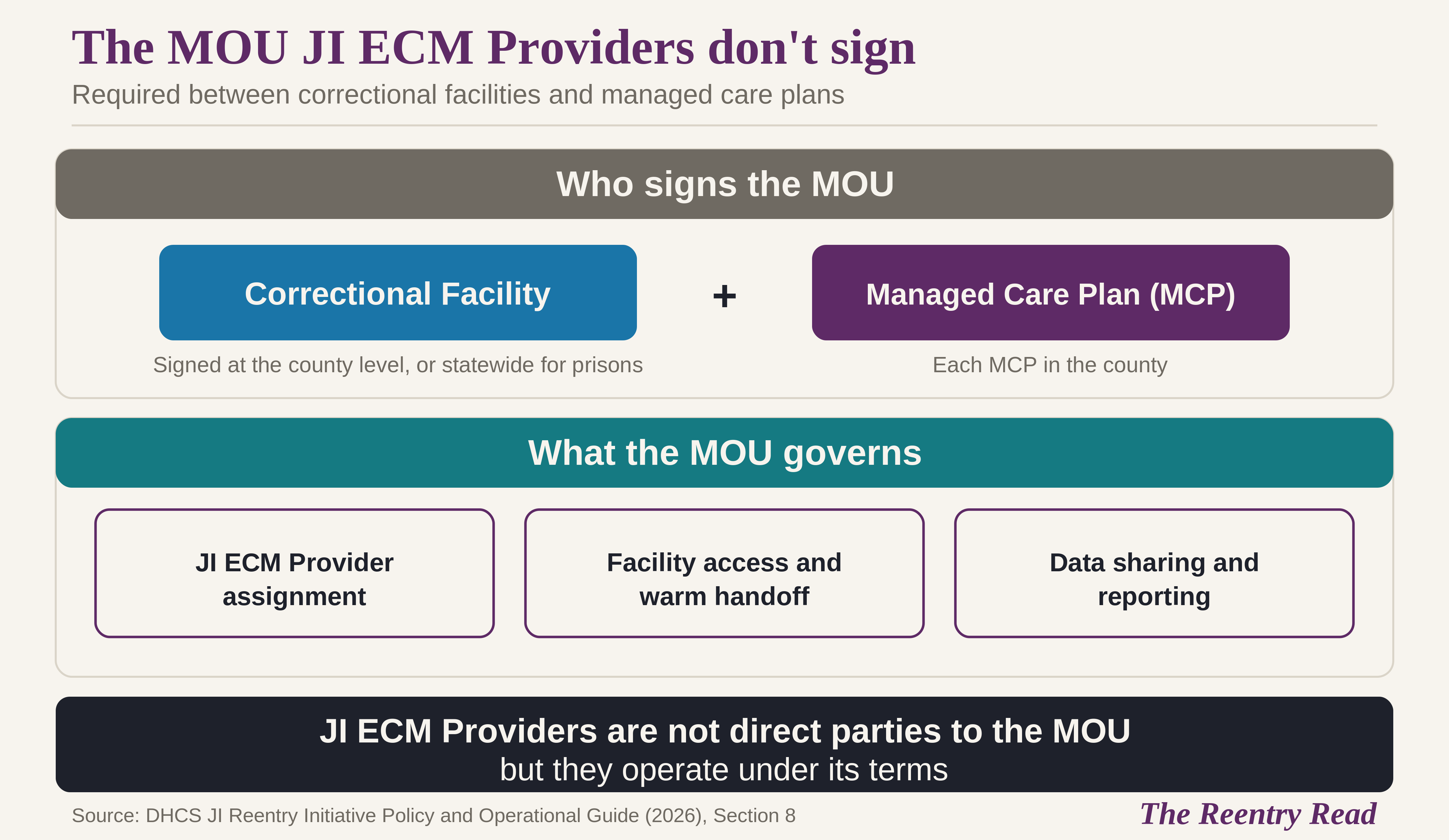
The new Guide requires correctional facilities and managed care plans (MCPs) in each county to sign a Memorandum of Understanding (MOU) using a template DHCS provides. The template for County jails and youth detention facilities has been released, and the template for the state prison system (CDCR) is still forthcoming.
The MOU establishes the JI ECM Provider assignment process (the subject of last week’s issue), correctional facility access and warm-handoff processes, and data-sharing and reporting expectations. JI ECM Providers are not direct parties to the MOU, but they will be operating under its terms. As such, those terms are likely to find their way into JI ECM Provider contracts with MCPs.
New federal requirements for detained youth
A recently implemented federal law, the Consolidated Appropriations Act (CAA) of 2023, now requires every state to provide a set of Medicaid-financed services to incarcerated youth who are post-disposition. (The Justice-Involved Reentry Initiative doesn’t distinguish between pre- and post-disposition.)
Post-disposition refers to youth who are incarcerated after conviction or adjudication.
The CAA applies to individuals under 21, or under 26 if they are former foster youth, which is consistent with California’s youth definition under the Justice-Involved Reentry Initiative. The services are specific: screening and diagnostic services in the 30 days before release, and targeted case management in the 30 days before release and for at least 30 days after.
DHCS has determined that these federally-mandated services fully align with Justice-Involved Reentry Initiative requirements. In addition, the federal government approved folding them into the same implementation timeline (over the two-year rollout ending September 30, 2026). There is no separate action that JI ECM Providers must take pertaining to the CAA, but it’s important to be aware of the broader landscape (use of Medicaid dollars for pre-release reentry services is rolling out across the country).
Peer Support Services get a louder mention
Peer Support Services have been a covered pre-release service since the original Guide was published, but they were a bit buried. These services receive more emphasis in the new Guide.
Peer Support Services offer individualized support, coaching, facilitation, and education to individuals with mental health needs and substance use disorders, and are delivered by providers who self-identify as having lived experience with the process of recovery from mental illness, substance use disorder, or both, whether as a consumer of those services or as the parent or family member of a consumer. (Senate Bill 803)
Peer Support Services are a special class of services offered under County Behavioral Health Agencies that have opted in to provide them. The Justice-Involved Reentry Initiative extends these services into the pre-release period. Providers who are interested in learning more about Peer Support Services should visit the DHCS website and their local County Behavioral Health Agency.
That closes our walk through of the new Guide. Five issues in, you now have the full picture of the changes that matter most to JI ECM Providers.
The ten supplemental Chapters are still to come. As DHCS releases them, I’ll be here to break down the relevant topics.
Until then, please feel free to reply with feedback or requests for future topics.
Thanks!
Rebekah
The Reentry Read is intended for educational purposes and reflects interpretation of published DHCS guidance. It is not legal, compliance, or regulatory advice, and provides no guarantees of Medi-Cal enrollment, managed care plan contracting, or reimbursement outcomes.
No posts
Comments
Nothing yet. Say the first thing.
Sign in to join the conversation.