
Before we dive in, a reminder about office hours for JI ECM Providers on Monday, August 3rd, 2pm-3pm. It’s a free working session to answer your questions about the JI Reentry Initiative and serving as a JI ECM Provider. Don’t forget to register here!
Welcome back to The Reentry Read!
For the past several weeks, we’ve been deep in the weeds of the new Policy and Operational Guide of California’s Justice-Involved Reentry Initiative. The pre-release care management models, the Medi-Cal Provider enrollment pathway, JI ECM Provider assignment, and more.
This week I want to step back and look at the bigger picture. It’s too easy to lose sight of how significant this Initiative is when we’re focused on the details.
Think about what’s happening here: California is extending Medi-Cal services to incarcerated individuals for the very first time. Public healthcare dollars are now being used to stabilize people while they are still incarcerated, support their reentry, and continue intensive case management services for them after they are released. A continuum of care from pre- to post-release.
For a population our healthcare system has long left behind, these services arrive exactly when they are needed most, during the fragile reentry period.
This is no longer theoretical. All 31 state prisons are already live, along with dozens of county jails and youth facilities. In the Initiative’s first year, facilities delivered more than 159,000 pre-release services and prescriptions. Correctional facilities that have not yet launched are required to do so before October 1, 2026.
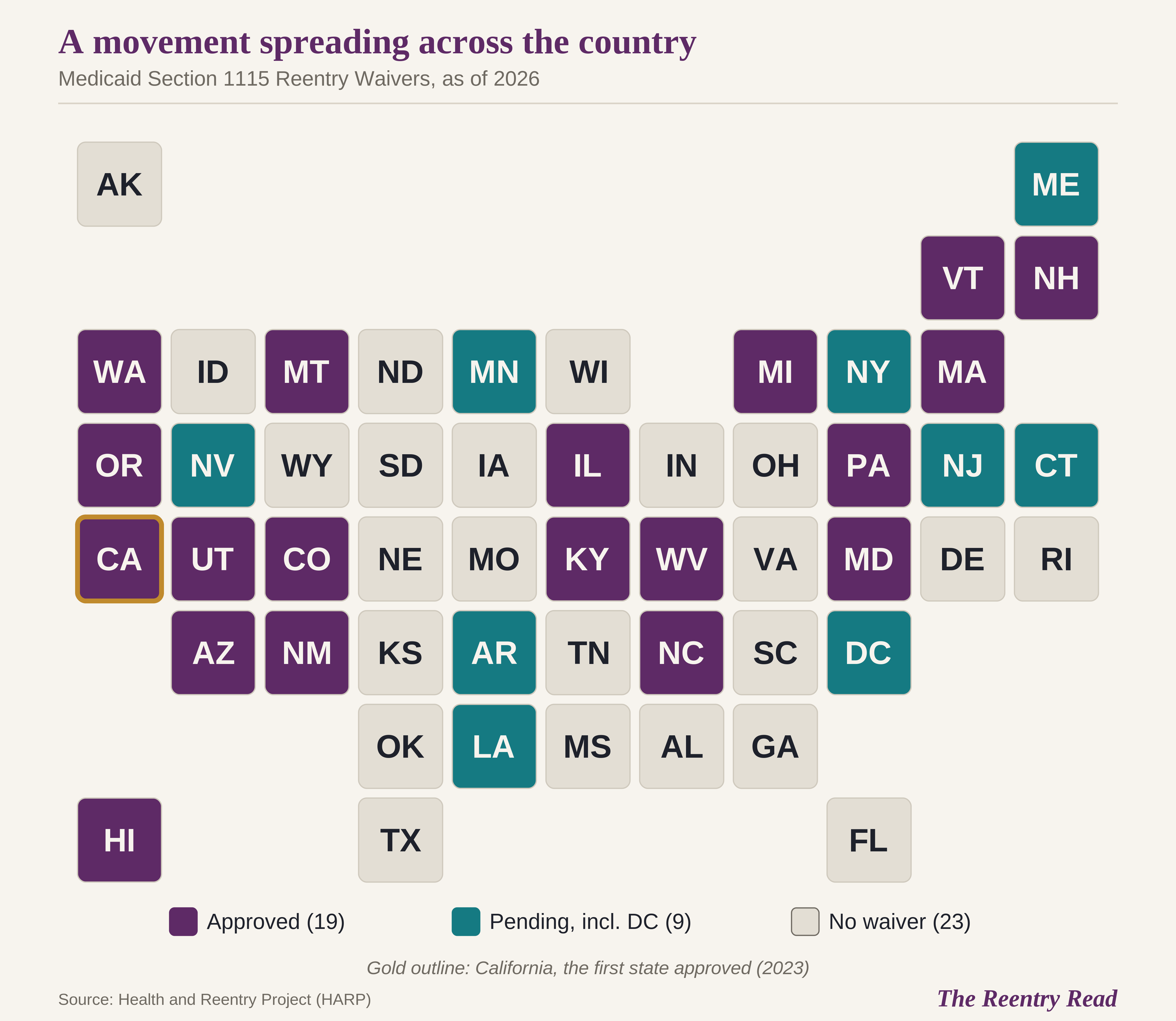
In January 2023, California became the first state in the nation to receive federal approval for a Medicaid waiver that provides pre-release services. This eventually became known as the Justice-Involved Reentry Initiative. It is now in good company.
Medicaid-covered services for incarcerated individuals are now rolling out across the country. At the time of this publication, about half of states have either been approved for their own 1115 reentry waiver or have one pending before the federal government. You can see the full national picture in this tracker from the Health and Reentry Project (HARP).
We also previously discussed the Consolidated Appropriations Act, which requires every state to provide specific Medicaid-covered reentry services for detained youth held after adjudication. This is federal law.
It’s an exciting time, but I don’t want to gloss over one important point: the five-year CalAIM Section 1115 demonstration that authorizes this Initiative ends December 31, 2026, and it’s up for renewal. The state has already submitted its request to the federal government, and now, we wait.
Increasingly, folks are asking me if I think the reentry waiver will get renewed. The truth is, I don’t know. There are many factors that could shape that decision, and I’m not in the business of making predictions.
But I am hopeful. When I look at the federal landscape, at the number of states building their own reentry waivers and at the youth services now written into federal law, I don’t see a one-and-done experiment. I see a movement spreading across the country.
I know this work is hard. The requirements are confusing, service delivery in correctional settings is complex, and the policy environment keeps shifting. I say we try to remain positive despite the hurdles and uncertainties and keep on grinding. Every individual served, every service rendered, every partnership launched helps move the work forward and build the case for its longevity. Thank you all for the vital role you play!
As always, please feel free to reply with feedback or requests for future topics.
Thanks!
Rebekah
The Reentry Read is intended for educational purposes and reflects interpretation of published DHCS guidance. It is not legal, compliance, or regulatory advice, and provides no guarantees of Medi-Cal enrollment, managed care plan contracting, or reimbursement outcomes.
No posts
Comments
Nothing yet. Say the first thing.
Sign in to join the conversation.