
Welcome back to The Reentry Read! One quick note before we start: this issue is written specifically for Community-Based Organizations (CBOs). If that is not you, feel free to skim. And, if you are a CBO that has already enrolled through PAVE, congratulations! This is one of the most daunting steps to becoming a JI ECM Provider. You can skim too, or pass this along to a colleague who has not gotten past this stage.
To become a JI ECM Provider, organizations must enroll as a Medi-Cal provider through the DHCS Provider Application and Validation for Enrollment (PAVE) portal. We’ll get to why this requirement exists (and the one workaround) in a moment.
Note of clarification: PAVE is a provider enrollment pathway, not where billing occurs.
Back in October 2023, when the original Policy and Operational Guide was published, the PAVE enrollment pathway for CBOs did not yet exist. That changed when the CBO enrollment pathway opened in November 2024, and the new Guide (published May 2026) is just now getting caught up.
Why does the PAVE enrollment requirement exist?
Unlike community-based Enhanced Care Management (ECM) services, which are paid through managed care, services provided to incarcerated individuals are paid through Medi-Cal Fee-For-Service (FFS).
Medi-Cal FFS is administered directly by the state (DHCS) rather than through the intermediary of a managed care plan (MCP).
To be eligible to bill and receive reimbursement for pre-release services like care management, providers must have a direct relationship with DHCS. This necessitates enrollment through PAVE, and an application that is approved by DHCS. No PAVE, no reimbursement for pre-release services.
Additionally, to align with state policy, MCPs are now requiring JI ECM Providers to enroll and get an application approved through PAVE in order to obtain a contract. So, no PAVE, no MCP contract.
What types of CBOs can enroll through PAVE?
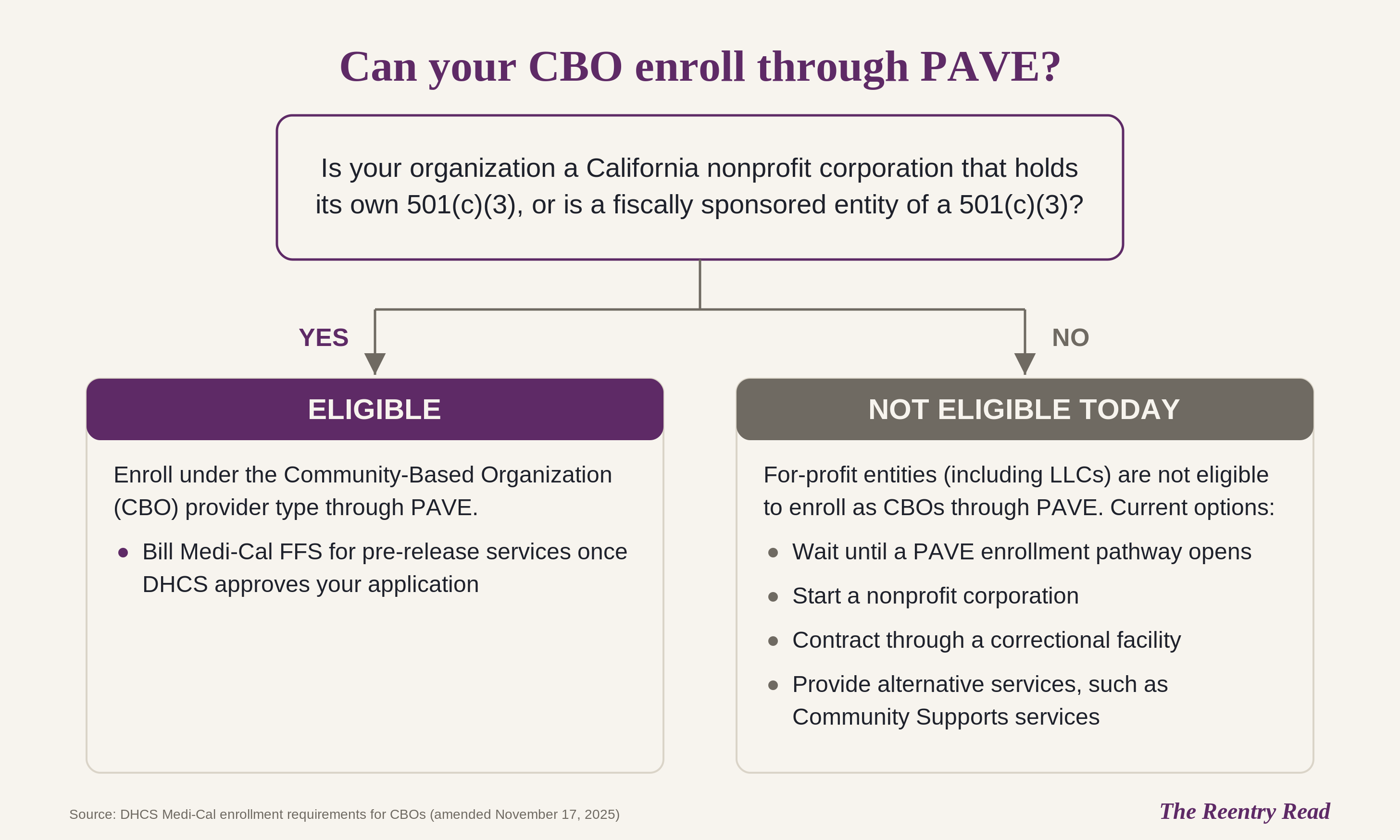
There is one major condition that determines whether a CBO can enroll through PAVE: your organization must be a California nonprofit corporation that either holds its own 501(c)(3) status or is a fiscally sponsored entity of a 501(c)(3).
Nonprofit incorporation and 501(c)(3) status are not the same thing. Incorporation is a state filing whereas 501(c)(3) is a federal tax designation.
Entities structured as limited liability companies (LLCs) currently have no pathway to enroll through PAVE, even with a fiscal sponsor. This is incredibly frustrating, especially because there are many great CBOs in California with extensive experience serving justice-involved individuals that just happen to be structured as LLCs.
My CBO meets the conditions to enroll through PAVE, where do I start?
If you do not yet hold MCP contracts, I strongly encourage you to engage with your local MCPs before you jump into PAVE enrollment. Let them know you are interested in becoming a JI ECM Provider, and find out if they are still accepting new Providers to join their JI ECM networks.
If you are already contracted but still need to get PAVE enrolled, don’t delay. This is a months-long process, and the window to back-bill the state for pre-release services starts closing as soon as 6 months from the date of service. Here’s a checklist from DHCS to help you prepare for your PAVE application.
My CBO does not meet the conditions to enroll through PAVE, what can I do?
You have a few options.
Wait. A pathway beyond nonprofit corporations may open eventually, so your organization might qualify down the line. Emphasis on eventually as this is not expected any time soon. And, we don’t know what the new parameters would be, so you might need a Plan B regardless.
Incorporate. There are plenty of fiscal and legal considerations here, but standing up a nonprofit corporation and getting the 501(c)(3) designation or a 501(c)(3) fiscal sponsor is certainly an option. Your MCP contracts will need to be under the same organization that is enrolled through PAVE, so make sure you talk with your MCPs if you are considering this pathway.
Contract. Obtaining contracts with correctional facilities is a DHCS-acknowledged option. If CBOs contract directly with correctional facilities, get paid under that contract, and the correctional facility bills the state directly for the services rendered, then the CBO doesn’t need to be PAVE enrolled. In reality, few correctional facilities are entertaining this option, so you’ll have to do some serious relationship-building to pull this one off.
Pivot. This one is a bit harsh, but it’s real. Becoming a JI ECM Provider just might not be feasible, and there may be better options for your organization to serve justice-involved individuals. For instance, consider offering Community Supports services, or serving other ECM populations of focus such as individuals experiencing homelessness. You may encounter formerly incarcerated individuals through alternative eligibility pathways.
The best move for your organization is the one that fits your structure and your mission.
Well, that was a mouthful!
Next week I’ll be covering peer support specialists, now a Medi-Cal covered pre-release service.
As always, please feel free to reply with feedback or requests for future topics.
Thanks!
Rebekah
P.S. Here are more resources from DHCS on PAVE enrollment for those who want to dig a bit deeper:
The Reentry Read is a newsletter for JI ECM Providers implementing California’s Justice-Involved Reentry Initiative. This newsletter is intended for educational purposes and reflects interpretation of published DHCS guidance. It is not legal, compliance, or regulatory advice, and provides no guarantees of Medi-Cal enrollment, managed care plan contracting, or reimbursement outcomes.
No posts
Comments
Nothing yet. Say the first thing.
Sign in to join the conversation.