
Welcome back to The Reentry Read! Today we continue our deep dive into the new Policy and Operational Guide for the Justice-Involved Reentry Initiative with a deceptively simple question. How does a JI ECM Provider get assigned to an incarcerated individual? The answer used to come from the state. Now it comes from your county.
This is the JI ECM Provider assignment process, sometimes called the referral process. It determines which provider will receive the ECM referral for a particular incarcerated individual.
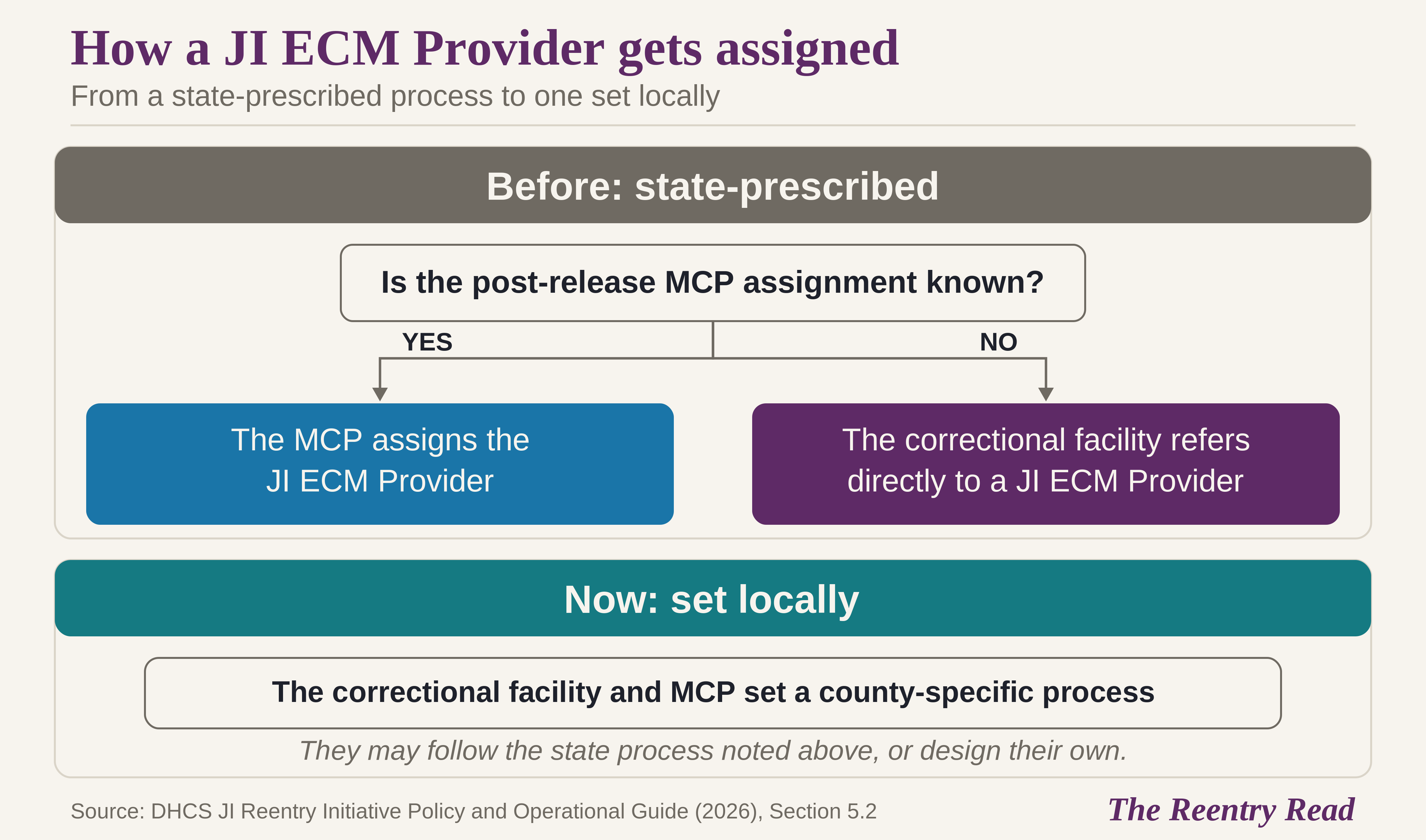
Previously, the state dictated the JI ECM referral process, which was based on post-release managed care plan (MCP) assignment, such as Kaiser, Health Net, or Blue Shield. Specifically, if MCP assignment was known, the correctional facility was required to route the referral through the MCP, and the MCP would make the JI ECM Provider assignment. If MCP assignment was not known, the correctional facility would instead make a direct referral to a JI ECM Provider
MCP assignment is typically known for incarcerated individuals already enrolled in Medi-Cal upon incarceration. It’s individuals who are newly enrolled in Medi-Cal during incarceration that can have a delayed, and thus unknown, MCP assignment.
Contracting with all MCPs operating in the county of release helps ensure the provider can continue serving the individual, regardless of which MCP they are ultimately assigned to.
Per the new Guide, correctional facilities and MCPs are no longer bound to a single state-prescribed process. They may follow the state process, or set a county-specific one.
Considerations for direct vs. indirect JI ECM Provider referrals
From an efficiency standpoint, direct JI ECM referrals (from correctional facilities to providers without using MCPs as an intermediary) make a lot of sense. Why add another layer of bureaucracy to slow down the process?
Of course, efficiency is only one factor to consider. There is also JI ECM Provider capacity (can the provider take on more referrals?), provider fit (are they capable of supporting the individual’s particular needs), continuity of services (did the individual already have an assigned ECM provider prior to incarceration), and equitable distribution of referrals among providers (is the process fair?). If they are looped in, MCPs can help manage these factors.
Finally, whether physically or virtually, JI ECM Providers are entering the correctional facility to engage with incarcerated individuals. This is the domain of CDCR (the state prison system), Sheriff’s Offices (jails), and Probation Departments (youth detention facilities). Correctional facilities should have a say on who enters their house.
The new Guide opens the door for correctional facilities and MCPs to partner and determine what will work best locally.
What this means for JI ECM Providers
Unless a broader forum is created, you (JI ECM Providers) are unlikely to get a seat at the table to determine the local process for JI ECM Provider referrals. That does not mean you have to operate in the dark.
Your job at this stage is to get informed. Reach out to the JI Liaison at each MCP and ask how JI ECM Provider assignment works for the correctional facilities in the counties where you operate. A few questions to start with:
Are MCPs or correctional facilities making JI ECM Provider assignments? Under what circumstances?
What processes are MCPs and/or correctional facilities using to assign specific JI ECM Providers? What are the criteria?
How is JI ECM Provider capacity managed? What should our organization do if we reach capacity and we are unable to accept new JI ECM referrals?
MCPs are required to have a dedicated individual or team to serve as a JI Liaison to support implementing partners, including correctional facilities and JI ECM Providers.
Since planning is still very much underway in many counties, MCPs may not be able to answer all of these questions just yet. Even so, it’s important to begin the conversation.
You may not be the one who sets the local process, but it’s critical you understand it.
In the next issue I’ll wrap up our deep dive of the new Guide with the remaining changes, including how new federal requirements for detained youth are being handled, what the state expects for MOUs between correctional facilities and MCPs, and a note about peer support services.
As always, please feel free to reply with feedback or requests for future topics.
Thanks!
Rebekah
The Reentry Read is intended for educational purposes and reflects interpretation of published DHCS guidance. It is not legal, compliance, or regulatory advice, and provides no guarantees of Medi-Cal enrollment, managed care plan contracting, or reimbursement outcomes.
No posts
Comments
Nothing yet. Say the first thing.
Sign in to join the conversation.