
By Jolie Braun, with Jessica P. Clark
Modern recipe collections are typically assemblages accumulated from a variety of sources over many years by an individual for personal use. While scholars have devoted considerable thought to early modern examples, it is perhaps because of their ordinariness and unassuming nature that modern instances have garnered less scholarly attention than published cookbooks. Yet, as the posts in this Spring 2026 issue of The Recipes Project reveal, they are fascinating historical artifacts worthy of our consideration.
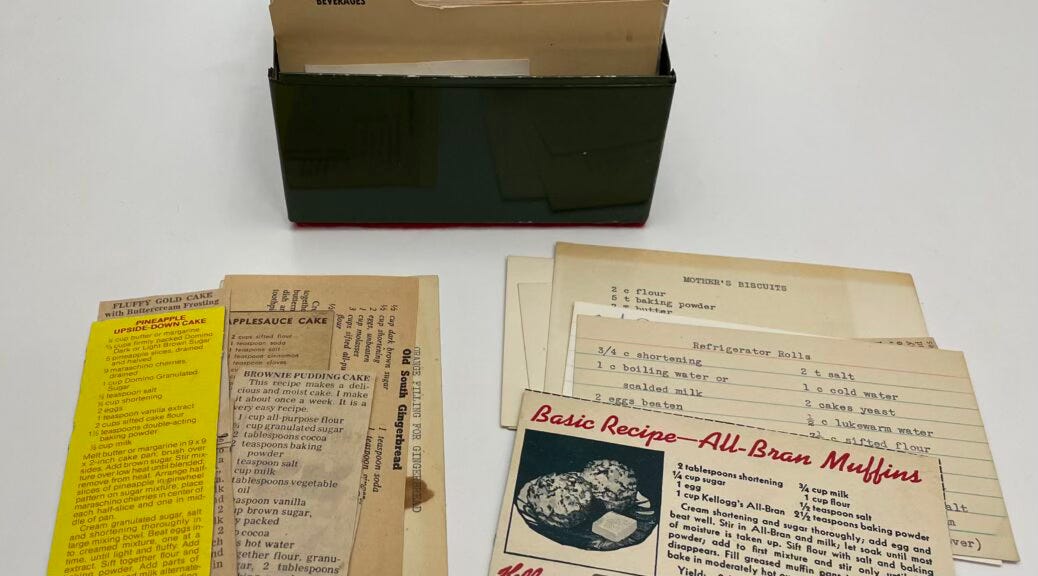
Collecting recipes is both a utilitarian and a creative endeavor. The activity is chiefly to address the practical need of having dishes to cook; but it is also the culmination of numerous choices about selecting, documenting, organizing, and preserving recipes and other culinary and domestic information. As primary sources, these collections tell us not only about their creators and the time and place in which the collection was developed, but also about the available ingredients, food trends, cooking methods, and even media and technology of the period.
The posts in this issue underscore the breadth and diversity of modern recipe collections. Case studies include an eighteenth-century Japanese chef’s manuscript book, paper scraps that eighteenth-century Swedish countesses used to record and organize their recipes, the wartime scrapbook of a Danish homemaker, mid-twentieth-century recipe binders that were part of a West German magazine’s marketing strategy, the research notes of a twentieth-century American cookbook author, recipe cards passed down to loved ones in twenty-first century North America, and contemporary recipes shared online. As this summary suggests, the posts also emphasize the various formats that have been used for collecting: bound volumes, loose leaf paper, scrapbooks, binders, recipe cards, and social media. The materiality of these collections is part of their meaning and the information they relay through handwriting, notes, wear, and stains.
While the collections are personal, they may not necessarily be entirely private, as several of these posts show. Recipes circulate; they are given to friends and neighbors, inherited by family members, and posted online. The act of sharing a recipe from one’s collection may be a way to demonstrate expertise, impart knowledge, strengthen bonds, or express love and care. Recipes sometimes credit their original source, an act of acknowledgement that reveals the creator’s personal network.
These posts also highlight that modern personal recipe collections do things that published cookbooks won’t or can’t. For example, they have greater flexibility, and can be edited, reorganized, and updated as needed. Additionally, they may include multiple different recipes for a single food or dish (reflecting the creator’s tastes and preferences). Some recipes are written as more of a memory aid than a set of instructions, eschewing standardization or omitting details the creator already knew (and because of this may even resist being used as a recipe by another individual).
And perhaps this is another reason modern recipe collections have been studied less than cookbooks: they can be messy, idiosyncratic, and intensely personal. But as these posts highlight, this is part of what makes them so compelling. They are intimate records that invite us into the creators’ lives and kitchens, showing us what real people cooked and ate, and how they documented, preserved, and shared their recipes.
On Being Influenced: Consuming, Producing, and Performing Recipes on Social Media, by Mark Anthony Arceño
Side Dishes and Supplemented Reading: Sammelrezepte in West German Women’s Magazines, by Ellen Barth
“From the Dear-Times”: What a Scrapbook Can Tell Us of Household Management, by Anna Katrine Werge Bønnelycke
Teaching Grandma Peg’s Recipes, by Jennifer Cognard-Black
The Poet’s Table: Recipes of the Sandburg Family, by Madi Duran
Folding and Pinning: Organization in Two Swedish 18th-Century Recipe Collections, by Isabelle Fredborg
A Recipe for Beans (Without the Beans), by Sarah Conrad Gothie
tsp to smbc: Culinary Vernacular and the Evolution of Language in Personal Recipes, by KC Hysmith
Recipe for an Unfinished Book: Helen Witty’s America Preserved, by Melina Moe
The “Silent Summary of Cooking” in Feudal Japan, by Miguel Ángel Pelayo Prieto
Culinary Literacy in Eighteenth- and Nineteenth-Century British Personal Recipe Collections, by Elizabeth M. Schmidt
Giving and Receiving (with) Recipe Cards, by Ozoz Sokoh
If you enjoy receiving updates from The Recipes Project via Substack, please consider sharing this newsletter with a friend! Happy reading, and happy spring!
— The Recipes Project Editorial Team
No posts
Comments
Nothing yet. Say the first thing.
Sign in to join the conversation.