
Readers who have followed me in Macleans, the Ottawa Citizen, the National Post and the Real Story newsletter will know that this history is something of a preocccupation of mine. Among other things, it’s a story about how we came within a hair’s breadth of a war with the United States and the unrecoverable loss of what the Fathers of Confederation would go on to envision as a peaceable dominion from the Atlantic to the Pacific.
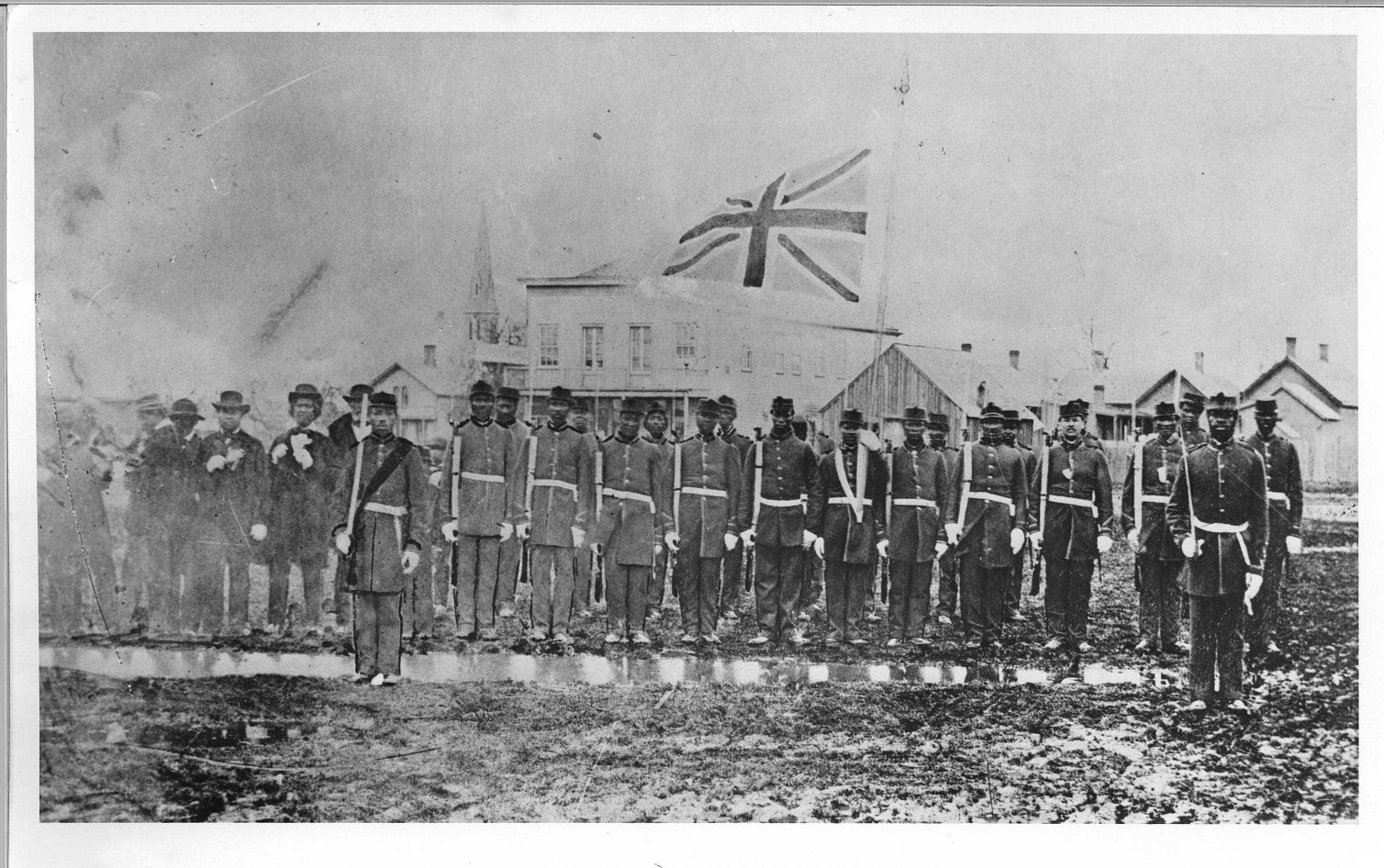
For the past eight years it’s been my custom on the British Columbia Day long weekend to have another go at it because Emancipation Day - the commemoration of the first statutory spike in the coffin of slavery throughout the British Empire, in 1834 - is the heart and soul of the founding colonial enterprise West of the Rockies. We very nearly lost it all to thousands of American marauders in the Fraser Canyon in 1858 and an invasion by more than 500 troops of the 29th U.S. Infantry in 1859.
So I’m at it again in the National Post, here.
Since 2021, this August long weekend has been officially Emancipation Day weekend, federally and provincially, which is to say we’re only catching up to what was a civic holiday in Victoria in the 1850s, and whenever I return to this history it’s been my experience that it tends to come as a shock to Canadians, and to Americans. Which is a testament to how disremembered it has become.
The Americans can account for this as they like, but Canadians have been officially dissuaded against comprehending this history, which I’ve always thought would be suitable for big-screen treatment of the kind associated with the great American documentarist Ken Burns. There’s a great deal of bloodshed, intrigue and betrayal in the story. It played out in the thronerooms and parlours of statesmen and kings in London, Washington and Paris, and it ran its bloody course across the entire western half of the North American continent until it met the force of an “octoroon” who was Thomas Jefferson’s moral superior.
I like the historian Keith Thor Carlson’s way of describing Sir James Douglas. “A century before Dr. Martin Luther King Jr., Douglas was envisaging a world in which white privilege would erode as people came to judge others less according to the colour of their skin and more according to the content of their character.”
It’s not quite true to say that one man stood in the way of all this barbarism, but it’s close. Sir James Douglas, who would go on to become British Columbia’s first governor, was a devoted follower of the British abolitionist William Wilberforce. He’d been Vancouver Island’s governor in 1851 before that colony’s forced union with the mainland colony, and he and Lady Amelia, an Irish Cree, presided over a thriving loyalist society of Orkney Islanders, Iroquois and Métis traders, Québécois voltigeurs, Hawaiian Kanakas and various “King George Indians” who had retreated ahead of the American advance across the Rockies into what is now Montana and Idaho.
Everybody knew back then what was happening on the American side of the border that partitioned the Columbia territory in 1846. After Douglas and the Crown loyalists were forced northward, there was the Cayuse War, the Klamath War, the Salmon River War, the Yakima War, and the Nisqually War.
The American victory in the U.S. war with Mexico, cemented in the Treaty of Guadalupe in 1848, pushed the American frontier to the Pacific Ocean and swallowed up territory that would later become Texas, California, Nevada, Utah, and parts of New Mexico, Arizona, Colorado and Wyoming. The denouement was an orgy of genocidal mass murder: the Yavapai slaughter, the Sand Creek Massacre, the Mendocino War, the Yuki genocide, the Snake River War, the Colorado War, and so on.
The U.S. general in charge of taking over from Douglas was the monstrous William Harney, who delighted in slaughtering and terrorizing Indigenous people. Harney’s benefactor and sponsor was the senator and war secretary Jefferson Davis, who would go on to serve as the president of the Confederacy. It should not be a surprise that the Songhees, Esquimalt, Tsartlip, Tseycum, Pauquachin, Malahat, Nanaimo and the rest formed a military alliance with Douglas and the loyalists, and entered into treaties with the Crown quite contentedly.
But for Canadians, the story of the 1846 partition of the Columbia territory and the dramatic convulsions that followed is “of no worth in the new societies of commerce, religion and imperialism,” as the novelist Michael Ondaatje put it. And so it’s been occluded in the dumbed-down postnational “narrative” that Canadians have been force-fed by a Liberal establishment that has taken every advantage of the crisis of epistemology that continues to enfeeble the Anglosphere. The crisis arises from the fact that it doesn’t matter that the facts don’t matter anymore.
It hasn’t helped that a post-literate amnesia has been induced by the ubiquity of AI slop in the dystopian digital-technology “attention economy” we’re all trying to navigate through. Here at the Real Story I’m trying my best to make myself useful with the old charts and sextants.
This story should be of interest to Americans who may be disturbed to learn that the Trump administration has so damaged America’s standing in the world that the Pew Foundation reports that China is now seen more positively than the United States in most of the 36 countries polled in its latest survey, Canada included.
It does not make me happy one bit that Canadians have stupidly come to view China more favorably than the United States: China gets a 44 percent “favorable” rating as opposed to the 33 percent of us who view the United States favorably, owing mainly to President Trump’s trade belligerence and his persistent “51st state” provocations.
This story might also be of particular interest to The Real Story’s British subscribers, not because it’s so wrapped up in British colonial history but because the United Kingdom, and particularly the Church of England, is currently embroiled in its own masochistic obsessions with slavery, and the demand for British reparations is all the rage in the Commonwealth at the moment.
It’s for all these reasons that I’m at it again this weekend in The National Post. I have at the whole business and its contexts in this podcast with Mike McDonald and Geoff Meggs. We cover quite a bit of ground. The mass psychosis of church burnings and statue-topplings incited by Justin Trudeau’s government in 2021, this past year’s uproars over the Cowichan decision, and we even got into Ottawa’s bizarre reinvention of the Komagata Maru incident of 1914. And much else.
It’s also a story that makes you wonder about what might have been, had Douglas’s successors not betrayed our old Indigenous allies, adopting the standpoint that Indians had no more right to the land than the “he-panther or the she-bear,” and lying their way into Confederation in 1871. It makes you wonder how things might have turned out if Douglas had succeeded in his hopes to convince the Colonial Office in London, during the U.S. Civil War, to retake the entire Columbia territory and to keep marching all the way to San Francisco Bay.
I didn’t even mention that when the Trudeau government officially got around to recognizing Emancipation Day, the move was rolled into a fictional rendering of what Justin Trudeau called “the painful history of slavery here in Canada.” Inconveniently, it was in 1867 that the Confederation of the Dominion of Canada was established, 33 years after the Slavery Abolition Act came into effect throughout the British Empire.
I may have missed it but I can’t find any Liberal pronouncement related to Emancipation Day that acknowledges Lieutenant-Governor John Graves Simcoe’s accompishment in 1793 in the Upper Canada Act to Prevent the Further Introduction of Slaves and to Limit the Term of Contracts for Servitude within This Province. This was at least a start, a gradualist remedy to the pathogen of slavery, but it nonetheless established Canada as the terminus for the Underground Railroad that ended up drawing something like 30,000 escaped slaves from America to Canada.
What you can’t help but notice was the way the Trudeau government’s Emancipation Day recognition was rolled into a cynical $800 million vote-harvesting operation by way of subsidies and investments in Black-owned businesses, Black equity and inclusion quangos, the Black Justice Initiative and so on. Most of Canada’s Black people are relatively recent immigrants, and fair play to them, but in any case, what has any of this got to do with slavery?
I suppose it’s all very heartwarming but missing in all of this is any acknowledgement of actually-existing slavery. I did point out at the time: Perhaps not so heartwarming is that the throngs of earnest protesters turning out for all those Black Lives Matter rallies across Canada are wearing clothes made by slaves.
Canadians are still going without an effective anti-slavery law in Canada, which was a priority of human rights campaigners six years ago. We mustn’t upset the People’s Republic of China, after all. Only a few months ago, Mark Carney’s government eliminated the office of the Canadian ombudsperson that was supposed to inquire into the traffic in slave goods.
Everybody knows that the Trump administration’s tariff push using forced-labour content in trade goods and commodities is a mere pretext to persist in what the U.S. courts had prevented him from doing. But for several years, the Americans have had a point about Canada’s laxity in these matters.
Prime Minister Carney says “Canada has the most rigorous set of engagements on the issue,” but the self-policing approach to corporations dealing in dodgy trade with China may already be a dead letter. Beijing’s recent Decrees 834 and 835 threaten to penalize foreign firms that adopt anything like rigorous scrutiny of its supply chains to comply with forced-labour standards.
Anyway, enough out of me for today. Below are some links to my earlier efforts to bring this history to light. If you take up a paying subscription to The Real Story you can delve into the archives where you’ll find several enlightening, maddening, amusing and entertaining treatments of this history going back some long while. It would do you good:
Victoria Day, an Expeditionary Force (a personal irredentism).
No posts
Comments
Nothing yet. Say the first thing.
Sign in to join the conversation.