
I’ve been on a bit of a tear these past few days. Apart from my usual contributions in the National Post and The Real Story I’ve been accepting invitations to podcasts and Youtube conversations where I seem to have fallen into the role of ‘guest who stubbornly chafes against respectable pieties.’
It’s not the role I’d want for myself, but here we are.
I’ve been trying to stay focused on the shadow wars Beijing and Moscow are waging on western democracies, and holy cow, there’s a lot to report - spies, sabotage, war of the bloodiest kind, geopolitical strongarming, global corporate collaborations and compromises, you name it.
It’s just that for several years, Emancipation Day has tended to draw me back to the civic hygiene involved in untangling the postmodern detritus that obscures the historic record of what’s precious and valuable about democracy in the first place.
That record is rich and deep and gripping, and my small part in the effort to reveal something about its protagonists and its dramatic plot twists this year includes this full page in the National Post, When Emancipation Day once actually meant something, and this Real Story contribution, Emancipation Day: Be Not Ashamed. Just for starters.
Then there’s this video conversation with Mike McDonald and Lotusland’s Geoff Meggs: Why are we denied our own history?
It began with my conversation with the Lean Out podcast’s Tara Henley, author of the just-published The Trust Spiral: Why the Media Needs Objectivity, and you can listen to it here: The Aftermath of The Year of the Graves.
Then I joined my dear pal, the author and famous conspiracy theory debunker Fred Litwin, on his podcast. You can find it here at the Real Story under The Unraveling Continues. Then there was my conversation with Senator Pamela Wallin, embedded in the Real Story post The Overlooked and the Unreported.
Later this week I’m on again with Michael Campbell at Money Talks, and I’ve been invited to Chief Aaron Pete’s excellent Nuanced broadcast later this month. I’m very much looking forward to that. Aaron’s doing amazing work.
In today’s video conversation, I’m quizzed by Mathew Giagnorio and Scott Douglas Jacobsen over at A Further Inquiry about how ideology, speech-policing and institutional amnesia have come to shape national identity in Canada.
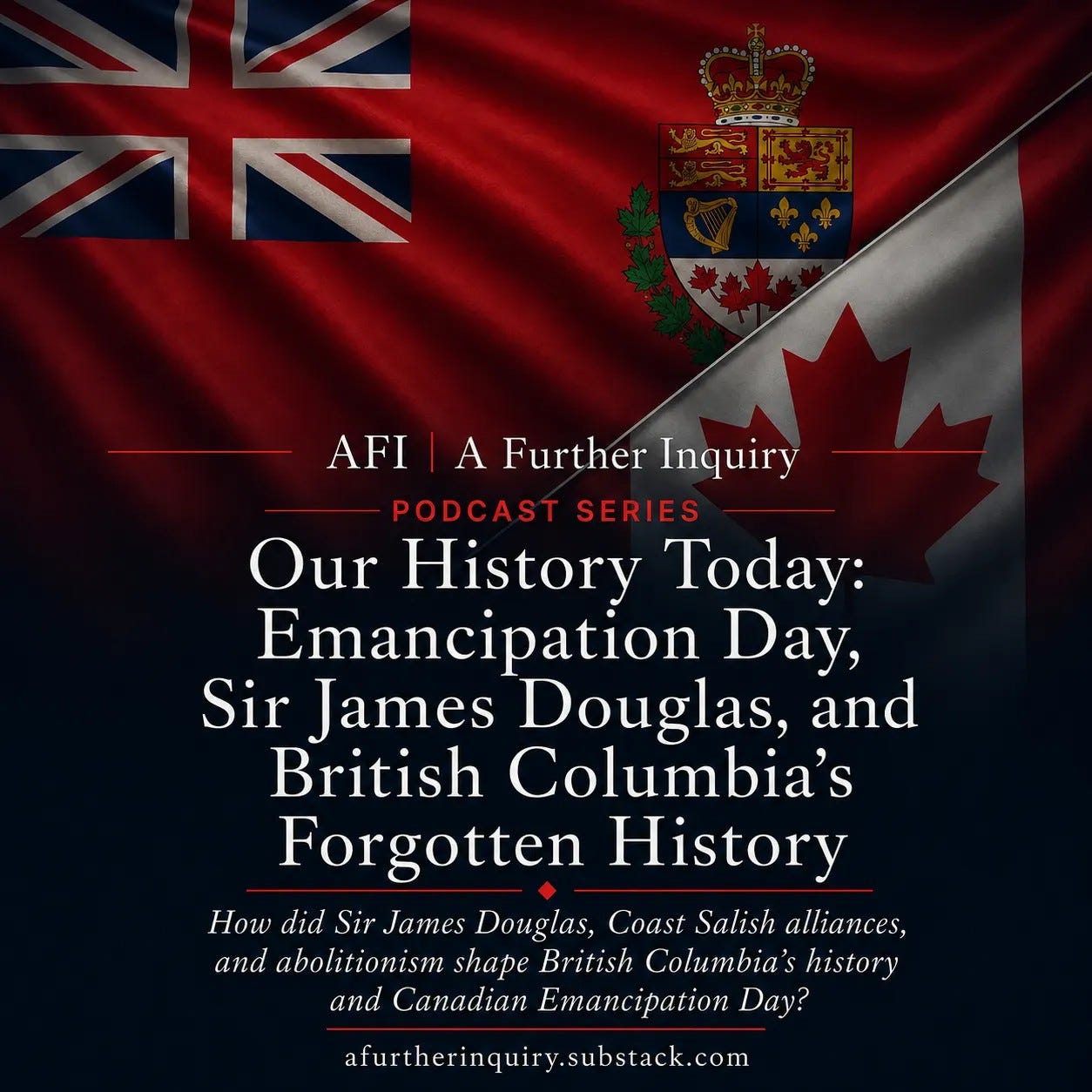
Yesterday, almost as an aside, I noted that the horribly violent and strangely disremembered partition of the Columbia territory, and the implications of the Treaty of 1846 in the struggle against slavery, are of a piece with the confounding unawareness of slavery’s global ubiquity today.
In Canada this is at least partly explained by the dumbed-down postnational “narrative” that Canadians have been force-fed by the Liberal establishment, which takes every advantage of the crisis of epistemology that continues to enfeeble the Anglosphere. That crisis can be summed up by the fact that it doesn’t matter that it doesn’t matter that the facts don’t matter anymore.
All this is occurring in the context of a post-literate amnesia lincreasingly aggravated by the dystopian, AI-addled “attention economy” we’re all trying to navigate through. The way I put it yesterday was that here at the Real Story it’s with the old charts and sextants that I’m trying my best to make myself useful.
But it’s been years since I’ve written a book. The contraction of magazine publishing leaves little room for literary journalism, which was until recently my bread and butter, and the eclipse of broadsheet newspapers has shrunk the space for long-form reporting of any serious kind. Most of my more in-depth inquiries end up right here in this newsletter, and it’s a lot to ask. Everybody’s got a newsletter nowadays.
There’s a growing body of thought among neuroscientists that an “explosion of textual fragments” across the media landscape is obliterating our capacity for sustained attention to the rich and complex information available in serious written work. We’re losing the ability to think deeply by exercising what the UCLA’s Maryanne Wolf calls our higher-order abilities of comprehension and synthesis. The result isn’t illiteracy so much as postliteracy.
I’m not sure I’m particularly comfortable with podcasts if they’re just replacing essays and long-form journalism. Tara Henley goes the distance: She published the transcript of her interview with me. I don’t know if this always helps, because speaking isn’t the same as writing. Then again, I used to worry about audiobooks replacing actual books, and I worry less about audiobooks now.
Do I worry too much? Let me know in comments.
No posts
Comments
Nothing yet. Say the first thing.
Sign in to join the conversation.